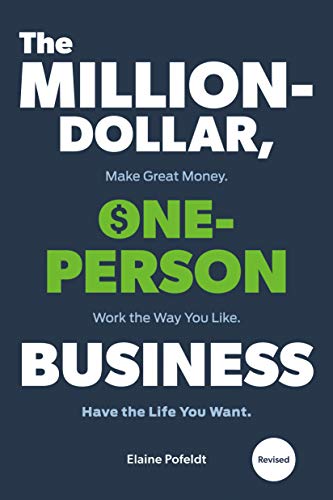
⚡️ What is The $1 Million One-Person Business About?
Have you ever wondered if the dream of “passive income” is actually a nightmare of infinite admin? I used to think that hitting the million-dollar mark meant I’d inevitably have to manage a team of twenty people and spend my days in endless Slack threads. More summaries by Elaine Pofeldt shows us that the old rules of growth are dead. She argues that we’ve entered an era where an individual, armed with the right tools and a specific mindset, can generate the kind of revenue that used to require a mid-sized corporation. It’s part of a growing collection of business book summaries that focus on efficiency over size.
Pofeldt, a veteran journalist who spent years tracking these “nonemployer” businesses for Forbes, isn’t selling a get-rich-quick scheme. Instead, she’s documenting a quiet economic shift. The central thesis is simple: you don’t need permission, capital, or a HR department to build something substantial. By focusing on scalable models—like e-commerce, content creation, or productized services—you can decouple your income from your hours. Isn’t that the real goal of entrepreneurship anyway?
🚀 The Book in 3 Sentences
- The path to a million-dollar solo business requires shifting from trading time for money to building assets that work while you sleep.
- Success in this model depends on a “lean” stack of automation software and specialized contractors rather than full-time employees.
- Scalability is the only filter that matters; if a business requires your manual presence for every unit of growth, it will never cross the seven-figure threshold alone.
🎨 Impressions
I walked away from this book feeling incredibly energized, mostly because Pofeldt focuses on the *how* through the lens of real people. It’s one thing to hear a guru talk about “scaling,” but it’s another to read about a guy selling hundreds of thousands of dollars in fitness equipment from a laptop while traveling. I’ve read a lot of business manifestos, but this one felt like a field guide. It doesn’t hide the fact that the initial grind is real, but it shows the light at the end of the tunnel isn’t a bigger office—it’s more freedom.
One thing that hit me was how much the book emphasizes the “why.” Most of the entrepreneurs she profiles didn’t start these businesses just for the cash; they did it because they hated the corporate commute or wanted to see their kids grow up. It’s an honest look at the trade-offs. I’ll admit, some of the e-commerce examples felt a bit dated given how much that space changes, but the underlying principles of systemization are evergreen. It made me look at my own to-do list and ask: “Could a script or a freelancer do this better than me?”
📖 Who Should Read This Book?
If you’re a freelancer who feels like you’re on a hamster wheel, this is your exit ramp. It’s perfect for the solo founder who wants to grow but has a physical visceral reaction to the idea of managing employees. However, if you’re looking for a technical manual on how to set up an Amazon FBA store or a specific SaaS product, you might find this too high-level. This is a strategy book, not a coding tutorial.
☘️ How This Book Changed My Thinking
Before reading this, I equated “bigger” with “better.” I thought a million-dollar business needed a fancy logo on a glass door. Now, I see headcount as a potential liability rather than a badge of honor.
- I stopped trying to “do it all” and started treating my time like a finite resource that must be protected by systems.
- I realized that a “productized service” is often superior to custom consulting because it allows for repeatable, automated workflows.
- I shifted my focus from total revenue to revenue-per-hour, which is the only metric that truly reflects the health of a solo business.
✍️ 3 Quotes That Stuck With Me
- “The common denominator is that these entrepreneurs have found ways to amplify their own efforts.” — This reminds me that hard work isn’t enough; you need a multiplier.
- “They don’t have employees, but they do have plenty of help.” — A great reminder that “solo” doesn’t mean “isolated.”
- “Automation is the silent partner in every million-dollar one-person business.” — It highlights that software is the modern equivalent of an entry-level staff.
📒 Summary + Notes
The book is structured to take you from a skeptical observer to a confident architect of your own business. Pofeldt begins by shattering the myth that you need a team to be “big.” She uses U.S. Census data to show that the number of million-dollar nonemployer firms is skyrocketing. Why? Because the cost of starting has plummeted while the reach of the internet has exploded. She categorizes these high-earning solos into six main areas: E-commerce, Manufacturing, Information technology, Professional services, Education/Training, and Personal services. By the end of the book, she wants you to believe that your specific expertise can be packaged into one of these buckets.
The narrative arc follows a logical progression: identify an idea that has a high ceiling, build a system to deliver that idea, and then ruthlessly automate or outsource the low-value tasks. Pofeldt argues that the “million-dollar mindset” is less about being a genius and more about being a systems designer. She emphasizes that the most successful solo founders are those who aren’t afraid to “fire themselves” from the daily grunt work. If you’re still answering every customer support email yourself, you’re not a business owner; you’re a high-paid clerk. How much longer can you sustain that?
🧠 Core Ideas Explained Simply
These concepts are the pillars that hold up the seven-figure solo structure.
The Nonemployer Revolution
This is the statistical reality that the “company of one” is a legitimate economic force. Pofeldt explains that as technology improves, the “transaction costs” of hiring contractors decrease, making it more efficient to stay small and nimble. Think of it as being a speed boat in a sea of slow-moving tankers. You can pivot faster, keep more of the profit, and avoid the politics that come with a traditional office environment.
The Productization Shift
Can you turn your brain into a box? Productization is the act of taking a service you provide and turning it into a standardized package with a set price and a set delivery timeline. This removes the “scope creep” that kills most freelancers. When you sell a productized service, you can create a standard operating procedure (SOP) that a freelancer or a piece of software can follow, allowing you to scale without doing more work.
1: The Rise of the One-Person Million-Dollar Business
Have you ever looked at a successful company and assumed they must have a massive office somewhere? Pofeldt starts by pulling back the curtain on the “invisible millionaires” who are running seven-figure empires from their dining room tables. She notes that in 2018, over 36,000 businesses with no employees hit the $1 million to $2.49 million mark. This isn’t just an anomaly; it’s a trend driven by the democratization of technology.
The chapter lays out the core philosophy: growth without headcount. It’s about high-margin, low-overhead operations. Pofeldt explains that the mindset of these founders is different—they value autonomy as much as profit. They use “the cloud” to do the heavy lifting that used to require a back-office staff.
2: Identify Your Best Idea
The hardest part isn’t starting; it’s choosing which rabbit hole to disappear down. Pofeldt suggests that you don’t need a “new” idea, you just need a better way to deliver an existing one. She looks at how founders find their “sweet spot” by looking at their current professional skills and asking how those can be scaled.
- Look for high-value problems that people are already paying to solve.
- Avoid “commodity” businesses where the only differentiator is price.
- Test your idea with a Minimum Viable Product (MVP) before quitting your day job.
3: Make It Scalable
There’s a specific moment in this book where the author talks about the “trap” of high-end consulting. If your business depends entirely on your unique, non-replicable talent, you are the bottleneck. To reach a million, you have to find a way to sell something that doesn’t require you to be “there.”
She introduces the concept of the “scalable model.” For e-commerce, this means drop-shipping or using fulfillment centers. For experts, it means courses, books, or memberships. The goal is to move from “one-to-one” work to “one-to-many” delivery. If you can’t imagine your business running while you’re on a week-long hike, you aren’t building for a million dollars; you’re building a job.
4: Automate Your Work
Software doesn’t get sick, it doesn’t need a 401k, and it never complains about Monday mornings. Pofeldt argues that automation is the “secret sauce” that allows one person to do the work of ten. She discusses tools for marketing, sales funnels, and customer relationship management.
The key takeaway here is to automate the “boring” stuff. This includes things like:
- Email marketing sequences that nurture leads while you sleep.
- Automated billing and invoicing.
- Self-service scheduling tools that eliminate the back-and-forth of setting meetings.
5: Outsource the Rest
You aren’t a CEO because you do everything; you’re a CEO because you ensure everything gets done. When automation reaches its limit, that’s when you bring in the humans—but not as employees. Pofeldt explores the world of virtual assistants, specialist freelancers, and agencies.
She emphasizes that you should outsource tasks that are “below your pay grade” or outside your zone of genius. If you’re a brilliant designer, why are you spending three hours a day trying to fix a CSS bug or doing your bookkeeping? By hiring a specialist for $50/hour, you free yourself up to do the work that generates $500/hour.
6: Financing Your Growth
Is it possible to scale without a venture capital injection? Pofeldt says yes, and in fact, she prefers it. Most of the founders she profiles “bootstrapped” their way to the top. They used their own savings or reinvested their initial profits to buy more inventory or better software.
She does touch on crowdfunding (like Kickstarter) and small business loans, but the overarching message is one of financial discipline. Keeping your personal overhead low in the early days allows you to keep your business overhead low, which creates a larger margin for error.
7: Keep the Momentum Going
What happens when you finally hit that million-dollar mark and realize you’re still the only person in the Zoom room? This chapter is about the mental game of staying the course. Pofeldt discusses burnout, the temptation to “hire just to feel like a real boss,” and the importance of community.
She encourages founders to join masterminds or find mentors. Running a solo business can be lonely, and without a peer group, it’s easy to lose perspective. The goal isn’t just to make a million once; it’s to build a sustainable lifestyle that keeps you energized for the long haul.
⚖️ A Critical Perspective
While the book is incredibly inspiring, it does suffer from a bit of survivorship bias. Pofeldt profiles people who have already “made it,” which can make the process look smoother than it actually is. She doesn’t focus much on the 90% of solopreneurs who burn out at $50k or the emotional toll of carrying all the risk yourself. Additionally, since it was written before the current AI boom, her advice on “automation” feels a bit primitive compared to what’s possible in 2025. The grind to the first $100k is often much messier than the glossy case studies suggest.
🔄 How It Compares
Compared to *The 4-Hour Workweek* by Tim Ferriss, Pofeldt’s book is much more grounded in data and diverse business models beyond just “muse” creation. While Ferriss focuses on lifestyle design and hacking, Pofeldt focuses on the economic viability and the “how-to” of reaching a specific revenue milestone. It’s less about escaping work and more about building a high-performance business that happens to be small.
🔑 Key Takeaways
These are the fundamental shifts you need to make to transition from freelancer to solo CEO.
- **Systemize First, Outsource Second:** Never hire a person to do a job that a piece of code can do for $20 a month.
- **Focus on Recurring Revenue:** The most stable million-dollar businesses have some form of membership or subscription model.
- **Protect Your Time Like Your Life Depends On It:** Every minute you spend on admin is a minute you aren’t spending on growth or strategy.
- **Build an “Ecosystem” of Partners:** Your “team” can be a collection of trusted agencies and contractors who only get paid when work is done.
💬 Frequently Asked Questions
Can a one-person business really make a million dollars?
Yes, and it’s becoming more common. Data from the U.S. Census shows thousands of businesses with zero employees hit the $1 million mark annually. These businesses typically rely on high-margin digital products, e-commerce automation, or productized professional services that allow for massive scale without a corresponding increase in labor hours.
What are the best industries for million-dollar solo businesses?
Pofeldt identifies six key categories: e-commerce, manufacturing (using third-party facilities), information technology, professional services (like high-end consulting turned into products), education/training (courses), and personal services. Generally, any industry where you can standardize a solution and deliver it through digital platforms or automated logistics is a prime candidate.
How much work is actually involved in a one-person business?
The “one-person” label is a bit of a misnomer; while there are no full-time employees, most of these founders work extremely hard in the early stages. The goal is to spend the majority of your time on “high-value” tasks while automation and contractors handle the rest. It’s not necessarily about working less, but working on more impactful things.
Is The $1 Million One-Person Business still relevant with AI?
It’s more relevant than ever. While the book was written before the explosion of Generative AI, the core principles of using technology to amplify individual output are exactly what AI facilitates. AI has simply lowered the floor for automation, making it even easier for a solo founder to manage complex operations.
Who is Elaine Pofeldt?
Elaine Pofeldt is a journalist and former editor at Fortune Small Business. She has spent her career researching and reporting on entrepreneurship, specifically focusing on “nonemployer” businesses. Her work has appeared in Forbes, Money, and Inc., making her one of the most authoritative voices on the solo economy.
Conclusion
The Million-Dollar One-Person Business is a manifesto for a new kind of freedom. It challenges the deep-seated cultural belief that “big” must equal “busy” and that success requires a hierarchy. In a world where software is eating the world, the individual who knows how to orchestrate that software is the most powerful player on the field. The book isn’t just about money; it’s about regaining control of your most precious asset: your time.
If you take only one thing from this, let it be this: you are currently living in the easiest time in human history to build a high-impact business without the headaches of traditional management. Don’t let old paradigms hold you back from building your own business. The question isn’t whether it’s possible—thousands of people are already doing it. The only question is when you’re going to start designing your own exit from the 9-to-5 grind.
More From Elaine Pofeldt →
Discover more from AI Book Summary
Subscribe to get the latest posts sent to your email.