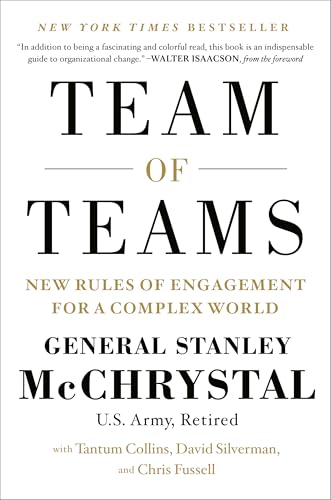
⚡️ What is Team of Teams About?
Imagine you’re leading the most elite, well-funded military force in history, and you’re getting your tail kicked by a ragtag group of insurgents using off-the-shelf tech and zero formal structure. That’s the reality Stanley McChrystal faced in 2004. In the book Team of Teams: New Rules of Engagement for a Complex World, McChrystal and his co-authors argue that the very thing we’ve worshipped for a century—efficiency—is exactly what’s making our organizations brittle and slow. If you want to survive a world that moves at the speed of the internet, you have to stop trying to be a master chess player and start being a gardener.
I picked this up thinking it would be another dry military memoir, but it’s actually one of the most profound management book summaries you’ll ever read. McChrystal, along with Tantum Collins, David Silverman, and Chris Fussell, takes the hard-won lessons from the Task Force in Iraq and maps them onto the corporate world. The central thesis? Efficiency is for a “complicated” world that stays still; “adaptability” is for a complex world that doesn’t. Why are we still using 19th-century management styles to solve 21st-century problems?
🚀 The Book in 3 Sentences
- The world has shifted from “complicated” systems (which are predictable) to “complex” ones (where tiny changes cause massive, unpredictable ripples).
- Traditional silos and top-down hierarchies are too slow for this new reality, requiring a shift toward radical transparency and decentralized decision-making.
- The goal is to create a “Team of Teams,” where the trust and agility of a small unit are scaled across an entire massive organization through shared consciousness and empowered execution.
🎨 Impressions
Honestly, this book hit me like a ton of bricks. We spend so much time in our professional lives trying to “optimize” processes, but McChrystal makes a compelling case that we’re often just making ourselves more fragile. The most striking part wasn’t the combat stories—though those are gripping—it was the realization that Al-Qaeda in Iraq was beating the US military because they didn’t have a headquarters to blow up. They were a network. It made me look at every corporate “org chart” I’ve ever seen and realize they’re mostly just maps of how information gets stuck.
There’s a humility here that you don’t usually get from four-star generals. McChrystal admits he had to stop making decisions to let the organization actually function. That’s a terrifying thought for most leaders, isn’t it? I dog-eared the section on “Shared Consciousness” because it feels like the missing link in most remote-work debates happening today. It’s not about where you sit; it’s about what you know and how fast you can act on it.
📖 Who Should Read Team of Teams?
If you’re a middle manager feeling squeezed by bureaucracy or a CEO wondering why your billion-dollar company is being out-innovated by two guys in a garage, you need this. It’s perfect for anyone leading large, distributed teams where the “old way” of doing things feels like wading through molasses. However, if you’re looking for a step-by-step “how-to” guide with templates, you might be frustrated. This is more of a philosophical shift and a case study in organizational cultural change than a tactical manual.
☘️ How This Book Changed My Thinking
Before reading this, I thought good leadership meant having all the answers and making the big calls. Now, I see that as a bottleneck. I’ve shifted my focus from trying to be the smartest person in the room to trying to be the best connector of people.
- I stopped trying to manage every detail and started focusing on whether my team has the context they need to decide for themselves.
- I realized that “efficiency” is a trap if it costs you the ability to pivot when the market changes unexpectedly.
- I started viewing silos not just as annoying, but as an existential threat to the survival of any project I’m working on.
✍️ 3 Quotes That Stuck With Me
- “The world has outpaced our ability to manage it using the old rules.” — A stark reminder that our mental models are often decades out of date.
- “Efficiency is no longer enough.” — This one hurts because it challenges the core of everything taught in business school.
- “The leader’s role is no longer that of the controlling master, but that of the humble gardener.” — It perfectly captures the ego-death required for modern leadership.
📒 Summary + Notes
The book’s narrative arc moves from the failure of traditional “Scientific Management” (Frederick Taylor style) to a new model of “Empowered Execution.” McChrystal begins by explaining why the US military, despite its technological and numerical superiority, was failing to defeat Al-Qaeda in Iraq. The enemy was a complex network that could adapt faster than the US’s complicated, hierarchical machine. To fight a network, you must become one.
The authors argue that we must move from a model of “Command and Control” to one of “Shared Consciousness” and “Empowered Execution.” This isn’t just about being nice or “empowering” people with words; it’s about a radical restructuring of how information flows. By the end of the book, the case is clear: the most successful organizations of the future will be those that can scale the intimacy and speed of a 10-person startup to a 10,000-person corporation. It requires leaders to give up the “herculean” role of the decision-maker and instead focus on creating the environment where the right decisions can happen organically at the edges.
🧠 Core Ideas Explained Simply
The book relies on a few heavy-hitting concepts that redefine how we look at work.
Complicated vs. Complex
Think of an internal combustion engine; it’s complicated. It has thousands of parts, but if you change one thing, you can predict exactly what will happen. A tropical rainforest, however, is complex. If you remove one species, the entire ecosystem might collapse in ways you never saw coming. Traditional management treats companies like engines, but modern markets are more like rainforests. You can’t “solve” a rainforest; you can only adapt to it.
Shared Consciousness
Ever notice how a small team just “knows” what everyone else is doing without having to hold a meeting? McChrystal wanted to scale that. He did this through a daily Operations & Intelligence (O&I) briefing that involved thousands of people. It wasn’t about giving orders; it was about ensuring everyone had the same holistic view of the battlefield so they could act independently without checking with HQ first.
Empowered Execution
This is the “eyes on, hands off” approach. Once you have shared consciousness, you can trust people to make the right calls. In the Task Force, this meant that a mid-level officer could greenlight a raid without waiting for McChrystal’s signature, because that officer already understood the broader strategy and the current risks. Have you ever felt the frustration of waiting 48 hours for an email approval on a 5-minute task? That’s the opposite of this concept.
1: The Protean Enemy
Why was a 21st-century superpower struggling against a group of insurgents with cell phones? McChrystal opens with the realization that Al-Qaeda in Iraq (AQI) was fundamentally different from any enemy they had fought before. They weren’t a hierarchy; they were a network. When the US killed a “leader,” the network didn’t die—it just routed around the damage like the internet.
The Task Force was incredibly efficient at killing and capturing individuals, but they were still losing the war. This chapter sets the stage for the entire book: being the best at “doing things right” is useless if you are doing the wrong things. The US was playing chess while the enemy was playing a game that didn’t even have a board.
2: Clockwork
How did we get so obsessed with efficiency in the first place? This section takes us back to Frederick Winslow Taylor and the birth of Scientific Management. Taylor’s idea was simple: there is one “best way” to do every task, and management’s job is to find it and force workers to follow it like clockwork.
- Optimization leads to silos: Everyone becomes an expert in their tiny slice of the pie.
- Predictability is the goal: Taylorism works perfectly if the environment never changes.
- The separation of “thinkers” (managers) and “doers” (workers): This is the root of the modern bureaucratic slowdown.
3: From Complicated to Complex
The world isn’t a clock; it’s a weather system. McChrystal explains that the technological revolution has moved us from a “complicated” world (linear, predictable) to a “complex” one (non-linear, unpredictable). In a complicated system, if you double the input, you double the output. In a complex system, doubling the input might do nothing—or it might cause the whole system to explode.
We are still trying to use complicated management tools to solve complex problems. This is why our long-term strategic plans are almost always wrong before the ink is dry. Can you remember the last five-year plan that actually survived its first eighteen months? Probably not. The speed of information has linked the world so tightly that a single tweet can move markets or start a revolution.
4: Doing the Right Thing
There’s a moment early on where a team of Navy SEALs performs a technically perfect mission, but it ends up being a strategic disaster because they didn’t have the context of what other teams were doing nearby. This chapter highlights the “efficiency vs. adaptability” trade-off.
Robustness is being able to withstand a hit. Resiliency is being able to absorb a hit and keep going. The Task Force realized they didn’t need a more robust hierarchy; they needed a more resilient network. This means prioritizing “relearning” over “knowing.” If you are perfectly optimized for today, you are probably perfectly vulnerable for tomorrow.
5: From Command to Team
What makes a small team like a SEAL platoon so effective? It’s not just their gear; it’s the trust. They have a level of “predictable behavior” where everyone knows what everyone else will do without a word being spoken. However, the problem with these elite teams is that they are often incredibly insular. They trust their own guys, but they don’t trust the “other” guys—the CIA, the Army, or the State Department. This creates a “Command of Teams”—a bunch of high-performing silos that don’t talk to each other.
6: Team of Teams
The goal is to scale the trust of a 10-person team to an organization of thousands. This is the “Team of Teams” model. It requires creating links between the silos. McChrystal didn’t try to merge all the departments; he tried to build bridges between them. He started an embedded program where his best people were sent to live and work with other agencies. This built the empathy and trust necessary for the whole system to function as one unit instead of a collection of warring tribes.
7: Seeing the System
Imagine you’re trying to build a puzzle, but you only have five pieces and you’ve never seen the picture on the box. That’s how most people work in a siloed organization. McChrystal’s solution was the Operations & Intelligence (O&I) briefing. It was a daily, 90-minute video conference that started with a few dozen people and grew to seven thousand.
The point wasn’t to give orders; it was to give everyone the “picture on the puzzle box.” When everyone sees the system as a whole, they start to see how their small actions affect the big picture. It’s about moving from “need to know” to “empowered to know.”
8: Brains Out of the Footlocker
“We want you to be a team player, but keep your ideas to yourself and just do your job.” This is the unspoken rule of most corporations. McChrystal argues that in a complex world, you can’t afford to have brains locked away. The information needs to flow horizontally, not just vertically.
This chapter discusses the physical environment of work. They literally knocked down walls in the headquarters to create a massive, open space where everyone could see everyone else. It forced people to bump into each other and share info that would have otherwise died in an email chain.
9: Beating the Prisoner’s Dilemma
Why is it so hard for departments to share information? Because of the Prisoner’s Dilemma—if I share my info and you don’t, I lose my leverage. McChrystal had to lead by example. He shared everything, even the embarrassing stuff, to prove that the goal was the mission, not internal politics. He focused on building “relational contracts” rather than just transactional ones. When you know the person on the other end of the radio, you’re much more likely to help them out.
10: Hands Off
How many times have you known exactly what to do but had to wait for a manager who was in a meeting to approve it? McChrystal realized he was the bottleneck. He moved to a system of “Empowered Execution,” where the default answer for his teams was “Yes” unless there was a compelling reason to say no.
- Decision-making must be pushed to the edges where the information is freshest.
- The role of the leader shifts from “deciding” to “verifying.”
- Speed is a weapon. In the time it takes for a request to go up the chain and back down, the opportunity is often gone.
11: Leading Like a Gardener
A gardener doesn’t actually “grow” tomatoes; the plants do that. The gardener just ensures the soil is good, the weeds are gone, and there’s enough water. This is the most powerful analogy in the book. McChrystal stopped trying to move the pieces on the board and started focusing on the culture of the organization. If the culture is right, the people will figure out the tactics. If you’re still micromanaging, you haven’t built a team of teams; you’ve built a fan club for your own ego.
12: Symmetries
The book wraps up by noting that these lessons aren’t just for war; they’re for hospitals, tech companies, and non-profits. The world is only getting more complex, not less. We can’t go back to the days of the “Great Man” leader who has all the answers. We need systems that are as dynamic and interconnected as the problems they are trying to solve. The question is: are you brave enough to let go of the steering wheel to let the car actually drive faster?
⚖️ A Critical Perspective
While the “Team of Teams” model sounds amazing in theory, the book glosses over the immense psychological cost of radical transparency. Not everyone wants their every move broadcast to 7,000 people in a daily briefing, and in the corporate world, this can lead to “performative work” where people spend more time looking busy than being productive. Additionally, McChrystal’s environment had an existential motivator—people were literally dying—which makes cultural change much easier than in a insurance company where the stakes are just quarterly earnings. The book also assumes a level of technological infrastructure and “intelligence” that most legacy businesses simply don’t have yet, making the jump to “Shared Consciousness” feel like a leap of faith many aren’t ready to take.
🔄 How It Compares
Compared to a book like Extreme Ownership by Jocko Willink, which focuses heavily on individual leadership and discipline, Team of Teams is much more focused on systemic architecture. While Jocko tells you how to lead your squad, McChrystal tells you how to connect 500 squads so they don’t accidentally shoot each other. It’s less about personal grit and more about organizational design for the digital age.
🔑 Key Takeaways
These are the fundamental shifts you need to make to stop being a bottleneck and start being a catalyst.
- Prioritize Resiliency Over Efficiency: Build systems that can break and recover rather than systems that are too rigid to bend.
- Flood the System with Information: Move from a “need to know” culture to a “shared consciousness” model to enable faster decision-making at the edges.
- Embed Liaisons: Break silos by physically sending your best people to work in other departments to build trust and empathy.
- The Leader as Gardener: Shift your focus from making tactical decisions to nurturing the environment and the culture of the team.
💬 Frequently Asked Questions
What is the main argument of Team of Teams?
The book argues that traditional, top-down hierarchies designed for efficiency cannot keep up with today’s complex, fast-moving world. To succeed, organizations must transform into a “team of teams,” combining the agility and trust of small groups with the scale and resources of a large enterprise through radical transparency.
What is the difference between complicated and complex?
Complicated systems are linear and predictable, like a clock, where inputs lead to known outputs. Complex systems are non-linear and unpredictable, like weather or a network, where tiny changes can lead to massive ripples. Management must shift from trying to control the former to adapting to the latter.
Is Team of Teams worth reading for non-military leaders?
Absolutely. While the examples are military-focused, the lessons regarding silos, information flow, and decentralized decision-making are directly applicable to any large organization. It’s particularly useful for tech companies or businesses facing rapid market disruption, though the cultural shift required is much harder than the book occasionally implies.
What does McChrystal mean by “Shared Consciousness”?
It is a state where every member of a large organization understands the overall system and strategy as clearly as the leaders do. This is achieved through extreme transparency and constant communication, ensuring that everyone has the context needed to make smart, independent decisions without needing constant approval.
What is the “Gardener” leadership style?
Leading like a gardener means moving away from being a “Chess Master” who directs every move. Instead, the leader focuses on creating and maintaining the ecosystem—nurturing culture, removing obstacles, and ensuring information flows—so that the teams can grow and execute on their own initiative.
Conclusion
At its heart, Team of Teams is an invitation to let go. It’s an acknowledgment that the world has become too big and too fast for any one person—no matter how brilliant or well-informed—to sit at the top and pull the levers. The old way of managing was built for a world that no longer exists, a world where you could plan five years ahead and expect things to go roughly as expected. Those days are gone.
If you take one thing away from this, let it be the image of the gardener. Your job isn’t to be the hero who saves the day; your job is to build a system so good that it doesn’t need a hero. It’s a terrifying shift for many of us who were raised on the myth of the “strong leader,” but it’s the only way to build something that lasts in a complex world. This is easily one of the most vital management book summaries I’ve encountered, and it’s changed how I view every team I’ve worked with since.
More From Stanley McChrystal; Tantum Collins; David Silverman; Chris Fussell →
Discover more from AI Book Summary
Subscribe to get the latest posts sent to your email.