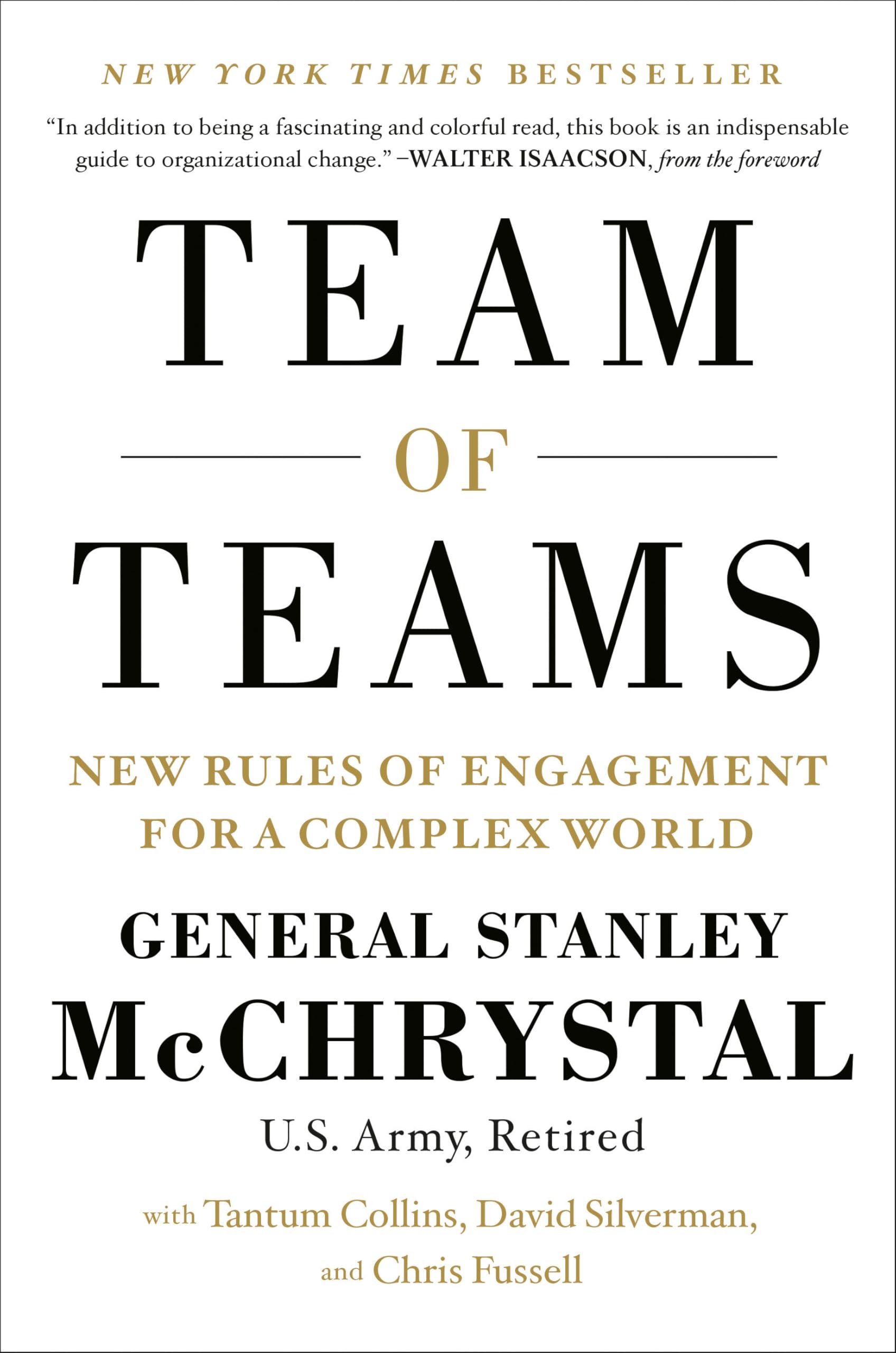
⚡️ What is Team of Teams about?
Team of Teams explores how organizations must adapt their leadership and structure to thrive in complex, fast-changing environments. Drawing from General Stanley McChrystal’s military experience, the book demonstrates how traditional hierarchical systems fail in volatile conditions and how decentralized, interconnected teams can drive unprecedented agility and effectiveness. It teaches leaders to replace rigid control with shared consciousness and empowered execution.
🚀 The Book in 3 Sentences
- Team of teams strategies replace siloed operations with shared awareness and decentralized decision-making to handle complex challenges.
- Traditional command-and-control systems become bottlenecks in a world that demands rapid adaptation.
- Unlocking team potential requires cultivating a culture of transparency, mutual trust, and shared purpose across all levels.
🎨 Impressions
Reading Team of Teams was a transformative journey into modern leadership philosophy. The concepts presented resonated deeply with the need for responsive organizational structures in today’s volatile environment. This book effectively bridges military strategy and business application, making it a powerful guide for adaptive leadership.
📖 Who Should Read Team of Teams?
This book is essential for executives, leaders, and managers serious about driving organizational change in complex environments. It’s particularly valuable for those implementing team of teams strategies in business transformation. Whether you’re leading a small startup or a multinational enterprise, the principles provide practical frameworks for enhancing team effectiveness.
☘️ How the Book Changed Me
How my life / behaviour / thoughts / ideas have changed as a result of reading the book.
- I now prioritize transparency and cross-functional communication in team of teams implementation
- I’ve shifted from control-based to empowerment-based leadership structures
- I focus on developing shared consciousness rather than hierarchical information flow
✍️ My Top 3 Quotes
- “The most efficient approach — the ‘well-oiled machine’ — is exactly what fails in a complex environment.”
- “Trust, once lost, is incredibly difficult to rebuild, but it is essential for any connected organization to function.”
- “The goal is not to be perfect, but to be excellent.”
📒 Summary + Notes
Team of Teams provides a framework for leading organizations through uncertainty and complexity. Drawing from McChrystal’s experience commanding Joint Special Operations Task Force, the book shows how traditional military hierarchies became inadequate for fighting an adaptive enemy, requiring a complete transformation in communication, decision-making, and collaboration.
Chapter 1: The World Is Complicated, and Getting More So
This chapter establishes the foundational premise: our environment has evolved from merely complicated to genuinely complex. Complicated systems are predictable and manageable through expertise, while complex systems are unpredictable, interconnected, and constantly changing. The military’s traditional approaches which worked for industrial-era problems became ineffective in this new landscape.
- Complex environments require new management paradigms beyond traditional hierarchies
- The rise of information technology and globalization intensifies interconnectivity
- Example: Iraq War demonstrated how conventional military strategies fail in adaptive conflicts
Chapter 2: An Iraq Awakening
The authors recount their awakening in Iraq, recognizing that despite tactical victories, the overall strategy was failing. Traditional special operations approaches focused on precise strikes and compartmentalized information weren’t addressing the root complexity of the insurgency. They realized the need for organizational transformation that went beyond better tactics.
- Success in individual operations didn’t translate to strategic success
- Case study: Al-Zarqawi’s network showed how decentralized enemies adapt faster
- Personal reflection: The need for systemic change exceeded tactical refinement
Chapter 3: Understanding the Environment
This chapter distinguishes between complicated and complex systems through real-world examples. Complicated problems (like building aircraft) follow known rules and expertise, while complex problems (like urban warfare) involve unknown unknowns, emergent behaviors, and adaptive adversaries. Understanding this distinction is crucial for selecting appropriate organizational responses.
- Distinguishing complicated manufacturing from complex adaptive conflicts
- Example: Hurricane response versus pandemic management
- Application to business: Market disruption requires complex problem-solving approaches
Chapter 4: The Modern Operating Environment
The authors explore how modern business and military environments share characteristics: increased speed, deeper interconnectivity, and greater uncertainty. Traditional hierarchies with their clear boundaries and information silos struggle in these conditions. Organizations must become more fluid, interconnected, and capable of distributed decision-making to remain competitive.
- Technology accelerates change and increases interdependence
- Case study: Financial crisis revealed system-wide vulnerabilities
- Business application: Supply chain disruptions test organizational adaptability
Chapter 5: The Tower and the Network
This chapter contrasts hierarchical ‘towers’ with decentralized ‘networks’. While towers provide efficiency and clarity, networks offer adaptability and resilience. The challenge lies in combining these strengths without losing the benefits of either structure. McChrystal’s team had to transform from a tower into a network while maintaining operational discipline.
- Towers ensure control but create bottlenecks in complex environments
- Networks adapt faster but risk coordination failures
- Example: Terrorist networks outpace traditional hierarchies despite less resources
Chapter 6: Confronting Reality at Every Level
Effective leadership in complex environments requires confronting uncomfortable realities rather than maintaining illusions of control. Traditional command structures often suppress vital information to preserve hierarchy. The authors describe how they broke down information barriers and encouraged brutal honesty throughout their organization.
- Culture of openness replaces need-to-know with need-to-share philosophy
- Example: Daily video conferences shared intelligence across all levels
- Personal reflection: Admitting failure becomes foundation for improvement
Chapter 7: Connecting the Dots
This chapter details how essential information was previously trapped in silos due to compartmentalization and hierarchy. The transformation required creating new communication channels and fostering understanding across different units and expertise domains. Shared awareness became the basis for coordinated action without centralized control.
- Breaking down information walls required cultural transformation, not just policy changes
- Example: Real-time intelligence sharing between previously isolated units
- Application: Cross-functional teams need comprehensive situational understanding
Chapter 8: Building Trust
Trust becomes the currency of networked organizations. Without deep trust between leaders and teams, decentralized decision-making leads to chaos. The chapter explores how they built trust through consistent actions, shared experiences, and radical transparency even when it was uncomfortable. Traditional military suspicion of outsiders had to transform into collaborative partnership.
- Trust requires vulnerability and consistent demonstration over time
- Case study: Trust-building exercises between rival military units
- Business insight: Trust enables rapid decision-making in distributed teams
Chapter 9: Implementing Team of Teams
The implementation process required simultaneous changes across culture, structure, and processes. Top leadership had to model new behaviors while empowering lower levels to make decisions. The emergence of liaisons, shared decision forums, and continuous communication rhythms became essential mechanisms for maintaining coordination without traditional hierarchy.
- Change management focused on both structural adjustments and cultural transformation
- Example: Creation of Integration Cell bridged different organizational cultures
- Personal insight: Implementation requires patience and persistence during transition
Chapter 10: Leading Like a Gardener
Leadership shifts from architect (designing structures) to gardener (creating conditions for growth). Instead of controlling every action, leaders must cultivate an environment where teams can flourish and adapt organically. This requires more nuanced leadership skills focused on coaching, enabling, and removing obstacles rather than commanding.
- Gardener leaders nurture rather than control outcomes directly
- Example: McChrystal’s shift from decision-maker to enabler of team decisions
- Reflection: Leadership comfort with uncertainty and emergent solutions
Key Takeaways
The most critical lessons from Team of Teams center on transforming organizational structures for complexity.
- Team of teams strategies require replacing hierarchical control with shared consciousness and empowered execution
- Trust and transparency are fundamental prerequisites for decentralized decision-making
- Leaders must shift from architect to gardener roles, focusing on enabling rather than controlling
Conclusion
Team of Teams offers a compelling roadmap for leaders navigating today’s complex landscape. By embracing transparency, building trust, and empowering teams while maintaining strategic coherence, organizations can achieve both agility and effectiveness. This approach to team of teams strategies isn’t just for military applications—it’s essential for any organization seeking to thrive in our interconnected world. The transformation requires commitment, but the results are transformational.
More From Stanley McChrystal; Tantum Collins; David Silverman; Chris Fussell →
Discover more from AI Book Summary
Subscribe to get the latest posts sent to your email.