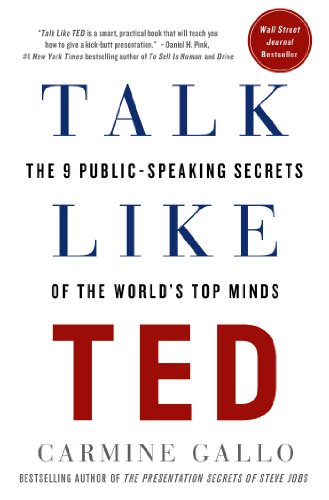
⚡️ What is Talk Like TED About?
Have you ever watched a speaker and felt like they were casting a spell on the room? It isn’t magic. It’s a specific set of psychological triggers that Carmine Gallo spent years decoding by watching thousands of hours of the world’s most viral presentations. The book argues that your ideas—no matter how brilliant—are essentially worthless if you can’t communicate them in a way that bypasses the audience’s natural skepticism and goes straight to their heart.
Gallo, a communications coach for some of the biggest tech brands on the planet, breaks down the “TED style” into nine actionable components. He categorizes these into three buckets: Emotional, Novel, and Memorable. This isn’t just about where to put your hands or how to design a slide; it’s about the neurochemistry of persuasion. If you’re looking for more ways to level up your personal growth, check out our other self-help book summaries.
🚀 The Book in 3 Sentences
- Effective public speaking is built on the “Rule of Three”: making an emotional connection, teaching the audience something novel, and presenting information in a way that’s impossible to forget.
- The most successful speakers dedicate 65% of their content to stories and pathos, rather than just dumping data and facts on a dry slide deck.
- Constraint is your best friend—limiting your talk to 18 minutes forces you to cut the fluff and focus on a single, core idea that matters.
🎨 Impressions
I read this book just before a major industry keynote, and honestly, it changed how I viewed my own slides. I realized I was hiding behind bullet points because I was too lazy to build a narrative. Gallo’s obsession with the 18-minute rule was the part that really hit home for me. It’s painful to cut your favorite anecdotes, but the result is a punchier, more respect-worthy performance. Why do we feel the need to fill an hour when twenty minutes would do?
One thing that slightly bugged me was the constant hero-worship of Steve Jobs and a few specific TED stars. It’s great to have examples, but after the tenth mention, it feels a bit like a fan club. However, the science Gallo brings in—like how our brains release dopamine when we encounter something new—makes up for the occasionally repetitive examples. It’s a fast read, and I promise you’ll find yourself editing your next email or meeting pitch before you’ve even finished the third chapter.
📖 Who Should Read Talk Like TED?
If you have to stand in front of people and convince them of anything—whether you’re a CEO or a PTA parent—this is required reading. It’s perfect for anyone who feels their presentations are “fine” but forgettable. If you’re looking for a technical manual on PowerPoint design or data visualization, you might find this a bit too high-level. But if you want to understand the soul of a great talk, buy it.
☘️ How This Book Changed My Thinking
Before reading this, I thought my job as a speaker was to be a walking encyclopedia. Now, I see myself as a tour guide for an idea.
- I stopped using bullet points almost entirely. If I can’t say it with a picture and a story, it doesn’t belong on the screen.
- I started timing my pitches to be 20% shorter than the allotted time. People love the person who gives them five minutes of their life back.
- I prioritize the “Holy Sh*t” moment—the one specific surprise that I want people to talk about at lunch.
✍️ 3 Quotes That Stuck With Me
- “Passion is the thing that will help you create the highest level of connection with your audience.” — This reminds me that if I’m bored with my topic, everyone else is too.
- “Stories are just data with a soul.” — I’ve realized that people don’t remember my stats, they remember the person the stats affected.
- “The brain cannot ignore novelty.” — This explains why we all tune out when we see the standard ‘Corporate Mission’ slide.
📒 Summary + Notes
The core thesis of Talk Like TED is that we are living in the “Knowledge Economy,” where the ability to sell your ideas is the single greatest competitive advantage you have. Gallo builds a narrative arc that starts with internal passion and ends with external performance. He wants you to believe that the most influential people aren’t just smarter; they are better at wrapping their logic in a blanket of emotion.
The book isn’t just about speaking; it’s about human psychology. It moves from the internal (passion and storytelling) to the external (body language and humor) and finally to the structural (brevity and multisensory input). By the end, the author expects you to stop viewing a presentation as a chore and start seeing it as a rare opportunity to change someone’s mind. Do you really want to waste that chance with a boring pie chart?
1: Unleash the Master Within
What is the one thing you are so obsessed with that you’d talk about it for free? Gallo starts here because passion isn’t just a fluffy feeling—it’s a biological signal. When a speaker is genuinely excited, their vocal variety increases and their gestures become more fluid. The audience picks up on this via mirror neurons. If you aren’t authentically moved by your topic, your audience will feel the disconnect immediately.
He suggests doing a “passion audit.” Ask yourself what makes your heart sing about your work. It’s often not the product itself, but the impact it has on people. When you lead with that, you aren’t just a salesperson; you’re a believer. And believers are much harder to ignore than presenters.
2: Master the Art of Storytelling
Stories are literally brain-syncing machines. Gallo points to research showing that when someone tells a story, the listener’s brain waves start to mimic the storyteller’s. He identifies three types of stories that work best:
- Personal stories that involve a struggle and a triumph.
- Stories about other people who have faced a challenge.
- Stories about the success or failure of brands and products.
Why do we still insist on using spreadsheets to win arguments? Humans have been telling stories around campfires for thousands of years; we’ve been using Excel for about thirty. Guess which one our brains are better at processing? If you want to be persuasive, your talk should be roughly 65% stories and only 25% data.
3: Have a Conversation
Imagine you’re watching a speaker who sounds like they’re reading a grocery list. It’s painful, right? This chapter is about the “conversational” style that defines TED. It requires an incredible amount of practice to sound this natural. Gallo mentions speakers who practiced their 18-minute talks over 200 times.
The goal is to master your material so well that your body language happens automatically. You shouldn’t be thinking about when to move your hands. You should be so present in the moment that your gestures match your words without effort. He emphasizes the importance of vocal variety—changing your speed, pitch, and volume to keep the listener’s brain from switching to autopilot.
4: Teach Me Something New
We are evolutionary junkies for novelty. When we see something we’ve never seen before, our brains release dopamine, which acts like a “save” button for memory. If your presentation is just a recap of things the audience already knows, their brains will literally shut down to save energy.
You have to offer a fresh perspective. Even if your topic is well-worn, can you frame it in a way that feels like a revelation? This is why the most popular TED talks often have titles like “How Schools Kill Creativity” or “The Power of Vulnerability.” They promise a new way of looking at a common problem. What is the one thing you can tell your audience that they can’t find on Google?
5: Deliver Jaw-Dropping Moments
Every legendary talk has a “moment” that people talk about for weeks. Think of Bill Gates releasing mosquitoes into the audience to make a point about malaria. That is a “Emotionally Charged Event” (ECE). It creates a spike in cortisol that makes the event much easier to recall later.
You don’t need insects to do this. It could be a shocking statistic, a physical prop, or a powerful photo. The key is that it must be unexpected. It breaks the pattern of a typical presentation. If your audience is leaning back, a jaw-dropping moment is what makes them sit up and pull out their phones to tweet what you just said.
6: Lighten Up
Is humor too risky for a serious business presentation? Actually, it’s riskier to be boring. Humor makes you more likable, and we are far more likely to agree with people we like. Gallo isn’t suggesting you tell “knock-knock” jokes. Instead, use observational humor or self-deprecation.
When you laugh with someone, your defenses drop. It builds an immediate bridge between the stage and the seats. The trick is to keep it natural—tell a funny story about a mistake you made rather than trying to be a stand-up comedian. If you can make them smile, they’ll be much more open to your harder-hitting points later on.
7: Stick to the 18-Minute Rule
Your audience has a cognitive limit. There is a reason TED talks are exactly 18 minutes: it’s long enough to be serious but short enough to hold attention. This is backed by “cognitive backlog” theory—the more information you pile on, the more the audience has to work to process it, until eventually, they just give up.
Brevity is an act of respect. It shows you value the listener’s time. If you can’t explain your idea in 18 minutes, you probably don’t understand it well enough yet. Gallo suggests using the “Rule of Three” to structure these minutes—give people three clear reasons or sections to follow. Our brains are optimized for groups of three; four is a crowd, and five is a mess.
8: Paint a Mental Picture
Think about the last time you saw a slide full of text. You probably started reading the slide and stopped listening to the speaker. This is called the “Picture Superiority Effect.” We remember images much better than words. Gallo advocates for slides that are visually stunning and text-light.
But it’s not just about visuals; it’s about all the senses. Can you use words that evoke smell, touch, or sound? When you engage multiple senses, the brain builds more connections to the information. Instead of saying “the product is fast,” describe the feeling of being pushed back into your seat in a sports car. Make them feel the data.
9: Stay in Your Lane
Authenticity isn’t just a buzzword; it’s the foundation of trust. If you try to act like Steve Jobs or Brene Brown, the audience will smell the fake from the back row. This final chapter is a reminder that all these techniques are useless if they don’t feel like *you*.
The most successful TED speakers are those who are comfortable in their own skin. They don’t hide their quirks; they lean into them. Being vulnerable and open about your true self is what finally seals the connection. You aren’t there to be a perfect robot; you’re there to be a human being sharing a piece of your world. Do that, and you’ll find the audience is rooting for you from the first word.
⚖️ A Critical Perspective
While the advice in this book is gold for public speaking, I do think Gallo oversimplifies how easy it is to find a “passion.” For many people in technical or bureaucratic roles, finding a “master within” is a tall order. Furthermore, since the book was published in 2014, the “TED style” has become so recognizable that it’s almost a parody of itself. In 2025, an audience might find the overly polished, story-heavy approach a bit manipulative if it’s not handled with extreme care. Sometimes, people just want the data without the dramatic pauses.
🔄 How It Compares
Compared to Confessions of a Public Speaker by Scott Berkun, Talk Like TED is much more focused on the external “theatrics” and psychological triggers of a talk. Berkun’s book is more of a gritty, behind-the-scenes look at the disasters and logistics of being a pro speaker. If you want a blueprint for a specific style, go with Gallo; if you want to know how to handle a failing projector and a heckler, go with Berkun.
🔑 Key Takeaways
Here is how to transform your next presentation from a sleep-inducer to a standout moment:
- The 65/25/10 Rule: Aim for 65% Ethos (stories/credibility), 25% Logos (data/logic), and 10% Pathos (emotional appeal).
- Kill the Bullets: Use pictures to tell the story; the audience can’t read and listen at the same time.
- The Power of Three: Never give an audience more than three key points to remember if you want them to actually retain them.
- Novelty is Currency: If you don’t teach them something new, you’re wasting their dopamine.
💬 Frequently Asked Questions
What are the 9 secrets in Talk Like TED?
The nine secrets are: Unleash the master within (passion), Master storytelling, Have a conversation, Teach something new, Deliver jaw-dropping moments, Lighten up (humor), Stick to the 18-minute rule, Use multisensory experiences, and Stay in your lane (authenticity). These secrets are designed to make presentations emotional, novel, and memorable.
Why are TED talks exactly 18 minutes long?
The 18-minute limit is based on the science of cognitive backlog. Research shows that as time goes on, the brain’s ability to process new information diminishes significantly. This constraint forces speakers to be disciplined, editing out secondary points and focusing only on their most impactful, core idea.
Is Talk Like TED worth reading for business professionals?
Yes, because business is ultimately about the transfer of ideas. While some examples feel repetitive, the core lessons on storytelling and brevity are invaluable for anyone who needs to influence others. It provides a practical framework for moving beyond dry data and actually connecting with clients or stakeholders.
What does the book say about using humor?
Gallo argues that humor makes a speaker more likable and the audience more receptive. He suggests avoiding scripted jokes and instead using observational humor, personal anecdotes, or funny videos. Humor lowers the audience’s natural defenses, allowing your message to land more effectively without feeling like a lecture.
Can anyone learn to speak like a TED presenter?
The book’s central argument is that great public speaking is a skill, not an innate gift. By practicing specific techniques—like the Rule of Three, using visuals instead of text, and rehearsing until the delivery feels conversational—anyone can significantly improve their ability to persuade and inspire an audience.
Conclusion
At its heart, Talk Like TED is a manifesto for the power of the human voice. It reminds us that in a world drowning in digital noise, a person standing on a stage sharing a deeply held belief is still the most potent force for change. Carmine Gallo doesn’t just give you a checklist; he gives you the psychological keys to unlock your listener’s attention.
The one thing you should take away is this: your audience wants you to succeed. They aren’t there to judge your slides; they are there to be moved, taught, and inspired. If you can show them your passion, tell them a story, and keep it brief, you’ve already won. So, next time you’re preparing a pitch, put down the laptop for a second and ask yourself: what is my 18-minute story? That shift in focus is what makes you go from a presenter to a leader in your self-help journey.
More From Carmine Gallo →
Discover more from AI Book Summary
Subscribe to get the latest posts sent to your email.