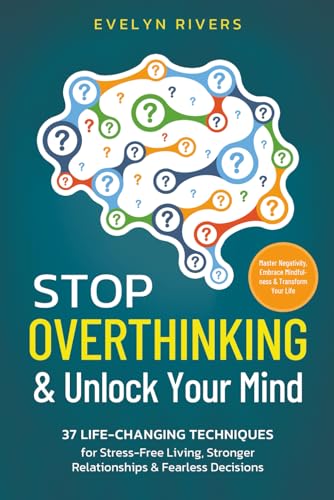
⚡️ What is Stop Overthinking about?
Stop Overthinking by Nick Trenton is a comprehensive guide that provides 37 practical strategies to help readers break free from the endless cycle of anxious thoughts and mental rumination. The book delves deep into understanding the root causes of overthinking, which Trenton identifies as anxiety manifesting through excessive mental chatter. Throughout the pages, readers will discover evidence-based techniques drawn from cognitive behavioral therapy, mindfulness practices, and time management methodologies that can be immediately implemented to regain control over their thoughts and emotions.
🚀 The Book in 3 Sentences
- Stop Overthinking reveals that the real problem isn’t what you’re thinking about, but the anxious thought patterns that keep your mind trapped in cycles of worry and stress.
- The book provides 37 actionable strategies including time management techniques, cognitive restructuring, and mindfulness practices to help readers gain immediate relief from mental overwhelm.
- Trenton emphasizes that while genetics may predispose us to anxiety, environmental factors and our interpretation of stressors are within our control and can be managed effectively.
🎨 Impressions
As someone who has struggled with Stop Overthinking patterns for years, I found Trenton’s approach refreshingly practical and science-backed. The book strikes an excellent balance between understanding the psychology behind anxious thoughts and offering immediately actionable solutions. What impressed me most was how Trenton doesn’t just tell you to “stop thinking” but provides specific frameworks and exercises that genuinely work to rewire your thought patterns and create lasting change.
📖 Who Should Read Stop Overthinking?
This book is essential reading for anyone trapped in cycles of Stop Overthinking, anxiety, or mental rumination that affects their daily life and decision-making. It’s particularly valuable for busy professionals, students dealing with academic pressure, and anyone who finds themselves paralyzed by excessive analysis of situations. The strategies are accessible enough for beginners yet comprehensive enough for those already familiar with self-help methodologies, making it a versatile resource for anyone seeking mental clarity and emotional relief.
☘️ How the Book Changed Me
How my life / behaviour / thoughts / ideas have changed as a result of reading the book.
- I’ve dramatically reduced my Stop Overthinking episodes by implementing the 5-4-3-2-1 grounding technique during moments of mental overwhelm
- My decision-making process has improved significantly after applying the Eisenhower Matrix and time blocking strategies from the book
- I now recognize cognitive distortions like all-or-nothing thinking and can immediately challenge these negative thought patterns with the restructuring techniques provided
✍️ My Top 3 Quotes
- “What you obsess about isn’t the problem. What you obsess about is the result of overthinking, so even if you solve the issue you can’t stop thinking about, another problem will take its place.”
- “Anxiety is the cause (the why) and overthinking is the effect (the how). Once you understand this relationship, you can start addressing the root rather than chasing symptoms.”
- “The idea is to eventually be able to identify a level of stress that’s comfortable. This requires awareness, which doesn’t happen overnight but through consistent practice.”
📒 Summary + Notes
Stop Overthinking by Nick Trenton offers a comprehensive roadmap for individuals trapped in cycles of anxious mental chatter. The book demystifies the complex relationship between anxiety and overthinking, providing readers with 37 practical strategies to regain mental clarity and emotional balance. Trenton’s approach combines psychological insights with immediately actionable techniques drawn from cognitive behavioral therapy, mindfulness practices, and time management methodologies.
Chapter 1: Overthinking Isn’t About Overthinking
This foundational chapter establishes that the problem isn’t what we’re thinking about, but the anxious thought patterns themselves. Trenton explains that overthinking manifests as worry, anxiety, stress, rumination, or obsession, and creates a vicious cycle that feels inescapable. The author clarifies that anxiety is the underlying cause while overthinking is simply the effect or manifestation of that internal distress.
- Anxiety is multifactorial, involving the interaction between genetics, environment, and our behavioral responses to stressors
- Environmental factors play a crucial role in triggering anxiety, though genetic predisposition can make some individuals more susceptible
- The vicious cycle means that solving one obsessive thought rarely helps because another anxiety-provoking topic will inevitably replace it
Chapter 2: The De-Stress Formula and Then Some
This chapter introduces the fundamental 4 A’s of stress management: Avoid, Alter, Accept, and Adapt. Trenton emphasizes that awareness is the prerequisite for any effective stress management strategy. The chapter provides practical tools including stress diaries, brain dumps, and bullet journaling to help readers identify triggers and track their emotional responses. A particularly powerful technique introduced is the 5-4-3-2-1 grounding exercise for immediate presence and calm.
- The 4 A’s framework offers multiple response options: avoid what you can, alter what’s changeable, accept what’s unchangeable, and adapt your approach over time
- Journaling techniques including stress diaries and brain dumps help create awareness of triggers and emotional patterns
- Narrative therapy concepts like externalization and deconstruction help separate the person from their problems and break overwhelming experiences into manageable pieces
Chapter 3: Manage Your Time and Inputs
This practical chapter addresses how poor time management contributes significantly to anxiety and overthinking. Trenton identifies six problematic personality types related to time management: time martyrs, procrastinators, distractors, underestimators, firefighters, and perfectionists. The author provides specific methodologies like Allen’s input processing technique, Eisenhower’s method, SMART goals, Kanban method, and time blocking to help readers optimize their schedules and reduce mental overwhelm.
- Personality-based solutions address specific time management challenges like procrastination, perfectionism, and the tendency to accept too many requests
- Eisenhower’s method helps prioritize tasks by distinguishing between urgent and important activities to prevent crisis management
- Time blocking eliminates decision fatigue by predetermining when specific tasks will be completed, promoting deep work and reducing multitasking stress
Chapter 4: How to Find Instant Zen
The focus shifts to immediate relaxation techniques that can be deployed during moments of intense overthinking. Trenton emphasizes that relaxation is a skill that requires regular practice rather than something that happens naturally. The chapter details three proven relaxation methods: autogenic relaxation (combining imagery, breathing, and awareness), progressive muscle relaxation (systematically tensing and releasing muscle groups), and visualization (creating mental “happy places” for instant stress relief).
- Autogenic training combines mental imagery with conscious breathing to create deep states of relaxation and body awareness
- Progressive muscle relaxation helps develop somatic awareness while systematically releasing physical tension that often accompanies mental stress
- Visualization techniques require practice to become effective tools, but eventually allow instant access to peaceful mental states during crisis moments
Chapter 5: Rewire Your Thought Patterns
This chapter dives deep into cognitive behavioral therapy techniques for identifying and transforming negative thought patterns. Trenton outlines common cognitive distortions including all-or-nothing thinking, overgeneralization, internalizing/externalizing, favoring the negative, and emotional reasoning. The ABC model (Antecedent-Behavior-Consequence) provides a framework for tracking thought patterns, while techniques like cognitive restructuring and behavioral experiments offer methods for challenging and replacing dysfunctional thinking.
- Cognitive distortions are systematic errors in thinking that contribute to anxiety and must be identified before they can be addressed effectively
- The ABC model helps track the sequence from triggers (antecedents) through reactions (behaviors) to outcomes (consequences) for better pattern recognition
- Self-talk scripting involves creating positive internal dialogues during calm moments that can be accessed during stress, essentially training your mind’s default responses
Chapter 6: Newfound Attitudes that Can Teach You to Be More Aware Over Time
The final chapter presents five transformative attitudes that create lasting change in how readers approach stress and overthinking. These include focusing on what you can control versus what you can’t, emphasizing action over paralysis, appreciating what you have rather than dwelling on what’s missing, staying present rather than ruminating about past or future, and distinguishing between needs and wants. Trenton also introduces the concept of emotional inversion as a powerful technique for shifting mental states.
- Control versus acceptance teaches readers to direct energy toward manageable aspects while gracefully accepting what cannot be changed
- Present-moment focus redirects mental energy from unproductive rumination about past or future toward actionable present-moment awareness
- Emotional inversion challenges readers to intentionally adopt opposite emotional states for brief periods to break stuck feeling patterns
Key Takeaways
The most essential lessons from Stop Overthinking can be distilled into practical strategies for immediate implementation and long-term mental health improvement.
- Stop Overthinking by identifying that anxiety is the root cause, not the specific topics that occupy your mind, allowing you to address the underlying issue rather than chasing symptoms
- Use the 4 A’s framework (Avoid, Alter, Accept, Adapt) to systematically respond to stressors in your environment with appropriate strategies
- Implement immediate grounding techniques like the 5-4-3-2-1 exercise to break cycles of mental rumination and return to present-moment awareness
- Rewrite cognitive distortions through journaling, the ABC model, and cognitive restructuring to transform negative thought patterns into more balanced perspectives
- Develop focusing attitudes that emphasize control, action, gratitude, presence, and needs-based decision-making over helpless worrying
Conclusion
Nick Trenton’s Stop Overthinking delivers on its promise by providing 37 scientifically-backed strategies that can transform how you relate to anxious thoughts and mental overwhelm. The book’s strength lies in its practical approach, combining immediate relief techniques with long-term mindset shifts that create lasting change. Whether you’re new to managing anxiety or looking to enhance your existing toolkit, this comprehensive guide offers valuable insights and actionable methods that can be implemented immediately. Don’t let another day pass trapped in cycles of Stop Overthinking – implement these strategies and reclaim your mental peace today.
More From Nick Trenton →
Discover more from AI Book Summary
Subscribe to get the latest posts sent to your email.