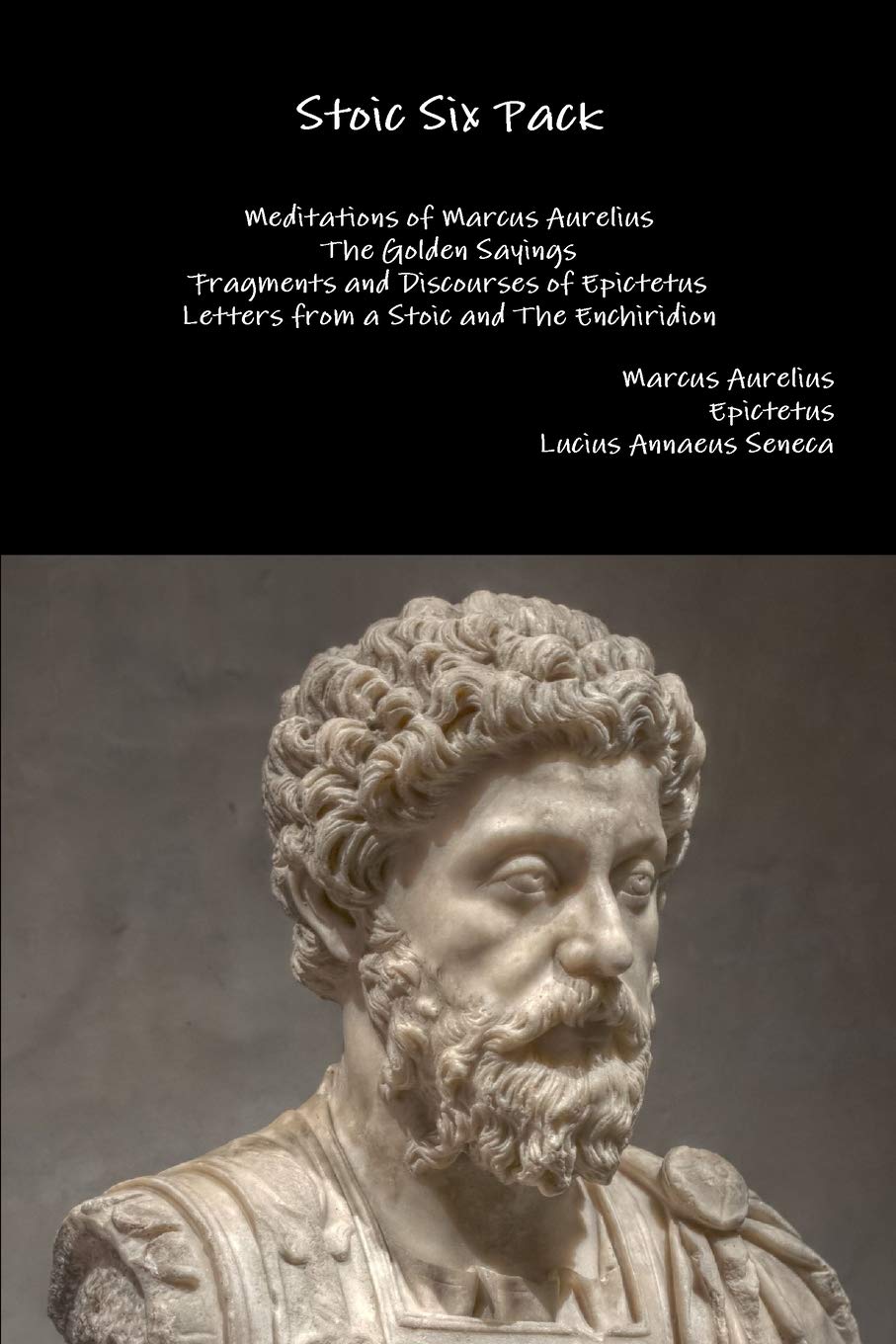
⚡️ What is Stoic Six Pack About?
Ever felt like the world was spinning out of your control while you just stood there, paralyzed by the noise? That’s exactly where I was before I cracked open the Stoic Six Pack. This isn’t just one book; it’s a massive, curated collection of the heavy hitters of Roman and Greek philosophy: Marcus Aurelius, Seneca, and Epictetus. It’s essentially a 2,000-year-old survival guide for the modern brain. These More summaries by Various authors aren’t interested in abstract theories or academic fluff. They want to know one thing: how do you keep your head while everyone else is losing theirs?
The central argument of this collection—and of Stoicism itself—is that our suffering doesn’t come from events, but from our judgment of those events. If you’ve been looking for a way to build an internal fortress that no annoying boss, traffic jam, or global crisis can breach, you’ve found the source code. It’s a foundational piece in the world of psychology book summaries because it essentially invented the logic behind Cognitive Behavioral Therapy (CBT).
🚀 The Book in 3 Sentences
- The dichotomy of control is the ultimate filter: if you can’t change it, worrying about it is a literal waste of your life force.
- Virtue and character are the only true “goods,” meaning you can be happy in a prison cell and miserable in a palace depending entirely on your internal state.
- By practicing negative visualization and memento mori, we can strip away the fear of loss and death that usually drives our worst decisions.
🎨 Impressions
Reading this collection felt like getting a stern, loving pep talk from a grandfather who has seen it all. I expected it to be dry and dusty, but Seneca’s letters, in particular, feel like they could have been written in a coffee shop last Tuesday. He’s talking about noisy neighbors, travel anxiety, and the fear of getting old. It’s remarkably grounded. I did find the “Discourses” of Epictetus a bit repetitive after a while, though. He’s like that coach who keeps shouting the same three drills until you finally get them right. It’s effective, but you’ll need some patience.
What surprised me most was how much Marcus Aurelius’s “Meditations” read like a private journal. He wasn’t writing for us; he was writing to convince himself not to be a jerk when he woke up in a bad mood. There’s something incredibly human about the most powerful man in the world telling himself, “The people you will meet today will be meddling, ungrateful, and arrogant.” It makes the philosophy feel attainable. It’s not about being perfect; it’s about the constant effort to get back on track when you inevitably stumble.
📖 Who Should Read Stoic Six Pack?
If you’re a high-stakes professional who feels like your blood pressure is tied to your inbox, you need this. It’s also perfect for anyone going through a major life transition or loss—the Stoics specialize in resilience. However, if you’re looking for “manifesting” or toxic positivity that tells you to ignore reality, stay away. This book is about staring reality in the face and refusing to blink. It’s for the person who wants grit over comfort.
☘️ How This Book Changed My Thinking
Before reading the Stoic Six Pack, I used to let small inconveniences ruin my entire afternoon. I lived in a state of constant reaction to the world around me.
- I stopped trying to “win” arguments with people who aren’t interested in truth; I realized their opinions are outside my control and therefore irrelevant to my peace.
- I started doing “pre-mortems” for my day, imagining what could go wrong so I’m not shocked when things actually do.
- I’ve replaced the phrase “this is bad” with “this is happening,” which removes the emotional sting and lets me focus on the next logical step.
✍️ 3 Quotes That Stuck With Me
- “You have power over your mind—not outside events. Realize this, and you will find strength.” — This is the foundation of everything, reminding me that my reaction is the only thing I truly own.
- “We suffer more often in imagination than in reality.” — Seneca nails the fact that most of my anxiety is about things that haven’t happened and probably won’t.
- “Don’t explain your philosophy. Embody it.” — A sharp reminder that reading these books is useless if I’m still acting like a child when things get difficult.
📒 Summary + Notes
The Stoic Six Pack is less a narrative and more a masterclass in psychological framing. The authors collectively build a case for radical personal responsibility. They argue that most of what we call “evil” or “misfortune” is simply the natural order of the universe, and our frustration stems from our refusal to accept that things change, people die, and plans fail. By the end of the collection, the authors want you to believe that your mind is an unassailable fortress, provided you don’t hand over the keys to external desires.
The arc moves from the internal self-correction of Aurelius to the practical, social applications of Seneca’s letters, and finally to the rigorous logical training of Epictetus. It’s a progression from “how do I feel better?” to “how do I live a life of meaning regardless of how I feel?” The goal isn’t just to be calm; it’s to be useful, virtuous, and rational in a world that is often none of those things.
🧠 Core Ideas Explained Simply
Stoicism is often misunderstood as being a “robot,” but these concepts are actually about reclaiming your humanity.
The Dichotomy of Control
Think of your life like a tennis match. You can control your training, your diet, and how hard you swing the racket. You cannot control the wind, the sun, or how well your opponent plays. Stoicism teaches you to place 100% of your self-worth on the swing, and 0% on the score. If you do that, you can never truly be defeated because you always have control over your effort.
Amor Fati (Love of Fate)
Is it possible to actually like it when things go wrong? This isn’t about being a masochist; it’s about treating every obstacle as fuel for your character. If a fire breaks out, the fire doesn’t complain about the wood; it consumes the wood to grow brighter. Amor Fati is the practice of saying “this is exactly what I needed to practice my patience/courage/logic.”
Premeditatio Malorum
Why do we get so angry when we hit traffic? Usually, it’s because we expected the road to be clear. Stoics perform a “premeditation of evils” by imagining the worst-case scenario before it happens. When you’ve already visualized the car breaking down or the client canceling, you aren’t shocked when it happens. You’re prepared. It turns life’s surprises into manageable events.
1: Meditations by Marcus Aurelius
What does the most powerful man on Earth tell himself when he’s tired of his job? Marcus Aurelius wrote these notes while leading Roman legions, and they are surprisingly humble. He focuses heavily on the idea of the “Common Good” and our duty as social animals. He constantly reminds himself that fame is fleeting—that the people who praise you today will be dead tomorrow, and so will you. Why worry about their opinions?
The core of Meditations is the “Inner Citadel.” Marcus believes that as long as your faculty of reason is intact, nothing can truly hurt you. He writes about the importance of waking up and doing your duty even when you’d rather stay under the warm covers. It’s a book of self-discipline and cosmic perspective. He often zooms out, looking at the Earth from above to remind himself how small his problems really are.
2: The Golden Sayings of Epictetus
How does a former slave become a teacher to emperors? Epictetus is the punchiest of the Stoics. His “Golden Sayings” are short, sharp reminders that our only true possession is our will. He is obsessed with the idea that no one can force you to think something you don’t want to think. You can chain a man’s leg, he says, but not even Zeus can conquer his choice.
This section is particularly good if you struggle with people-pleasing. Epictetus argues that if you want to make progress, you have to be okay with people thinking you’re a fool or an idiot regarding external things. He pushes the reader to stop seeking approval from others and to start seeking it from their own conscience. It’s about building an internal compass that doesn’t spin every time the wind blows.
3: Fragments and Discourses of Epictetus
Are you actually a philosopher, or just someone who reads philosophy books? Epictetus gets aggressive here. He mocks students who can explain complex logic but can’t handle a simple insult. The Discourses are transcripts of his classroom sessions, and they are filled with real-world scenarios: how to behave at a dinner party, how to handle a brother who is angry with you, and how to deal with illness.
- He emphasizes that learning is useless without application.
- He constantly challenges his students to identify what is “mine” (my opinions, my desires) versus what is “not mine” (my body, my property, my reputation).
- The Fragments add extra layers of wisdom on the nature of God and the universe, though they can be a bit disjointed compared to the Discourses.
4: Letters from a Stoic by Seneca
Can you be a Stoic and still be wealthy? Seneca is the most controversial Stoic because he was a high-level advisor to Nero and very rich. But his letters to his friend Lucilius are pure gold. He writes about the “shortness of life,” arguing that we aren’t given a short life but that we waste much of it. His writing is beautiful, full of metaphors about voyaging, athletics, and war.
Seneca’s big contribution in this collection is the idea of “practicing poverty.” He suggests setting aside a few days a month to eat the cheapest food and wear the roughest clothes while asking yourself, “Is this what I used to fear?” By de-risking your life, you become truly free. You realize that even if you lost everything, you’d still be okay. It’s the ultimate antidote to the consumerist treadmill.
5: The Enchiridion by Epictetus
If you only had ten minutes to learn Stoicism, what would the handbook look like? The Enchiridion literally means “Manual” or “Hand-Knife.” It’s a condensed version of Epictetus’s teachings designed to be kept close at hand. It’s incredibly practical. It tells you exactly how to react when someone insults you, when you lose a possession, or when you feel envious of someone else’s promotion.
One of my favorite bits here is the “Broken Cup” analogy. He says if you like a china cup, remind yourself it’s just a cup that can break. When it does, you won’t be disturbed. Then, he courageously applies this to our loved ones. If you realize your child is mortal, you won’t be shattered when they eventually (as all humans do) face the end. It’s harsh, but it’s the ultimate mental armor against grief.
6: The Moral Sayings of Publilius Syrus
Ever wonder where those old Latin proverbs come from? Syrus wasn’t a philosopher in the formal sense, but a former slave who became a famous writer of mimes. His moral sayings are one-sentence zingers that align perfectly with Stoic thought. They cover everything from friendship and debt to anger and luck. They are the original “Twitter threads” of the Roman world.
These sayings act as the “Six Pack’s” finishing touch, offering quick bites of wisdom that stick in your brain. For example: “To do two things at once is to do neither.” It’s a reminder that Stoicism is as much about focus and presence as it is about emotional control. This section serves as a great summary of the practical ethics discussed in the more dense sections of the book.
⚖️ A Critical Perspective
While Stoicism is a powerhouse for individual resilience, it can be dangerously close to passivity when it comes to social change. If you truly believe that external circumstances don’t matter, you might find yourself accepting a toxic workplace or systemic injustice because “only your internal state matters.” Modern psychology also suggests that suppressing emotions (which some readers mistakenly think Stoicism advocates) can lead to long-term trauma. The authors occasionally drift into a “grit your teeth and bear it” mentality that doesn’t always account for the complexity of clinical mental health issues.
🔄 How It Compares
Compared to Ryan Holiday’s modern Stoic books like “The Obstacle Is the Way,” the Stoic Six Pack is much more demanding and less “polished.” Holiday gives you the highlights with modern examples, but the Six Pack gives you the raw, unfiltered source material. If you want a quick hit of inspiration, go with Holiday; if you want the deep, transformative mental training, go to the original sources in this collection.
🔑 Key Takeaways
The lessons in this collection are about shifting your perspective from the external world to the internal self.
- Guard your attention: What you focus on, you become. Stop feeding your mind with trash.
- Practice discomfort: By occasionally choosing the harder path, you remove the fear of it being forced upon you.
- Accept impermanence: Everything is on loan from the universe—your house, your job, your family. Enjoy them, but don’t cling to them.
- Focus on the present: Anxiety is a time-traveler’s disease; you can only live (and act) in the now.
💬 Frequently Asked Questions
What is the main argument of the Stoic Six Pack?
The central argument is that while we cannot control what happens to us, we have total control over how we interpret those events. By aligning our will with reason and nature, we can maintain inner peace and virtue regardless of external misfortune, poverty, or even death.
Is Stoicism about being emotionless?
No, that’s a common misconception. Stoicism is about overcoming “passions” (destructive emotions like rage or paralyzing fear) while cultivating “eupatheia” (healthy emotions like joy, caution, and wishing others well). It’s not about feeling nothing; it’s about not being a slave to your impulses.
Which book in the Stoic Six Pack should I read first?
Most readers find Marcus Aurelius’s “Meditations” the most accessible as it’s short and relatable. However, if you want a clear, logical framework, start with Epictetus’s “Enchiridion.” Seneca’s letters are best if you enjoy beautiful prose and practical life advice on specific topics like money and friendship.
What does ‘the dichotomy of control’ actually mean?
It is the practice of dividing everything into two buckets: things you can control (your opinions, intentions, and actions) and things you cannot (other people’s thoughts, the weather, the past). Stoics argue we should only invest our emotional energy into the first bucket.
Is the Stoic Six Pack still relevant in 2025?
It’s arguably more relevant now than when it was written. In an age of digital outrage, social media comparison, and global uncertainty, these texts provide the exact tools needed to filter out noise and focus on personal character and mental stability.
Conclusion
Ultimately, the Stoic Six Pack isn’t something you read once and put on a shelf. It’s more like a gym membership for your soul. You have to keep going back to it. Every time I re-read a letter from Seneca or a discourse from Epictetus, I find a new way I’ve been letting the world get under my skin. It’s a constant reminder that my peace of mind is my own responsibility, and no one can take it from me unless I let them.
If you carry away just one thing from this summary, let it be this: you are the gatekeeper of your own mind. You don’t have to have an opinion on everything. You don’t have to be upset because someone else is being irrational. The Stoic Six Pack gives you the permission to stay calm in the storm. It’s a foundational text in my personal library of psychology book summaries, and I suspect it will be in yours too.
More From Various →
Discover more from AI Book Summary
Subscribe to get the latest posts sent to your email.