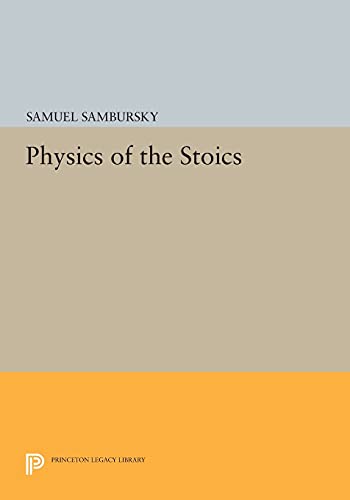
⚡️ What is Stoic Physics about?
Stoic Physics by J.B. Gould explores the foundational ideas of how the Stoics understood the natural world. Far from being a scientific textbook, this book unpacks how ancient philosophers saw matter, causality, and the universe as a unified, rational whole. It focuses on how Stoics believed everything is part of a divine, material cosmos governed by reason (logos) and fate (heimarmene).
🚀 The Book in 3 Sentences
- Stoic Physics reveals how ancient philosophers believed everything in the universe is physical matter shaped by a rational principle (logos).
- The cosmos is unified and governed by fate, where all events are part of a rational process unfolding toward a cosmic harmony.
- Understanding Stoic Physics offers a powerful framework for seeing the world as interconnected and meaningful, shaping how we respond to life’s ups and downs.
🎨 Impressions
I found Stoic Physics fascinating for how it links abstract philosophical ideas with practical life skills. Unlike typical science books, it’s more about mindset than empirical methods. Gould’s clear breakdown of how Stoics viewed the cosmos—connected, rational, and destined—provides a powerful lens through which to see one’s place in the universe.
📖 Who Should Read Stoic Physics?
This book is ideal for readers interested in philosophy, ancient thought, or personal development. Stoic Physics is particularly useful for those who want to understand how ancient Stoics applied scientific-like reasoning to understand emotions, behavior, and cosmic order. Anyone seeking intrinsic resilience will benefit.
☘️ How the Book Changed Me
How my life / behaviour / thoughts / ideas have changed as a result of reading the book.
- I started viewing setbacks as part of a larger rational process, aligning with Stoic Physics concepts.
- I became more accepting of change and impermanence by understanding Stoic fate.
- I internalized the idea that all matter—including myself—is part of a single, divine cosmos.
✍️ My Top 3 Quotes
- “God is the soul of the world, communicating itself through cosmic fire.”
- “The fundamental principle of Stoic Physics is that the universe is a single, material entity pervaded by reason.”
- “All things are linked by necessary sequence; nothing occurs by chance but by rational law.”
📒 Summary + Notes
Stoic Physics by J.B. Gould examines the materialist and deterministic worldview of ancient Stoicism. The Stoics believed in a unified, rational universe shaped by divine reason and necessity. Nature wasn’t chaotic but governed by law. Understanding Stoic Physics gives us practical insight into how to live purposefully and calmly within our roles in this larger whole.
Chapter 1: The Nature of Matter
Gould begins by explaining how Stoics saw matter as fundamental and active. Unlike the passive matter of other philosophers, Stoic matter is infused with pneuma (“breath” or spirit), an active force that organizes and shapes the physical world. This made matter more than just mass—it was alive.
- Active Matter: The Stoics saw matter not as inert, but as infused with divine energy.
- Pneuma: This vital force acts like an organizing spirit, turning raw potentiality into structured reality.
- Understanding the nature of matter is foundational for grasping Stoic Physics.
Chapter 2: The Concepts of Fire and Pneuma
This chapter details how Stoics used fire and pneuma metaphorically to describe the active principle that animates the universe. Fire is not just literal fire but represents the idea of pure activity, a dynamic force that transforms and gives form to the material world.
- Fire as Principle: Not just combustion, but an energetic, transformative spirit representing life itself.
- Pneuma Interconnectivity: Pervades all substance, creating cohesion between objects and beings.
- This active principle is essential in understanding how Stoics approached Stoic Physics.
Chapter 3: Unity and Mixture
Gould explains how the Stoics believed that things were not formed from external combination, but always already contained necessary connections. The union of matter with reason meant that every part contained the whole, leading to a coherent cosmology where everything partook in the same essence.
- Mixture vs. Composition: Not two things joined but an internal fusion of constituents at every level.
- This unity creates a sensation of fundamental interconnectedness in Stoic Physics.
- Such unity supports the ethical framework of how one should relate to others.
Chapter 4: Divinity in Matter
In this chapter, Gould shows how the Stoics found divinity not in distant heavens but immanent in matter itself. God and cosmos are one. Divinity is understood as reason moving through matter, showing Stoicism as materialist yet deeply pantheistic.
- Immanent Divinity: Divine reason permeates all things equally, not separate from the world.
- This concept changed how individuals grasp their own inner and outer lives in Stoic Physics.
- Framed around cosmology and ethics rather than theology in the standard sense.
Chapter 5: Causality and Fate
Stoic thinkers strongly held that every event had a natural cause. This deterministic model excludes randomness. Fate (heimarmene) was not arbitrary but followed logically from cosmic laws. This understanding influences how Stoics face challenges with equanimity—they accept necessity.
- Rational Determinism: Nothing random in events—fate is structured, not arbitrary.
- Freedom lies in responding appropriately rather than trying to escape preordained consequences.
- This idea gives deeper power to Stoic Physics, reinforcing emotional resilience.
Chapter 6: Identity of Opposites
The Stoic perspective of opposites being ultimately identical helps reconcile dualistic thinking. Destruction and creation, good and bad, are parts of a single continuous process. This eliminates unnecessary judgment and fear of change, emphasizing the cosmic rhythm.
- Cyclical Nature: Creation and destruction are vital to each other in eternal transformation.
- This cyclical view contributes philosophically to stress management using Stoic Physics.
- Mind sees beyond surface conflict to find greater correspondence and balance.
Chapter 7: Time and Space
Gould explains that for Stoics, time and space are inseparable from matter. Unlike Aristotle’s background-dependent model, Stoic time and space are intrinsic features of the cosmos, extending along with the living cosmos on its full scale.
- Connected Systems: The Stoics conceived time and space as closely tied to motion and being.
- Eternally Changing: Space-time follows natural dynamics rather than static conditions.
- This represents a holistic understanding of the physical world echoed in Stoic Physics.
Chapter 8: Final Comments
Gould ends by summarizing some key critiques and broader implications of Stoic Physics, suggesting they shouldn’t be constrained by historical debates alone. Their ideas have influenced modern science, psychology, and metaphysics, proving their ongoing relevance beyond antiquity.
- Enduring Ideas: Although ancient, the proponents of Stoic Physics remain open to reinterpretation today.
- The books’ intellectual legacy extends into modern philosophical traditions and practices.
- If incorporated thoughtfully, this philosophy strengthens personal clarity and emotional steadfastness.
Key Takeaways
The Stoics taught that all things reside in a unified universe shaped by reason and fate. Matter is not dead but animated by a divine breath. Understanding Stoic Physics allows us to embrace uncertainty and find peace through the harmony of even conflicting forces, letting ethics and science exist as complements instead of conflicts.
- Unity of Matter and Spirit: Matter is both material and active due to the permeating divine breath (pneuma).
- Deterministic View of Life: Everything is caused by prior states according to universal laws.
- Interconnectedness of the Cosmos: We and our environment share a single origin—a divine fire.
Conclusion
If you’re looking to make sense of existence while building a mindset resilient to discontinuity, then go read Stoic Physics by J.B. Gould—it’s not just about abstract metaphysics but practical tools for emotional strength framed within cosmic rationality. Delving into the depths of Stoic Physics can reframe your perception of suffering, agency, and value. Give it a try!
More From J.B. Gould →
Discover more from AI Book Summary
Subscribe to get the latest posts sent to your email.