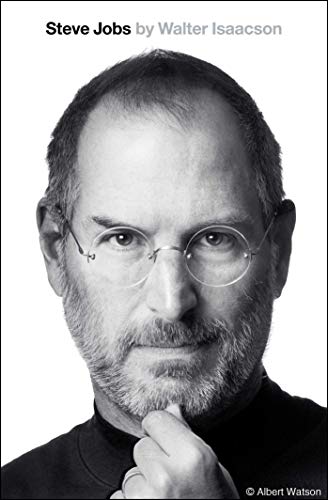
⚡️ What is Steve Jobs about?
Walter Isaacson’s Steve Jobs is the authorized biography of the Apple co-founder, providing an unflinching and comprehensive look at the man behind the revolution. Based on over forty interviews with Jobs himself, as well as conversations with more than a hundred family members, friends, adversaries, competitors, and colleagues, the book chronicles his life from his adoption and early years to his final days. It’s not just a story about technology; it’s a deep dive into the complex, often contradictory personality of a visionary who was equal parts genius, artist, and tyrant. The narrative explores his core passions for perfection, design, and simplicity, revealing the Steve Jobs strategies that shaped multiple industries and forever changed our relationship with technology.
🚀 The Book in 3 Sentences
- This biography presents the full, unvarnished story of Steve Jobs, a passionate perfectionist who drove himself and others to create beautiful, groundbreaking products.
- It details his journey from a rebellious college dropout to the pinnacle of the business world, showcasing his unique fusion of technology with the liberal arts.
- Ultimately, the book is a testament to how an intense, laser-focused vision can indeed ‘put a ding in the universe.’
🎨 Impressions
Reading this book felt like getting a backstage pass to the greatest tech show on earth, but with all the drama and ego left in. My most lasting impression is the profound duality of Steve Jobs. He was a Zen Buddhist who could be incredibly cruel, a minimalist obsessed with material objects, and a visionary who often refused to look beyond his own perspective. Isaacson masterfully avoids hagiography, presenting Jobs as a deeply flawed human whose genius was inextricably linked to his intensity. The book demystifies the ‘magic’ of Apple, replacing it with something more impressive: the brutal, relentless, and often messy reality of innovation driven by one man’s uncompromising standards.
📖 Who Should Read Steve Jobs?
This book is essential reading for entrepreneurs, designers, product managers, and anyone in a leadership position. If you’re fascinated by the intersection of creativity and technology, or if you want to understand the Steve Jobs techniques for building iconic products and companies, this biography is unparalleled. It’s also for anyone who appreciates a compelling human story about ambition, failure, redemption, and the relentless pursuit of excellence, offering profound lessons that extend far beyond the world of business.
☘️ How the Book Changed Me
Reading this biography fundamentally shifted my perspective on what it takes to create something truly great. It moved me from a place of romanticizing innovation to understanding the sheer force of will required.
- I now have a deeper obsession with simplicity, both in my work and personal life, constantly asking what can be removed to make something better.
- I’ve learned the power of saying ‘no’ to a hundred good ideas to focus on one or two truly great ones, a core Steve Jobs principle.
- My view on leadership has evolved; I now see that unwavering vision and a refusal to compromise can be more powerful than seeking consensus.
✍️ My Top 3 Quotes
- “Your work is going to fill a large part of your life, and the only way to be truly satisfied is to do what you believe is great work. And the only way to do great work is to love what you do.”
- “Deciding what not to do is as important as deciding what to do.”
- “I want to put a ding in the universe.”
📒 Summary + Notes
This summary provides a chapter-by-chapter journey through the life of Steve Jobs, as meticulously documented by Walter Isaacson. Each section breaks down the key events, personality traits, and business decisions that defined his legacy. From his childhood in Mountain View to the creation of the iPhone, these notes capture the essence of his relentless drive, his complex relationships, and the revolutionary Steve Jobs strategies that shaped modern technology. It’s a detailed roadmap of a life lived at the intersection of art and technology.
Chapter 1: Childhood
This chapter details Jobs’s adoption, his relationship with his working-class parents, and his early life in the cradle of Silicon Valley. It highlights his precocious intelligence, his boredom with formal schooling, and his early exposure to electronics through his father and a summer job at HP. We see the seeds of his brilliance and his social alienation being planted early on.
- Born to unmarried graduate students, Steve Jobs was adopted by Paul and Clara Jobs, who promised to send him to college.
- His father, a mechanic, taught him the importance of craftsmanship and attention to detail, even on parts no one would see.
- He was a brilliant but difficult child, often playing pranks and feeling intellectually superior to his parents and peers.
- A call to Bill Hewlett at age 12 for spare parts landed him a summer job at HP, solidifying his interest in electronics.
- He felt a sense of abandonment from his biological parents, a theme that would recur throughout his life and relationships.
Chapter 2: Woz
The chapter focuses on the pivotal friendship between Steve Jobs and Stephen Wozniak. Despite their five-year age difference, they bonded over a shared love of electronics, pranks, and Bob Dylan. Woz was the engineering wizard; Jobs was the visionary who could see the commercial potential. Their partnership, which would later define Apple, began with a shared passion for outsmarting the system, exemplified by their ‘blue box’ project.
- Jobs met Wozniak (‘Woz’) through a mutual friend; Woz was the hardware genius, Jobs was the forward-thinking ideas man.
- They bonded deeply over pranks, music (especially Bob Dylan), and a shared disdain for authority.
- Together, they built and sold ‘blue boxes,’ devices that allowed them to make free long-distance phone calls, an early lesson in teamwork.
- Woz’s engineering skill and Jobs’s charisma and business acumen were a perfect, albeit sometimes volatile, combination.
- This friendship laid the foundational dynamic for Apple: the brilliant engineer and the driven visionary.
Chapter 3: The Dropout
Jobs’s brief and tumultuous time at Reed College is explored here. He chose an expensive liberal arts college, much to his parents’ financial strain, only to drop out after one semester. However, he stayed on campus, ‘dropping in’ on classes that interested him, most notably a calligraphy course. This seemingly random decision would later influence the beautiful typography of the Macintosh, demonstrating his intuitive connection between technology and the arts.
- Jobs enrolled at Reed College, an expensive liberal arts school, but dropped out after six months to find himself.
- He continued to live on campus, auditing classes like calligraphy, which he found fascinating for its artistic and historical beauty.
- This calligraphy class would later become the basis for the beautiful typography and multiple fonts on the first Macintosh.
- He began exploring Eastern spirituality, Zen Buddhism, and psychedelic drugs, which shaped his minimalist aesthetic and worldview.
- His time at Reed solidified his belief in following his intuition, even when it didn’t make logical sense to others.
Chapter 4: Atari and India
After dropping out, Jobs took a job at Atari, where his difficult personality and poor hygiene made him an unpopular colleague. To escape, he embarked on a spiritual journey to India with a friend. The trip was a profound, if disillusioning, experience that exposed him to poverty and intuition. He returned more focused, having shaved his head and adopted new Steve Jobs techniques for concentration, though his abrasive personality remained largely intact.
- Jobs landed a technician job at Atari, where his arrogance and lack of hygiene led to him being assigned the night shift.
- To fund a trip, he convinced Atari to send him to Germany but instead went to India seeking spiritual enlightenment.
- The trip to India was a formative experience; he was struck by the intuition and spiritualism of the people there, contrasting with Western rationality.
- He returned from India with a shaved head, wearing traditional Indian clothing, and more focused on his mission.
- His time at Atari taught him the importance of industrial design and simplicity, influenced by its founder, Nolan Bushnell.
Chapter 5: The Apple I
This chapter marks the official birth of Apple. Inspired by the Altair 8800, Wozniak designed a computer circuit board purely for the joy of it. Jobs immediately saw its potential as a product. He convinced Woz to sell the design, and together they founded Apple Computer in Jobs’s garage. The chapter details the creation and marketing of the Apple I, their first product, which was sold as a kit for hobbyists.
- The Homebrew Computer Club, where Woz showed off his designs, was the incubator for the personal computer movement.
- Wozniak engineered the Apple I circuit board, and Jobs had the vision to package it as a commercial product.
- They founded Apple Computer on April 1, 1976, with Jobs selling his VW van and Woz selling his calculator to fund it.
- The name ‘Apple’ was chosen by Jobs to be friendly and simple, and to appear before Atari in the phone book.
- The Apple I was primarily sold to hobbyists, marking the first step in their journey to bring computers to the masses.
Chapter 6: The Apple II
The Apple II was the machine that truly put Apple on the map. Jobs insisted on a complete, integrated product with a case, keyboard, and power supply, not just a circuit board. His obsession with design and perfectionism became a driving force. This chapter introduces the ‘Apple marketing philosophy‘—empathy, focus, and impute—which would guide the company for decades. The minimalist aesthetic, inspired by Zen and his time at a commune, became a core Apple tenet.
- Jobs envisioned the Apple II as a fully integrated consumer appliance, not just a kit for engineers.
- He became obsessed with the beauty of the enclosure, insisting on a sleek, beige plastic case that was friendly and approachable.
- He developed the core Apple marketing philosophy: empathy (understand the customer), focus (eliminate the unimportant), and impute (present products beautifully).
- Jobs insisted on a fanless power supply, a major engineering challenge, because he found the noise of fans distracting.
- The success of the Apple II cemented the partnership between Jobs’s vision and Woz’s engineering brilliance.
Chapter 7: Chrisann and Lisa
This chapter delves into Jobs’s volatile relationship with his high school girlfriend, Chrisann Brennan, and the birth of his first daughter, Lisa. Jobs initially denied paternity, a decision that would haunt him for years. It paints a stark portrait of his emotional immaturity and cruelty, showing a side of him completely at odds with his public persona as a visionary. His personal life was a mess of neglect and denial, a stark contrast to his professional focus.
- Jobs’s on-again, off-again relationship with Chrisann Brennan was tumultuous and emotionally abusive.
- When Brennan became pregnant, Jobs denied he was the father, claiming he was sterile and refusing to provide support.
- His daughter, Lisa Nicole Brennan, was born in 1978, and Jobs initially abandoned her, a decision he later regretted.
- This period reveals a deep emotional detachment and cruelty in Jobs’s character, showing his inability to deal with complex personal responsibilities.
- The computer he later developed, the Apple Lisa, was widely believed to be named after his daughter, though he denied it.
Chapter 8: Xerox and Lisa
As Apple grew, Jobs became determined to create a product that was truly his own, not just Woz’s. He spearheaded the Lisa project, a next-generation computer. The turning point came when he was given a tour of Xerox PARC, where he saw the future of computing: a graphical user interface, mouse, and bitmapped display. Jobs and his team immediately understood the potential and ‘appropriated’ these ideas, refining them into what would become the foundation of the Macintosh.
- Jobs was desperate to create a machine that surpassed the Apple II, leading to the ambitious Lisa project.
- In exchange for allowing Xerox to invest in Apple, Jobs was granted a tour of the secretive Xerox PARC research center.
- At PARC, he saw the Alto, a computer with a graphical user interface (GUI) and a mouse, and instantly recognized its revolutionary potential.
- Jobs famously told his team, ‘We are creating the future,’ after the PARC visit, making the GUI the cornerstone of Apple’s next computers.
- He pushed the Lisa team to create a ‘what you see is what you get’ (WYSIWYG) interface with overlapping windows and icons.
Chapter 9: Going Public
This chapter covers Apple’s meteoric rise and its historic IPO in 1980. The company’s valuation skyrocketed, making Jobs a multimillionaire at 25. It explores his complicated relationship with wealth and materialism. He was an ‘antimaterialistic hippie’ who loved beautifully designed, high-end objects but lived a spartan personal life. The chapter also highlights Wozniak’s generosity, as he sold shares to employees who missed out on the initial offering.
- Apple went public on December 12, 1980, with a valuation of $1.79 billion, creating more instant millionaires than any IPO in history.
- At age 25, Jobs’s net worth was over $256 million, but he remained famously detached from material wealth.
- He had a love for beautifully designed objects like BMWs and high-end audio equipment but kept his own home sparsely furnished.
- Wozniak, feeling the original team was left out, sold his own shares at a low price to employees, showcasing his selfless nature.
- The IPO marked the transition of Apple from a garage startup to a major corporate player, bringing new pressures and challenges.
Chapter 10: The Mac Is Born
The Macintosh project started as a skunkworks effort led by Jef Raskin to create a low-cost, easy-to-use computer. When the Lisa project became too expensive and corporate for his taste, Jobs hijacked the Macintosh team. He infused it with his own passion, vision, and rebellious spirit, transforming it from a simple appliance into a revolutionary product that would ‘put a dent in the universe.’ This chapter details the clash between Raskin’s pragmatic vision and Jobs’s ambitious one.
- The Macintosh project was started by Jef Raskin, who envisioned a $500, user-friendly appliance computer.
- After being pushed off the Lisa team, Jobs took over the Macintosh division in 1981, infusing it with his revolutionary zeal.
- He molded the Mac team into a band of pirates—artisans, poets, and rebels on a mission to create an insanely great product.
- Jobs’s vision for the Mac was far more ambitious than Raskin’s, aiming for a machine that would be transformative, not just functional.
- The team worked with a fanatical passion, driven by Jobs’s reality distortion field and the belief they were changing the world.
Chapter 11: The Reality Distortion Field
This chapter gives a name to one of Jobs’s most powerful and infamous traits: his ‘reality distortion field.’ Borrowed from Star Trek, it describes his ability to convince himself and others to believe almost anything, using a mix of charisma, will, and persistence. He could ignore impossible deadlines and bend reality to his vision, often pushing his teams to achieve what they thought was impossible. It was a key Steve Jobs strategy for innovation but also made him incredibly difficult to work with.
- The ‘Reality Distortion Field‘ was the term coined by Bud Tribble to describe Jobs’s ability to convince anyone of anything.
- Jobs used this field to motivate his teams to meet impossible deadlines and achieve feats of engineering they deemed unattainable.
- It stemmed from his core belief that he could will the world into conforming to his vision, often ignoring physical or logistical constraints.
- While it led to breakthroughs, it also caused immense strain and burnout among his employees, who felt they were living in an alternate reality.
- Jobs himself was often a victim of his own field, genuinely believing in things that were not yet true.
Chapter 12: The Design
Jobs’s obsession with design is the central theme of this chapter. It wasn’t just about how the product looked on the outside; it was about the entire user experience. He insisted on elegant, simple design for the Mac’s case, its keyboard, and even its internal circuit boards. He believed that a great product should be a work of art, from the packaging to the signatures of the team etched inside the case. This philosophy of end-to-end design became a hallmark of Apple.
- Jobs was obsessed with making the Macintosh beautiful inside and out, insisting the signatures of the team be molded into the plastic case.
- He believed that design was not just about aesthetics but about how the product worked, felt, and functioned.
- He famously said, ‘A great carpenter isn’t going to use lousy wood for the back of a cabinet, even though nobody’s going to see it.’
- Jobs insisted on a perfectly seamless and integrated design, from the shape of the mouse to the layout of the motherboard.
- This relentless focus on design was a direct result of his Zen-inspired appreciation for simplicity and his belief in the soul of a machine.
Chapter 13: Building the Mac
This chapter details the intense, grueling process of actually engineering and manufacturing the Macintosh. Jobs pushed his team to the brink with his demands for perfection and impossible deadlines. The Mac was conceived as a closed system, a stark contrast to the open Apple II. This decision, while ensuring a seamless user experience, alienated hobbyists and hackers. The chapter highlights the immense pressure and passion that went into creating the machine, which shipped 16 months behind schedule.
- The Mac team worked grueling hours, fueled by passion, caffeine, and Jobs’s relentless drive and occasional tirades.
- Jobs insisted on a closed system, meaning users couldn’t open the machine or expand it, to ensure a controlled and perfect experience.
- This philosophy of hardware and software integration was a core tenet for Jobs, but it was controversial and went against the hacker ethos of the time.
- The project was chronically delayed, but Jobs used his reality distortion field to keep the team focused and motivated.
- His mantra during the crunch time was, ‘It’s better to be a pirate than to join the navy,’ fostering a rebellious, us-against-them culture.
Chapter 14: Enter Sculley
Feeling Apple needed a professional CEO to manage its growing success, Jobs recruited John Sculley, the president of Pepsi-Cola. Their relationship began with mutual admiration but quickly soured due to their clashing styles and visions. Jobs, the young visionary, and Sculley, the seasoned marketing executive, represented two different worlds. This chapter sets the stage for the power struggle that would eventually lead to Jobs’s ousting from the company he founded.
- Jobs famously lured Sculley from Pepsi by asking, ‘Do you want to sell sugared water for the rest of your life, or do you want to come with me and change the world?’
- Sculley was brought in to provide professional management and operational discipline, which Jobs lacked.
- Initially, the two had a strong bond, with Sculley acting as a mentor and father figure to the temperamental Jobs.
- However, their philosophical differences soon became apparent, especially regarding the Mac’s pricing and marketing strategy.
- Sculley’s focus on profit and market share clashed with Jobs’s obsession with product perfection and vision.
Chapter 15: The Launch
The launch of the Macintosh in 1984 is the centerpiece of this chapter. It was a masterclass in marketing, headlined by the iconic ‘1984’ Super Bowl commercial directed by Ridley Scott. The ad positioned Apple as a rebellious force of freedom against the totalitarian ‘Big Brother’ (IBM). The launch was a huge success, but the chapter notes the early signs of trouble: the Mac was underpowered and expensive, and its closed system limited its appeal to a niche audience.
- The ‘1984’ commercial, directed by Ridley Scott, is considered one of the greatest ads of all time and defined Apple’s brand as a rebel.
- The ad aired only once during the Super Bowl but generated massive buzz, framing the Mac as a tool for liberation.
- The Macintosh was unveiled to great fanfare on January 24, 1984, with Jobs introducing it from a bag on stage like a piece of magic.
- Despite the brilliant marketing, the Mac had flaws: it was expensive and underpowered, with little software available initially.
- The launch cemented Jobs’s reputation as a master showman and marketer, but the product’s long-term success was not yet guaranteed.
Chapter 16: Gates and Jobs
This chapter explores the complex, often adversarial relationship between Steve Jobs and Bill Gates. They were two of the most influential figures in personal computing, but they came from different worlds and had fundamentally different philosophies. Jobs was an artist who integrated hardware and software; Gates was a pragmatist who licensed software to run on a variety of machines. Their rivalry began when Gates developed software for the Mac and then ‘borrowed’ the GUI for Windows, a betrayal Jobs never forgave.
- Jobs and Gates had a relationship of mutual respect and deep rivalry, recognizing each other’s genius but clashing on philosophy.
- Jobs saw the Mac’s GUI as his creation, while Gates viewed it as an evolution that should be shared and licensed.
- When Microsoft announced Windows in 1985, Jobs was furious, accusing Gates of ripping off the Mac, to which Gates famously replied, ‘It’s more like we both had this rich neighbor named Xerox.’.
- Gates was a software genius focused on market dominance; Jobs was a product visionary obsessed with creating a perfect end-to-end experience.
- This fundamental difference in approach—open vs. closed, licensed vs. integrated—would define their competition for decades.
Chapter 17: Icarus
The initial excitement of the Mac launch quickly faded as sales stalled. The Mac was an amazing product that was failing in the marketplace. Jobs’s refusal to add more memory or expansion slots, his mercurial management, and his blaming of others for the problems created turmoil within Apple. This chapter details the power struggle that culminated in Jobs being stripped of his operational role by CEO John Sculley and the board, a humbling fall from grace for the young prince of Silicon Valley.
- Despite the hype, Mac sales were disappointing due to its high price, lack of software, and limited memory.
- Jobs’s management style became increasingly erratic and divisive, leading to a breakdown in the executive team.
- Sculley and the board began to see Jobs as more of a liability than an asset, blaming him for the company’s problems.
- In a dramatic boardroom showdown, Jobs was stripped of his power and removed as head of the Macintosh division.
- Like Icarus who flew too close to the sun, Jobs’s arrogance and refusal to compromise led to his dramatic fall from power at Apple.
Chapter 18: NeXT
After being forced out of Apple, Jobs was devastated but quickly regrouped. He sold almost all of his Apple stock and founded a new company, NeXT. His goal was to build the perfect computer for the higher education market. This chapter details the creation of the NeXT Cube, a stunningly beautiful but prohibitively expensive machine. Jobs’s perfectionism was on full display, from the magnesium cube case to the custom-built factory, but his focus on aesthetics over market needs led to limited commercial success.
- After leaving Apple, a heartbroken but determined Jobs founded NeXT, with the mission of building the ultimate computer for higher education.
- He poured his energy into creating the NeXT Cube, a stunning black magnesium cube that was a marvel of industrial design.
- Jobs’s perfectionism reached new heights; he spent millions on a state-of-the-art factory and obsessed over the perfect curve of the cube’s corners.
- The NeXT computer was technologically advanced but commercially unsuccessful due to its incredibly high price and limited software.
- This period was a humbling one for Jobs, as he struggled to replicate Apple’s success without the resources and team he left behind.
Chapter 19: Pixar
While running NeXT, Jobs also made a side investment that would become even more significant. He bought the computer graphics division of George Lucas’s film company for $10 million, which was later renamed Pixar. Initially, it was a high-end computer hardware company, but Jobs eventually pivoted its focus to making animated films. This chapter chronicles the struggles and eventual triumph of Pixar, culminating in the release of ‘Toy Story,’ which made Jobs a billionaire and cemented his reputation as a visionary, this time in Hollywood.
- In 1986, Jobs bought the computer graphics division from George Lucas for $10 million, renaming it Pixar.
- Initially, Pixar struggled to sell its expensive, high-end image computer, and Jobs had to pour millions of his own money into it to keep it afloat.
- Jobs eventually pivoted the company away from hardware and toward making animated feature films, partnering with Disney.
- The release of ‘Toy Story’ in 1995 was a monumental success, both critically and commercially, revolutionizing animation.
- Pixar’s IPO made Jobs a billionaire again, proving he could create magic outside of Apple and giving him the resources and confidence to return.
Chapter 20: A Regular Guy
This chapter offers a glimpse into Jobs’s personal life during his years in the wilderness. He reconnected with his biological sister, the novelist Mona Simpson, and finally began to build a relationship with his daughter, Lisa. His romantic life was tumultuous, marked by a long-term relationship with a woman named Redse who couldn’t handle his emotional neglect. It was a period of personal growth and maturation, as he slowly began to confront the flaws and abandonment issues from his own childhood.
- Jobs reconnected with his biological sister, Mona Simpson, and they formed a close bond, sharing stories of their search for their parents.
- He began to repair his relationship with his daughter, Lisa, though it remained difficult and often distant for many years.
- His long-term relationship with a woman named Redse ended because she felt his emotional neglect was a form of abuse, highlighting his personal struggles.
- During this period, Jobs was often described as more mature and self-aware, though still prone to the same intense moods.
- He was learning to balance his driving ambition with a more grounded personal life, a process that would continue for years.
Chapter 21: Family Man
In 1991, Jobs married Laurene Powell, a brilliant and grounded woman who could finally provide the stability he needed. This chapter shows Jobs in a new light: as a devoted husband and father to three children. He bought a large but modestly furnished home in Palo Alto and tried to create a normal family life. His Zen philosophy of minimalism extended to his home, but his passion for design and perfectionism was still evident in things like his German washing machine. He was finally learning to find balance.
- Jobs met and married Laurene Powell in 1991, a relationship that brought him a sense of peace and stability he had never known.
- He became a devoted family man to his three children with Laurene—Reed, Erin, and Eve—often prioritizing family dinners.
- He bought a house in Palo Alto that was famously sparsely furnished, reflecting his Zen belief that material possessions clutter life.
- Despite his wealth, he lived a relatively normal life, driving his own car and having no security detail or live-in servants.
- This period marked a significant maturation in Jobs, as he learned to channel his passions into his family as well as his work.
Chapter 22: Toy Story
This chapter details the making of ‘Toy Story,’ the first full-length computer-animated film. It was a grueling process, marked by creative clashes with Disney over the film’s tone and story. Jobs, as the CEO of Pixar, played a crucial role in navigating these conflicts. He and his team, led by John Lasseter, fought to maintain the film’s heart and soul. The success of ‘Toy Story’ was not just a financial triumph; it was a validation of Jobs’s belief that story and character were more important than technology.
- The production of ‘Toy Story’ was fraught with conflict, as Disney executives repeatedly tried to make the film edgier and less heartwarming.
- Jobs backed his creative team, John Lasseter and Pixar, in their fight to preserve the story’s emotional core.
- He successfully negotiated a new deal with Disney that gave Pixar more control, a significant percentage of the profits, and branding credit.
- The phenomenal success of ‘Toy Story’ proved that Jobs’s instincts for product and story were as sharp in Hollywood as they were in Silicon Valley.
- The film’s release was a triumphant moment for Jobs, marking his successful reinvention as an animation mogul.
Chapter 23: The Second Coming
By 1996, Apple was in a death spiral. The company was bleeding money, its product line was a confusing mess, and it was running out of time. In a desperate move, Apple bought NeXT for $400 million, primarily to acquire its advanced operating system. The deal brought Steve Jobs back to the company he founded, initially as an advisor to the CEO. His return was the first step in one of the greatest turnarounds in business history.
- By 1997, Apple was near bankruptcy, with a bloated product line, outdated OS, and no clear direction.
- In a stunning move, Apple bought NeXT for $429 million, bringing Jobs back as an advisor, with his NeXT OS set to become the foundation for Apple’s future.
- Jobs’s return was met with a mix of excitement and trepidation, as no one was sure what role he would play.
- He quickly began assessing the damage, horrified by the lack of taste and the proliferation of mediocre products.
- His return marked the beginning of the end for the old Apple and the dawn of a new, focused era.
Chapter 24: The Restoration
Within months of his return, Jobs had staged a boardroom coup and was once again the CEO of Apple. He immediately began to implement his core Steve Jobs strategies: focus and simplification. He slashed the product line from dozens of models to just four, ended the licensing of the Mac OS to clone makers, and forged a surprising partnership with Microsoft. This chapter details the dramatic and decisive actions Jobs took to save Apple from the brink of collapse.
- Jobs convinced the board to oust the then-CEO and took over the ‘interim’ role, which would soon become permanent.
- He ruthlessly cut the product line from dozens of confusing models to just four: a consumer and pro desktop, and a consumer and pro portable.
- In a shocking move, he announced a $150 million investment from Microsoft at Macworld, ending years of bitter rivalry.
- He killed the Mac clone program, believing that Apple’s strength lay in its tight integration of hardware and software.
- His famous ‘Think Different’ ad campaign re-established Apple’s brand identity as a home for creative innovators.
Chapter 25: Think Different
This chapter explores the creation and impact of the ‘Think Different’ ad campaign. It was more than just marketing; it was a declaration of Apple’s renewed identity and values. The campaign celebrated ‘the crazy ones, the misfits, the rebels’—people like Albert Einstein and Martin Luther King Jr.—positioning Apple users as part of a proud, creative tribe. It was a brilliant Steve Jobs technique for rebuilding brand loyalty and attracting a new generation of customers.
- The ‘Think Different’ campaign was created by the ad agency Chiat/Day and became the cornerstone of Apple’s revival.
- Instead of focusing on products, the campaign focused on the brand’s values, aligning Apple with history’s greatest innovators and artists.
- Jobs loved the campaign because it spoke to his core belief that Apple was a tool for creative people to change the world.
- The campaign helped re-establish Apple’s ‘cool’ factor and rebuild its emotional connection with customers.
- It was a statement of purpose, signaling that under Jobs’s leadership, Apple was back to its original mission of creating tools for the mind.
Chapter 26: Design Principles
With Apple back on track, Jobs re-infused the company with his passion for design. He recruited Jony Ive and gave him the freedom and resources to create a new design language. This chapter details their partnership and the core principles that would guide Apple’s products: simplicity, honesty, and a deep appreciation for materials. They shared a belief that design wasn’t just about how a product looked, but how it worked and felt, creating a seamless and intuitive user experience.
- Jobs found a kindred spirit in Jony Ive, Apple’s head of design, with whom he would forge one of the great creative partnerships in business history.
- They shared a passion for minimalism and an obsession with every detail of a product’s design, from its materials to its user interface.
- Jobs’s design philosophy was heavily influenced by his Zen training and the principles of Dieter Rams’s work at Braun.
- He believed in honest design, where the form of a product was dictated by its function, without unnecessary ornamentation.
- This renewed focus on design became Apple’s key competitive advantage, setting its products apart in a sea of beige plastic boxes.
Chapter 27: The iMac
The iMac was the first product that truly signaled Apple’s rebirth. It was a bold, all-in-one computer with a colorful, translucent plastic case that was a radical departure from the boring beige boxes of the time. Jobs made the controversial decision to omit a floppy disk drive, betting on the future of USB and the internet. The iMac was a huge success, saving Apple financially and re-establishing it as a leader in innovation and design.
- The iMac, introduced in 1998, was a bold and colorful all-in-one computer that was a radical departure from anything else on the market.
- Its translucent case, which showed the internal components, was a design statement that emphasized the machine’s simplicity and honesty.
- Jobs’s decision to eliminate the floppy disk drive was controversial but forward-thinking, pushing users towards the internet and USB.
- The ‘i’ in iMac stood for internet, individual, instruct, inform, and inspire, signaling its role as a tool for the new digital age.
- The iMac was a massive commercial success, selling 800,000 units in its first year and pulling Apple back from the brink of financial ruin.
Chapter 28: CEO
This chapter covers Jobs’s transition from ‘interim’ CEO to permanent CEO and the changes he made to Apple’s operations. He hired Tim Cook to revolutionize Apple’s supply chain and inventory management. He also adopted his signature uniform of a black turtleneck, blue jeans, and sneakers, arguing that it reduced decision fatigue. Under his leadership, Apple became a lean, focused, and incredibly efficient machine, poised for its next phase of explosive growth.
- Jobs finally dropped the ‘interim’ from his title and became the permanent CEO of Apple in 2000.
- He hired Tim Cook from Compaq to overhaul Apple’s operations, dramatically improving its supply chain efficiency and profitability.
- Jobs adopted his signature uniform—a black St. Croix turtleneck, Levi’s 501 jeans, and New Balance sneakers—to simplify his life.
- He introduced Mac OS X, a stable and modern operating system based on the technology from NeXT, finally giving the Mac a world-class OS.
- Under his leadership, Apple’s culture was reshaped into one of accountability, focus, and an unwavering commitment to excellence.
Chapter 29: Apple Stores
Jobs realized that to control the customer experience, Apple needed to control the retail experience. He decided to open Apple’s own stores, a move that was widely criticized as a huge mistake. This chapter details the meticulous design and strategy behind the Apple Store. It wasn’t just a place to buy products; it was a place to experience them, with a focus on clean design, hands-on interaction, and knowledgeable staff. The stores became a massive success and a key driver of Apple’s growth.
- Jobs decided to open Apple retail stores because he felt big-box retailers were doing a terrible job of presenting Apple’s products.
- The Apple Store concept was revolutionary: a minimalist space designed around user experience, not just moving boxes.
- He recruited Mickey Drexler from Gap to help design the stores, focusing on location, layout, and creating a place where people would want to hang out.
- The ‘Genius Bar’ was a key innovation, providing face-to-face tech support and building a strong relationship with customers.
- Despite widespread skepticism, the Apple Stores became incredibly successful, generating more sales per square foot than any other retailer.
Chapter 30: The Digital Hub
At a company retreat, Jobs articulated his new strategy for Apple: the personal computer would become the ‘digital hub’ for a user’s life, managing devices like cameras, music players, and camcorders. This led to the creation of a suite of ‘iApps’ like iMovie, iPhoto, and iTunes. It was this strategy that directly led to the development of the iPod. This chapter explains how Jobs saw the coming digital revolution and positioned Apple at its center.
- Jobs envisioned the Mac as the ‘digital hub‘ for a user’s emerging collection of digital devices: cameras, camcorders, and music players.
- This strategy led to the creation of a suite of simple, creative applications: iMovie for video, iPhoto for photos, and iTunes for music.
- Jobs realized that the next step was a portable music device that could seamlessly integrate with the hub, which became the iPod.
- The ‘rip, mix, burn’ strategy of iTunes empowered users to manage their music collections legally and easily.
- This digital hub strategy was a brilliant Steve Jobs strategy that made the Mac more relevant and set the stage for the iPod’s dominance.
Chapter 31: The iTunes Store
The iPod was a success, but the music industry was being ravaged by illegal file-sharing services like Napster. Jobs knew he needed to create a legal, easy-to-use alternative. This chapter details the intense negotiations with the five major music labels to create the iTunes Store. It was a groundbreaking model that offered songs for $0.99, making it easier to buy music than to steal it. The iTunes Store, coupled with the iPod, created an unstoppable ecosystem that transformed the music industry.
- To combat the rise of music piracy, Jobs masterminded the iTunes Store, creating a legal and compelling alternative to services like Napster.
- He convinced the major music labels to agree to a simple pricing model of $0.99 per song, a revolutionary concept at the time.
- The iTunes Store was seamlessly integrated into the iTunes software, making it incredibly easy to discover, purchase, and sync music to the iPod.
- When launched for Windows in 2003, it opened up the iPod-iTunes ecosystem to the vast majority of computer users.
- This combination of elegant hardware, intuitive software, and a legal content platform created a virtuous cycle that dominated the digital music market.
Chapter 32: Music Man
This chapter offers a brief look at Jobs’s personal passion for music. He was a huge fan of artists like Bob Dylan, The Beatles, and The Rolling Stones. His love for music wasn’t just a business interest; it was a deep, personal passion that fueled his desire to create the perfect music player and store. His friendships with musicians like Bono and Yo-Yo Ma also highlight his place at the intersection of technology and the arts.
- Jobs had a deep and lifelong love for music, with Bob Dylan and The Beatles being among his all-time favorites.
- His passion for music was a key motivator behind the creation of the iPod and iTunes, as he wanted to create a tool he himself would love to use.
- He was known to meticulously curate playlists and would often gift personalized mixes to friends and colleagues.
- His friendships with artists like Bono showed his genuine connection to the creative community, not just as a businessman but as a fellow artist.
- This personal passion ensured that Apple’s music products were not just technically proficient but also emotionally resonant.
Chapter 33: Pixar’s Friends
The chapter focuses on the relationship between Pixar and Disney. While Pixar was producing hit after hit, Disney’s animation division was struggling. Jobs, as Pixar’s CEO, was in a strong negotiating position. This chapter details the tense but ultimately successful negotiations for a new deal that gave Pixar much more favorable terms, including full ownership of its films. It was a masterclass in negotiation, showcasing the leverage Jobs had built with Pixar’s success.
- As Pixar’s string of hits continued, Jobs’s relationship with Disney CEO Michael Eisner became increasingly strained.
- Jobs used Pixar’s success to negotiate a much more favorable distribution deal, demanding that Pixar get a larger share of profits and own the films outright.
- The negotiations were tense and public, but Jobs held all the cards, as Disney’s own animation studio was failing.
- This standoff eventually led to Disney’s decision to buy Pixar, making Jobs Disney’s largest individual shareholder.
- The chapter highlights Jobs’s evolution as a negotiator and businessman, now operating with the confidence and leverage of a proven winner.
Chapter 35: Round One
In 2003, Jobs was diagnosed with a rare form of pancreatic cancer. This chapter details his initial reaction, which was to reject conventional medical treatment in favor of alternative diets and therapies. He kept his illness a secret from the public and most of his Apple colleagues for nine months. His refusal to have surgery early on, when the tumor was operable, was a decision that would have profound consequences for his health in the years to come.
- In October 2003, Jobs was diagnosed with a neuroendocrine tumor, a rare but treatable form of pancreatic cancer.
- He shocked his doctors by refusing the recommended surgery, opting instead for alternative medicine and a special diet.
- He kept his illness a secret for nine months, a decision that frustrated his family and colleagues.
- Jobs’s Zen-like belief in intuition and his desire to avoid being ‘opened up’ led him to make a fateful decision to delay treatment.
- It wasn’t until the tumor had grown that he finally agreed to surgery in July 2004, by which time the cancer may have spread.
Chapter 36: The iPhone
This chapter is the story of the creation of the iPhone, perhaps Jobs’s most defining achievement. It began as a project to create a tablet, but Jobs had the epiphany that a multi-touch screen could be used for a phone. The chapter details the intense, secretive development process, the decision to use a hardened glass screen, and the partnership with AT&T. The iPhone, launched in 2007, was not just a phone; it was a breakthrough in computing that completely transformed the industry.
- The iPhone project was born out of a tablet research project, but Jobs pivoted to a phone after realizing the potential of multi-touch technology.
- He challenged his team to create a phone with a single physical button and a revolutionary user interface, eschewing the stylus and physical keyboards of the time.
- The development was incredibly secretive, with different teams working on isolated components without knowing the final product.
- Jobs famously demanded scratch-proof glass for the screen, leading to the creation of what would become known as Gorilla Glass.
- The launch of the iPhone in 2007 was a masterstroke, and it redefined the mobile phone, computer, and music player in one device.
Chapter 37: Round Two
Jobs’s health problems returned in 2008. He lost a dramatic amount of weight, leading to widespread public concern and speculation about Apple’s succession plan. This chapter details his efforts to manage his illness through diet while continuing to lead Apple. Eventually, his health deteriorated to the point where he had to take a medical leave of absence and undergo a liver transplant in 2009. It was a fragile period for both Jobs and the company he led.
- In 2008, Jobs’s health visibly declined, and his dramatic weight loss became a source of intense public and media scrutiny.
- He tried to manage his condition with special diets, but his health continued to deteriorate, forcing him to take a medical leave of absence.
- In early 2009, he secretly flew to Memphis for a liver transplant, a fact he did not publicly disclose until after the procedure.
- During his absence, Tim Cook effectively ran Apple, demonstrating the strength of the executive team Jobs had built.
- His return to Apple later in 2009 was met with relief, but it was clear that his health was a long-term vulnerability for the company.
Chapter 38: The iPad
The iPad was the culmination of a long-held dream for Jobs, who had been thinking about a tablet computer since the early 1980s. This chapter describes its development, which ran parallel to the iPhone project. The iPad was met with initial skepticism by the tech press, who saw it as just a big iPhone. But Jobs understood its potential as a new category of device for browsing, media consumption, and more. It was another massive success, opening up a new market and further cementing Apple’s lead in the post-PC era.
- The iPad was a project Jobs had wanted to do for years, but the technology only became viable after the development of the iPhone’s multi-touch interface.
- He envisioned it as a device that was more intuitive than a laptop and more capable than a smartphone, perfect for consuming media.
- The design process was obsessive, with Jobs and Jony Ive debating the exact shape and thinness of the device.
- Despite the skepticism, the iPad was a huge success upon its launch in 2010, selling millions of units and creating a new product category.
- It was a testament to Jobs’s ability to see the future of personal computing and create products that defined new markets.
Chapter 39: New Battles
In the final years of his life, Jobs faced new competitive battles, most notably with Google’s Android operating system. He felt that Android was a ‘stolen product’ and declared ‘thermonuclear war’ on it. This chapter explores his anger at Google, a company he had mentored, and his determination to destroy Android. It also covers Apple’s other challenges, like managing the App Store ecosystem and the long-awaited deal to bring The Beatles’ music to iTunes.
- Jobs felt betrayed by Google, particularly Eric Schmidt, who was on Apple’s board while Google was developing Android.
- He viewed Android as a rip-off of the iPhone’s multi-touch interface and vowed to spend his last dying breath and all of Apple’s money to destroy it.
- This ‘thermonuclear war’ against Google defined Apple’s competitive strategy in the mobile market for years to come.
- He also had to navigate the complexities of the App Store ecosystem, deciding which apps to allow and how to control the user experience.
- A personal victory was finally securing the rights to sell The Beatles’ catalog on iTunes, a long-held dream for the lifelong fan.
Chapter 40: To Infinity
Even as his health failed, Jobs’s passion for product creation never waned. This chapter details his work on the iPad 2, the MacBook Air, and his final grand project: iCloud. He envisioned iCloud as a way to seamlessly sync all of a user’s digital content across their devices, wirelessly and automatically. It was his vision for the future of computing, where the PC was no longer the central hub. The chapter shows him working tirelessly, even from his sickbed, to shape Apple’s future.
- Even while seriously ill, Jobs remained deeply involved in product design, obsessing over details like the Smart Cover for the iPad 2.
- His final major project was iCloud, which he envisioned as a way to demote the PC and make the cloud the digital hub.
- He wanted iCloud to work ‘seamlessly and automatically’, syncing all of a user’s content across their devices without them having to think about it.
- He worked with his biographer, Walter Isaacson, to ensure his story was told, especially for his children, so they would know who he was.
- This chapter shows a man facing his mortality but still driven by an insatiable desire to create and build things that would last.
Chapter 41: Round Three
Jobs’s health began its final decline in 2011. He took another medical leave of absence and eventually resigned as CEO of Apple, handing the reins over to Tim Cook. This chapter is a poignant account of his last months. It includes his meeting with President Obama, where he offered unsolicited advice on education and manufacturing, and a final, emotional visit from Bill Gates, where the two rivals reconciled and reminisced about their shared history.
- In early 2011, Jobs’s health took a sharp turn for the worse, and he resigned as CEO in August, recommending Tim Cook as his successor.
- He met with President Obama, bluntly telling him that he was headed for a one-term presidency unless he became more business-friendly.
- Bill Gates visited him for a long, emotional conversation, where the two giants of tech talked about their lives, families, and legacy.
- He spent his final days at home with his family, saying his goodbyes and finding a measure of peace.
- His focus in his last days was on his legacy and ensuring that the culture of Apple would endure long after he was gone.
Chapter 42: Legacy
The final chapter reflects on the immense legacy of Steve Jobs. He was not a typical engineer or CEO, but a genius who stood at the intersection of the humanities and technology. His key contributions were his unwavering focus, his passion for beautiful products, and his belief that hardware and software should be seamlessly integrated. He didn’t invent many things outright, but he was a master at refining existing technologies and packaging them into beautiful, intuitive products that changed the world. His legacy is not just Apple, but a new standard for what technology can be.
- Jobs’s core legacy is the company he built, which became the most valuable in the world through a relentless focus on making great products.
- He believed that people don’t know what they want until you show it to them, a philosophy that led to the creation of entirely new markets.
- His greatest strength was his ability to blend technology with liberal arts, creating products that were both powerful and beautiful.
- He was a master of focus, knowing that deciding what not to do was more important than deciding what to do.
- Ultimately, his story is a reminder that passion, perseverance, and an unwavering belief in one’s vision can indeed change the world.
Key Takeaways
The life of Steve Jobs offers a masterclass in vision, leadership, and innovation. The most profound lessons are not just about business strategy but about a fundamental approach to work and life. His journey, with all its brilliant successes and staggering failures, provides a blueprint for how to create things that matter. The key takeaways are about focus, design, and the courage to follow your intuition, even when it goes against all conventional wisdom.
- Focus is Everything: Jobs’s ability to say ‘no’ to a thousand good ideas to focus on the one great one was perhaps his greatest superpower. This Steve Jobs strategy of ruthless prioritization is crucial for any innovator.
- Design is Not How It Looks, But How It Works: He obsessed over the entire user experience, from the unboxing to the feel of the software. He taught the world that beauty and simplicity were not just aesthetic choices but functional imperatives.
- Vision Trumps Market Research: Jobs believed that customers can’t tell you what they want next. He relied on his intuition and a deep understanding of human needs to create products that people didn’t even know they needed.
- Connect the Dots: His calligraphy class seemed irrelevant at the time, but it gave the Mac beautiful typography. He believed you can only connect the dots looking backward, so you have to trust that your diverse experiences will eventually make sense.
- Stay Hungry, Stay Foolish: This was his guiding philosophy. It means never being satisfied with the status quo and always being willing to try new things, take risks, and follow your heart, no matter the odds.
Conclusion
Walter Isaacson’s biography is an essential read for anyone who wants to understand the DNA of modern innovation. It’s a raw, honest, and inspiring portrait of a complex man who was as flawed as he was brilliant. The story of Steve Jobs is not a fairy tale; it’s a gritty, real-world account of the passion, pain, and perseverance required to build something that lasts. It challenges you to think differently about your own work, to demand more from yourself, and to believe that a small group of thoughtful, committed people can, in fact, put a ding in the universe.
More From Walter Isaacson →
Discover more from AI Book Summary
Subscribe to get the latest posts sent to your email.