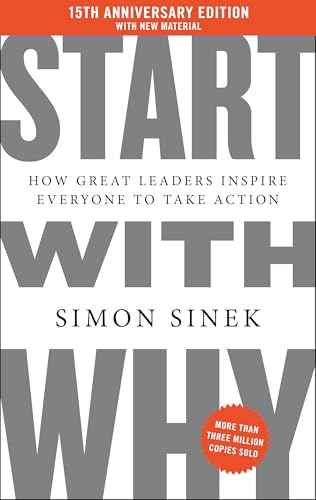
⚡️ What is Start with Why About?
Have you ever wondered why some companies command cult-like loyalty while others have to beg for your attention with 20% off coupons? That’s the question Simon Sinek tackles in this book. He suggests that most of us are doing business backward. We talk about what we do and how we do it, but we rarely touch on why we actually exist in the first place. Sinek’s central argument is that people don’t buy what you do; they buy why you do it.
I first encountered this idea in Sinek’s viral TED talk, but the book adds much-needed layers to the concept. It’s not just a marketing manual; it’s a manifesto on leadership and biology. If you’re looking for more insights on how to build an organization that lasts, you might enjoy More summaries by Simon Sinek. It fits perfectly into the broader world of business book summaries because it challenges the standard MBA approach of data-driven manipulation.
🚀 The Book in 3 Sentences
- The Golden Circle framework—Why, How, and What—reveals that the most inspiring leaders communicate from the inside out.
- Inspiration is a much more sustainable and profitable strategy than manipulation, which relies on price drops, fear, and peer pressure.
- True loyalty comes when a company’s products or services serve as tangible proof of a shared belief between the brand and the consumer.
🎨 Impressions
Honestly, I went into this thinking it was going to be another fluff-filled “find your passion” book. I was wrong. What caught me off guard was how Sinek ties the Golden Circle to actual brain anatomy. It’s one thing to say “emotions matter,” but it’s another to point out that the part of the brain responsible for feelings doesn’t even have the capacity for language. That explains why we often say a decision just “feels right” even when we can’t explain it logically.
The writing is punchy, though I’ll admit he uses Apple as an example so many times I started to wonder if Steve Jobs was a silent co-author. It can feel a bit repetitive in the middle sections, but the core message is so vital that I didn’t mind the reinforcement. It’s the kind of book that makes you look at your own LinkedIn profile or company website and realize you’ve just been listing boring features instead of telling a story people can actually get behind.
📖 Who Should Read Start with Why?
This is a must-read for founders and marketing leads who feel like they’re stuck in a commodity trap. If your only way to win is to be the cheapest, you need this framework. It’s also great for anyone in a leadership role who’s struggling to get their team motivated beyond just “hitting the numbers.” However, if you’re looking for a step-by-step tactical guide on how to run a Facebook ad campaign or optimize a supply chain, this isn’t it. This is high-level strategy and mindset stuff.
☘️ How This Book Changed My Thinking
Before reading this, I thought “branding” was mostly about logos and color palettes. I realize now that’s just the surface level.
- I stopped trying to convince people with facts and started looking for people who share my core beliefs.
- I’ve started using the “Celery Test” for my own projects—if a new opportunity doesn’t align with my ‘Why,’ I say no, regardless of the payout.
- I realized that ‘How’ is just as important as ‘Why’—having a purpose without a disciplined process is just a pipe dream.
✍️ 3 Quotes That Stuck With Me
- “People don’t buy what you do; they buy why you do it.” — This is the lightning bolt moment that changes how you view every advertisement you see.
- “Leadership is the ability to rally people not for a single event, but for a years-long period of time.” — It reminds us that inspiration isn’t a one-off speech; it’s a consistent rhythm.
- “Working hard for something we don’t care about is called stress; working hard for something we love is called passion.” — This puts the whole “hustle culture” debate into a much healthier perspective.
📒 Summary + Notes
The book’s arc follows a simple but profound realization: the order in which you communicate determines whether you are manipulating or inspiring. Sinek starts by exposing the world of “carrots and sticks”—the endless cycle of price drops and promotions that businesses use because they don’t know how to build loyalty. These tactics work in the short term, but they’re expensive and they erode trust over time. They are the drug of the business world.
From there, he builds the case for the Golden Circle. He argues that while every company knows WHAT they do, very few can articulate WHY they do it. The ‘Why’ is the purpose, cause, or belief that drives everything. When a leader starts with ‘Why,’ they tap into the limbic system of the human brain, which is where trust and loyalty live. By the end of the book, Sinek wants you to believe that clarity of ‘Why’ is the only way to achieve sustainable success that outlasts the founder or the latest product cycle.
🧠 Core Ideas Explained Simply
Sinek relies on a few key concepts that act as the pillars for his entire argument.
The Golden Circle
Think of this like a target with three rings. The outermost ring is ‘What’ (the product), the middle is ‘How’ (the process), and the center is ‘Why’ (the purpose). Most people communicate from the outside in because it’s easier to talk about features. Great leaders communicate from the inside out. When you start with the center, you’re speaking directly to the part of the brain that controls behavior, making the ‘What’ merely the tangible proof of your belief.
The Limbic Brain vs. The Neocortex
Why is it so hard to put our feelings into words? It’s because the limbic brain—the part that makes decisions and feels trust—has no capacity for language. That’s the Neocortex’s job. When we focus on data and facts (the ‘What’), we’re talking to the Neocortex. It can process the info, but it won’t drive the action. To get someone to move, you have to talk to the limbic system through ‘Why.’
The Celery Test
This is the ultimate filter for decision-making. Imagine you’re at a grocery store and everyone is giving you advice: “Buy cookies! Buy celery! Buy milk!” If your ‘Why’ is to be healthy, you only buy the celery and maybe the fruit. Without a ‘Why,’ you buy everything, spend too much, and end up with a mess that doesn’t help you. Knowing your ‘Why’ tells you which opportunities to ignore.
1: Assume you know
Why do American car workers use mallets while Japanese ones don’t? Sinek opens with a story about a visit to a Japanese assembly line. In the US, workers would hit the door with a rubber mallet to make it fit. In Japan, they engineered the doors to fit from the start. This is a metaphor for leadership. Most of us are busy swinging mallets—fixing problems after they happen—rather than engineering a culture from the start that makes things fit naturally.
2: Carrots and sticks
Have you ever noticed how most sales feels like being bribed? Sinek argues that manipulations like price drops, fear-mongering, and peer pressure are the “sticks” of the business world. They get results, but they don’t create loyalty. If you buy a product because it’s the cheapest, you’ll leave the moment someone else is cheaper. This chapter was the one I dog-eared most because it highlights how expensive and exhausting it is to run a business based on manipulation.
3: The golden circle
Imagine a target with three rings. This is the heart of the book. Sinek breaks down why ‘Why’ must come first. He uses Apple as the prime example: they don’t say “We make great computers, want to buy one?” They say “We challenge the status quo. We do that by making beautiful products. We just happen to make computers.” By starting with the belief, they make the product a symbol of that belief.
4: This is not opinion, this is biology
What if I told you your business strategy is actually hard-coded into your skull? Sinek maps the Golden Circle to the human brain. The ‘What’ corresponds to the neocortex (rationality and language). The ‘Why’ and ‘How’ correspond to the limbic brain (feelings and decision-making). This is why “gut decisions” feel so powerful—they are literally happening in the part of the brain that controls behavior but can’t speak.
5: Clarity, discipline, and consistency
Is there a difference between “thinking” a decision is right and “knowing” it is? Sinek says yes. For the Golden Circle to work, you need three things: clarity of ‘Why,’ discipline of ‘How,’ and consistency of ‘What.’ If you have a ‘Why’ but your ‘What’ is inconsistent, you look like a hypocrite. If you have a ‘What’ but no ‘Why,’ you’re just another commodity. It’s the alignment of all three that creates a brand people will follow into a fire.
6: The emergency of trust
Can you actually hire for “passion,” or is that just something HR says? Trust emerges when we perceive that another person or organization is driven by things other than their own self-interest. Sinek argues that the goal is not to hire people who need a job, but to hire people who believe what you believe. When employees are inspired by a ‘Why,’ they work for themselves, not for you. They don’t need to be managed; they need to be led.
7: How a tipping point tips
How do you cross the chasm from being a weird niche to a household name? Sinek references the Law of Diffusion of Innovations. You shouldn’t try to win over the “middle” of the market (the majority). Instead, focus on the innovators and early adopters who see your product as a way to express their own ‘Why.’ Once you reach about 15-18% market penetration, the rest usually follows because the early adopters have made it safe for them.
8: Start with why but know how
Why does every visionary need a person who’s obsessed with spreadsheets? This chapter introduces the ‘Why-type’ and ‘How-type’ of leaders. Sinek says that ‘Why-types’ (like Walt Disney) have the vision but often can’t build the structure. They need ‘How-types’ (like Roy Disney) to make the vision a reality. Without the ‘Why,’ the ‘How’ has nothing to build. Without the ‘How,’ the ‘Why’ is just a dreamer who never gets anything done.
9: Know why. Know how. Then what?
What happens when the founder isn’t in the room anymore? As a company grows, the leader’s job is to become the “source” of the message. The company itself becomes a megaphone for that message. If the message (the ‘Why’) is clear, the megaphone works. If the message is fuzzy, the megaphone just makes a lot of noise. This is why many companies struggle after their founder leaves—they lose the source of the ‘Why.’
10: Communication is about listening
Does your logo actually mean anything to anyone but you? Sinek uses Harley-Davidson as the ultimate example of a symbol. People get the Harley logo tattooed on their bodies not because they love the engine specs, but because the brand represents an idea: freedom. This chapter also introduces the “Celery Test,” explaining how ‘Why’ acts as a filter for every business decision, from marketing to hiring.
11: When why goes fuzzy
Why did Walmart go from being a community hero to a corporate villain? Sinek looks at the downfall of giants. When Sam Walton ran Walmart, the ‘Why’ was about helping people and communities. After he died, the focus shifted entirely to the ‘What’ (low prices) and the ‘How’ (efficiency). When the ‘Why’ goes fuzzy, the company becomes purely transactional, and that’s when the lawsuits and labor issues usually start piling up.
12: Split happens
Can passion survive the “growth” phase? Sinek describes the “split” as the moment when the ‘Why’ and the ‘What’ start to pull apart. At the beginning, the founder’s passion is the company. But as things scale, success itself can become the biggest threat to ‘Why.’ People start focusing on the metrics and the stock price, and they forget the original reason the company was founded in the first place.
13: The origin of a why
Where do you actually find your purpose? Sinek claims that ‘Why’ is not an invention; it’s a discovery. You don’t look forward to finding it through market research. You look backward at your own history and the moments that truly moved you. It’s an internal process of looking at your best days and asking what they had in common. This is a very different approach than the typical “find a gap in the market” business advice.
14: The new competition
Who is your biggest competitor? In the final chapter, Sinek argues that if you’re competing against others, you’re always in a state of stress and manipulation. But if you’re competing against yourself—trying to be a better version of your ‘Why’ than you were yesterday—everyone wants to help you. The goal isn’t to be the best; it’s to be better than you were before.
⚖️ A Critical Perspective
While the book is incredibly inspiring, it has its flaws. Sinek’s reliance on Apple as the primary case study for almost every point feels a bit lazy—it’s easy to retroactively apply the ‘Why’ framework to a massive success story. Additionally, his biological explanation of the limbic brain is a massive oversimplification that most neuroscientists would cringe at. It’s also worth noting that in 2025, many companies have learned to “fake” their why through hollow corporate social responsibility programs, something the book doesn’t quite address.
🔄 How It Compares
If you’ve read Built to Last by Jim Collins, you’ll notice similarities in the idea of “core ideology.” However, while Collins focuses on organizational design and “clock building,” Sinek is much more focused on the psychology of communication and the role of the individual leader’s purpose.
🔑 Key Takeaways
If you take nothing else away from this summary, remember these four shifts in perspective.
- **Start Inside Out:** Always define your purpose before you talk about your product or your process.
- **Stop Manipulating:** Price drops and fear tactics are short-term drugs; inspiration is the only way to build a brand that lasts.
- **Hire for Belief:** Skills can be taught; sharing a core ‘Why’ cannot. If you hire people who believe what you believe, they’ll give you their blood, sweat, and tears.
- **Use the Celery Test:** A clear ‘Why’ is your best defense against shiny object syndrome and bad business deals.
💬 Frequently Asked Questions
What is the main argument of Start with Why?
The main argument is that most people and organizations communicate from the outside in (starting with What they do). However, the most successful and inspiring leaders communicate from the inside out, starting with Why they do it. This approach taps into the decision-making part of the human brain.
What exactly is the Golden Circle?
The Golden Circle is a framework consisting of three layers: Why (purpose), How (process), and What (product). Sinek uses it to show that while everyone knows What they do, very few can articulate Why. Starting at the center (Why) is the key to inspiring long-term loyalty and action.
Is the biological explanation in the book scientifically accurate?
It is a simplified metaphor. While Sinek correctly identifies that the limbic system is involved in emotion and the neocortex in language, the brain is far more interconnected than the book suggests. However, as a mental model for communication and leadership, the analogy remains a powerful and useful tool.
What is the difference between Why-types and How-types?
Why-types are the visionaries and optimists who see the future but often struggle with the logistics of getting there. How-types are the practical realists who build the systems and structures to make the vision happen. Every great organization needs a partnership between these two types to succeed at scale.
Who should read Start with Why in simple terms?
Anyone who wants to lead people or build a brand that people actually care about. It is particularly useful for entrepreneurs, managers, and marketers who are tired of competing on price and features and want to move toward building a community of loyal, dedicated followers and employees.
Conclusion
At the end of the day, Start with Why isn’t just a business strategy; it’s a call to be more authentic. We live in a world saturated with “Whats”—endless products, features, and noise. Sinek reminds us that the only way to cut through that noise is to stand for something. Whether you’re leading a Fortune 500 company or just trying to get your kids to clean their room, the principle is the same: if you don’t know why you’re doing it, why should they care?
The one thing I want you to remember is the Celery Test. In a world of infinite choices, your ‘Why’ is your only real filter. If you don’t have one, you’ll spend your whole life chasing someone else’s definition of success. But if you can find that core purpose, everything else—the marketing, the hiring, the strategy—becomes a whole lot easier. It’s a foundational read for anyone looking to master the art of business.
More From Simon Sinek →
Discover more from AI Book Summary
Subscribe to get the latest posts sent to your email.