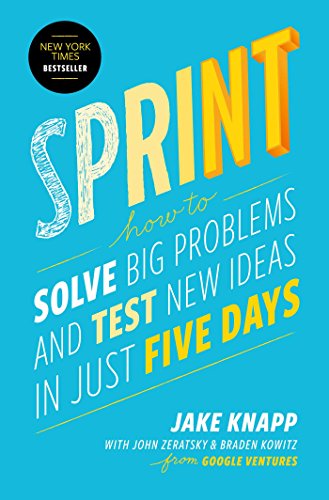
⚡️ What is Sprint about?
Sprint is a revolutionary approach to solving complex business problems and testing new ideas in just five days. As the inventor of this methodology, Jake Knapp, along with co-authors John Zeratsky and Braden Kowitz, presents a structured process that helps teams streamline their innovation efforts. The book teaches readers how to compress months of work into a single week through an intensive design sprint process that involves mapping out challenges, sketching solutions, making critical decisions, building prototypes, and testing with real customers.
🚀 The Book in 3 Sentences
- The Sprint method enables teams to solve complex challenges by compressing the innovation process into a structured 5-day framework.
- Through concrete exercises like expert interviews, sketching sessions, and prototype testing, teams can make faster, better decisions with less risk.
- By the end of the sprint, teams gain real insights from customer feedback, giving them clear direction on whether to proceed with their ideas or pivot.
🎨 Impressions
I found Sprint to be an eye-opening guide that brought structure to what often feels like chaos in the world of product development. The real strength lies in its practical applications—this isn’t just theory. The process is clearly detailed and battle-tested across numerous companies and industries. Reading Sprint made me rethink how I approach innovation, especially in fast-paced environments where mistakes are costly if discovered too late. Knapp’s no-nonsense style and actionable techniques make the book both inspiring and immediately useful.
📖 Who Should Read Sprint?
Ideally, Sprint is perfect for project managers, startup founders, product developers, UX designers, and anyone involved in innovation or strategic decision-making. It’s particularly suited for those in organizations that need to move fast, cut through bureaucracy, and validate their ideas quickly. Whether you’re launching a new product or improving an existing one, Sprint provides the framework you need to avoid wasting time and misaligned team efforts. The book isn’t just for large organizations—it works equally well for small teams looking to scale smartly.
☘️ How the Book Changed Me
How my life / behaviour / thoughts / ideas have changed as a result of reading the book.
- I now approach problems with a more systematic perspective, using Sprint strategies to fast-track solutions with less guesswork.
- My collaboration with teams has improved significantly after learning how to involve the right stakeholders at the right time during the process.
- I’ve started applying early prototyping techniques in my own projects to validate concepts before investing too much time or money.
✍️ My Top 3 Quotes
- “Great innovation is built on existing ideas, repurposed with vision.”
- “The sprint only works if you stick together until the end.”
- “A successful test is not the end of the process, but the beginning.”
📒 Summary + Notes
The Sprint process, invented by Jake Knapp at Google Ventures, was designed to answer critical business questions through rapid prototyping and real user feedback. This structured 5-day framework allows teams to make better decisions, reduce risk, and accelerate innovation. Sprint is not just about moving fast—it’s about moving with purpose.
Chapter 1: The History of the Sprint
The authors begin by retracing the evolution of sprints, highlighting how they were inspired by design thinking, Lean Startup principles, and agile development. They developed the sprint at Google, where decisions needed to be made quickly due to complex products and high stakes.
- Sprints initially stemmed from a need to make high-impact decisions rapidly.
- The method was shaped and refined over hundreds of sprints conducted with startups at Google Ventures.
- A sprint allows teams to compress months of decision-making into one intensive week of collaborative work.
Chapter 2: Why Sprints Work
In chapter 2, the authors explore the psychological and structural reasons why sprints are so effective. They argue that our default approach to innovation — long meetings, endless revisions, and decentralized decision-making — leads to weak outcomes. Sprints address these pitfalls by centralizing decision-making, focusing on action, and incorporating quick user feedback.
- Sprints remove ambiguity and provide a fixed time frame to resolve key challenges.
- The authors emphasize the importance of having a “Decider” who can make final calls to keep the process moving.
- The key stages (Monday to Friday) prevent teams from getting lost in ideation without validation.
Chapter 3: Monday—Start at the End
On Monday, the goal is to clearly define the problem and align the team on a shared vision. This begins with expert interviews, followed by mapping out the challenge and identifying where customers interact with the product. By starting from the long-term goal, teams are able to frame not just what they’re designing, but why.
- Monday opens with expert interviews to surface critical insights and avoid assumptions.
- The “Start at the End” method is critical for goal alignment and narrowing the problem space.
- Teams often use the “How Might We” technique to convert insights into actionable opportunities.
Chapter 4: Tuesday—Diverge and Converge
Tuesday’s focus is on idea generation and exploration. The team begins by conducting lightning demos to gather inspiration from existing solutions. Each team member sketches potential solutions using the four-step sketch method: notes, ideas, crazy 8s, and solution sketch. The goal is to generate diverse approaches before narrowing them down.
- Teams start with lightning demos to spark inspiration from similar solutions.
- The Four-Step Sketch Method helps all participants contribute individual ideas without groupthink.
- Crazy 8s are quick doodles that enhance creativity in the final solution sketch phase.
Chapter 5: Wednesday—Decide
Decision day shapes the prototype and roadmap. Team members silently critique solutions posted on a decision board, discussing pros and cons. The Decider reviews all options and makes the final decision using structured criteria. After the decision, the team creates a storyboard to guide prototype development.
- Silent critique is used to fairly evaluate all solutions without biased input.
- The Decider plays a key role in choosing the direction that best solves the problem.
- A storyboard is created to clarify the prototype’s function and flow, making it easier to build quickly.
Chapter 6: Thursday—Prototype
Thursday is all about speed and simplicity. The aim is not to build a complete or perfect product, but a realistic simulation that mimics the real experience. Each team member plays a specific role—like recruiter, asset collector, or builder—to make the most of limited time and resources. The prototype must be ready for user testing by end of day.
- Rapid prototyping is about building just enough to simulate the final concept.
- The team divides into focused roles (e.g., copywriter, asset finder) to maximize productivity.
- A prototype doesn’t need polished code—it needs user-relevant fidelity to deliver valuable insights.
Chapter 7: Friday—Test
Friday is where all the previous days of planning and building culminate. The team interviews five customers to test the prototype and gain qualitative insights. During these interviews, the focus is not on impressing users—it’s about asking the right questions and observing their reactions. These sessions are observed by the rest of the team behind a one-way mirror.
- User testing with real customers helps validate or dismantle assumptions about the product’s usability.
- The interviews are structured to gather behavioral responses rather than surface-level feedback.
- The team observes the sessions together to capture different perspectives and facilitate discussion.
Chapter 8: Debrief and Next Steps
After the sprint week is complete, the team reflects on what they’ve learned. This involves reviewing notes, filling out a sprint retrospective, and discussing actionable next steps. This stage helps solidify insights and ensures the momentum continues into the next phase of work.
- Post-sprint analysis helps teams extract lessons and apply them to future projects.
- The retrospective identifies what worked, what didn’t, and how to improve.
- Clear next steps prevent the sprint outcome from getting lost in process and confusion.
Chapter 9: Common Traps
In chapter 9, the authors discuss common mistakes that derail sprints and how to avoid them. From team conflicts to unclear goals, these sections offer guidance on how to stay on track even when things go off the rails. It’s a valuable section for anyone planning a sprint for the first time.
- Mistakes like skipping the Decider or not validating assumptions can ruin a sprint.
- Facing resistance or lack of time requires proactive adjustments early in the process.
- Overcomplicating the prototype can delay the testing phase and waste valuable insight cycles.
Key Takeaways
After reading Sprint, these are the most important takeaways to put into practice:
- A sprint is a 5-day process to solve big problems and validate ideas quickly.
- Mon-Fri structure includes mapping problems, sketching, decisions, prototyping, and user testing.
- Skills required include facilitating, sketching, constructing, and leading customer studies.
- Success hinges on stakeholder alignment, minimal viable prototype design, and real human feedback.
Conclusion
Sprint is more than a methodology—it’s a mindset shift in the way we innovate and make decisions. Whether you’re tackling a startup idea or revamping an existing product, this sprint approach will save time, reduce risk, and bring clarity to your team. I encourage you to dive into the full book to learn how to run your first sprint and see firsthand the power of answering big business questions in just five days.
More From Jake Knapp; John Zeratsky; Braden Kowitz →
Discover more from AI Book Summary
Subscribe to get the latest posts sent to your email.