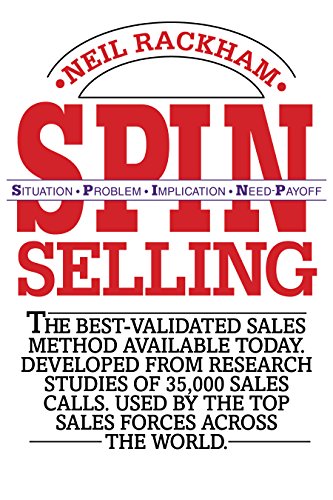
⚡️ What is SPIN Selling about?
SPIN Selling is a revolutionary sales methodology born from the largest-ever research project on sales effectiveness. Neil Rackham and his team analyzed over 35,000 sales calls to debunk traditional sales myths and uncover what truly drives success in large, complex sales. The book’s core premise is that classic closing techniques and aggressive pitches often backfire in high-stakes deals. Instead, Rackham introduces the SPIN Selling model, a structured, consultative approach built around four key types of questions: Situation, Problem, Implication, and Need-payoff. This framework is designed to guide sales conversations, helping buyers uncover the true depth of their problems and articulate the value of a solution for themselves. It’s about shifting from a persuasive seller to a insightful problem-solver, building trust and credibility to win major accounts.
🚀 The Book in 3 Sentences
- Traditional sales techniques, like high-pressure closing, are ineffective and often detrimental in large, complex sales cycles.
- Success in major sales comes from using a structured questioning model—SPIN Selling—to uncover and develop customer needs.
- The goal is not to push a product but to help customers understand the seriousness of their problems and the value of your solution, leading them to close the sale themselves.
🎨 Impressions
Reading SPIN Selling felt like a revelation. As someone familiar with the high-pressure world of sales, this book was a breath of fresh air, grounded in hard data rather than sales folklore. Rackham’s evidence-based approach immediately dismantles many of the “always-be-closing” clichés I’d encountered. What impressed me most was its focus on the customer’s psychology and the long-term value of building genuine relationships. The SPIN model isn’t a manipulative trick; it’s a sophisticated framework for having more meaningful and effective conversations. It fundamentally changed my perspective from “how can I sell this?” to “how can I help this person solve a significant problem?” This shift feels more ethical and, paradoxically, far more effective for substantial deals.
📖 Who Should Read SPIN Selling?
This book is essential reading for anyone involved in B2B sales, account management, or selling high-value products and services with long sales cycles. If you’re a sales professional, consultant, or business owner who struggles with complex deals involving multiple stakeholders, SPIN Selling is your playbook. It’s less relevant for simple, transactional sales but is invaluable for those who need to build trust, navigate corporate hierarchies, and sell solutions rather than just products. Anyone looking to move from a transactional to a consultative sales approach will find this book transformative.
☘️ How the Book Changed Me
\p>Applying the principles of SPIN Selling fundamentally reshaped my professional interactions. I moved from being a product-focused talker to a customer-focused listener, which dramatically improved my relationships and closing rates.- I stopped fearing objections and started focusing on preventing them by asking better SPIN Selling techniques early in the conversation.
- I learned to be comfortable with silence, giving clients space to think after I ask a deep Implication question, which often leads to powerful insights.
- I now prepare for calls by planning questions, not just a product pitch, which makes my conversations more targeted and valuable.
- I shifted my definition of a successful call from “getting a yes” to “uncovering an Explicit Need,” which makes every interaction a step forward.
- I’ve become more patient, understanding that in major sales, building the case for change is more important than pushing for an immediate decision.
✍️ My Top 3 Quotes
- “What works in small sales can hurt your success as the sales grow larger.”
- “In larger sales, Implied Needs don’t predict success, but Explicit Needs do.”
- “Objection prevention turns out to be a superior strategy to objection handling.”
📒 Summary + Notes
SPIN Selling is built on a foundation of meticulous research, challenging conventional wisdom at every turn. Rackham begins by differentiating between small, simple sales and large, complex sales, showing that the skills required are vastly different. The book’s central thesis is that success in major sales hinges on the seller’s ability to uncover and develop the buyer’s needs. This is achieved through a four-stage sales call model: Preliminaries, Investigating, Demonstrating Capability, and Obtaining Commitment. The Investigating stage is the most critical, and it’s where the SPIN questioning framework comes into play. The following chapter summaries will break down each component of this powerful model and its associated strategies.
Chapter 1: Sales Behavior and Sales Success
This chapter lays the groundwork for the entire book by explaining the extensive research behind its conclusions. Rackham’s team studied over 35,000 sales calls to identify what separates top performers in large sales. The key finding is that the behaviors leading to success in small sales (like closing techniques) are ineffective or even harmful in larger ones. He introduces the crucial distinction between small and major sales, noting that larger sales are characterized by longer cycles, multiple decision-makers, and a greater need for a consultative approach. The chapter also outlines the four stages of a sales call that will be explored in detail: Opening (Preliminaries), Investigating, Demonstrating Capability, and Obtaining Commitment.
- Traditional sales training is built on myths from small sales, not data from large ones.
- The most critical stage of a major sale is the Investigating stage, where needs are uncovered.
- Success in large sales is measured by building a strong business case, not just winning a single transaction.
- The research found a clear correlation between the use of certain questions and sales success.
Chapter 2: Obtaining Commitment: Closing the Sale
\Rackham directly attacks the sacred cow of traditional sales: the close. He presents compelling evidence showing that using classic closing techniques (e.g., the assumptive close, the alternative close) in major sales not only fails to increase success rates but can also increase customer dissatisfaction and lead to lost sales. The research found no correlation between the number of closing attempts and the success of a call. Instead of “closing,” Rackham reframes the final stage as “Obtaining Commitment.” In a major sale, this rarely means signing a contract on the first call. It means advancing the sale to the next logical step, such as a meeting with a higher-level decision-maker or a detailed product analysis. The goal is to get the customer’s agreement to move forward, building momentum and consensus.
- Closing techniques are negatively correlated with success in larger sales.
- High-pressure closing can make customers feel manipulated and damage the relationship.
- The most effective way to obtain commitment is to summarize the key points and check for agreement.
- Focus on a clear, realistic commitment that advances the sale, not on a final “yes.”
- Successful sellers in major calls don’t close; they build a case so strong the buyer convinces themselves.
Chapter 3: Customer Needs in the Major Sale
\This chapter delves into the psychology of buyer needs, a cornerstone of the SPIN Selling model. Rackham introduces a critical distinction: Implied Needs (statements of problems or difficulties, e.g., “Our current system is slow”) versus Explicit Needs (specific wants or desires, e.g., “We need a system that can process reports in under 10 minutes”). In small sales, either type of need can lead to a purchase. However, in major sales, only Explicit Needs are strong predictors of a successful outcome. The seller’s primary job is to help the buyer evolve their Implied Needs into powerful, action-oriented Explicit Needs. This chapter explains that needs develop in stages, from initial dissatisfaction to a clear desire for a solution, a process that skilled sellers can facilitate through strategic questioning.
- The definition of a “need” changes as the size of the sale increases.
- Implied Needs are the raw material; Explicit Needs are the drivers of action in major sales.
- Uncovering Implied Needs is easy; developing them into Explicit Needs is the key skill.
- The more Explicit Needs you can uncover, the higher the probability of sale success.
- Buyers must feel the need is their own; a seller cannot simply “give” them an Explicit Need.
Chapter 4: The SPIN Strategy
\p>Here, Rackham unveils the heart of the book: the SPIN questioning model. He breaks down the four types of questions that are most effective at developing Implied Needs into Explicit Needs. Situation Questions gather facts about the buyer’s current state. Problem Questions explore difficulties, dissatisfactions, or problems. Implication Questions are the most powerful and sophisticated; they ask about the consequences or effects of the problems, building up the seriousness of the situation. Finally, Need-payoff Questions focus on the value or usefulness of a proposed solution, encouraging the buyer to state the benefits themselves. Rackham provides evidence showing that successful sellers in large calls ask significantly more Problem and Implication questions than their less successful counterparts.- Situation Questions: Use sparingly, as too many can bore the buyer. Do your homework first.
- Problem Questions: Essential for uncovering Implied Needs in the early stages of a call.
- Implication Questions: The key to success in major sales. They build up the cost of the problem.
- Need-payoff Questions: Focus on the positive outcome and have the buyer state the benefits.
- The sequence is important: you generally move from S to P to I to N, though it’s not rigid.
Chapter 5: Giving Benefits in Major Sales
\This chapter refines the classic sales concepts of Features, Advantages, and Benefits. Rackham redefines them based on his research. A Feature is a fact about the product or service. An Advantage shows how a feature can help the customer, but it often addresses an Implied Need. A Benefit, in Rackham’s terminology, explicitly shows how a product or service meets an Explicit Need. The research is clear: in small sales, Features and Advantages work reasonably well. But in major sales, only Benefits have a strong positive impact. Advantages can even create objections because they give the buyer something to push back on. The lesson is to avoid prematurely touting features and advantages. Instead, use SPIN questions to develop Explicit Needs first, then show how your solution provides a direct Benefit.
- Success in major sales correlates strongly with the use of Benefits, not Features or Advantages.
- A true Benefit must be linked to an Explicit Need that the customer has stated.
- Prematurely showing Advantages can prevent you from developing the need further.
- The most powerful way to demonstrate capability is to let the buyer articulate the need-payoff.
- Top sellers talk about benefits ten times more often than average sellers in major sales.
Chapter 6: Preventing Objections
\p>Rackham challenges the traditional sales focus on “handling objections.” His research found that in major sales, top performers don’t get significantly more objections than average performers; they get fewer. The most effective strategy is not to have clever rebuttals, but to prevent objections from arising in the first place. How? By using the SPIN model effectively. Specifically, asking thorough Problem and Implication questions builds a strong business case. When the seller understands and has helped the buyer explore the full depth and cost of their problems, objections about price or features tend to dissolve. The buyer has already convinced themselves of the need. Objections, the book argues, are often a symptom of a seller who has moved to the solution phase too quickly, before the need was fully developed.- Objections are more a result of seller behavior than buyer resistance.
- The skill of objection prevention is far more valuable than the skill of objection handling.
- Price objections often signal that you haven’t successfully built the value of the solution.
- Strong Implication questions are the single best tool for preventing value-related objections.
- If you do get an objection, don’t defend; instead, go back to investigating the need behind it.
Chapter 7: Preliminaries: Opening the Call
\p>This chapter covers the first stage of the sales call: the opening. Rackham’s research found that the opening is much less critical to the success of a major sale than the Investigating stage. However, a poor opening can certainly derail a call. The key is to get down to business quickly. Traditional, slick opening techniques or building “rapport” by talking about the weather are ineffective with busy, sophisticated buyers. The best openings are focused on establishing your credibility as a problem-solver and getting to the purpose of the call. Rackham advises stating the reason for your call concisely and then transitioning to the Investigating stage. The goal of the opening is not to sell, but to set the stage for a productive, needs-focused conversation.- Avoid traditional, personality-based opening techniques in major sales.
- Get to the point quickly; buyers are busy and appreciate directness.
- Focus your opening on establishing your role as a consultant, not a vendor.
- The most successful openings are those that naturally lead into investigating needs.
- A good opening sets a contract for the call, agreeing on its agenda and purpose.
Chapter 8: Turning Theory into Practice
\p>In the final chapter, Rackham provides a practical guide for implementing the SPIN model. He emphasizes that SPIN is a skill, not just a set of techniques, and skills require practice and development. He outlines four rules for learning skills: practice one behavior at a time, try the new behavior in low-risk situations, get feedback, and focus on the planning process before each call. The chapter provides a framework for planning a sales call using the SPIN model, encouraging sellers to write down potential Situation, Problem, Implication, and Need-payoff questions before the meeting. The final message is one of empowerment: by systematically applying these research-backed SPIN Selling techniques, any salesperson can significantly improve their effectiveness in large sales and build more valuable, lasting customer relationships.- Learning SPIN requires a commitment to practice, not just reading about it.
- Start by focusing on mastering one type of question at a time, beginning with Problem questions.
- Planning your questions before a call is the single most effective way to improve performance.
- Don’t be afraid to try new behaviors; the biggest barrier is often psychological.
- The goal is to make the SPIN framework a natural part of your conversational style.
Key Takeaways
The lessons from SPIN Selling are profound and actionable, providing a clear roadmap for success in complex sales. The book’s power lies in its evidence-based approach, replacing guesswork with proven strategies. By internalizing these core principles, you can transform your sales process from one of persuasion to one of collaboration.
- Focus on Needs, Not Closing: The ultimate goal is to develop Explicit Needs so strong that the buyer closes the sale for you.
- Master the Four Question Types: The SPIN model (Situation, Problem, Implication, Need-payoff) is your primary tool for building value.
- Prevent Objections, Don’t Handle Them: Thoroughly investigate the problem’s implications, and objections will rarely surface.
- Sell Benefits, Not Features: Only talk about how your solution meets an Explicit Need the buyer has already stated.
- It’s a Skill, So Practice: Use a planning framework to write out your SPIN questions before each call and practice one behavior at a time.
Conclusion
SPIN Selling is more than a book; it’s a foundational text for modern, consultative sales. Its principles are timeless because they are rooted in a deep understanding of human psychology and decision-making in a business context. By shifting the focus from the seller’s agenda to the buyer’s needs, Rackham provides a more effective, ethical, and sustainable path to sales success. While this summary provides the core framework, the full book offers a wealth of examples, data, and nuanced advice that will deepen your understanding. If you are serious about excelling in major sales, mastering the SPIN Selling strategies within these pages is not just recommended—it’s essential. Pick up the book, start practicing the questions, and prepare to transform your career.
More From Neil Rackham →
Discover more from AI Book Summary
Subscribe to get the latest posts sent to your email.