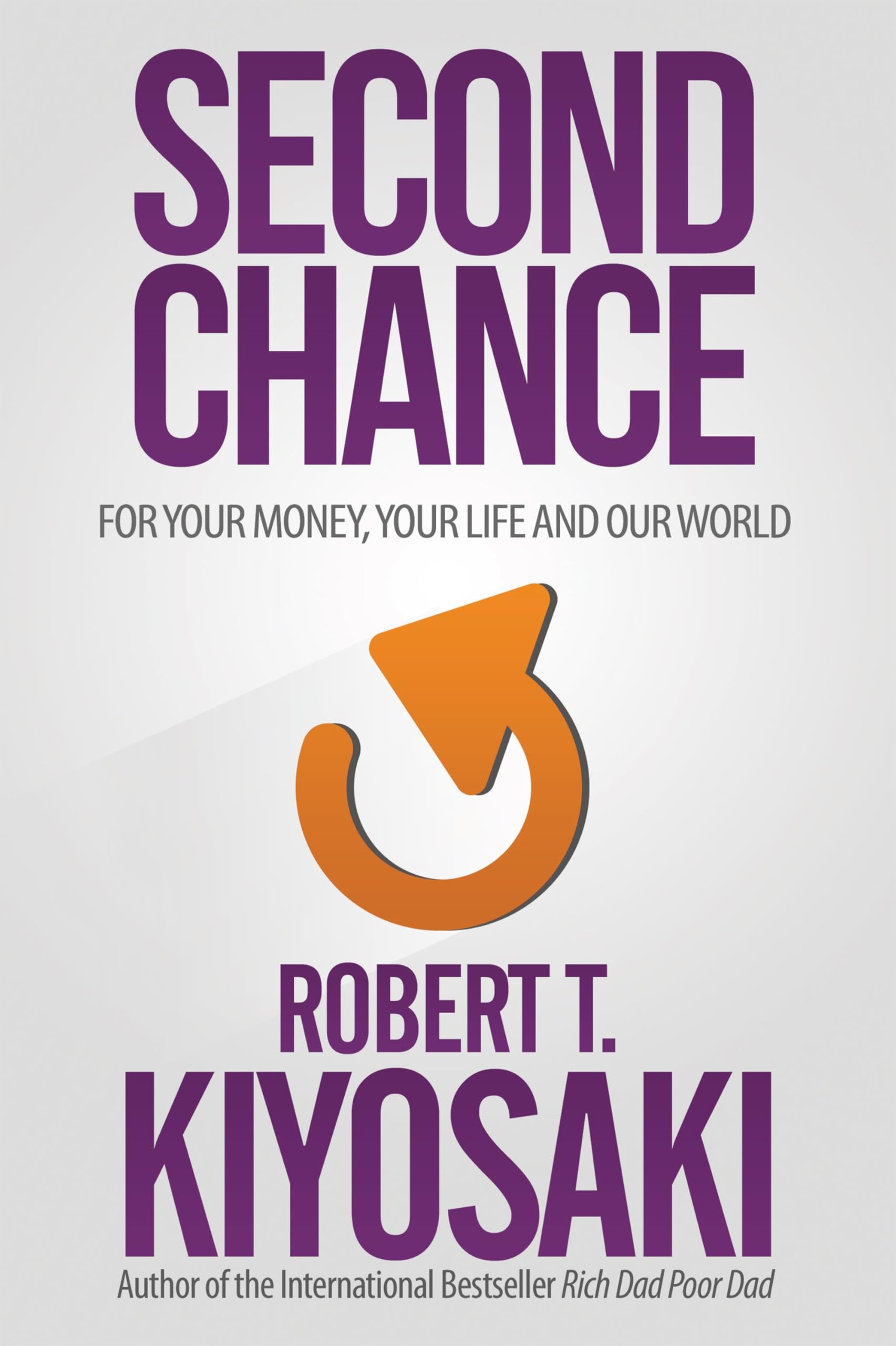
⚡️ What is Second Chance About?
I finished this book last week and I’ve been thinking about the “Invisible” world ever since. In the book, Robert Kiyosaki teams up with Tim Wheeler to deliver what feels like a frantic but necessary wake-up call for anyone relying on a 401(k) or a steady paycheck. The central thesis? The rules of money changed in 1971 when Nixon took us off the gold standard, and most people are still playing by the old rulebook. It’s a fascinating, if sometimes terrifying, look at why the middle class is being systematically wiped out.
You can find More summaries by Robert Kiyosaki; Tim Wheeler on our site, but this one feels different from his earlier work. While Rich Dad Poor Dad was an introduction, this is the advanced masterclass on survival. It’s part history lesson, part economic prophecy, and part tactical manual. If you’re tired of hearing that “saving money is smart,” you’re in the right place in these Finance book summaries.
🚀 The Book in 3 Sentences
- The global financial system is built on debt and “fake” money, which inherently devalues the labor of those who work for a paycheck.
- A “Second Chance” requires shifting your mindset from being an employee or self-employed to becoming a business owner or professional investor who uses debt as an asset.
- Financial literacy is the only true protection against the coming economic turbulence that the author argues has been brewing since 2008.
🎨 Impressions
I’ll be honest: Kiyosaki can be frustrating. He repeats his core stories—the Rich Dad, the flight to the gold mine, the Marine Corps days—almost to a fault. But I find myself dog-earing pages anyway because his fundamental logic about how currency works is hard to refute. There’s a moment early on where he explains that your house isn’t an asset because it takes money out of your pocket, and even though I’ve heard it before, the way he frames it against the 2008 crash in this book made it click in a new way.
The tone is punchy and urgent. It doesn’t feel like a stuffy finance textbook. It feels like a friend grabbing you by the shoulders and telling you to get out of the burning building. It’s cynical about the government and the school system, which I found refreshing, though I think he oversimplifies how easy it is for a regular person to start “seeing the invisible” financial opportunities he describes.
📖 Who Should Read Second Chance?
If you feel like you’re working harder but falling further behind, you need to read this. It’s perfect for the person who is skeptical of traditional financial advice and wants to understand the macro-forces moving the world. However, if you’re looking for a step-by-step guide on which stocks to buy tomorrow, you should probably skip this. It’s more about the “why” and the “how” of wealth rather than a list of ticker symbols.
☘️ How This Book Changed My Thinking
Before reading this, I viewed my savings account as my primary safety net. Now, I see it as a melting ice cube.
- I stopped focusing on “saving” and started focusing on “acquiring” cash-flowing assets.
- I realized that taxes are the biggest expense for the poor and middle class, and the rich actually get paid by the government to do what the government wants (provide housing, jobs, and energy).
- I’ve started looking at the news through the lens of currency devaluation rather than just market volatility.
✍️ 3 Quotes That Stuck With Me
- “The most dangerous advice you can give a child today is: ‘Go to school, get good grades, and look for a safe, secure job.'” — This hits hard because it challenges the very foundation of how most of us were raised.
- “Savers are losers because the money they are saving is no longer money; it is a currency that is designed to lose value.” — This is a brutal reminder that the system is designed to reward debtors, not savers.
- “If you want to be rich, you need to learn how to see what is invisible to most people.” — This sets the stage for the rest of the book’s focus on financial education over traditional schooling.
📒 Summary + Notes
the book is structured into three parts: The Past, The Present, and The Future. Kiyosaki uses the first part to explain how we got into this mess—specifically the 1971 removal of the gold standard and the 1913 creation of the Federal Reserve. He argues that these events effectively turned our money into debt. By the end of the book, he wants you to believe that the only way to survive is to stop acting like an employee and start acting like a professional investor.
The core narrative is that we are in a period of “Great Transition.” The Information Age has replaced the Industrial Age, yet our schools are still training people to be factory workers. He emphasizes that wealth isn’t found in the assets themselves, but in the information and education used to acquire and manage those assets. It’s a call to arms for individual responsibility in a world where the safety nets are fraying.
🧠 Core Ideas Explained Simply
Some of the concepts in the author’s case might seem complex, but they boil down to a few fundamental shifts.
The Difference Between Currency and Money
Most people use these terms interchangeably, but they shouldn’t. Money has intrinsic value and acts as a store of wealth (like gold), while currency is a medium of exchange that the government can print at will. When they print more, your purchasing power drops. Understanding this is the first step to protecting your future.
The Cashflow Quadrant (E, S, B, I)
Why do some people work less and earn more? It’s because they move from the left side of the quadrant (Employees and Self-employed) to the right side (Business owners and Investors). On the left, you trade time for money and pay the highest taxes. On the right, you use other people’s time and money to create wealth, often with massive tax breaks.
Financial Literacy as ‘Vision’
Kiyosaki argues that you don’t see money with your eyes; you see it with your mind. Financial literacy is the ability to read a financial statement and understand the story it’s telling. If you can’t read the numbers, you’re financially blind and vulnerable to every predatory bank and “expert” out there.
1: Why the Rich Don’t Work for Money
Have you ever wondered why the hardest-working people often have the least amount of wealth? Kiyosaki opens with a punch: the rich don’t work for money—they work for assets. He revisits his Rich Dad’s lessons, emphasizing that working for a paycheck is a trap designed to keep you paying taxes and interest to the people who own the assets. He argues that in a world of devaluing currency, your labor is a depreciating asset if you don’t convert it into something that produces cash flow.
2: Why Teachers Aren’t Rich
Imagine if our schools taught us how to use debt as a tool instead of just warning us to avoid it. This chapter is a scathing critique of the academic elite. Kiyosaki claims that most teachers are financially illiterate because they belong to the “Employee” quadrant and value job security over financial freedom. He suggests that the current education system is a relic of the Industrial Age, designed to produce compliant workers who don’t question the system. It’s a harsh take, but it forces you to look at where you get your advice.
3: The Story of Three Pigs
Remember the childhood story of the three little pigs? Kiyosaki uses it as an analogy for financial structures. Most people live in houses of straw (jobs) or sticks (small businesses), which can be blown down by an economic storm. The “brick house” represents a portfolio of assets that produces income regardless of the economy. He argues that we are currently in a storm, and if you haven’t built your financial house out of bricks (education and assets), you’re in trouble.
4: The Wisdom of Buckminster Fuller
I found this section to be the most philosophical part of the book. Kiyosaki credits futurist Buckminster Fuller for changing his worldview. Fuller’s concept of “Generalized Principles” suggests that the world has plenty of resources, but we lack the systems to distribute them efficiently. Kiyosaki uses this to argue that we live in an era of abundance for those who understand technology and systems, but an era of scarcity for those trapped in old ways of thinking.
5: Why the Poor Stay Poor
It’s a bold and controversial claim, but the author argues that poverty is a mindset passed down through generations. He suggests that the poor and middle class are “conditioned” to fear mistakes and avoid risk. Because they are terrified of being wrong, they never take the necessary steps to learn how money works. He also points out that the tax code is written specifically to benefit the people who create jobs and housing, leaving the poor to shoulder the tax burden.
6: What is a Crisis?
What if a crisis was actually a massive transfer of wealth that you could participate in? Kiyosaki reframes economic crashes as “sales” for the financially literate. He walks through the 2008 collapse and shows how he and his wife Kim actually got richer because they were prepared to buy assets while everyone else was panicking. He warns that another, larger crisis is inevitable and asks the reader: are you going to be the victim or the buyer?
7: What Does a Teacher Do?
Does a teacher give you fish, or teach you how to fish? Kiyosaki distinguishes between “fake” teachers—those who don’t practice what they preach—and “real” teachers who are actually in the trenches. He argues that most financial advisors are actually salespeople, not teachers. This chapter emphasizes the importance of finding mentors who have achieved the specific results you want, rather than just listening to someone with a degree or a certification.
8: The Future is Here
The Information Age isn’t coming; it’s already been here for decades, but our habits haven’t caught up. Kiyosaki points out that the internet has democratized wealth creation, but it has also made traditional jobs more vulnerable to automation and outsourcing. He argues that your “Second Chance” depends on your ability to leverage information—specifically financial information—to create value in a world that is moving faster than ever before.
9: A Second Chance
We’ve looked at the past and the present, so how do we actually pivot? This chapter is about the mindset shift required to take your second chance. It involves letting go of the need for a steady paycheck and embracing the uncertainty of the B and I quadrants. Kiyosaki stresses that this isn’t easy; it requires a complete re-education. He frames it as a choice between the “security” of a cage and the freedom of the wild.
10: Your Financial Education
What does real financial education look like? It’s not about learning how to balance a checkbook. It’s about understanding the five levels of an investor and the difference between capital gains and cash flow. Kiyosaki breaks down the technical skills you need: reading financial statements, understanding the tax code, and learning how to use debt to buy assets. He argues that these are the true “bricks” for your financial house.
11: How to See the Invisible
Think about a game of poker: if you can’t see the cards, you’re just gambling. Most people are gambling with their retirement because they can’t see the “cards” of the global economy. This chapter focuses on technical analysis and market trends. Kiyosaki explains that the “invisible” forces—like interest rates and debt-to-GDP ratios—are what actually drive the markets. Once you can see them, you stop being a victim of volatility.
12: Giving Back
Is wealth just about hoarding money? Surprisingly, Kiyosaki ends with the importance of contribution. He argues that the more people you serve, the richer you become. This isn’t just about charity; it’s about providing value to the marketplace through business and housing. He suggests that the ultimate purpose of your “Second Chance” is to become someone who can help solve the world’s problems rather than being one of the problems.
⚖️ A Critical Perspective
While the book is incredibly motivating, it’s not without its flaws. Kiyosaki tends to brush over the sheer difficulty and risk involved in his strategies—using debt to buy real estate isn’t a “magic pill,” and it can lead to ruin if the market turns or management fails. He also has a habit of sounding like a doomsday prepper, which can make some of his very valid economic points feel like conspiracy theories. Furthermore, he often assumes everyone has the temperament to be a business owner, which simply isn’t true; some people are better off as specialized employees who just need better investment habits.
🔄 How It Compares
Compared to Rich Dad Poor Dad, this book is much more aggressive and politically charged. While his first book was a gentle introduction to assets, this is a loud warning about the fragility of the global financial system. It’s less about “minding your own business” and more about “surviving the collapse.”
🔑 Key Takeaways
These are the core lessons for anyone looking to secure their financial future in 2025.
- Your job is your biggest liability because it’s the most taxed and least secure source of income in the Information Age.
- The government wants you to invest in housing, energy, and business—so they provide tax incentives that essentially pay you to do so.
- Stop saving “fake” money and start acquiring “real” assets like gold, silver, or cash-flowing real estate.
- True financial security comes from your ability to produce income regardless of the job market or the state of the economy.
💬 Frequently Asked Questions
What is the main argument of Second Chance?
The book argues that the middle class is being destroyed by a rigged financial system that devalues currency through debt and printing. To survive, individuals must seek a “Second Chance” by moving from being employees to becoming professional investors who understand how to use debt and taxes to their advantage.
Is Second Chance better than Rich Dad Poor Dad?
It’s different. While Rich Dad Poor Dad teaches the basics of assets vs. liabilities, Second Chance is a much deeper look at macroeconomics and history. It is more urgent and provides a broader context for why those basic lessons are more critical now than they were twenty years ago.
What does Kiyosaki say about the middle class in Second Chance?
He argues the middle class is a “dying species” because they are trapped in the Industrial Age mindset of job security and saving. Because they lack financial education, they are the most vulnerable to inflation, high taxes, and the erosion of purchasing power caused by government policy.
What is the “Second Chance” Kiyosaki refers to?
It is the opportunity for individuals to re-educate themselves and change their financial habits before the next major economic crisis. It refers to a personal turning point where you stop following traditional advice and start building a foundation of financial literacy and cash-flowing assets.
Does the book offer practical advice for 2025?
Yes, though it is more strategic than tactical. It encourages readers to focus on commodity-based assets (gold/silver), real estate that produces income, and building businesses. Its most practical advice is to stop trusting paper assets like stocks and bonds and start learning how to read financial statements.
Conclusion
At its heart, Second Chance is a book about vision. It challenges you to look past the surface of your bank balance and see the gears of the global economy for what they really are: a system that rewards the bold and the educated while punishing the passive and the obedient. It’s a wake-up call that arrives just as the ground beneath our feet feels more unstable than ever.
The one thing I want you to remember is that the “crisis” everyone fears is only a crisis for those who don’t understand it. For the rest, it’s the ultimate sale. Don’t wait for the world to change; change your own financial rulebook today. You can get more insights on building wealth and managing your life in our Finance book summaries category. The world won’t give you a second chance, but you can certainly take one for yourself.
More From Robert Kiyosaki; Tim Wheeler →
Discover more from AI Book Summary
Subscribe to get the latest posts sent to your email.