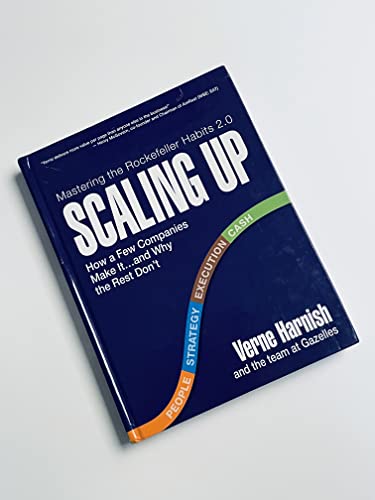
⚡️ What is Scaling Up about?
Scaling Up by Verne Harnish is the definitive guide for growing companies beyond the startup phase. The book provides a comprehensive framework for overcoming the three major obstacles that prevent businesses from scaling successfully: leadership challenges, scalable infrastructure deficits, and shifting market dynamics. Harnish presents practical tools and methodologies to help companies transition from small operations to significant growth engines, focusing on the critical foundations of People, Strategy, Execution, and Cash.
🚀 The Book in 3 Sentences
- Scaling Up requires mastering four foundational pillars: People, Strategy, Execution, and Cash to achieve sustainable business growth.
- Companies must overcome three core growth barriers: leadership development, infrastructure scalability, and adapting to changing market conditions.
- The 4D framework (Drivers, Demands, Disciplines, Decisions) provides a systematic approach to implementing Scaling Up strategies effectively.
🎨 Impressions
Scaling Up is an incredibly practical and comprehensive guide that transforms abstract growth concepts into actionable frameworks. Harnish’s experience with the Entrepreneurs’ Organization shines through in his deep understanding of real-world business challenges. The book balances theoretical insights with implementable tools, making it invaluable for leaders serious about systematic business expansion. What impressed me most was how the book addresses the human element of scaling while maintaining focus on operational excellence.
📖 Who Should Read Scaling Up?
Entrepreneurs and business leaders who have moved beyond the startup phase and are ready to scale their operations should read Scaling Up. The book is particularly valuable for CEOs, executives, and managers facing the complexities of growing organizations. It’s also essential reading for business owners experiencing the common growing pains of leadership gaps, process inefficiencies, and cash flow challenges. Anyone looking to implement systematic Scaling Up strategies in their organization will find this book indispensable.
☘️ How the Book Changed Me
How my life / behaviour / thoughts / ideas have changed as a result of reading the book.
- I now prioritize building systematic approaches to Scaling Up rather than reacting to growth challenges
- My understanding of the critical importance of cash flow management in business expansion has dramatically improved
- I’ve adopted the Rockefeller Habits framework for creating consistent execution routines in my work
- I place greater emphasis on hiring A-players and developing clear accountability structures
- My approach to strategic planning has become more structured and comprehensive
✍️ My Top 3 Quotes
- “If more than one person is accountable, then no one is accountable.”
- “The best companies know that one great person can replace three good ones.”
- “Cash is the oxygen that fuels growth.”
📒 Summary + Notes
Scaling Up provides a comprehensive roadmap for businesses ready to move beyond the startup phase and achieve significant growth. Harnish identifies the three primary obstacles that prevent companies from scaling successfully and presents the 4D framework to overcome them. The book emphasizes that sustainable growth requires mastering four foundational elements: People, Strategy, Execution, and Cash. Through detailed explanations and practical tools, readers learn how to systematize their approach to business expansion.
Chapter 1: The Hump
The first chapter introduces the concept of “The Hump” – the critical transition point where companies must shift from entrepreneurial chaos to systematic growth. Harnish explains that most businesses follow an S-curve growth pattern, and successfully navigating The Hump requires overcoming three primary obstacles. The chapter establishes the foundation for understanding why some companies scale while others stagnate or fail.
- The Hump represents the challenging transition from startup mode to scalable organization
- Most businesses fail to scale because they can’t overcome leadership, infrastructure, and market dynamics challenges
- Success requires systematic approaches rather than heroic efforts from the founder
Chapter 2: The 4D Framework
The 4D Framework serves as the core methodology for implementing Scaling Up strategies. Harnish breaks down the four components: Drivers (who), Demands (what), Disciplines (how), and Decisions (where to focus). This framework provides a systematic approach to addressing growth challenges while maintaining organizational coherence. The chapter emphasizes that successful scaling requires consistent application of these four dimensions.
- Drivers focus on leadership development and accountability throughout the organization
- Demands address the balance between people-centric and process-centric approaches
- Disciplines establish the routines and rhythms necessary for consistent execution
Chapter 3: People Foundation
The People Foundation chapter emphasizes the critical importance of having the right people in the right roles. Harnish introduces the concept that one A-player can replace three good employees, highlighting the exponential impact of talent quality. The chapter provides frameworks for hiring, developing, and managing top performers while establishing clear accountability structures. It also addresses the challenge of scaling leadership capabilities throughout the organization.
- Hiring A-players is the single most important factor in successful Scaling Up
- Clear accountability structures prevent confusion and ensure ownership
- Leaders must develop other leaders to create scalable organizational capacity
Chapter 4: Strategy Foundation
Strategy Foundation focuses on developing clear, executable strategic plans that differentiate companies in the marketplace. Harnish presents tools for articulating core values, defining unique competencies, and creating compelling market positions. The chapter emphasizes that successful scaling requires more than just good intentions – it needs systematic strategic thinking backed by concrete action plans. The One-Page Strategic Plan tool is introduced as a method for aligning entire organizations around shared strategic objectives.
- Clear strategy provides the foundation for all scaling decisions and investments
- The One-Page Strategic Plan tool helps communicate strategy across the entire organization
- Differentiation is essential for sustainable competitive advantage as companies grow
Chapter 5: Execution Foundation
The Execution Foundation chapter introduces the Rockefeller Habits as the essential routines that drive consistent business performance. Harnish explains that perfect execution of a mediocre strategy beats mediocre execution of a perfect strategy. The chapter provides frameworks for establishing priorities, gathering data systematically, and creating meeting rhythms that drive accountability. It emphasizes that execution excellence becomes scalable when it’s systematized into organizational routines.
- The Rockefeller Habits provide the 3 essential routines for consistent execution: priorities, data, meeting rhythm
- Perfect execution of a mediocre strategy outperforms mediocre execution of a perfect strategy
- Systematic data collection and analysis enable better decision-making at all levels
Chapter 6: Cash Foundation
Cash Foundation addresses one of the most critical yet often overlooked aspects of Scaling Up – cash flow management. Harnish emphasizes that cash is the oxygen that fuels growth, and businesses often fail not because they’re unprofitable but because they run out of cash. The chapter introduces financial levers that entrepreneurs can pull to accelerate cash flow and profitability. It also provides frameworks for understanding the relationship between growth, profit, and cash generation.
- Cash flow management is more critical than profit management during scaling phases
- Seven key financial levers can accelerate cash generation and business growth
- Growth typically burns cash, so companies must proactively manage liquidity
Chapter 7: The Four Decisions
The Four Decisions chapter integrates the foundational elements into a cohesive framework for strategic decision-making. Harnish presents four critical questions that leadership teams must answer consistently: What’s our market? How will we win in that market? What organizational capabilities are required? What is our financial plan? These decisions provide the strategic coherence necessary for successful scaling and help align all organizational efforts toward common objectives.
- The Four Decisions provide a framework for aligning strategy, people, execution, and cash management
- Consistent answers to these questions create organizational clarity and focus
- Regular review of these decisions ensures adaptation to changing market conditions
Chapter 8: Real-World Scaling
Real-World Scaling provides practical case studies and examples of companies that have successfully implemented Scaling Up strategies. Harnish shares stories of organizations that navigated the growth challenges effectively and those that failed to make the transition. The chapter offers insights into common pitfalls and successful patterns that emerge when companies commit to systematic scaling approaches. It emphasizes that successful scaling is a multi-year journey requiring persistence and continuous learning.
- Successful Scaling Up typically takes 3-5 years of consistent implementation
- Common failure patterns include neglecting people development and cash management
- Companies that scale successfully maintain focus on fundamentals while adapting to growth
Key Takeaways
These fundamental insights form the core of successful Scaling Up implementation and provide a roadmap for sustainable business growth.
- Master the four foundations (People, Strategy, Execution, Cash) to create scalable organizational capacity
- Implement the 4D framework to systematically address leadership, market, and infrastructure challenges
- Prioritize cash flow management as the lifeblood of scaling operations
- Establish the Rockefeller Habits for consistent execution and organizational alignment
- Develop A-player talent systematically to multiply organizational impact
Conclusion
Scaling Up offers a comprehensive and practical roadmap for businesses ready to transition from startup survival to systematic growth. Verne Harnish’s framework provides leaders with the tools and methodologies necessary to overcome the common obstacles that prevent companies from achieving significant expansion. The book’s emphasis on the four foundational elements, combined with the 4D framework, creates a systematic approach to sustainable business development. For any leader serious about implementing Scaling Up strategies, this book serves as both a guide and a reference for the multi-year journey ahead. The real value lies not just in reading the concepts, but in the disciplined implementation of these principles over time.
More From Verne Harnish →
Discover more from AI Book Summary
Subscribe to get the latest posts sent to your email.