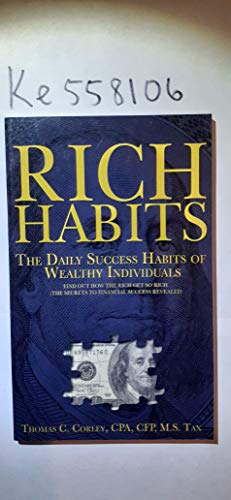
⚡️ What is Rich Habits About?
Have you ever wondered if the gap between your bank account and a millionaire’s isn’t about intelligence or luck, but just a series of small, boring choices? That’s the exact premise Thomas C. Corley explores in his breakthrough book. After spending five years studying the daily lives of 233 wealthy people and 128 people living in poverty, Corley realized that wealth is a byproduct of specific behaviors he calls “Rich Habits.” It’s not a book about picking stocks or flipping real estate; it’s a book about personal architecture. You can find more summaries by Thomas C. Corley on our site, but this one is the foundation of his entire philosophy.
Corley writes from the perspective of a financial professional who’s seen behind the curtain of high-net-worth individuals. He argues that most of us are sleepwalking through “poverty habits” that act like an invisible tax on our potential. By using a relatable parable and a checklist of ten core habits, he shows how anyone can pivot their financial trajectory. If you’re looking for more finance book summaries, you’ll notice many focus on the ‘how-to’ of money, but Corley focuses on the ‘who-you-become’ of money.
🚀 The Book in 3 Sentences
- Wealth is the direct result of daily rituals that accumulate over years, creating a “compound interest” effect on your character and opportunities.
- The biggest differentiator between the rich and the poor isn’t their starting capital, but their commitment to self-improvement, health, and relationship building.
- Financial success requires a shift from passive living to active “habit tracking,” where you consciously replace destructive routines with productive ones.
🎨 Impressions
I’ve read a lot of finance books that feel like they were written by robots or spreadsheet-obsessed hedge fund managers. Rich Habits is different. It’s punchy, almost deceptively simple. When I first cracked it open, I thought, “Wait, is he really telling me that successful people just wake up early and read?” But as you keep reading, the cumulative weight of his research starts to hit you. It’s not about one single habit; it’s about the ecosystem of discipline you build around yourself.
Honestly, some of the prose feels a bit like a 1990s business seminar, but I don’t care about the polish—I care about the data. Corley’s stats on how much time the wealthy spend watching TV versus reading for self-improvement were a gut-punch for me. It made me realize how much time I was leaking into low-value activities. It’s a convicting read that doesn’t let you off the hook with excuses about the economy or “the system.”
📖 Who Should Read Rich Habits?
If you feel like you’re working hard but spinning your wheels, this is your manual. It’s perfect for young professionals who want to build a foundation before they get bogged down by mid-life obligations. However, if you’re looking for technical advice on asset allocation, tax strategy, or complex investing, you should probably skip this. This book is for the person who needs to fix their mindset and daily schedule before they worry about their portfolio.
☘️ How This Book Changed My Thinking
Before reading this, I viewed wealth as something that happens *to* people—usually through a lucky break or a high-paying job. After Corley’s breakdown, I started seeing my day as a series of micro-investments.
- I stopped viewing “networking” as a chore and started seeing it as “relationship networking,” focusing on how I can help others daily.
- I replaced thirty minutes of evening scrolling with thirty minutes of non-fiction reading, realizing that the wealthy are almost all obsessive self-educators.
- I began tracking my daily habits on a simple checklist, which made my failures (and successes) impossible to ignore.
✍️ 3 Quotes That Stuck With Me
- “Successful people are slaves to their good habits.” — This reframes discipline not as a lack of freedom, but as a path to a better master.
- “You cannot be a success if you are a loner.” — A blunt reminder that your net worth is tied to the quality of your community.
- “The rich are not just lucky; they create their own luck through persistent action.” — I love how this strips away the mysticism of ‘good fortune’ and replaces it with work. ol>
- Your habits are your destiny; you must audit them with a written checklist to see where you are bleeding time.
- The “30-Minute Rule” for reading and exercise is the most common denominator among self-made millionaires.
- Relationship networking isn’t about collecting cards; it’s about being the person who remembers birthdays and adds value to others first.
- Success is a marathon of moderation, not a sprint of intensity; consistency beats occasional brilliance every single time.
📒 Summary + Notes
The book starts with the story of J.C. Jobs, a struggling insurance salesman who is essentially the poster child for bad habits. He’s broke, stressed, and unhealthy. Through a mentor, he discovers the secret isn’t a new sales technique, but a total overhaul of his daily life. This narrative structure makes the ten habits feel less like a lecture and more like a roadmap for a total life transformation. Corley wants you to believe that the difference between a life of lack and a life of abundance is about 30 minutes of focused effort and a series of disciplined ‘nos’.
Corley’s core thesis is that habits are the cause, and wealth is the effect. He breaks these habits into categories: health, relationships, goals, and mindset. By the end of the book, he argues that anyone can achieve financial independence if they are willing to adopt the “Rich Habits” checklist for at least thirty days. It’s a call to take radical responsibility for your time. Do you own your day, or does your day own you?
1: The Story of J.C. Jobs
What if your professional failure was actually a lifestyle problem? J.C. Jobs is a man on the brink of losing everything, and his journey serves as the framing device for the entire book. He represents the “average” person who works hard but lacks the structure to actually move the needle. Through his eyes, we see that the “secrets” of the wealthy aren’t complex financial maneuvers, but simple disciplines that J.C. had been ignoring his whole life.
2: Habit 1 – Good Daily Habits
Successful people realize that their habits are either the fuel or the anchor of their lives. Corley insists that the first step is creating a daily habit checklist. You literally write down “Good Habits” in one column and “Bad Habits” in another. Why? Because you can’t fix what you haven’t measured. The goal is to ensure that at least 80% of your day is governed by the good habits column. Are you reacting to life, or are you executing a plan?
3: Habit 2 – Daily Goals
Imagine trying to sail a ship without a compass; that’s how most people approach their careers. Wealthy individuals don’t just have “vague wishes”; they have daily, monthly, and yearly goals. Corley notes that 67% of the wealthy write their goals down, compared to only 6% of the poor. It’s about being goal-oriented rather than task-oriented. It isn’t enough to be busy; you have to be busy with the things that actually matter for your long-term vision.
4: Habit 3 – Self-Improvement
I’ve always found it fascinating that the busiest people on earth seem to have the most time for reading. Habit 3 is about devoting at least thirty minutes a day to self-education. Corley’s research found that 88% of wealthy people read for self-improvement for 30 minutes or more every day. They aren’t reading fiction for entertainment; they are reading biographies, self-help, or professional journals. They are effectively “leveling up” their brain while everyone else is watching reality TV.
5: Habit 4 – Health
You can’t build an empire from a hospital bed. Corley makes a direct connection between physical fitness and financial fitness. This means 30 minutes of aerobic exercise daily and eating healthy food. It’s not just about longevity; it’s about the energy and mental clarity required to perform at a high level. Did you know that 76% of wealthy people do aerobic exercise four days a week? It turns out that a healthy heart is a prerequisite for a healthy bank account.
6: Habit 5 – Relationships
Think about the last time you called a friend just to say “Happy Birthday” or offer a word of encouragement. Wealthy people view relationships as assets that need to be nurtured. They make “Hello” calls, “Happy Birthday” calls, and “Life Event” calls. They are proactive about building a network of success-minded people. As Corley says, you are the average of the five people you spend the most time with. If your inner circle is stagnant, you’ll likely stay stagnant too.
7: Habit 6 – Moderation
“Live each day as if it were your last” is terrible financial advice. Instead, the wealthy live in a state of moderation. They avoid the “boom and bust” cycles of emotional spending or extreme behavior. This applies to food, alcohol, and work. By staying on an even keel, they avoid the costly mistakes that come from impulsivity. They are the tortoises in a world of hares, and we all know who wins that race in the end.
8: Habit 7 – Completing Tasks
Do you have a pile of half-finished projects sitting on your desk? Habit 7 is the “Do It Now” habit. Successful people have a bias toward action. They don’t procrastinate on the important stuff. Corley suggests that whenever you feel the urge to put something off, you should repeat the phrase “Do It Now” to yourself until you start. This builds the muscle of completion, ensuring that your goals don’t just stay on paper but actually manifest in reality.
9: Habit 8 – Rich Thinking
Your bank account is a lagging indicator of your internal dialogue. Wealthy people use positive self-talk and visualization. They believe they are responsible for their own success. This is a sharp contrast to the “poverty mindset,” which blames the government, the boss, or bad luck for their situation. If you tell yourself you’ll never be rich, you’ve already won that argument. Why would your brain look for opportunities that you’ve already decided don’t exist?
10: Habit 9 – Saving
It’s not about how much you make; it’s about how much you keep. Wealthy people pay themselves first. Corley advocates for the 80/20 rule: live on 80% of your income and save/invest the other 20%. This seems basic, but it’s the habit that 95% of people fail to implement. Saving isn’t about deprivation; it’s about buying your future freedom. Every dollar saved is a “freedom soldier” that works for you while you sleep.
11: Habit 10 – Controlling Thoughts and Emotions
There’s a moment early on in your career where an angry email or a bad meeting can ruin your whole week. Wealthy people don’t have that luxury. They practice emotional mastery. They don’t let their emotions dictate their actions. By staying calm and logical, they make better decisions under pressure. They understand that losing your temper usually means losing your leverage. Have you ever noticed that the person with the most control in the room is usually the one who talks the least?
⚖️ A Critical Perspective
While the book’s advice is undeniably practical, it does suffer from a bit of survivorship bias. Corley assumes that because rich people do X, doing X will make you rich. However, it ignores systemic economic factors and the fact that many “rich habits” (like aerobic exercise or eating high-quality food) are easier to maintain once you already have money and time. Additionally, the J.C. Jobs parable can feel a bit simplistic for a modern audience used to more nuanced storytelling. That said, the core message of personal agency remains incredibly powerful despite these minor flaws.
🔄 How It Compares
If you compare this to The Millionaire Next Door, Corley is much more focused on the *micro-behaviors* of the daily schedule rather than just the macro-financial habits of saving and spending. While both books emphasize frugality, Rich Habits provides a more granular checklist for your actual 24-hour day. It’s less of a sociological study and more of a practical field guide for personal discipline.
🔑 Key Takeaways
These lessons are designed to turn your life into a factory for success by automating the boring stuff.
💬 Frequently Asked Questions
What is the main argument of Rich Habits?
The main argument is that wealth is not a matter of luck but a result of “Rich Habits”—daily behaviors that build wealth over time. Corley argues that by adopting ten specific habits, anyone can move from a life of financial struggle to one of abundance and success.
How many people did Thomas C. Corley study for his book?
Corley conducted a five-year study observing the daily activities of 233 wealthy individuals and 128 people living in poverty. This extensive research provided the statistical foundation for his claims about how reading, exercise, and goal-setting directly correlate with higher net worth and professional success.
Is Rich Habits worth reading if I already have a financial plan?
Yes, because it focuses on the behavioral side of money rather than the technical. While your financial plan tells you where to put your money, this book shows you how to manage your time and energy so you can earn more and stay disciplined enough to follow that plan.
What is the most important habit in the book?
Habit 1—creating a daily habit checklist—is arguably the most critical because it provides the structure for all others. Without measuring your daily actions, you cannot consciously improve them. It transforms vague intentions into a binary system of “success” or “failure” for each day.
Can these habits really make you rich if you start with nothing?
Corley argues they can, provided you are persistent. While they won’t make you a millionaire overnight, these habits are designed to expand your opportunities, improve your health, and build a high-value network, which are the fundamental building blocks for long-term wealth creation from any starting point.
Conclusion
At its heart, Rich Habits is a book about the power of the incremental. It’s a reminder that while we can’t always control the economy or our bosses, we have absolute control over what we do in the first and last hours of our day. It strips away the glamour of the “overnight success” and replaces it with the grit of the daily checklist. If you take one thing away from this, let it be that your future is currently being written by your current routines.
I genuinely believe that if you pick just two of Corley’s habits—the 30 minutes of reading and the daily goal setting—you will be in a completely different financial position a year from now. This isn’t just about money; it’s about the dignity of self-mastery. Rich Habits isn’t just a book you read; it’s a book you do. Go out and start your checklist today. Your future self is already thanking you for it, and you’ll find it’s one of the best finance book summaries you’ve ever put into action.
More From Thomas C. Corley →
Discover more from AI Book Summary
Subscribe to get the latest posts sent to your email.