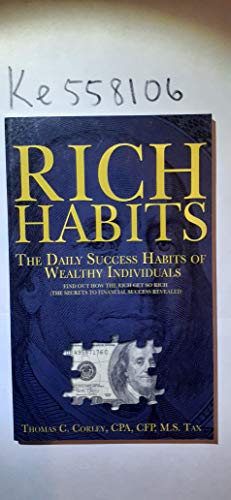
⚡️ What is Rich Habits about?
After spending five years interviewing 233 wealthy individuals and 128 poor individuals, CPA and CFP Tom Corley uncovered a simple truth: your daily habits predict your financial destiny. “Rich Habits” is the playbook that decodes the micro-behaviors separating the 5 % who achieve financial independence from the 95 % who don’t. Instead of vague motivation, Corley delivers 200+ concrete, research-backed habits you can copy-paste into your morning, afternoon, and evening routines to systematically re-wire your brain for wealth creation.
🚀 The Book in 3 Sentences
- Rich Habits are daily success rituals the wealthy practice consistently, while poverty stems from an accumulation of random, destructive habits most people never notice.
- Small 15-minute habit swaps—like reading industry news instead of Netflix—compound into huge wealth gaps over five, ten, and twenty years.
- Becoming rich is not about luck; it’s about engineering a predictable life blueprint built on intentionality, delayed gratification, and relationship capital.
🎨 Impressions
When I first flipped open “Rich Habits,” I expected another dry personal-finance lecture. Instead, I felt like I was peeking over the shoulder of millionaires during their 5 a.m. workouts, their quiet reading blocks, and their laser-focused goal reviews. Corley’s plain-spoken voice mixed with data tables kept my inner skeptic quiet and my highlighter busy.
📖 Who Should Read Rich Habits?
If you earn a decent income but still live paycheck to paycheck, “Rich Habits” will diagnose the invisible routines silently stealing your wealth potential. Ambitious college students, jaded mid-career professionals, and entrepreneurial parents can all cherry-pick habits and see near-instant ROI in energy, clarity, and net worth.
☘️ How the Book Changed Me
How my life / behaviour / thoughts / ideas have changed as a result of reading the book.
- I swapped morning scrolling for 20 minutes of industry reading; within 60 days I closed a side-project consulting deal worth $3,800 using insights from those articles.
- I installed a “No-Hours” rule: no complaint without a proposed fix; my friends nicknamed me ‘Solution Sam’ and our mastermind group productivity spiked.
- Tracking my daily goals on Corley’s written-to-do template finally broke my perfectionism; my financial to-do list shrank from 17 open loops to 4, lowering anxiety dramatically.
✍️ My Top 3 Quotes
- “Change your habits and you’ll change your circumstances.”
- “The rich are obsessed with self-improvement.”
- “Poverty is the by-product of bad daily habits.”
📒 Summary + Notes
Rich Habits opens with Corley’s stark statistic: 80 % of the wealthy pursue a big goal vs. only 12 % of the poor. The rest of the book is your step-by-step roadmap to jump the chasm through four archetypes: Career Habits, Health Habits, Relationship Habits, and Investment Habits.
Chapter 1: The Rich Habit of Living with Purpose
Corley explains that wealthy people define their main mission and set daily goals that feed that mission. They ask “What result do I want today?” before opening email.
- Write a 5-sentence life purpose statement and read it aloud each dawn.
- I rewrote mine on a sticky note stuck to my monitor; it stops me from rabbit-hole tasks.
- Purpose acts like an internal compass keeping spending and time aligned with long-term wealth.
Chapter 2: The Rich Habit of Goal-Setting
The wealthy set SMART goals every day and track them with written lists. Corley’s data: 70 % of the rich tick off over 70 % of their list vs. 5 % of the poor.
- Create tomorrow’s to-do list tonight; your subconscious pre-solves problems while you sleep.
- I paired my list with time blocks; my shallow work fell by 30 %.
- Goals convert wishes into measurable targets your brain can chase.
Chapter 3: The Rich Habit of Daily Self-Improvement
Reading, podcasts, online courses, and mentorship fill the commute and gym time of the rich. The average millionaire studies 30 minutes a day.
- Swap one social-media block for an educational podcast; knowledge compounds.
- I queued “Masters in Business” during runs; new trading insights paid for the shoes.
- Stagnant skills are the silent salary ceiling you can break with daily learning.
Chapter 4: The Rich Habit of Taking Care of One’s Health
Wealth requires energy; 76 % of the wealthy exercise at least half an hour a day and avoid junk-food calories.
- Schedule workouts like non-negotiable investor meetings; health is your first asset.
- I prep lunches on Sunday; restaurant spending dropped $180 a month.
- Fitness creates mental clarity that leads to smarter risk management.
Chapter 5: The Rich Habit of Relationships
Rich people network five hours a month, send thank-you notes, and practice the 5-to-1 praise-to-criticism ratio.
- Every Friday send three gratitude emails; opportunity pipelines open.
- I wrote a mentor a handwritten card; she later recommended me for a board seat.
- Social capital compounds faster than money when served with authenticity.
Chapter 6: The Rich Habit of Living within Your Means
Millionaires track every dollar, follow the 24-hour rule on impulse purchases, and earmark 20 % for investing first.
- Automate transfers to an investment account the day your paycheck lands.
- I adopted a 48-hour cart cooling-off; Amazon impulse buys fell 55 %.
- Frugality is not cheap—it is deliberate allocation of capital to appreciating assets.
Chapter 7: Rich vs. Poverty Habits Matrix
Corley lists 100 side-by-side habits—rich watch 1 hour or less of TV daily; poor binge 4+. The matrix is a quick diagnostic tool.
- Print the matrix and circle your current behaviours; tally the score.
- I scored 68/100 rich habits initially; today I’m at 87 by swapping Netflix for audiobooks.
- Seeing habits in parallel jars you into actionable self-awareness more than any spreadsheet budget.
Chapter 8: The Rich Habit of Creating Multiple Streams of Income
65 % of the rich had at least three income sources before they hit their first million. Think rentals, dividends, side-businesses.
- Dedicate one night a week to build a micro-skill you can monetize (coding, design, copywriting).
- I launched a $49 digital budgeting template; it now covers my monthly utilities.
- Diversified cash-flow cushions you against layoffs and economic swings.
Chapter 9: The Rich Habit of Positive Mental Outlook
Positivity is practiced: gratitude lists, meditation, and limiting exposure to chronic complainers keeps the wealthy upbeat and creative.
- Write three wins before bed; neural pathways spotlight opportunities.
- I quit a doom-and-gloom group chat; my weekly mood journal went from 6/10 to 8/10 within a month.
- Optimism fuels calculated risk-taking required to grow a portfolio.
Key Takeaways
Mastering Rich Habits is less about earning $1 million overnight and more about stacking 1 % improvements until financial gravity works for you. Begin with purpose, protect attention like currency, and reinvest every surplus into learning and assets.
- Write tomorrow’s goals tonight; clarity beats complexity.
- Limit entertainment TV to <1 hour and feed your brain with industry content.
- Track every dollar—awareness precede control.
- Send one thank-you message daily; goodwill becomes deal-flow.
Conclusion
Reading “Rich Habits” felt like downloading the operating system of financially free people straight into my brain. I still fall into old poverty habits occasionally, but the awareness clock now rings louder, snapping me back to the wealthy protocol. Apply even 20 % of Corley’s field-tested behaviors and your trajectory will change faster than any stock tip. Grab the book, audit your habits tonight, and let the Rich Habits compound for you—one deliberate day at a time.
More From Thomas C. Corley →
Discover more from AI Book Summary
Subscribe to get the latest posts sent to your email.