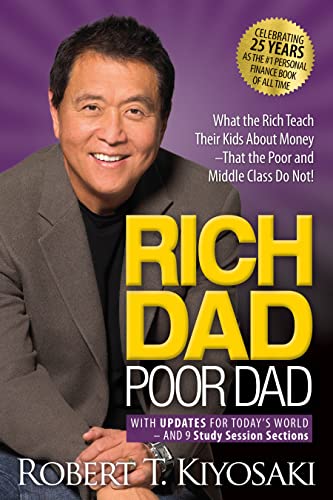
⚡️ What is Rich Dad Poor Dad about?
Rich Dad Poor Dad is a groundbreaking personal finance book that challenges conventional wisdom about money and wealth building. Robert Kiyosaki shares the contrasting financial philosophies he learned from his biological father (the poor dad) and his best friend’s father (the rich dad). Through these two perspectives, the book reveals how the wealthy think differently about money, investing, and building assets versus liabilities. The core message emphasizes that financial education is crucial for achieving true wealth and financial independence.
🚀 The Book in 3 Sentences
- Rich Dad Poor Dad teaches that financial literacy and understanding the difference between assets and liabilities is fundamental to building lasting wealth.
- The book emphasizes that the rich invest in assets that generate income, while the poor and middle class often accumulate liabilities they mistake for assets.
- Kiyosaki advocates for developing financial intelligence through education, taking calculated risks, and focusing on making money work for you rather than working for money.
🎨 Impressions
Rich Dad Poor Dad completely transformed my perspective on personal finance and wealth building. The book’s straightforward approach to explaining complex financial concepts makes it accessible to readers at all levels. Kiyosaki’s insights about the mindset differences between wealthy and middle-class individuals opened my eyes to fundamental flaws in traditional financial thinking, particularly regarding Rich Dad Poor Dad strategies.
📖 Who Should Read Rich Dad Poor Dad?
Rich Dad Poor Dad is essential reading for anyone seeking to improve their financial literacy and break free from the cycle of living paycheck to paycheck. The book is particularly valuable for young adults entering the workforce, individuals struggling with debt, and those interested in developing wealth-building strategies. Anyone looking to understand Rich Dad Poor Dad techniques and fundamentally change their relationship with money should read this transformative book.
☘️ How the Book Changed Me
How my life / behaviour / thoughts / ideas have changed as a result of reading the book.
- I began viewing money as a tool for building wealth rather than just covering expenses, implementing core Rich Dad Poor Dad strategies
- I started focusing on acquiring income-generating assets instead of accumulating liabilities disguised as assets
- I prioritized financial education and invested time in learning about investing techniques and opportunities
- I developed a mindset that seeks opportunities rather than dwelling on limitations and fears
✍️ My Top 3 Quotes
- “The rich don’t work for money. Money works for them.”
- “It’s not how much money you make, but how much money you keep, and how hard that money works for you.”
- “The most important skill in today’s fast-changing world is the ability to learn and adapt quickly.”
📒 Summary + Notes
Rich Dad Poor Dad is a transformative book that revolutionizes how we think about money, wealth, and financial independence. The book’s core Rich Dad Poor Dad strategies center around understanding that true wealth comes from financial education, asset accumulation, and making money work for you rather than the other way around.
Rich Dad Poor Dad Chapter 1: The Rich Don’t Work for Money
This foundational chapter introduces the core philosophy that separates the wealthy from the poor and middle class. Kiyosaki explains that most people work for money out of fear and greed, trapped in what he calls the “rat race.” The chapter explores how emotions drive financial decisions and why breaking free from this cycle is essential for wealth building.
- The rat race is driven by fear of not having money and greed for more money
- Most people learn to work for money instead of learning how to make money work for them
- True education involves developing financial intelligence and understanding money’s behavior
Rich Dad Poor Dad Chapter 2: Why Teach Financial Literacy?
This chapter emphasizes the critical importance of financial education, which is typically missing from traditional schooling. Kiyosaki argues that understanding basic financial concepts like assets and liabilities is more valuable than academic knowledge alone. The chapter stresses that financial literacy is the foundation for making intelligent money decisions.
- Most schools focus on academic subjects but neglect financial education
- Understanding cash flow and the difference between assets and liabilities is crucial
- Financial literacy empowers individuals to make informed decisions about money and investments
Rich Dad Poor Dad Chapter 3: Work to Learn—Don’t Work for Money
Kiyosaki challenges readers to view work as a learning opportunity rather than just a source of income. This chapter focuses on the importance of acquiring skills that increase financial intelligence, such as sales, marketing, and management. The author emphasizes that these skills are more valuable than academic degrees for building wealth.
- Choose employment based on learning opportunities rather than salary alone
- Focus on developing transferable skills that enhance financial intelligence
- Academic knowledge is important, but practical financial skills are essential for wealth building
Rich Dad Poor Dad Chapter 4: Mind Your Own Business
This chapter introduces the concept of building your own business and asset portfolio rather than working solely for others. Kiyosaki explains that true financial independence comes from owning income-generating assets. The chapter defines what constitutes real assets and provides guidance on building an asset column that produces passive income.
- Distinguish between your profession (working for others) and your business (building assets)
- Real assets include businesses that run without you, stocks, bonds, real estate, and intellectual property
- Focus on building assets that generate income even when you’re not actively working
Rich Dad Poor Dad Chapter 5: The History of Taxes and the Power of Corporations
Chapter 5 delves into the tax system and how corporations offer significant advantages to their owners. Kiyosaki explains how the wealthy use legal structures to minimize their tax burden and protect their assets. The chapter emphasizes the importance of understanding corporate structures as part of overall financial strategy.
- Corporations can provide tax advantages and legal protection that individuals don’t have
- The wealthy use corporations to shield assets and reduce taxable income
- Understanding the tax code and legal structures is part of financial intelligence
Rich Dad Poor Dad Chapter 6: The Rich Invent Money
The final chapter focuses on the entrepreneurial mindset and how the wealthy create opportunities rather than waiting for them. Kiyosaki emphasizes the importance of creativity, innovation, and taking calculated risks. The chapter encourages readers to develop their ability to see opportunities where others see problems or obstacles.
- Wealthy individuals focus on creating value and generating multiple income streams
- Financial intelligence involves understanding how money works and how to make it multiply
- Successful investing requires both technical knowledge and emotional courage to take action
Key Takeaways
The book delivers several powerful lessons about financial independence and wealth building that fundamentally change how readers approach money management.
- Rich Dad Poor Dad strategies emphasize that financial education is more important than academic education for building wealth
- The fundamental principle of distinguishing between assets (that put money in your pocket) and liabilities (that take money out)
- Building wealth requires developing financial intelligence through continuous learning and practical experience
- Successful wealth building involves taking calculated risks and viewing failures as learning opportunities
- Creating multiple income streams through asset accumulation is essential for true financial independence
Conclusion
Rich Dad Poor Dad remains one of the most influential personal finance books ever written, fundamentally changing how millions of readers approach money and wealth building. The book’s core message that financial education is more important than traditional academic knowledge has inspired countless individuals to pursue financial independence through asset accumulation and investment strategies. By implementing the Rich Dad Poor Dad techniques outlined in this summary, readers can begin their journey toward true financial freedom and make money work for them rather than the other way around. The principles taught in Rich Dad Poor Dad continue to be relevant today, making this book essential reading for anyone serious about building lasting wealth.
More From Robert Kiyosaki; Sharon Lechter →