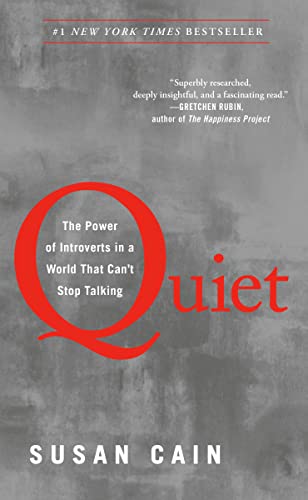
⚡️ What is Quiet about?
Quiet by Susan Cain is a groundbreaking book that champions the undervalued power of introverts in a world that is overwhelmingly biased towards extroversion. It meticulously deconstructs what Cain calls the “Extrovert Ideal”—the cultural bias that favors bold, assertive, and sociable personalities. Through a compelling blend of research, neuroscience, and real-life stories, Cain argues that introversion is not a flaw but a unique and valuable temperament. The book explores how introverts think, work, and lead differently, and why their quiet strengths—like deep thinking, creativity, and careful observation—are crucial for innovation and leadership. It’s a powerful call to action for introverts to embrace their nature and for society to recognize and harness the immense potential that lies in quiet.
🚀 The Book in 3 Sentences
- Society has a powerful bias towards extroversion, often causing introverts to feel undervalued and out of place.
- Introversion is a biological temperament with inherent strengths, such as deep thought, creativity, and heightened sensitivity, which are essential for a balanced world.
- By understanding and applying specific Quiet strategies, both introverts and extroverts can create more productive, creative, and harmonious environments.
🎨 Impressions
Reading Quiet was a profoundly validating experience. As someone who often needs solitude to recharge, Susan Cain’s work felt like a long-overdue permission slip to be myself. The book is a masterful blend of compelling storytelling and rigorous scientific research, making complex psychological concepts accessible and relatable. What impressed me most was how Cain reframes traits often seen as liabilities—like preferring quiet environments or thinking before speaking—as powerful assets. It’s not an attack on extroverts but a beautiful case for balance. The book’s impact lies in its ability to shift your perspective, helping you appreciate the subtle but profound power that introverts bring to the table in every aspect of life, from business to personal relationships.
📖 Who Should Read Quiet?
This book is a must-read for anyone who has ever felt like they don’t quite fit into the loud, fast-paced rhythm of modern life. Introverts will find it empowering and full of validation, while extroverts will gain invaluable insight into their quieter friends, family members, and colleagues. Managers, educators, and parents should absolutely read it to learn how to create environments where both personality types can thrive. If you’re interested in psychology, personal development, or simply understanding human behavior on a deeper level, Quiet offers a wealth of knowledge that will change how you see yourself and others.
☘️ How the Book Changed Me
\p>Reading Quiet fundamentally shifted my self-perception and how I manage my energy. I used to feel guilty for declining social invitations or needing time alone after a busy week. Now, I see this not as a weakness, but as a necessary part of my biological wiring. The book gave me the language and confidence to advocate for my needs without apology. I’ve started to proactively schedule “restorative niches” into my day, which has dramatically improved my focus and well-being.- I now structure my workday to include long, uninterrupted blocks of solo time for deep work, knowing this is when I do my best thinking.
- I’ve learned to communicate my needs more clearly to my extroverted partner, explaining that my need for quiet isn’t a rejection of them.
- I’ve stopped trying to force myself to be the life of the party, instead embracing my role as a thoughtful listener and observer in social settings.
✍️ My Top 3 Quotes
- “There’s zero correlation between being the best talker and having the best ideas.”
- “Solitude matters, and for some people, it’s the air they breathe.”
- “Love is essential, gregariousness is optional.”
📒 Summary + Notes
Susan Cain’s Quiet is a comprehensive exploration of introversion, arguing for its immense value in a world that can’t stop talking. The book is structured to first identify the problem—the cultural Extrovert Ideal—then dive into the science of temperament, and finally offer practical Quiet techniques for navigating work, relationships, and life. Cain uses a rich tapestry of psychological research, from studies on high-reactive infants to the neuroscience of dopamine pathways, to build a rock-solid case for the biological basis of introversion. She then masterfully applies this research to real-world scenarios, debunking myths about creativity, leadership, and collaboration along the way. The ultimate message is one of empowerment: by understanding our own temperaments, we can design lives that honor our natural dispositions and allow us to contribute our best selves to the world.
Chapter 1: The Rise of the “Extrovert Ideal”
Cain begins by tracing the historical shift in American culture from a “Culture of Character” to a “Culture of Personality.” In the past, inner virtue and moral integrity were prized. However, with the rise of industrialization and urbanization, a new ideal emerged: the magnetic, outgoing, and charismatic extrovert. Cain points to figures like Dale Carnegie and the self-help movement as key drivers of this change. This new Extrovert Ideal, she argues, now dominates our schools, workplaces, and social lives, leaving introverts feeling like they need to change who they are to succeed.
- The shift from character to personality made public perception more important than private virtue.
- Tony Robbins-style seminars are a modern embodiment of the Extrovert Ideal.
- This cultural bias explains why introverts are often overlooked for leadership roles, even when they are more competent.
Chapter 2: The Myth of Charismatic Leadership
This chapter dismantles the common belief that the most effective leaders are charismatic and assertive. Cain cites a study by Harvard Business School professor Francesca Gino, which found that introverted leaders often deliver better outcomes than extroverts, especially when managing proactive employees. The reason? Introverted leaders are more likely to listen to and implement the good ideas of their team members. In contrast, extroverted leaders can get so caught up in their own vision that they drown out the contributions of others. The chapter challenges the perception that talkers are smarter, a bias Cain calls “the babble effect.”
- Extroverted leaders can feel threatened by proactive subordinates, while introverted leaders empower them.
- The perception of competence is often tied to assertiveness, not actual ability.
- Quiet leaders excel at fostering a culture of collaboration and innovation by stepping back and letting others shine.
Chapter 3: When Collaboration Kills Creativity
Cain takes on the modern obsession with teamwork, open-plan offices, and constant brainstorming sessions. She argues that while collaboration has its place, the most innovative ideas are often born in solitude. The chapter highlights the work of psychologist Anders Ericsson on “deliberate practice,” which requires intense, uninterrupted focus. Cain points to Steve Wozniak, who designed the first Apple computer by himself, as a prime example of introverted genius. She suggests that the forced, artificial nature of many group brainstorming sessions can stifle creativity by creating pressure for conformity and making it hard for introverts to think deeply.
- Open-plan offices are a disaster for introverted focus and productivity.
- True creativity requires a state of “flow,” which is best achieved alone.
- The “New Groupthink” undervalues the work of the individual mind, which is where most breakthrough ideas originate.
Chapter 4: Is Temperament Destiny?: Nature, Nurture, and the Orchid Hypothesis
This chapter delves into the science behind introversion and extroversion. Cain introduces the work of psychologist Jerome Kagan, who studied infants and found that “high-reactive” babies—those who were sensitive to new stimuli—were more likely to grow into introverted adults. “Low-reactive” babies tended to become extroverts. This suggests a strong biological basis for temperament. Cain also explains the role of brain chemistry, particularly the differences in how introverts’ and extroverts’ brains respond to the neurotransmitter dopamine. The chapter introduces the “Orchid Hypothesis,” which suggests that introverts, like delicate orchids, are highly sensitive to their environment and can wilt in bad conditions but flourish spectacularly in good ones.
- High-reactive infants have a more sensitive amygdala, leading to a heightened response to stimulation.
- Introverts are more sensitive to dopamine than extroverts, meaning they need less of it to feel happy.
- The Orchid Hypothesis reframes high sensitivity not as a vulnerability, but as a potential for exceptional success in the right environment.
Chapter 5: Beyond Temperament
While temperament has a strong biological basis, this chapter argues that we are not completely slaves to it. Cain introduces the “Free Trait Theory,” which suggests that we can act out of character in the service of our “core personal projects”—things that are deeply meaningful to us. The key is to find “restorative niches”—places or times where we can return to our true selves to recharge. The chapter also discusses the personality trait of “self-monitoring.” High self-monitors are social chameleons who can easily adapt their behavior to fit any social situation, a skill that can be learned and practiced.
- Core personal projects give us the motivation to stretch our personalities, even if it feels uncomfortable.
- Restorative niches are essential for introverts who have to spend time in extroverted environments.
- You can identify your core projects by asking yourself what you loved as a child, what you gravitate towards now, and what makes you jealous.
Chapter 6: Franklin Was a Politician, But Eleanor Spoke Truth to Power
This chapter challenges the stereotype that leaders must be bold and charismatic. Cain uses historical examples like Eleanor Roosevelt, Mahatma Gandhi, and Rosa Parks to illustrate the power of quiet leadership. These introverted leaders led not with booming voices, but with quiet conviction, deep preparation, and a focus on their cause. They were masters of “soft power”—the ability to influence and inspire through their character and ideas rather than through dominance. Cain argues that introverted leaders are often more thoughtful, less impulsive, and better at empowering their teams.
- Introverted leaders often lead with principle rather than personality.
- Eleanor Roosevelt prepared meticulously for her press conferences, turning her perceived weakness (shyness) into a strength (thoroughness).
- Quiet leaders excel at one-on-one interactions and building deep, trusting relationships.
Chapter 7: Why Did Wall Street Crash and Warren Buffett Prosper?
Cain applies the lens of personality to the world of high finance. She argues that the 2008 financial crisis was, in part, a failure of the Extrovert Ideal. The risk-loving, overly confident, and charismatic leaders on Wall Street took reckless gambles, ignoring warning signs. In contrast, introverted investors like Warren Buffett thrive because they are cautious, deliberate, and comfortable with going against the crowd. They do deep research and trust their own analysis, rather than getting swept up in market euphoria. This chapter highlights the introvert’s advantage in high-stakes environments where careful risk assessment is more valuable than bold action.
- Buffett’s famous mantra, “Be fearful when others are greedy, and greedy when others are fearful,” is a classic introvert’s approach.
- Extroverts’ reward systems are more sensitive to dopamine, making them more prone to risk-taking.
- The financial world’s bias for bold, confident action can lead to disastrous groupthink and the ignoring of dissenting, quieter voices.
Chapter 8: Soft Power: Asian-Americans and the Extrovert Ideal
This chapter explores the cultural dimension of introversion. Cain notes that many Asian cultures, particularly in East Asia, value quietude, humility, and harmony more than the assertive individualism prized in the West. This can create a “bamboo ceiling” for Asian-Americans in corporate America, where their quiet nature is often misinterpreted as a lack of leadership potential. Cain explains the concept of “relationship honoring,” where being reserved and deferential is a sign of respect. The chapter highlights the painful clash between these cultural values and the Western Extrovert Ideal, showing how it can lead to misunderstanding and missed opportunities.
- In many Asian cultures, speaking up in class or at work can be seen as arrogant, not confident.
- The “bamboo ceiling” is a real barrier for many qualified Asian-American professionals who are passed over for leadership roles.
- Cultural differences in communication styles can lead to significant misunderstandings in multicultural workplaces.
Chapter 9: When Should You Act More Extroverted Than You Really Are?
Offering practical advice, this chapter explores when and how introverts should stretch themselves to act more extroverted. The key, reiterating the Free Trait Theory, is to do it only for things you genuinely care about—your core personal projects. Cain provides a framework for figuring out when to make the effort. She suggests asking yourself three questions: What did you love to do as a child? What kind of work do you gravitate towards now? What makes you feel envious? The answers can reveal your deepest motivations. The chapter emphasizes that even when you do act out of character, you must plan for restorative niches to avoid burnout.
- Acting out of character is a trade-off; you gain something you value but lose a bit of your authenticity.
- The most successful “pseudo-extroverts” are those who are very clear about why they are doing it.
- Simple compromises, like agreeing to go to a party but only for an hour, can help introverts navigate social obligations.
Chapter 10: The Communication Gap
This chapter focuses on the communication challenges that can arise between introverts and extroverts, particularly in romantic relationships. Cain explains that extroverts often think out loud, using conversation as a tool to process their thoughts. Introverts, on the other hand, need to think before they speak. This fundamental difference can lead to misunderstandings, with extroverts feeling that introverts are withholding and introverts feeling that extroverts are dominating the conversation. The chapter offers practical advice for bridging this gap, such as extroverts learning to pause and give introverts space to think, and introverts learning to share their internal thought process more explicitly.
- Extroverts process externally, while introverts process internally, which can feel like a conversational mismatch.
- Cain uses the example of a couple where the extroverted husband talks through problems and the introverted wife needs quiet time to think before she can respond.
- Understanding these differences is the first step to more empathetic and effective communication in any relationship.
Chapter 11: On Cobblestones and the Inner Kingdom
In the final chapter, Cain brings it all together with a message of self-acceptance and empowerment. She encourages readers to embark on a journey to their “inner kingdom”—to explore and understand their own unique temperament. The chapter offers advice for parents on how to raise introverted children, advocating for supporting their interests and not pushing them into too many social activities. For adults, the message is to find work and a lifestyle that aligns with their natural disposition. It’s a powerful conclusion that urges introverts to stop trying to be someone they’re not and to recognize the immense value of their quiet nature. The path to happiness, Cain argues, is not to fix yourself, but to honor yourself.
- Parents should act as “gentle nannies” to their children’s personalities, providing support without pushing them too hard.
- Finding a “sweet spot”—a job that uses your strengths but doesn’t demand too much acting—is key to career satisfaction.
- The ultimate goal is to live a life that is authentic to your core self, free from the pressure to conform to the Extrovert Ideal.
Key Takeaways
Quiet is packed with transformative insights, but a few lessons stand out as particularly life-changing. First, introversion is a biological superpower, not a personality flaw, linked to deeper thought and creativity. Second, solitude is not loneliness; it is the essential ingredient for focus, innovation, and mastery. Third, the world needs a balance of temperaments—introverts and extroverts complement each other and create stronger teams together. Fourth, you can strategically act outside your comfort zone, but only for things you truly care about, and you must schedule time to recharge. Finally, understanding your own temperament is the first step to designing a life that is both successful and authentic.
- Embrace your introversion as a source of strength, not a weakness to be overcome.
- Prioritize solitude for deep work and creative thinking.
- Use Quiet strategies like “restorative niches” to manage your energy and avoid burnout.
Conclusion
Susan Cain’s Quiet is more than just a book; it’s a cultural movement that has given a voice to the silent half of the population. It masterfully dismantles the myths surrounding introversion and replaces them with scientific evidence and empowering stories. The book provides not just understanding, but also practical Quiet techniques for navigating a world that often feels too loud. Whether you’re an introvert seeking validation, an extrovert seeking understanding, or a leader seeking to build a more effective team, this book offers invaluable wisdom. It’s a powerful reminder that in a world that can’t stop talking, the quietest people often have the most important things to say. Reading Quiet is the first step toward a more balanced, compassionate, and effective world.
More From Susan Cain →
Discover more from AI Book Summary
Subscribe to get the latest posts sent to your email.