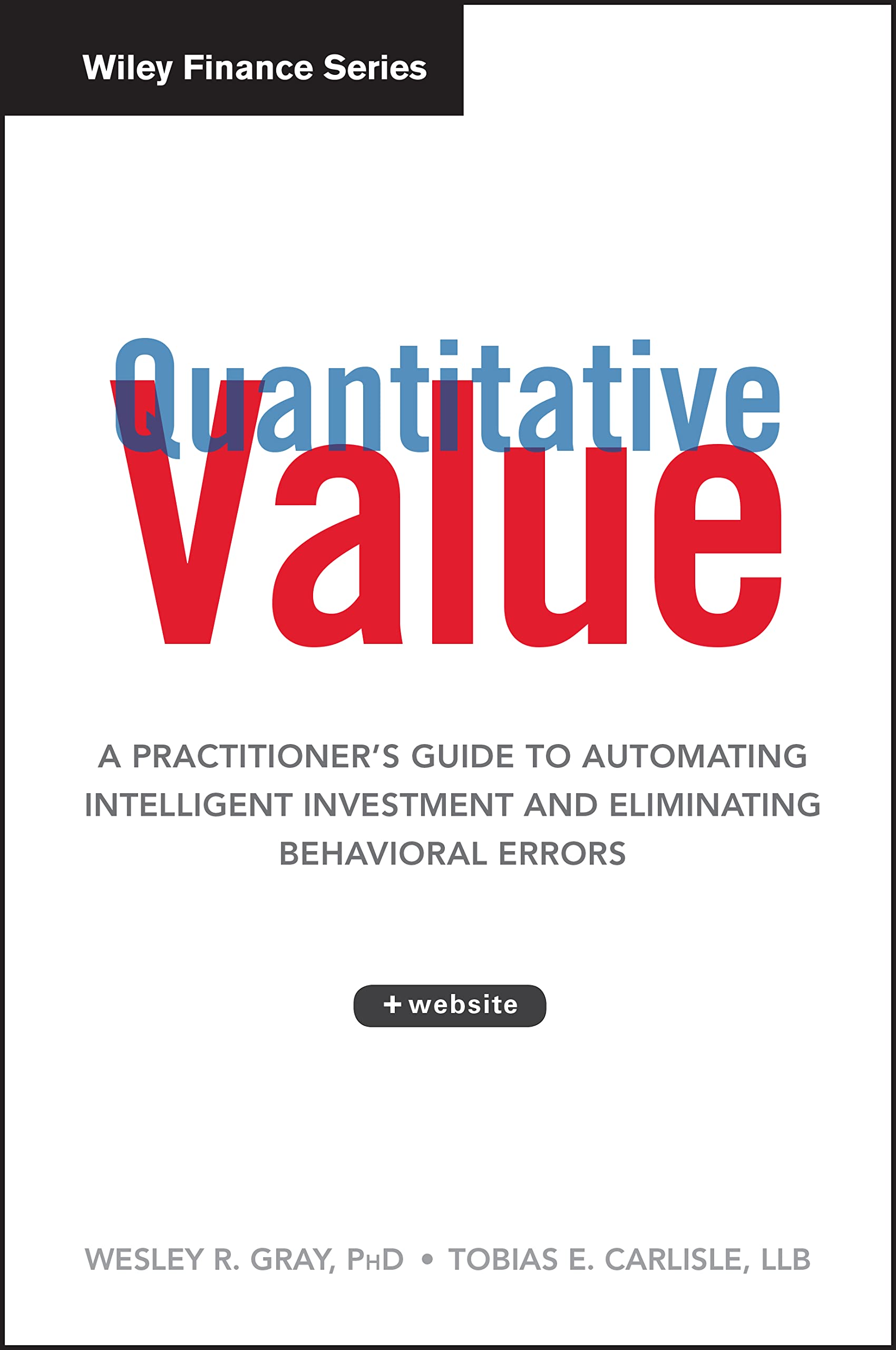
⚡️ What is Quantitative Value About?
Why do smart people consistently make such terrible decisions with their money? That’s the question that kept me glued to this book. Wesley R. Gray and Tobias E. Carlisle argue that our brains are essentially hard-wired to fail in the stock market. We’re prone to FOMO, we panic-sell at the bottom, and we’re suckers for a good story even when the math doesn’t add up. The authors propose a radical solution: stop being a “stock picker” and start being a system builder. This is a rigorous guide to building a quantitative model that finds deep value stocks while aggressively filtering out the frauds and the failures.
The central thesis of the book is that systematic value investing — essentially a more robust, bulletproof version of Joel Greenblatt’s “Magic Formula” — can systematically outperform the market over the long term. It’s not about finding the next Tesla; it’s about finding the unloved, boring, and mispriced stocks that the rest of the market has ignored. If you’re tired of the noise on CNBC and want a clinical, evidence-based approach to your portfolio, you’re in the right place. This is easily one of the most practical investing book summaries for those who want to move beyond basic index funds without losing their shirts.
🚀 The Book in 3 Sentences
- The authors present a comprehensive checklist for automating the value investing process, focusing on identifying cheap, high-quality companies while avoiding “the loser’s game” of frauds and financial distress.
- By using objective metrics like the EBIT/TEV ratio and the Piotroski F-Score, investors can eliminate the behavioral biases—like loss aversion and overconfidence—that typically kill individual returns.
- The ultimate goal is to create a “Quantitative Value” model that systematically buys mispriced assets and holds them until the market recognizes their true worth, all without human intervention.
🎨 Impressions
I’ll be honest: this book isn’t a light beach read. It’s dense, academic in parts, and doesn’t pull any punches when it comes to backtesting and data. But that’s exactly why I loved it. Most investing books are full of vague platitudes like “buy low, sell high,” but Gray and Carlisle give you the actual blueprints. They don’t just say “avoid bad stocks”; they give you the Beneish M-Score and explain exactly how it caught Enron before the collapse. It’s incredibly satisfying to see the “voodoo” of stock picking dismantled and replaced with a cold, hard algorithm.
What surprised me most was how much time they spent on *not* losing money. Usually, we’re all obsessed with the upside, right? But the authors spend the first third of the book teaching you how to stay away from the “garbage.” They argue that most investors fail because they step on landmines—frauds, bankruptcies, and earnings manipulators. Once you’ve cleared the field of those, the “value” part of the equation actually has room to work. It’s a defensive mindset that leads to offensive gains, and it’s a perspective I haven’t seen articulated this clearly anywhere else.
📖 Who Should Read Quantitative Value?
If you’re a DIY investor who’s tired of emotional decision-making, this is your Bible. It’s perfect for the person who likes spreadsheets, understands basic financial statements, and wants a repeatable process. However, if you’re looking for “get rich quick” schemes or high-frequency trading tips, you’ll be disappointed. This is for the patient, long-term investor who can handle periods of underperformance in exchange for a massive edge over decades. If you don’t know what an income statement is, you might want to start with something simpler before tackling this one.
☘️ How This Book Changed My Thinking
Before reading this, I thought “value” was just about a low P/E ratio. I’d look for cheap stocks and hope for the best. Now, I realize that “cheap” is often a trap unless you have a rigorous way to filter for quality and safety. The biggest shift for me was moving from an “intuitive” approach to a “rule-based” one.
- I stopped looking at P/E ratios and started obsessing over EBIT/TEV (Enterprise Value) as a more accurate measure of what a business is actually worth to an owner.
- I realized that “Human Discretion” is usually just a fancy word for “Bias”—I now trust my rules more than my “gut feeling” about a company’s CEO or product.
- I’ve become hyper-vigilant about earnings manipulation; if a company’s M-Score is high, I don’t care how cheap it looks, I’m out.
✍️ 3 Quotes That Stuck With Me
- “The goal of a quantitative value investor is to be a disciplined, dispassionate buyer of what others are selling in a panic.” — This sums up the entire psychological edge of the strategy.
- “Simple models beat experts because experts are distracted by the ‘broken leg’—they focus on details that don’t actually matter.” — A great reminder that complexity is often the enemy of performance.
- “You don’t need to be a genius to beat the market; you just need to be more disciplined than the average investor.” — This is incredibly empowering for those of us who aren’t math PhDs.
📒 Summary + Notes
The book’s narrative arc follows a logical progression: first, it explains why humans are bad at investing, then it shows how to identify the “worst” stocks to avoid, then it teaches how to find the “best” value stocks, and finally, it shows how to put it all together into a system. It’s a journey from psychological chaos to mathematical order. The authors make a compelling case that even “simple” quantitative models outperform the vast majority of active fund managers because the model doesn’t get scared, greedy, or bored. It just executes.
One of the most important sections involves the “Magic Formula” by Joel Greenblatt. While they respect Greenblatt’s work, Gray and Carlisle show through extensive backtesting that it can be significantly improved. They argue that Greenblatt’s “Quality” metric (Return on Capital) is okay, but using the Piotroski F-Score—a 9-point checklist for financial health—is much more effective at identifying companies that are actually turning a corner. By the end of the book, they’ve built a comprehensive “Quantitative Value” model that is demonstrably more robust than its predecessors.
🧠 Core Ideas Explained Simply
Quantitative Value relies on a few heavy-hitting concepts that might sound intimidating but are actually quite intuitive once you break them down.
The Acquirer’s Multiple (EBIT/TEV)
Imagine you’re buying a whole business, not just a share of stock. You wouldn’t just look at the price; you’d look at how much debt you’re taking on and how much cash is in the bank. That’s Total Enterprise Value (TEV). Then you’d look at the Operating Income (EBIT). The ratio of these two tells you exactly how much “yield” you’re getting for every dollar spent. It’s the ultimate “no-nonsense” way to see if a stock is truly cheap compared to its peers.
The Piotroski F-Score
Can a simple 1-to-9 score really tell you if a company is healthy? Apparently, yes. Developed by a Stanford professor, this score looks at things like: Is net income positive? Is cash flow higher than net income? Is the company’s debt decreasing? It’s a blunt instrument, but it’s incredibly effective at filtering out “value traps”—companies that look cheap but are actually circling the drain. It turns “quality” from a vague vibe into a measurable number.
The Beneish M-Score
What if you could predict a corporate scandal before it hit the front page of the Wall Street Journal? The M-Score is a mathematical model that uses eight financial ratios to detect when a company is “massaging” its earnings. It looks for red flags like a sudden spike in accounts receivable or unusual changes in depreciation. It’s the “lie detector test” of the investing world, and it’s a core pillar of the authors’ “don’t lose money” philosophy.
1: The Value of a Quantitative Process
Why do we keep making the same dumb mistakes in the market? Gray and Carlisle open by explaining that the biggest threat to your portfolio isn’t the Fed or the economy—it’s the three pounds of meat between your ears. We are evolutionarily programmed to look for patterns where none exist and to run with the herd. They argue that “discretionary” investing (picking stocks based on research and intuition) is a losing game because we can’t help but be influenced by recent news, social pressure, and our own egos.
The authors point to studies showing that even simple algorithms outperform expert doctors, psychologists, and—yes—fund managers. A quantitative process acts as a straightjacket, preventing you from doing something stupid when the market gets volatile. It ensures that you’re buying when others are fearful and selling when they’re greedy, not because you’re brave, but because the rules tell you to. It’s about moving from “I think” to “the data says.”
2: The Loser’s Game
The quickest way to win a game of tennis is to let your opponent hit the ball into the net. This “loser’s game” philosophy is the bedrock of the first stage of the Quantitative Value model. Before we look for winners, we have to eliminate the stocks that are likely to blow up. The authors introduce a “Financial Distress” screen and a “Fraud” screen. They use tools like the Ohlson O-Score to find companies likely to go bankrupt and the Beneish M-Score to sniff out accounting manipulation.
They share a fascinating look at historical frauds, showing that many of them had clear red flags in their financial statements years before they collapsed. By running these screens, you’re not trying to find the next Google; you’re just making sure you don’t own the next WorldCom. This defensive layer is what separates this book from almost every other value investing manual. If you can simply avoid the bottom 10% of stocks that go to zero, you’ve already won half the battle.
3: The Acquirer’s Multiple
There is a specific moment early on where the authors prove that not all “value” metrics are created equal. They test P/E ratios, Price-to-Book, and Dividend Yield, but the clear winner is the Acquirer’s Multiple (EBIT/TEV). Why? Because it’s the most honest way to look at a company’s price. It takes into account the debt a buyer would have to pay off and the cash they would receive. It’s the “private market” way of thinking about a public stock.
They argue that deep value works because it’s uncomfortable. To get a high Acquirer’s Multiple, you usually have to buy a company that has just had a terrible year, or one that is in a “boring” industry. These stocks are cheap because people hate them, and that hatred is your opportunity. The data shows that buying the cheapest stocks based on this multiple consistently produces market-beating returns over long horizons. But—and this is a big “but”—you have to be able to stomach the periods where these unloved stocks stay unloved for a while.
4: Quality and the Piotroski F-Score
Is a cheap stock always a good stock? Of course not. Sometimes a stock is cheap because the business is fundamentally broken. This is the “Value Trap.” To solve this, the authors look at “Quality.” However, they don’t look for quality in the way Warren Buffett does (moats and brands). Instead, they use the Piotroski F-Score to find “Financial Strength.” This is a list of 9 binary tests: Is profitability improving? Is liquidity getting better? Is the company issuing more stock?
The beauty of the F-Score is its simplicity. You don’t need to interview the CEO to know if a company’s margins are expanding. The data tells the story. By combining the “Cheapness” of the Acquirer’s Multiple with the “Quality” of the F-Score, the authors create a double-filter. You’re finding companies that are both unloved by the market *and* fundamentally improving. This combination is the “secret sauce” that drives the model’s outperformance.
5: The Backtesting Evidence
Wait, does any of this actually work in the real world? This chapter is where the authors bring the receipts. They run the Quantitative Value model against decades of market data, comparing it to the S&P 500 and the Magic Formula. The results are eye-opening. The QV model doesn’t just beat the market; it crushes it, especially during recovery periods after a crash. But they are also brutally honest about the “tracking error.”
There are years—sometimes several in a row—where the QV model underperforms the index. This is where most investors quit. The authors argue that this underperformance is actually a good thing; if it worked all the time, everyone would do it, and the “value” would disappear. The “pain” of underperformance is the price you pay for the long-term gains. They show that the strategy is most effective in the small-cap and mid-cap space, where the market is less efficient and mispricing is more common.
6: The Final Quantitative Value Model
What does the final “robot” actually look like? In this concluding chapter, Gray and Carlisle pull all the threads together into a step-by-step implementation guide. They outline the “8 Steps” of the QV process, from the initial universe selection to the final portfolio weighting. They recommend a concentrated portfolio (typically 30-50 stocks) and a “mechanical” rebalancing schedule—usually once a year.
The most important part of this chapter is the emphasis on “Execution.” A perfect model is worthless if you don’t follow it. They suggest automating as much as possible so that your “human” brain can’t interfere with the system. They end with a powerful reminder: the goal isn’t to be “smart,” it’s to be “consistent.” If you follow the model, you’re relying on the collective irrationality of the market to provide you with opportunities, and the mathematical laws of mean reversion to provide you with profits.
⚖️ A Critical Perspective
While the data is compelling, there’s a significant “survivorship bias” risk in any backtest that is 10 years old. Since 2013, “Value” as a factor has had one of its worst decades in history compared to “Growth.” The book doesn’t fully address how an investor should cope with a 10-year period where their “smart” model is getting demolished by simple tech index funds. Furthermore, the model relies heavily on financial statements that are increasingly being “gapped” by intangible assets like software and intellectual property—metrics that EBIT/TEV doesn’t always capture perfectly. It’s also worth noting that the strategy’s heavy tilt toward small-cap stocks can lead to liquidity issues if you’re managing a larger amount of capital.
🔄 How It Compares
Compare this to The Dhandho Investor by Mohnish Pabrai. While Pabrai focuses on the qualitative “art” of finding low-risk, high-uncertainty bets through stories and intuition, Gray and Carlisle take the exact opposite approach. Quantitative Value is “Dhandho” on steroids and spreadsheets—it removes the human element entirely to ensure that the “low-risk” part is mathematically proven rather than just felt.
🔑 Key Takeaways
Here are the essential lessons for anyone looking to systematize their investing:
- Avoid “The Loser’s Game” by screening for fraud and financial distress before ever looking at a company’s potential upside.
- Use the Acquirer’s Multiple (EBIT/TEV) instead of the P/E ratio to find companies that are truly “cheap” from the perspective of an owner.
- The Piotroski F-Score is a powerful, objective way to measure a company’s financial momentum without falling for management’s “narrative.”
- The biggest hurdle to success isn’t the model—it’s your own ability to stick to the system during years when it underperforms the market.
💬 Frequently Asked Questions
What is the main difference between Quantitative Value and the Magic Formula?
Quantitative Value improves on the Magic Formula by adding aggressive screens for fraud and financial distress. It also uses the Acquirer’s Multiple (EBIT/TEV) for valuation and the Piotroski F-Score for quality, which the authors show through backtesting provides more robust and safer long-term returns than Greenblatt’s original metrics.
How does the Beneish M-Score help investors?
The M-Score is a mathematical model used to detect earnings manipulation. It identifies companies that are likely to be inflating their profits through aggressive accounting. By filtering out stocks with high M-Scores, investors can avoid catastrophic losses from corporate frauds and accounting scandals before they are widely known.
Is Quantitative Value still effective in 2025?
While “Value” has faced headwinds from high-growth tech stocks recently, the core principles of buying cheap, quality assets remain valid. However, modern investors must account for intangible assets (like IP) that are more prevalent today than in the past, potentially requiring minor adjustments to how “value” is calculated in certain sectors.
Can an individual investor actually implement this system?
Yes, but it requires access to financial data and a high level of discipline. Tools like stock screeners make it easier to find EBIT/TEV and F-Score data. The hardest part is not the math, but the emotional fortitude required to buy stocks that the news media is currently bashing.
Why does the book emphasize “The Loser’s Game”?
The authors argue that in investing, avoiding big mistakes (like buying a fraud) is more important than finding home runs. By systematically removing the bottom layer of stocks—those in distress or manipulating earnings—you naturally improve your portfolio’s performance without taking on unnecessary risk. This “defensive” starting point is crucial.
Conclusion
Quantitative Value is a masterclass in removing the “human error” from the equation of wealth building. Gray and Carlisle have built a bridge between the academic world of factor investing and the practical world of the retail investor. They remind us that the stock market is a giant machine for transferring wealth from the emotional and disorganized to the disciplined and systematic. By building a “robot” to handle your investing, you aren’t just protecting your money—you’re protecting yourself from your own worst impulses.
If there’s one thing you should take away from this book, it’s that “cheap” is a powerful force, but “cheap and healthy” is an unstoppable one. Don’t just look for a low price; look for a sound business that the rest of the world is too scared to touch. Whether you use their exact formula or just adopt their “defensive” mindset, Quantitative Value will change the way you look at a balance sheet forever. Now, go build your system and let the math do the heavy lifting in your investing journey.
More From Wesley R. Gray; Tobias E. Carlisle →
Discover more from AI Book Summary
Subscribe to get the latest posts sent to your email.