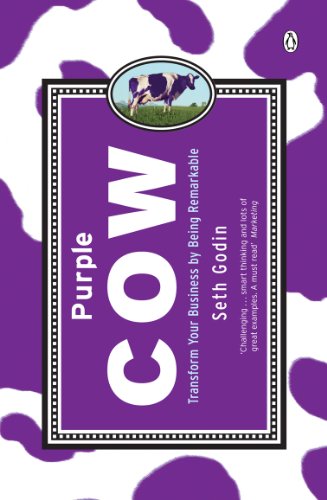
⚡️ What is Purple Cow about?
The Purple Cow is about transforming your business by creating remarkable products that people notice and talk about. In a world saturated with advertising noise, traditional marketing no longer works. Seth Godin explains why you must make your product or service so extraordinary that it stands out like a purple cow in a field of brown ones. This approach focuses on innovation, remarkability, and building products that naturally generate word-of-mouth marketing.
🚀 The Book in 3 Sentences
- Purple Cow marketing requires creating products so remarkable they naturally generate word-of-mouth buzz.
- Traditional mass advertising is dead; instead, focus on targeted, permission-based marketing strategies.
- Success comes from taking calculated risks to build something truly unique rather than playing it safe.
🎨 Impressions
Purple Cow is a marketing classic that challenges conventional wisdom about advertising and product development. Seth Godin’s approach is refreshingly bold—he argues that in today’s saturated market, only the remarkable gets noticed. This book isn’t just about marketing; it’s about building a business philosophy centered on innovation and customer delight. The Purple Cow concept fundamentally changes how you think about product creation and customer engagement.
📖 Who Should Read Purple Cow?
This book is essential for entrepreneurs, marketers, product developers, and business leaders who want to break through the noise of traditional marketing. It’s perfect for anyone looking to understand how to create products that sell themselves through word-of-mouth. Whether you’re launching a startup or revitalizing an existing brand, Purple Cow provides actionable strategies for making your offerings truly remarkable and unforgettable.
☘️ How the Book Changed Me
How my life / behaviour / thoughts / ideas have changed as a result of reading the book.
- I now focus on creating remarkable experiences rather than relying on traditional advertising methods
- My approach to product development has shifted to prioritize uniqueness and customer delight
- I’ve learned to target early adopters and influencers rather than trying to appeal to everyone
✍️ My Top 3 Quotes
- “Stop advertising and start innovating.”
- “The best the timid can hope for is to be unnoticed. Criticism comes to those who stand out.”
- “You have to go where the competition is not. The farther the better.”
📒 Summary + Notes
Purple Cow revolutionizes how we think about marketing by emphasizing the importance of creating remarkable products. In a world where consumers are overwhelmed with choices and advertising messages, only the truly exceptional stand out. Seth Godin argues that traditional mass marketing is dead, and businesses must focus on building products so unique they naturally generate word-of-mouth buzz. This approach requires courage, innovation, and a willingness to take calculated risks rather than playing it safe.
Chapter 1: Not Enough Ps
This opening chapter sets the stage by explaining why traditional marketing’s “4 Ps” (Product, Price, Placement, Promotion) are no longer sufficient. Godin argues that in today’s saturated market, businesses need something more—a “Purple Cow” that stands out dramatically from the competition. He emphasizes that simply following conventional marketing practices won’t cut it anymore.
- The traditional marketing mix is outdated in the face of information overload
- Consumers have become immune to standard advertising techniques
- Businesses need to create something so remarkable it breaks through the noise
Chapter 2: The New P
Godin introduces “Purple Cow” as the new “P” in marketing—the idea that remarkable products are the cornerstone of successful marketing. He explains that instead of focusing on promotion, businesses should focus on creating products that promote themselves through word-of-mouth. This shift represents a fundamental change in marketing philosophy.
- Purple Cow represents the new marketing paradigm—remarkability over promotion
- Products should be designed to generate organic buzz and customer advocacy
- Marketing should focus on creating something worth talking about rather than pushing messages
Chapter 3: Boldfaced Words and Gutsy Assertions
This chapter emphasizes the importance of making bold, clear statements about what makes your product unique. Godin argues that successful marketing requires taking a stand and making gutsy assertions about your product’s value. He suggests that businesses should be unapologetically clear about what makes them different and better.
- Clear, bold positioning statements are more effective than vague marketing messages
- Consumers appreciate honesty and clarity in brand messaging
- Successful brands make specific claims about their unique value proposition
Chapter 4: Before, During, and After
Godin explores the evolution of marketing through three eras: before mass advertising, during mass advertising, and after mass advertising. He explains how each era required different marketing strategies and why the post-advertising era demands remarkable products. This historical perspective helps readers understand why traditional approaches no longer work.
- Pre-advertising era relied on personal selling and word-of-mouth
- Mass advertising era allowed businesses to reach large audiences through broadcast media
- Post-advertising era requires products that sell themselves through remarkable features
Chapter 5: The Greatest Thing Since Sliced Bread
This chapter discusses the importance of creating products that are genuinely innovative and valuable. Godin argues that businesses should aim to create products that are so good they become the “greatest thing since sliced bread” in their category. He emphasizes that true innovation creates its own marketing power.
- Innovative products generate their own marketing buzz and customer loyalty
- Consumers are willing to pay premium prices for genuinely superior products
- Real innovation solves problems or fulfills needs in ways that competitors can’t match
Chapter 6: Did You Notice the Revolution?
Godin points out that most revolutionary products don’t advertise their revolutionary nature—they simply are revolutionary. He argues that businesses should focus on creating products that are so obviously better that they don’t need to explain their revolutionary qualities. The revolution happens quietly through customer experience and word-of-mouth.
- Truly revolutionary products don’t need to announce their revolutionary nature
- Customers recognize and appreciate revolutionary improvements through direct experience
- Marketing should focus on enabling customers to discover the revolution themselves
Chapter 7: Why You Need the Purple Cow
This chapter explains why businesses absolutely need to create remarkable products in today’s competitive landscape. Godin argues that playing it safe leads to mediocrity and invisibility. He provides examples of companies that succeeded by being remarkable, showing that taking risks to create something unique is the path to market leadership.
- Safe, conventional products blend into the background and get ignored
- Remarkable products attract attention and generate organic marketing
- Risk-taking in product development is necessary for market differentiation
Chapter 8: The Death of the TV-Industrial Complex
Godin discusses how traditional mass media advertising, particularly television, has lost its effectiveness. He argues that the “TV-industrial complex” of mass marketing is dead because consumers have learned to tune out traditional advertising. Instead, businesses must focus on creating products that generate their own media attention through remarkable features.
- Mass media advertising has become increasingly expensive and less effective
- Consumers use technology to avoid traditional advertising (ad-blockers, DVR, etc.)
- Remarkable products create their own media coverage and word-of-mouth marketing
Chapter 9: Before and After
This chapter continues the discussion of the pre- and post-advertising eras, emphasizing how the landscape has fundamentally changed. Godin explains that businesses can no longer rely on mass marketing techniques and must instead focus on creating products that stand out through their inherent qualities. He stresses that the rules have changed permanently.
- The pre-advertising era relied on personal relationships and local reputation
- The advertising era allowed mass reach through broadcast media
- The post-advertising era requires products that sell themselves through remarkable features
Chapter 10: Consider the Beetle
Using the Volkswagen Beetle as an example, Godin shows how a remarkable product with a unique positioning can succeed. He explains how the Beetle’s honest, quirky advertising emphasized its differences rather than trying to appeal to everyone. This case study illustrates the power of embracing what makes you different rather than trying to be average.
- The Beetle succeeded by celebrating its unconventional features (ugly design, small size)
- Honest positioning that acknowledged differences resonated with specific customer segments
- Trying to appeal to everyone often results in appealing to no one
Chapter 11: What Works?
Godin addresses the question of what marketing strategies actually work in the post-advertising era. He argues that strategies focused on creating remarkable products and enabling word-of-mouth are most effective. Traditional mass marketing approaches are expensive and ineffective compared to letting your product’s remarkable qualities do the talking.
- Permission marketing and relationship building are more effective than interruption marketing
- Creating remarkable products that generate organic buzz works better than paid advertising
- Targeted, niche marketing strategies outperform mass market approaches
Chapter 12: Why The Wall Street Journal Annoys Me So Much
In this chapter, Godin explains his frustration with traditional business publications that continue to promote outdated marketing approaches. He argues that these publications fail to recognize the fundamental shift in marketing and continue to advocate strategies that no longer work. This illustrates the broader point that businesses must think differently to succeed.
- Traditional business advice often fails to acknowledge marketing’s fundamental changes
- Many “experts” continue promoting strategies that are no longer effective
- Business leaders must question conventional wisdom and adapt to new realities
Key Takeaways
These are the most important lessons from Purple Cow that will help you transform your business approach:
- Create remarkable products that naturally generate word-of-mouth marketing and customer advocacy
- Focus on early adopters and influencers rather than trying to appeal to everyone in mass marketing approaches
- Embrace your unique qualities and position them boldly rather than trying to be average
- Invest in product development and innovation rather than expensive advertising campaigns
- Take calculated risks to stand out from the competition and avoid mediocrity
Conclusion
Purple Cow provides a revolutionary approach to marketing that’s more relevant than ever in today’s crowded marketplace. Seth Godin’s insights challenge conventional wisdom and provide a clear path to business success through remarkable product creation. By focusing on what makes your offering truly unique and remarkable, you can break through the noise of traditional marketing and create products that sell themselves through word-of-mouth. If you’re serious about transforming your business and creating sustainable competitive advantages, Purple Cow is essential reading that will change how you think about marketing forever.
More From Seth Godin →
Discover more from AI Book Summary
Subscribe to get the latest posts sent to your email.