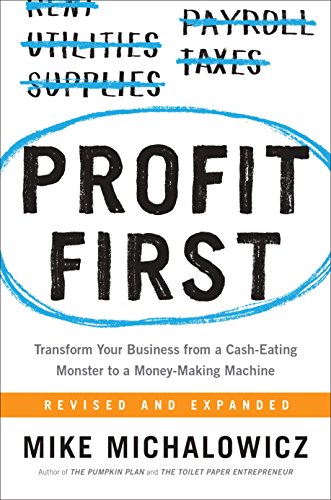
⚡️ What is Profit First About?
Why is it that your revenue keeps climbing, yet your bank account feels perpetually empty at the end of the month? It’s a gut-wrenching realization most entrepreneurs face: they aren’t running a business; they’re feeding a “cash-eating monster.” In this book, Mike Michalowicz argues that the traditional accounting formula—Sales minus Expenses equals Profit—is logically sound but behaviorally a disaster. It treats profit as a leftover, an afterthought that rarely happens because humans have a natural tendency to spend whatever is available.
The central thesis here is a psychological flip: Sales minus Profit equals Expenses. By taking your profit first, you’re forced to innovate and operate within the remaining bounds. It’s a system designed for the way real people actually manage money—by checking their bank balances, not by studying complex P&L statements. This is one of the most practical finance book summaries you’ll read because it focuses on changing your habits rather than your math skills.
🚀 The Book in 3 Sentences
- The traditional GAAP formula of Sales – Expenses = Profit ensures that profit is always the last thing on your mind and the first thing to disappear.
- By moving a predetermined percentage of every deposit into a separate Profit account immediately, you force your business to become efficient with what’s left.
- Sustained profitability is a habit, not a year-end event, and it requires managing your business based on your actual bank balance rather than theoretical accounting.
🎨 Impressions
I’ve read plenty of business books that tell you to “focus on the bottom line,” but few actually give you the shovel to dig yourself out of the hole. Michalowicz’s tone is refreshingly blunt. He doesn’t treat you like a CFO; he treats you like a stressed-out founder who’s tired of living paycheck-to-paycheck despite making six or seven figures. What surprised me most was the simplicity of his “bank balance accounting” idea. I’ve always felt a bit guilty for not looking at my spreadsheets every day, and he basically tells you it’s okay because our brains aren’t wired for them anyway.
Honestly, some of the steps felt a bit extreme at first—like opening five different bank accounts. I thought, “Won’t my banker hate me?” But once you see the logic of creating “fences” around your money, it clicks. It’s the financial equivalent of using smaller plates to lose weight. If the money isn’t in the Operating Expenses account, you won’t spend it. It’s that simple, and it’s remarkably effective at exposing which parts of your business are actually just vanity projects.
📖 Who Should Read Profit First?
This is a must-read for the “accidental entrepreneur”—the person who is great at their craft but feels like they’re drowning in the financial side of the business. If you’re doing $100k to $5M in revenue but never seem to have cash for a rainy day, this is for you. If you’re a corporate accountant looking for complex tax strategies or GAAP compliance, you might find this too simplistic. It’s for the person who wants a business that serves their life, not a life that serves their business.
☘️ How This Book Changed My Thinking
Before reading this, I viewed profit as a reward for a job well done at the end of the year. Now, I see it as a non-negotiable expense that happens every single Tuesday when I do my allocations.
- I stopped trying to “grow my way out” of cash flow problems; I realized growth is often a magnifying glass for existing inefficiencies.
- I moved from one messy checking account to five specialized ones, which instantly ended the “can I afford this?” guessing game.
- I realized that if I can’t pay myself a living wage and take a profit, I don’t have a business—I have a very expensive and stressful hobby.
✍️ 3 Quotes That Stuck With Me
- “Profit is not an event. Profit is a habit.” — This reminds me that I can’t wait for a “big exit” to feel successful; I need to be profitable today.
- “Growth is only half the equation. It is an important half, but still only half.” — It’s a sobering check against the cult of “scaling” that ignores actual margins.
- “When less money is available to run your business, you will find ways to get the same or better results with less.” — This is Parkinson’s Law in action, and it’s the secret to true innovation.
📒 Summary + Notes
The core of the Profit First system is about engineering your environment to match your human nature. Michalowicz observes that we all suffer from “Parkinson’s Law,” which states that we consume whatever resource is available to us. If you have 30 days to finish a project, it takes 30 days. If you have $10,000 in your checking account, you’ll find $10,000 worth of “necessary” expenses. By moving the profit out first, you artificially limit the resources available for expenses, which forces you to become more efficient.
The narrative arc follows a journey from financial chaos to “The Profit First Life.” It starts by diagnosing the “Survival Trap”—where we chase any revenue just to pay the bills—and moves toward a structured system of five bank accounts: Income, Profit, Owner’s Comp, Tax, and Operating Expenses. The author wants you to believe that a smaller, profitable business is infinitely better than a massive, struggling one. By the end, the goal isn’t just a healthy bank balance; it’s the freedom that comes when the business finally pays the owner what they are actually worth.
🧠 Core Ideas Explained Simply
While the book is tactical, these three psychological pillars are what actually make the system work long-term.
The Primacy Effect
We place more importance on whatever we encounter first. In traditional accounting, that’s Sales, followed by Expenses. Profit is literally the “bottom line,” which is a polite way of saying it’s the least important leftover. By moving Profit to the first position in your workflow, you signal to your brain—and your business—that it is the primary objective of the enterprise.
Bank Balance Accounting
Most entrepreneurs manage by “looking at the bank balance.” Instead of trying to change that behavior (which usually fails), Profit First uses it. By splitting your money into different accounts for specific purposes (Tax, Profit, Owner Pay), your bank balance finally tells you the truth about what you can actually afford to spend on that new software or office chair.
The 10/25 Rule
Efficiency thrives on rhythm. Michalowicz suggests doing your allocations and paying bills only twice a month—typically on the 10th and 25th. This prevents you from being “reactive” to every invoice that hits your inbox and gives you a clear birds-eye view of your cash flow trends without getting bogged down in daily micro-transactions.
1: Your Business Is a Cash-Eating Monster
Have you ever felt like you’re working for your business rather than it working for you? Michalowicz opens with the painful truth that many businesses are just “monsters” that eat every dollar we throw at them. We think the solution is more sales, but more sales without a profit system just creates a bigger, hungrier monster. He challenges the “Growth at all costs” mentality that dominates Silicon Valley, arguing that size doesn’t matter if you’re not keeping any of the money.
2: The Fundamentals of Profit First
What if the accounting formula we’ve used for centuries is actually the problem? This chapter introduces the flip: Sales – Profit = Expenses. It’s a behavioral hack. Just like the best way to save for retirement is to have the money taken out of your paycheck before you see it, the best way to run a business is to hide the profit from yourself before you have a chance to spend it on “essentials.”
3: The Naked Truth
You can’t fix what you haven’t measured, and most of us are flying blind. This section is about the “Instant Assessment.” It’s a cold, hard look at where your business actually stands compared to healthy, profitable companies of a similar size. Are you overspending on ops? Are you underpaying yourself? Most people find out they’ve been subsidizing a failing business with their own sweat and unpaid wages. It’s a wake-up call designed to be uncomfortable.
4: How to Manage Your TAPs
Imagine your bank account as a series of envelopes, much like our grandparents used to manage the household budget. This chapter explains the Target Allocation Percentages (TAPs). You don’t just guess how much to move; you set specific targets for Profit, Owner’s Pay, Tax, and Operating Expenses. The author provides a chart based on your revenue range, giving you a clear benchmark for what a healthy business should look like.
5: Allocation Day
It’s the 10th or the 25th of the month—do you know where your money is? This is the “rhythm” chapter. Instead of checking your bank account every five minutes, you batch your financial tasks. You move money from the Income account into the others based on your percentages. It turns the chaotic process of “paying bills” into a disciplined ritual of “allocating wealth.” It’s about taking control of the flow rather than being swept away by it.
6: Putting Profit First into Motion
Starting with just 1% might feel like a joke, but it’s the only way to build the muscle. Michalowicz knows that if you try to jump to 15% profit overnight, you’ll probably starve your business and quit. He advocates for the “crawl, walk, run” approach. Start so small you don’t even feel it. If you can run a business on $1,000, you can run it on $990. That $10 is the seed of your future fortune.
7: Destroy Your Debt
Debt is the weight that keeps the monster hungry. If you’re in the hole, you can’t just ignore it. This chapter provides a clear strategy for killing debt without killing your cash flow. The key is to avoid “adding fuel to the fire.” You stop the bleeding first, then use a portion of your allocations to systematically chip away at what you owe. It’s not about a “get rich quick” scheme; it’s about becoming debt-free through consistent, boring progress.
8: Finding Money in Your Business
Every dollar spent is a choice to not have that dollar in your pocket. This is where the author gets ruthless about cutting expenses. He suggests going through your bank statements and killing any “recurring revenue” for other companies that isn’t providing a massive ROI for yours. When you have less money in your Operating Expenses account, you suddenly realize you didn’t need half the stuff you were paying for.
9: Advanced Profit First
Once the basics are humming, it’s time to look at the edge cases. What about sales tax? What about large inventory purchases? This chapter addresses the complexities that come with scaling. He introduces the concept of the “Vault” account for emergencies and how to handle the “drip” of large annual payments. It’s the technical manual for someone who has already mastered the five-account basics.
10: The Profit First Life
This isn’t just about the office; it’s about how you live. Michalowicz argues that the habits you build in your business will naturally bleed into your personal life. If you’re disciplined with your company’s cash, you’ll likely become disciplined with your own. He talks about the joy of actually taking a “Profit Distribution” and using it for something fun, rather than just using it to pay the electricity bill.
11: How to Keep It from Falling Apart
The biggest threat to your profitability is actually you. When a “big opportunity” comes along or a “crisis” hits, your instinct will be to raid the Profit account. This final chapter is about setting up safeguards. He suggests moving your Profit and Tax accounts to a different bank entirely—one that’s hard to access and doesn’t have an online login you check daily. It’s about protecting the business from your own impulsive tendencies.
⚖️ A Critical Perspective
While the behavioral logic is bulletproof, the book does oversimplify certain tax and debt nuances. For instance, if you have high-interest debt (20%+), mathematically it often makes more sense to aggressively pay that down before building a “Profit” account that earns 0.01% interest. Additionally, the system can be a nightmare for businesses with extremely low margins or heavy inventory requirements where cash is tied up for months. It’s a great philosophy, but you’ll likely need to tweak the “percentages” significantly based on your specific industry’s reality.
🔄 How It Compares
Compared to The Barefoot Investor or Total Money Makeover, Profit First is the business equivalent of those personal finance classics. While those books focus on household debt and savings, Michalowicz applies the “bucket” or “envelope” system specifically to the complexities of running a company. It is far more actionable than the high-level theory found in Good to Great, focusing on the “how” rather than the “why” of financial health.
🔑 Key Takeaways
These are the foundational shifts required to stop the bleeding and start building wealth.
- Open Five Accounts Immediately: Don’t wait. The friction of multiple accounts is the feature, not the bug.
- Start with 1%: It’s better to be 1% profitable today than to plan for 20% profit in five years and never get there.
- Pay Yourself a Real Wage: If the business can’t afford to pay its CEO, the business model is broken, not your work ethic.
- The “No” List: Use the scarcity of your Operating Expense account to say no to projects, tools, and clients that don’t actually move the needle.
💬 Frequently Asked Questions
What is the main argument of Profit First?
The main argument is that traditional accounting (Sales – Expenses = Profit) is behaviorally flawed because humans spend what they see. By flipping the formula to Sales – Profit = Expenses, you ensure profitability by treating it as a non-negotiable deduction before any expenses are paid.
How many bank accounts do I need for Profit First?
Michalowicz recommends starting with five core accounts: Income, Profit, Owner’s Comp, Tax, and Operating Expenses. For advanced users, he suggests two additional “hold” accounts at a separate bank for Profit and Tax to remove the temptation to raid them during lean months.
Is Profit First worth reading for a new business?
Yes, it’s arguably most valuable for new businesses. Implementing these habits early prevents the “lifestyle creep” of business expenses and ensures you build a model that is actually viable. It helps you avoid the common trap of hiring too fast or overspending on vanity assets.
What are the Target Allocation Percentages (TAPS)?
TAPs are the percentage goals for where your money should go. While they vary by revenue, a typical healthy small business might aim for 5-15% Profit, 50% Owner’s Comp, 15% Tax, and 30% Operating Expenses. These act as a North Star for your financial health.
Can I use Profit First if I have a lot of debt?
Absolutely. The system includes a specific debt-destruction strategy. By taking even 1% profit, you build the confidence and habit of profitability while using the remaining “cleared” funds from expense cutting to systematically pay down your creditors without compromising your operations.
Conclusion
At the end of the day, Profit First isn’t about being a math wizard; it’s about being honest about how we actually behave with money. We are all prone to spending what we have, and no amount of willpower or complex spreadsheets will change that. By engineering a system that works with our flaws rather than against them, Michalowicz gives us a path to freedom that feels inevitable rather than impossible.
If you take one thing away from this, let it be this: your business exists to serve you, not the other way around. If you aren’t taking your profit today, you’re likely just building a bigger cage for yourself tomorrow. Go open those accounts, move that first 1%, and start treating your profit like the priority it is. You’ll find more great insights in our other finance book summaries, but this one might just be the one that saves your business.
More From Mike Michalowicz →
Discover more from AI Book Summary
Subscribe to get the latest posts sent to your email.