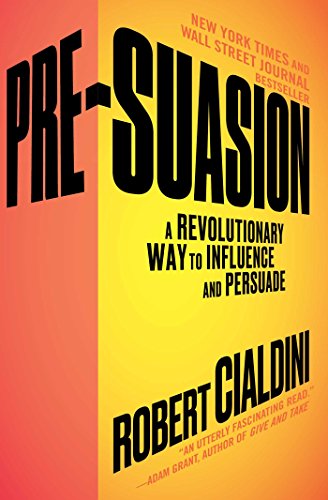
⚡️ What is Pre-Suasion About?
I used to think that the perfect sales pitch was all about the words you chose in the heat of the moment. I was wrong. It turns out, if you’re waiting until you start talking to influence someone, you’ve already missed the most important window. In this fascinating follow-up to his classic Influence, Robert Cialdini argues that the highest achievers don’t just have better arguments; they spend more time crafting the environment before the pitch even happens. They create a ‘privileged moment’ where the recipient is already primed to agree before the ask is even made.
This isn’t about manipulation through trickery, but rather understanding the mental machinery of attention. When we focus on something, we automatically assume it’s important. By directing that focus strategically, a communicator can change what a person values in real-time. This book effectively bridges the gap between social psychology and practical negotiation, making it a cornerstone for anyone interested in psychology book summaries and the science of human behavior.
🚀 The Book in 3 Sentences
- The most effective persuasion happens in the moments before a message is delivered by arranging the audience’s state of mind to be receptive.
- Our attention acts as a ‘channeled focus’ where whatever we are looking at in the moment feels disproportionately important and causal to our decisions.
- By using subtle associations, metaphors, and environmental cues, you can trigger specific mental frameworks that make your subsequent request feel like a natural next step.
🎨 Impressions
Honestly, I went into this thinking it might be a ‘B-side’ collection of ideas Cialdini couldn’t fit into his first book. It’s not. I’ve read a lot of sales and psychology books, and few made me stop and reconsider my daily interactions as much as this one. The concept of ‘privileged moments’ hit me hard because it explains why so many logically sound arguments fail—the soil wasn’t prepared for the seed. I found myself dog-earing the sections on ‘Persuasive Geographies’ because I realized I’ve been holding important meetings in rooms that actually worked against my goals.
There was a point in the middle where the academic citations got a bit dense, and I’ll admit I skimmed some of the lab study details. But the central thesis is so sticky that it didn’t matter. It’s a rare book that makes you feel slightly more powerful (and slightly more vulnerable) by the time you reach the final page. Don’t you want to know if the music in the background of a wine shop is actually choosing your bottle for you?
📖 Who Should Read Pre-Suasion?
If you’re in marketing, sales, or leadership, this is mandatory. You’ll stop obsessing over the ‘what’ and start mastering the ‘when.’ It’s also great for parents who are tired of losing negotiations with toddlers. However, if you’re looking for a quick list of ‘dark patterns’ or ‘hacks’ to trick people, you’ll be disappointed. This is a deep study of human cognition, not a collection of cheap tricks.
☘️ How This Book Changed My Thinking
Before reading this, I thought persuasion was a battle of information. I believed that if I provided the best data, I’d win the ‘yes.’ Now, I see it as a battle of attention management.
- I stopped sending important emails on Friday afternoons when people are primed for ‘exit’ and started timing them for when they are focused on ‘planning.’
- I changed my home office setup. I realized that having certain books or icons in my peripheral vision was actually ‘pre-suading’ my own creative output.
- I now spend 50% of my preparation time on the ‘intro’ or the ‘setting’ rather than just polishing the final ask.
✍️ 3 Quotes That Stuck With Me
- “The guiding factor in a decision is often not the one that counsels most wisely; it’s one that has recently been brought to mind.” — This made me realize why urgency often beats logic.
- “Anything that draws focused attention to itself can lead observers to overestimate its importance.” — A sobering reminder of how easily we are distracted by ‘shiny’ features.
- “To persuade optimally… it’s necessary to pre-suade optimally.” — The core mantra that I now repeat before every big call.
📒 Summary + Notes
The book’s narrative arc moves from the internal mechanics of the mind to the external triggers we can use to influence it. Cialdini starts by dismantling the idea that humans are rational actors. Instead, he shows we are ‘focal’ actors. We give weight to whatever is right in front of us. He then builds a case for how we can ‘direct the spotlight’ of an audience’s attention toward a specific concept—like ‘quality’ or ‘savings’—so that when we finally present our offer, the audience has already been conditioned to value that specific trait above all others.
By the end, Cialdini connects these new insights back to his famous six principles of persuasion, adding a seventh: Unity. The goal is to move the conversation from ‘what can I get you to do’ to ‘who are we together.’ It’s a shift from transactional influence to relational alignment. He wants you to believe that the most powerful form of influence doesn’t feel like influence at all; it feels like the recipient is simply following their own current train of thought.
🧠 Core Ideas Explained Simply
While the book is packed with data, three central pillars hold the weight of the entire argument.
The Focusing Illusion
Think of your attention like a flashlight in a dark room. Whatever the beam hits is the only thing that ‘exists’ to you in that moment. Cialdini points out that we have a massive cognitive bias: we assume that if we are focusing on something, it must be important. If a salesperson gets you to talk about the ‘safety’ of a car for ten minutes, your brain decides safety is the #1 priority, even if you walked onto the lot looking for speed. One real-world implication is that you can effectively change someone’s priorities simply by asking them a biased question that forces them to look at a specific feature.
Privileged Moments
Have you ever noticed how you’re more likely to agree to a favor right after someone has thanked you for one? That is a privileged moment. It’s a brief window of time where the ‘psychological gates’ are open. Cialdini argues these moments don’t just happen by accident; they can be manufactured. By introducing a concept (like ‘helpfulness’ or ‘adventurousness’) right before a request, you create a temporary state where the person feels a need to act in accordance with that concept.
Associative Priming
Our brains are giant spiderwebs of associations. When you hear the word ‘hospital,’ your brain also subtly ‘lights up’ nodes for ‘doctor,’ ‘medicine,’ and ‘sickness.’ Pre-suasion works by ‘lighting up’ nodes that are favorable to your goal. If you want someone to buy an expensive French wine, playing French accordion music in the background primes the ‘France’ node in their brain. They don’t even realize the music influenced them; they just ‘happen’ to feel like having a Bordeaux. It’s about using the environment to do the heavy lifting for you.
1: Pre-Suasion: An Introduction
The highest achievers in any field of influence aren’t necessarily the ones with the most charisma, but the ones who spend the most time preparing the ‘ground’ before the ‘seed’ is planted. Cialdini opens with the story of a top-performing fire-alarm salesman who would ‘accidentally’ forget his manual in the car. He’d ask the homeowners for a key to get back in, and by the time he returned, he had established a level of trust (since they gave him a key) that made the actual sale effortless. He pre-suaded them into seeing him as a trusted guest rather than a cold-calling salesman.
2: Privileged Moments: Creating the Opening
Why do people sometimes act totally out of character? It’s often because they’ve been led into a ‘privileged moment’ where only one part of their personality is being called to the surface. Cialdini describes a study where people were asked if they considered themselves ‘helpful.’ Almost everyone said yes. Then, when asked to help with a survey immediately after, 77% agreed. Without that ‘pre-suasive’ question, only 29% agreed. By making them focus on their ‘helpfulness’ first, the researchers created a moment where saying ‘no’ would have felt like a betrayal of their own identity.
3: The Importance of Attention… Point 1: The Focusing Illusion
Imagine you’re trying to choose between two different laptops. If I keep asking you questions about the ‘battery life’ of Laptop A, your brain starts to assume battery life is the most important metric for any laptop. This is the focusing illusion in action. Cialdini explains that we can’t multitask our focus. If you can control what someone is paying attention to, you control what they consider important. This is why ‘limited time offers’ work so well; they force your focus onto the availability of the item, making you forget to check if you actually need the item.
4: What’s Focal Is Causal
Whatever we are looking at, we believe is the cause of the event. Cialdini highlights a fascinating (and terrifying) study on police interrogations. If the camera is pointed only at the suspect, juries are much more likely to believe the confession was voluntary and ’caused’ by the suspect’s guilt. If the camera shows both the suspect and the interrogator, the jury sees the pressure being applied and is less likely to convict. In our daily lives, we often credit ‘leaders’ for a company’s success simply because they are the most focal person, ignoring the thousands of external factors at play.
5: Commanders of Attention 1: The Attractors
There is a biology to what we look at. Sex and violence are the obvious ones, but Cialdini points out that ‘change’ is the real commander of attention. Our ancestors had to notice the slight rustle in the grass to survive. In a marketing context, this means that ‘new,’ ‘improved,’ or ‘different’ will always win the battle for the initial glance. However, he warns that while ‘sexual’ imagery might grab attention, it only helps the sale if the product itself is related to romance or grooming. If you use sex to sell a power drill, you’ve grabbed the focus, but you’ve misdirected it away from the product’s actual utility.
6: Commanders of Attention 2: The Magnetizers
Is there a way to hold attention once you’ve grabbed it? Cialdini introduces the ‘Zeigarnik Effect’—the psychological phenomenon where we remember uncompleted tasks better than completed ones. If you want to keep someone thinking about your message, leave them with a puzzle or an unfinished story. He also discusses the power of ‘The Self.’ We are magnetically drawn to anything that mentions our name, our hometown, or our birthday. Use the word ‘you’ more than ‘we’ if you want the reader to stay locked in.
7: The Power of Association: I Link, Therefore I Think
Language is not just a carrier of meaning; it’s a trigger for associations. When a politician uses ‘war’ metaphors to describe a social issue, they are pre-suading the public to accept ‘aggressive’ and ‘costly’ solutions. Cialdini argues that we should be incredibly careful with the metaphors we use. If you describe a new project as a ‘race,’ people will focus on speed (and maybe cut corners). If you describe it as a ‘journey,’ they might focus more on the process and the obstacles. Words lead the mind down specific paths before the logic even kicks in.
8: Persuasive Geographies: All the Right Places
Go to your ‘happy place’ isn’t just a cliché; it’s a productivity strategy. Cialdini noticed that when he wrote his book in his university office, it sounded like an academic textbook. When he wrote it in a coffee shop surrounded by ‘normal’ people, his writing became more accessible and conversational. The ‘geography’—the physical cues in your environment—pre-suades you. If you’re trying to convince your boss of a bold new idea, don’t do it in a cramped, grey conference room. Take them somewhere that suggests growth and vision.
9: The Mechanics of Pre-Suasion: Causes, Constraints, and Confines
How do we actually trigger these associations in someone else’s mind? It comes down to ‘cues.’ Cialdini discusses how an online sofa retailer changed the background of its website to fluffy clouds for one group of visitors and small coins for another. Those who saw clouds suddenly valued ‘comfort’ and were willing to pay more. Those who saw coins became ‘price-conscious’ and bought the cheapest options. Neither group believed the background influenced them. The mechanics are invisible, which is why they are so potent.
10: Six Main Roads to Change: Common Standards as Shortcuts
This chapter is a refresher on Cialdini’s original six principles (Reciprocity, Liking, Social Proof, Authority, Scarcity, and Consistency), but viewed through the lens of pre-suasion. The key takeaway here is that these principles work best when they are used as ‘openers.’ For example, instead of asking for a favor and then offering a gift (reciprocity), you must offer the gift first to create the ‘privileged moment’ of indebtedness before you ever make your request. Timing is the differentiator between a nudge and a shove.
11: Unity 1: Being Together
What if you could make someone feel like you were part of their family? This is the new 7th principle: Unity. This goes beyond ‘Liking.’ It’s about a shared identity. Cialdini notes that we are significantly more likely to be persuaded by someone we perceive as ‘one of us’—whether that’s through shared ethnicity, shared religion, or even just being a fellow fan of a sports team. This ‘we-ness’ bypasses normal logical scrutiny because we instinctively trust members of our own tribe. It’s the most powerful (and dangerous) tool in the pre-suader’s kit.
12: Unity 2: Acting Together
The fastest way to build ‘Unity’ is through ‘co-creation.’ When people act together—whether it’s singing in a choir, marching in a protest, or just collaborating on a project—they become ‘unitized.’ If you want a client to buy into your proposal, don’t just ‘present’ it to them. Ask for their ‘advice’ during the process. Cialdini points out that asking for advice (rather than an opinion) creates a state of ‘togetherness’ where the client now feels partially responsible for the success of the idea.
13: Ethical Pre-Suasion: A Practical and Moral Framework
With great power comes the temptation to be a jerk. Cialdini dedicates an entire chapter to the ‘costs’ of unethical pre-suasion. He argues that companies that use deceptive priming eventually foster a culture of dishonesty internally. If you train your employees to lie to customers, they will eventually start lying to you. He calls this ‘The Triad of Unethical Workplace Outcomes.’ Basically, the ‘honest’ employees leave, the ‘dishonest’ ones stay, and eventually, the company rots from the inside out. Ethical influence is the only sustainable business model.
14: Post-suasion: Effecting Lasting Change
How do you make sure the ‘yes’ sticks once the privileged moment has passed? Cialdini suggests getting a public or written commitment. The ‘Consistency’ principle from his first book is the perfect ‘anchor’ for pre-suasive moments. If you use a cue to get someone to agree, you must immediately follow up with an action that solidifies that agreement into their identity. Otherwise, once they leave the ‘geography’ of your influence, the effect will fade like a dream. Pre-suasion gets the door open; consistency keeps it open.
⚖️ A Critical Perspective
While the book is brilliant, I have to be honest: some of the psychological ‘priming’ studies Cialdini cites have faced a bit of a ‘replication crisis’ in the years since he wrote this. Some of the more dramatic lab results—like the idea that holding a warm cup of coffee makes you ‘warmer’ toward a stranger—have been hard to reproduce consistently. I also felt that Cialdini slightly oversimplifies how much these ‘cues’ can override deep-seated personal values. You can’t just play French music and get me to buy a $500 bottle of wine if I only have $10 in my pocket. However, as a general framework for human tendencies, his logic remains sound and incredibly useful.
🔄 How It Compares
Compared to Daniel Kahneman’s Thinking, Fast and Slow, Pre-Suasion is much more actionable. While Kahneman explains why our brains are biased, Cialdini shows you exactly how to use those biases in a conversation. It’s the difference between a textbook on anatomy and a manual on how to win a wrestling match. If you liked Influence, this is the necessary ‘pro’ level upgrade.
🔑 Key Takeaways
These are the lessons that will actually change your day-to-day interactions.
- The ‘Advice’ Hack: Never ask for ‘feedback’ or an ‘opinion’; ask for ‘advice.’ Advice triggers a state of collaboration (Unity), while feedback triggers a state of criticism.
- Manage the Background: Whether it’s the music in your store or the art on your walls, ensure every background cue aligns with the value you want the customer to focus on.
- Capture the First Question: The person who asks the first question controls the ‘privileged moment.’ Start with questions that lead the person to acknowledge a trait you want them to act upon.
- Visual Authority: If you are presenting, ensure you are the most focal thing in the room. If there are distractions behind you, you are no longer seen as the ’cause’ of the message.
💬 Frequently Asked Questions
What is the difference between persuasion and pre-suasion?
Persuasion is the process of using logic, emotion, or incentives within a message to get a ‘yes.’ Pre-Suasion is the process of arranging the environment and the recipient’s attention before the message is even delivered so that they are psychologically primed to be receptive to it.
What are the “privileged moments” in Pre-Suasion?
A privileged moment is a brief window of time created by a ‘pre-suasive’ opener where a person is especially vulnerable or receptive to a specific idea. For example, asking someone if they consider themselves ‘adventurous’ creates a privileged moment where they are more likely to try a new product.
How does Robert Cialdini define the principle of Unity?
Unity is the 7th principle of influence. It refers to a sense of shared identity—being ‘one of us.’ It goes beyond mere liking and relies on deep-seated tribal or familial bonds. When Unity is established, the influencer’s goals become the recipient’s goals because they see themselves as part of the same unit.
Is Pre-Suasion better than Cialdini’s first book, Influence?
It’s not ‘better’ so much as it is ‘supplementary.’ Influence teaches you the ‘weapons’ of persuasion, while Pre-Suasion teaches you how to prepare the battlefield. If you haven’t read Influence, start there, but Pre-Suasion is what takes those principles from theoretical to masterfully practical.
Can pre-suasion be used for self-improvement?
Absolutely. Cialdini suggests ‘pre-suading’ yourself by changing your environment. If you want to focus on deep work, you can pre-suade your brain by removing distractions and placing symbols of productivity (like a specific desk lamp or music) that your brain associates with focus.
Final Thoughts
After finishing Pre-Suasion, I’ve started looking at the world as a series of set-ups and pay-offs. You realize that the store layout, the ‘free’ water at the car dealership, and even the way your spouse asks for help with the dishes are all attempts to prime your mind. It’s a bit like seeing the code in The Matrix. Once you see it, you can’t unsee it. More importantly, you can start using it to your advantage.
The biggest takeaway for me is that the ‘truth’ of your argument often matters less than the ‘readiness’ of the person hearing it. If you want to change someone’s mind, stop shouting at them and start changing the music. In the noisy world of 2025, the person who controls the ‘before’ always wins the ‘after.’ If you’re interested in more, check out our other psychology book summaries to see how these theories stack up against the rest of the field.
More From Robert Cialdini →
Discover more from AI Book Summary
Subscribe to get the latest posts sent to your email.