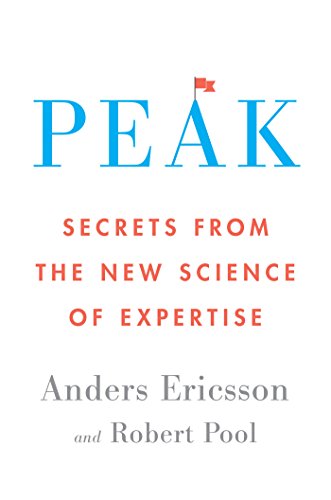
⚡️ What is Peak about?
Peak by Anders Ericsson and Robert Pool is a groundbreaking exploration of Peak performance and how anyone can achieve extraordinary levels of skill through deliberate practice. Unlike the popular belief that talent is innate, this book reveals that expertise is developed through specific, focused training methods. The authors challenge the myth of natural talent and provide a scientific framework for transforming Peak potential into actual achievement. Whether you want to master a musical instrument, excel in sports, or become proficient in any field, Peak offers the roadmap to get there.
🚀 The Book in 3 Sentences
- Peak performance isn’t about natural talent but about deliberate, purposeful practice with specific goals and feedback.
- Experts develop their skills through years of focused training that pushes beyond their comfort zones consistently.
- Anyone can improve dramatically by applying the principles of Peak learning and abandoning the myth of fixed abilities.
🎨 Impressions
Peak completely transformed how I view skill development and mastery. The scientific approach Ericsson brings from his decades of research makes this book both credible and practical. What struck me most was how the book debunks the talent myth while providing actionable strategies for improvement. The emphasis on Peak performance through deliberate practice feels revolutionary, especially in a world that often attributes success to innate gifts rather than dedicated effort.
📖 Who Should Read Peak?
Anyone seeking to improve their skills, whether professionally or personally, should read Peak. This includes athletes, musicians, students, professionals, and entrepreneurs who want to maximize their potential. The book is especially valuable for those stuck in traditional learning methods or believing they lack natural talent. Peak offers hope and a clear path forward for anyone willing to commit to deliberate practice and embrace the journey of continuous improvement.
☘️ How the Book Changed Me
How my life / behaviour / thoughts / ideas have changed as a result of reading the book.
- I now approach learning with a focus on Peak performance strategies rather than just putting in time
- I’ve started implementing deliberate practice techniques in my daily skill development routine
- I no longer believe in fixed abilities and embrace the possibility of continuous growth
✍️ My Top 3 Quotes
- “The ability to evaluate one’s performance accurately is one of the key ingredients of deliberate practice.”
- “Great performers don’t make it look easy; they make it look effortless because they’ve made it automatic through countless hours of deliberate practice.”
- “The goal of deliberate practice is not just to improve performance, but to extend the limits of human performance.”
📒 Summary + Notes
Peak performance, according to Anders Ericsson’s groundbreaking research, isn’t about natural talent but about deliberate, purposeful practice. The book challenges the myth that expertise is predetermined by genetics and provides a scientific framework for achieving extraordinary skill levels. Through decades of research studying violinists, chess players, athletes, and other experts, Ericsson reveals that Peak performance is accessible to anyone willing to engage in the right kind of practice.
Chapter 1: The Man Who Made Time Stand Still
This chapter introduces Steve Faloon, a college student who participated in a memory experiment that seemed impossible. Under Ericsson’s guidance, Faloon’s ability to remember random numbers increased dramatically from 7 digits to over 80 digits through deliberate practice. The chapter establishes that extraordinary abilities aren’t innate but developed through specific training methods. It challenges the assumption that memory capacity is fixed and demonstrates how systematic practice can expand human capabilities beyond what seems naturally possible.
- The myth of fixed memory capacity can be overcome through deliberate training
- Steve Faloon’s transformation from average to exceptional memory shows the power of purposeful practice
- This example illustrates how Peak performance is achieved through scientific methods rather than natural talent
Chapter 2: But I Don’t Have Talent
This chapter dismantles the myth of natural talent by examining various fields where deliberate practice creates experts. Ericsson discusses how Mozart’s genius was largely developed through intensive training from his father, and how child prodigies in chess are products of early, intensive coaching rather than innate ability. The chapter explores how the brain adapts to specific types of practice and how expertise is domain-specific – meaning you can be exceptional in one area while being average in another. It emphasizes that talent is overrated and practice is the true differentiator.
- Natural talent is largely a myth perpetuated by misunderstanding the role of early intensive training
- Child prodigies achieve their status through deliberate, guided practice rather than inherent gifts
- Expertise is domain-specific, requiring focused development in particular areas for Peak performance
Chapter 3: The Power of Purposeful Practice
Ericsson defines purposeful practice as having well-defined specific goals, focusing intensely on tasks outside comfort zones, requiring feedback, and involving continuous refinement. This chapter contrasts purposeful practice from naive practice (simply repeating tasks without improvement focus). The author explains that pushing beyond current abilities, maintaining concentration, and receiving immediate feedback are crucial elements. Examples include musicians who focus on difficult passages rather than playing pieces they already master, and how this approach leads to measurable improvement in performance.
- Purposeful practice requires specific goals that push beyond current capabilities
- Immediate feedback and focused attention are essential for meaningful progress
- Peak performance emerges from challenging tasks rather than comfortable repetition
Chapter 4: The Gold Standard: Deliberate Practice
Deliberate practice is defined as purposeful practice that knows exactly where the performance level is and how to improve it. This chapter emphasizes that deliberate practice requires a teacher or coach who can provide guidance and feedback. It must be designed specifically to improve performance and often involves tasks that are not inherently enjoyable. The practice develops skills that are relevant to performance in competitive situations. Ericsson explains that deliberate practice is most effective in domains where the best performers have developed highly sophisticated mental representations.
- Deliberate practice requires expert guidance and structured feedback for Peak development
- The practice involves challenging, often uncomfortable tasks designed for specific improvement
- Mental representations become more sophisticated through deliberate practice, enabling expert performance
Chapter 5: Experts on Top of the Mountain
This chapter explores how experts develop superior performance through accumulated deliberate practice. It discusses how expert brains are physically different from novices, with more efficient neural pathways and enhanced mental representations. The concept of pattern recognition in experts is examined, showing how they can process vast amounts of information quickly by recognizing familiar patterns. The chapter also addresses how experts maintain their skills and continue improving throughout their careers through ongoing deliberate practice.
- Experts’ brains show physical differences due to years of deliberate practice for Peak performance
- Pattern recognition allows experts to process complex information rapidly and accurately
- Continuous deliberate practice is essential for maintaining and extending expert capabilities
Chapter 6: Mozart and His Magical Musical Brain
The chapter debunks the Mozart myth by examining his early compositions and training background. Ericsson reveals that Mozart’s compositions were heavily influenced by his father’s intensive training and exposure to music from an extremely young age. The author analyzes how Mozart’s abilities developed over time through deliberate practice rather than appearing magically. This chapter reinforces the book’s central thesis that even seemingly miraculous talents are products of systematic development and practice, not innate gifts.
- Mozart’s genius was cultivated through intensive early training rather than natural talent
- His compositions evolved over years of deliberate practice and refinement
- The Peak achievement myth ignores the extensive development behind apparent prodigies
Chapter 7: The Winning Walk
This chapter examines the development of championship-level performance in sports, particularly focusing on golf. Ericsson discusses how golfers develop their skills through deliberate practice that involves analyzing every aspect of their game. The chapter covers how top athletes work with coaches to identify weaknesses and systematically address them through targeted practice. It also explores how mental preparation and visualization contribute to athletic excellence, showing that physical skills alone aren’t sufficient for Peak performance.
- Championship athletes achieve excellence through systematic deliberate practice approaches
- Coaching and feedback are crucial for identifying and correcting specific weaknesses
- Mental preparation complements physical skills for achieving Peak athletic performance
Chapter 8: The 10,000-Hour Rule
Ericsson addresses the popular 10,000-hour rule and clarifies that simply accumulating practice hours doesn’t guarantee expertise. The chapter emphasizes that the quality of practice matters more than quantity. Deliberate practice, not just time spent, determines whether someone achieves expert performance. The author explains that the 10,000-hour figure comes from studying violinists and represents the average amount of deliberate practice needed, not a magic number that guarantees success. This chapter reinforces that Peak performance requires purposeful, guided practice rather than mere repetition.
- The 10,000-hour rule is often misunderstood as a guarantee rather than an average benchmark
- Quality of practice matters significantly more than quantity for achieving Peak performance
- Deliberate practice with expert guidance is essential, not just accumulated hours of repetition
Chapter 9: The Dark Side of Deliberate Practice
This chapter acknowledges that deliberate practice is mentally and emotionally demanding. Ericsson discusses how the process often involves failure, frustration, and pushing beyond comfort zones. The chapter explores why so few people engage in deliberate practice despite its benefits – it’s difficult, uncomfortable, and requires sustained effort over long periods. The author also addresses how to maintain motivation and develop the mental resilience needed to continue with deliberate practice when progress feels slow or setbacks occur.
- Deliberate practice involves significant mental and emotional challenges for Peak achievement
- The discomfort of pushing beyond comfort zones often discourages consistent practice
- Maintaining motivation requires understanding that progress may be slow but cumulative
Chapter 10: How All This Can Transform Us
The final chapter explores how the principles of deliberate practice can be applied to various fields beyond traditional expertise domains. Ericsson discusses how these concepts can transform education, business, and personal development. The chapter provides practical guidance on how to identify areas for improvement, find appropriate mentors or resources, and design deliberate practice routines for any skill. It emphasizes that while achieving world-class expertise requires exceptional dedication, significant improvement is possible for everyone through deliberate practice.
- Deliberate practice principles can be applied to transform performance in any field
- Significant improvement is achievable for everyone, even without pursuing world-class expertise
- Systematic application of Peak strategies leads to measurable progress in personal and professional development
Key Takeaways
Peak performance is achieved through deliberate practice rather than natural talent. The most successful individuals develop their abilities through systematic, purposeful training with expert guidance. Understanding these principles allows anyone to significantly improve their skills and achieve personal transformation.
- Peak performance requires deliberate practice with specific goals, feedback, and continuous challenge beyond comfort zones
- Expertise is developed through years of focused training rather than innate talent
- Mental representations become more sophisticated through deliberate practice, enabling superior performance
- Quality of practice matters more than quantity – deliberate practice is essential for meaningful improvement
- Anyone can achieve significant improvement through systematic application of deliberate practice principles
Conclusion
Peak offers a revolutionary perspective on human potential that challenges everything we thought we knew about talent and ability. Through scientific research and compelling examples, Ericsson and Pool demonstrate that extraordinary achievement is accessible to anyone willing to engage in deliberate practice. The book’s insights into Peak performance have profound implications for personal development, education, and professional growth. While achieving world-class expertise requires exceptional dedication, the principles outlined in this book can transform performance in any field. If you’re serious about improving your skills and reaching your full potential, Peak provides the essential roadmap for that journey.
More From Anders Ericsson; Robert Pool →
Discover more from AI Book Summary
Subscribe to get the latest posts sent to your email.