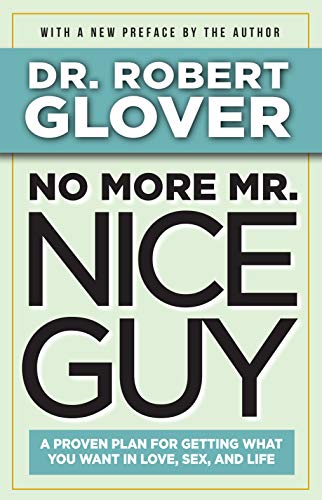
⚡️ What is No More Mr. Nice Guy about?
No More Mr. Nice Guy is a groundbreaking book that explores the phenomenon of the “Nice Guy Syndrome” – a pattern of behavior where men suppress their true selves to seek approval and avoid conflict. Dr. Robert A. Glover reveals how these men, despite their good intentions, end up feeling frustrated, unfulfilled, and resentful in their relationships and lives. The book provides a proven plan for breaking free from these limiting patterns, helping men develop authentic masculinity, set healthy boundaries, and create fulfilling relationships. Through practical exercises and insightful strategies, Glover guides readers on a journey of self-discovery and personal transformation, showing them how to get what they truly want in love, sex, and life.
🚀 The Book in 3 Sentences
- No More Mr. Nice Guy exposes the self-defeating patterns of men who seek approval by hiding their true selves and offers a path to authentic living.
- The book reveals how Nice Guys’ attempts to please everyone ultimately lead to frustration, resentment, and unfulfilling relationships.
- Through practical strategies and exercises, Glover provides a roadmap for reclaiming personal power, embracing masculinity, and creating satisfying connections with others.
🎨 Impressions
No More Mr. Nice Guy is one of those rare books that delivers both profound insights and practical solutions. Glover’s direct, no-nonsense approach cuts through the self-deception that Nice Guys practice, offering clarity and hope. What impressed me most was how the book balances psychological theory with actionable steps, making it accessible to readers regardless of their background. The exercises are transformative, challenging men to confront their deepest fears and insecurities while providing the tools to overcome them. This isn’t just another self-help book; it’s a manual for authentic living that has the power to change lives.
📖 Who Should Read No More Mr. Nice Guy?
No More Mr. Nice Guy is essential reading for men who find themselves constantly seeking approval, avoiding conflict, or feeling resentful despite their “nice” behavior. It’s particularly valuable for those who struggle in relationships, feel unfulfilled in their careers, or sense they’re not living up to their potential. Women partnered with Nice Guys will also gain invaluable insights into their partner’s behavior patterns. Therapists, counselors, and coaches working with men will find this book an indispensable resource for understanding and addressing the Nice Guy Syndrome.
☘️ How the Book Changed Me
Reading No More Mr. Nice Guy was a wake-up call that transformed my understanding of myself and my relationships. I realized how much of my behavior was driven by a desperate need for approval rather than authentic expression.
- I stopped seeking external validation and began developing my internal sense of self-worth, which dramatically improved my confidence and decision-making.
- I learned to set clear boundaries without guilt, leading to more respectful and balanced relationships both personally and professionally.
- I embraced my masculinity without apology, finding a new sense of power and purpose that had been suppressed by years of people-pleasing behavior.
✍️ My Top 3 Quotes
- “Nice Guys believe that if they are good and do things right, they will be loved, get their needs met, and have a smooth life.”
- “Trying to please everyone often results in pleasing no one – especially yourself.”
- “An integrated male doesn’t strive to be perfect or gain the approval of others. Instead, he accepts himself just as he is, warts and all.”
📒 Summary + Notes
No More Mr. Nice Guy presents a revolutionary approach to understanding and overcoming the Nice Guy Syndrome. Dr. Glover explains how this pattern develops in childhood as a response to abandonment experiences and toxic shame, leading men to create a false self designed to seek approval. The book reveals the hidden costs of Nice Guy behavior – including dishonesty, manipulation, and unfulfilling relationships – while providing a clear path to recovery. Through acceptance of self, reclaiming personal power, and embracing authentic masculinity, men can break free from these limiting patterns and create lives of passion, purpose, and genuine connection.
Introduction
The introduction sets the stage for understanding the Nice Guy Syndrome – a pattern of behavior where men seek approval by hiding their true selves. Dr. Glover explains how five decades of social change have created a breed of men conditioned to seek others’ approval at the expense of their authenticity. These men are concerned with looking good and doing things “right,” avoiding conflict, and striving to make others happy. Despite their peaceful and generous nature, Nice Guys live by a myth: if they are “good,” they will be loved, get their needs met, and live problem-free lives. When this strategy fails, Nice Guys typically try harder, creating a cycle of helplessness and resentment that makes them anything but nice.
- Nice Guys are especially concerned about pleasing women and being different from other men, which often leads to inauthentic relationships.
- The Nice Guy Syndrome represents a belief system that drives men to suppress their true needs, feelings, and desires in favor of seeking external validation.
- Glover introduces the concept of the “Integrated Male” – a man who can accept all aspects of himself, including his power, assertiveness, courage, and imperfections.
Chapter 1: The Nice Guy Syndrome
Chapter 1 delves into the characteristics and consequences of the Nice Guy Syndrome. Nice Guys frequently state that it makes them feel good to give to others, but their giving is often motivated by a desire for approval rather than genuine generosity. They fix and caretake, seek approval, avoid conflict, and try to hide their perceived flaws and mistakes. Nice Guys often look for the “right” way to do things, repress their feelings, and make their partners their emotional center. Despite appearing nice on the surface, these behaviors lead to negative traits including dishonesty, secrecy, manipulation, passive-aggressiveness, and rage.
- Nice Guys are often more comfortable relating to women than to men, which isolates them from the benefits of male companionship and masculine energy.
- The chapter introduces the concept of the “Integrated Male” – a man who has a strong sense of self, takes responsibility for getting his needs met, and is comfortable with his masculinity and sexuality.
- Breaking free from the Nice Guy Syndrome doesn’t involve becoming “not nice” but rather becoming “integrated” – able to embrace all aspects of oneself.
Chapter 2: The Making Of A Nice Guy
Chapter 2 explores the developmental origins of the Nice Guy Syndrome, tracing it back to childhood experiences of abandonment and toxic shame. During their formative years, Nice Guys received messages that it wasn’t safe to be who they truly were. Children’s natural ego-centrism leads them to believe they are the cause of everything that happens to them, including abandonment experiences. This creates toxic shame – a core belief that one is fundamentally bad. To cope with this shame, children develop survival mechanisms including seeking approval and hiding perceived flaws, which become the foundation of the Nice Guy paradigm.
- The chapter identifies two types of Nice Guys: the “I’m so bad” Nice Guy who believes he is the worst kind of person, and the “I’m so good” Nice Guy who masks his toxic shame with good deeds.
- Social changes including the transition to an industrial economy, absence of fathers from homes, and radical feminism have contributed to the widespread phenomena of the Nice Guy Syndrome.
- These social dynamics created three profound effects: boys were separated from fathers, left to be raised by women, and received messages that men were bad or unnecessary.
Chapter 3: Learn to Please Yourself
Chapter 3 addresses the core issue of approval-seeking that defines the Nice Guy Syndrome. Nice Guys believe they must hide their flaws and become what others want them to be to gain love and get their needs met. They use attachments – possessions, relationships, achievements – as external validation of their worth. This is especially pronounced in their relationships with women, where they interpret female approval as the ultimate validation of their worth. Ironically, seeking women’s approval often creates rage toward them when they fail to provide the expected validation. Nice Guys become master cover-up artists, hiding their humanity behind a facade of perfection.
- The chapter introduces strategies for developing self-approval, including identifying approval-seeking behaviors, taking good care of oneself, using affirmations, spending time alone, and revealing oneself to safe people. li>By shedding their chameleon skin and learning to please themselves, recovering Nice Guys begin to experience the intimacy and connection they have always desired.
- Glover emphasizes that when Nice Guys begin focusing on pleasing themselves, they actually experience greater intimacy and connection with others than they did when desperately seeking approval.
Chapter 4: Make Your Needs A Priority
Chapter 4 tackles the Nice Guy’s difficulty with getting their needs met. Nice Guys generally focus on meeting everyone else’s needs while trying to be “low-maintenance” themselves. They try to appear needless and wantless while attempting to get their needs met indirectly and covertly. This approach creates several problems: they make it difficult for others to give to them, they use covert contracts (unconscious expectations of reciprocity), and they confuse caretaking with genuine caring. The chapter introduces the concept of the “victim triangle” – a cycle of giving with strings attached that leads to resentment and rage when expectations aren’t met.
- Glover distinguishes between caring (giving freely without expectations) and caretaking (giving to get something in return or to feel needed/valuable).
- The chapter presents a paradigm shift: “no one was put on this planet to meet your needs” and “you weren’t put on this planet to meet anyone else’s needs” (except for children).
- Recovering Nice Guys learn to take responsibility for their own needs, recognizing that having needs is part of being human and that mature people make meeting their needs a priority.
Chapter 5: Reclaim Your Personal Power
Chapter 5 focuses on helping Nice Guys reclaim their personal power, defined as a state of mind in which a person is confident they can handle whatever may come. Nice Guys tend to see others as causing their problems and operate from a paradigm of powerlessness. They have difficulty expressing feelings, facing fears, developing integrity, and setting boundaries. The chapter emphasizes that personal power comes from feeling fear but not giving in to it. It provides strategies for developing this power, including surrendering to life’s complexity, expressing feelings authentically, facing fears directly, developing integrity through honesty, and setting healthy boundaries.
- Surrender allows recovering Nice Guys to let go and respond to life’s complexity rather than trying to control it, seeing life as a laboratory for learning and growth.
- The chapter highlights that men in touch with their feelings are powerful, assertive, and energized – contrary to the Nice Guy belief that expressing feelings is a sign of weakness.
- Setting boundaries is presented as a crucial aspect of personal power, with the understanding that if someone is crossing a boundary, it’s the Nice Guy’s responsibility to address it, not the other person’s.
Chapter 6: Reclaim Your Masculinity
Chapter 6 addresses the disconnection from masculinity that characterizes many Nice Guys. This disconnection manifests in several ways: Nice Guys tend to be disconnected from other men, from their own masculine energy, and often remain unconsciously “monogamous to their mothers.” The chapter explains how masculinity empowers men to create, produce, provide for, and protect those important to them, while acknowledging that masculine energy also includes potential for aggressiveness and destructiveness. Women often report being initially drawn to Nice Guys’ pleasing demeanor but finding it difficult to maintain attraction due to the absence of discernible life energy.
- Connecting with other men helps recovering Nice Guys become less susceptible to seeking women’s approval or allowing themselves to be defined by the opposite sex.
- The chapter emphasizes the importance of physical strength and health as components of reclaiming masculinity, with the understanding that physical strength translates into self-confidence in other areas of life.
- Re-examining their relationship with their fathers helps Nice Guys see them as wounded human beings rather than idealized or demonized figures, facilitating healing and integration.
Chapter 7: Get The Love You Want: Success Strategies For Intimate Relationships
Chapter 7 explores how Nice Guys co-create dysfunctional relationships that prevent them from getting the love they want. Nice Guys tend to engage in patterns of enmeshment (becoming overly involved at the expense of self) or avoidance (being emotionally unavailable). They often recreate familiar childhood relationship patterns and are “bad enders” – staying in relationships that don’t work. The chapter presents strategies for building successful relationships, emphasizing that there are no perfect relationships or partners. Relationships are inherently chaotic, eventful, and challenging, but these qualities don’t have to preclude intimacy and satisfaction.
- Learning to approve of themselves helps Nice Guys get the love they want by reducing their dependency on external validation and approval from their partners.
- Setting boundaries creates safety for vulnerability and true intimacy, with the “second date rule” helping Nice Guys identify unacceptable behaviors and the “healthy male rule” guiding appropriate responses.
- Focusing on the relationship rather than the partner allows Nice Guys to use their partner to get in touch with childhood experiences and heal old wounds, rather than trying to fix or change their partner.
Chapter 8: Get The Sex You Want: Success Strategies For Satisfying Sex
Chapter 8 addresses the sexual challenges faced by Nice Guys, where all their abandonment experiences, toxic shame, and dysfunctional survival mechanisms are focused and magnified. Nice Guys experience various sexual problems including not getting enough sex, settling for less than satisfying sex, sexual dysfunction, repression, and compulsive sexual behavior. At the core of these issues is shame and fear about being sexual beings. The chapter introduces the term “Vagiphobia” to describe the Nice Guy’s propensity to avoid sexual situations despite their apparent desire for sex.
- Trying to be a “good lover” actually prevents Nice Guys from having passionate, reciprocal, spontaneous, and intimate sexual experiences, as it keeps them focused on their partner’s pleasure rather than their own.
- “Coming out of the closet” with sexual shame and fears is presented as essential for recovery, involving revealing every aspect of one’s sexual self to safe, supportive people.
- The chapter introduces “healthy masturbation” as a practice for taking responsibility for one’s sexual pleasure and expression, contrasting with the compulsive or shame-filled masturbation many Nice Guys experience.
Chapter 9: Get The Life You Want: Discover Your Passion And Purpose In Life, Work, And Career
Chapter 9 extends the principles of recovery from the Nice Guy Syndrome to all areas of life, work, and career. The same dynamics that keep Nice Guys stuck in dysfunctional relationships often keep them stuck in unsatisfying vocations. Fear is identified as the common factor at the core of every problem experienced by Nice Guys, including fear of failure and paradoxically, fear of success. Other barriers include trying to “do it right,” attempting to do everything themselves, self-sabotage, distorted self-image, and deprivation thinking. The chapter presents strategies for realizing one’s passion and potential.
- Charting one’s own path involves recognizing that the only thing stopping Nice Guys from having the life they want is themselves, and that what one man can do, another man can do.
- Identifying self-sabotaging behaviors helps Nice Guys get out of their own way, allowing them to start getting what they want in life, work, and career.
- Developing a more accurate view of the world involves challenging the paradigm of scarcity and deprivation, recognizing that the world can’t give us what we’re not ready to receive.
Key Takeaways
No More Mr. Nice Guy offers transformative insights for men trapped in people-pleasing patterns. The most important lessons include recognizing that Nice Guy behavior is driven by toxic shame and fear of abandonment, understanding that seeking approval leads to inauthentic relationships, and realizing that true masculinity involves embracing all aspects of oneself. Recovery requires developing self-approval, making personal needs a priority, reclaiming personal power, reconnecting with masculine energy, and setting healthy boundaries. By implementing these strategies, men can break free from the Nice Guy Syndrome and create lives of authenticity, passion, and genuine connection.
- The Nice Guy Syndrome is not about being genuinely nice but about seeking approval through hiding one’s true self, which ultimately leads to frustration and resentment.
- Recovery involves becoming an “Integrated Male” who can accept all aspects of himself, including his power, assertiveness, courage, and imperfections.
- Setting boundaries, expressing feelings authentically, and facing fears directly are essential practices for reclaiming personal power and creating satisfying relationships.
- Healthy sexuality requires letting go of trying to be a “good lover” and instead taking full responsibility for one’s own pleasure and expression.
- Creating the life you want involves identifying self-sabotaging behaviors, challenging scarcity thinking, and recognizing that you have the power to shape an exciting and fulfilling life.
Conclusion
No More Mr. Nice Guy is more than just a book – it’s a roadmap to authentic masculinity and fulfilling relationships. Dr. Glover provides a proven plan for breaking free from the self-defeating patterns of the Nice Guy Syndrome, offering hope and practical guidance for men ready to reclaim their power and live with integrity. By implementing the strategies in this book, men can transform their relationships, their careers, and their lives. The journey from Nice Guy to Integrated Male isn’t always easy, but it’s infinitely rewarding. If you’re ready to stop seeking approval and start living authentically, this book provides the tools and insights you need to make that transformation. Don’t just be nice – be real, be powerful, be integrated.
More From Robert A. Glover →
Discover more from AI Book Summary
Subscribe to get the latest posts sent to your email.