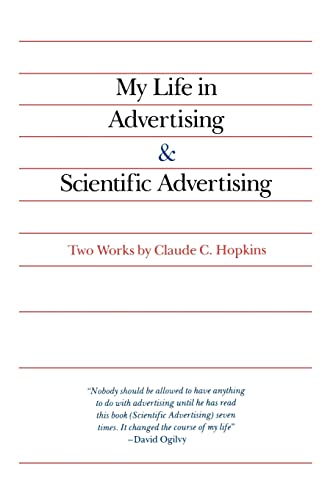
⚡️ What is My Life in Advertising about?
My Life in Advertising is a classic marketing memoir by Claude C. Hopkins, one of advertising’s founding fathers. Written in the early 1900s, this influential book reveals the fundamental principles of effective advertising that remain relevant today. Hopkins shares his personal journey from humble beginnings to becoming a legendary advertising executive, detailing the scientific approaches and tested strategies that made his campaigns legendary. Through real-world examples and practical insights, he demonstrates how to sell products by focusing on service, human psychology, and measurable results rather than traditional puffery.
🚀 The Book in 3 Sentences
- My Life in Advertising teaches that successful advertising must be based on scientific principles, measurable results, and deep understanding of human psychology rather than guesswork or creative flair alone.
- The book emphasizes that effective marketing strategies should focus on offering genuine service to customers, creating curiosity, and providing concrete evidence rather than exaggerated claims or boastful language.
- Throughout My Life in Advertising, Hopkins demonstrates how specific, tested advertising techniques can multiply campaign effectiveness while avoiding common pitfalls that waste advertising budgets.
🎨 Impressions
Despite being written over a century ago, My Life in Advertising remains surprisingly modern and relevant to today’s marketing landscape. Hopkins’ emphasis on testing, measurement, and customer psychology feels like reading a contemporary marketing playbook. What struck me most was how his core principles—focusing on service, using specific claims, and understanding human nature—transcend time and medium. This isn’t just a historical curiosity; it’s a practical guide that still delivers value for modern marketers seeking proven advertising strategies.
📖 Who Should Read My Life in Advertising?
My Life in Advertising is essential reading for marketers, entrepreneurs, and business owners who want to understand the foundational principles of effective advertising. Whether you’re crafting your first ad campaign or managing million-dollar marketing budgets, Hopkins’ timeless techniques provide invaluable insights. The book particularly benefits those working in direct response marketing, copywriting, or any role involving persuasive communication. Anyone serious about mastering advertising strategies and techniques should study this seminal work, as it forms the bedrock of modern marketing principles.
☘️ How the Book Changed Me
How my life / behaviour / thoughts / ideas have changed as a result of reading the book.
- I now focus on specific, measurable claims in all my advertising strategies rather than vague, boastful statements that fail to convince audiences.
- I’ve learned to prioritize customer service and benefits over self-promotion, shifting my approach to truly understand what customers want and need.
- The book taught me to test every aspect of my advertising campaigns, from headlines to offers, ensuring continuous improvement in my marketing techniques.
- I now understand that human psychology remains constant, so timeless advertising principles can be applied across different eras and platforms.
- I stopped wasting money on unproven advertising methods and instead focus on trackable results and data-driven decisions.
✍️ My Top 3 Quotes
- “The only purpose of advertising is to make sales. It is profitable or unprofitable according to its actual sales.”
- “When one proves that a plan is right and safe the great object is quick development. Attain the maximum as soon as you can.”
- “Don’t think of people in the mass. That gives you a blurred view. Think of a typical individual, man or woman, who is likely to want what you sell.”
📒 Summary + Notes
My Life in Advertising serves as a comprehensive guide to fundamental advertising principles that have stood the test of time. Written by one of advertising’s greatest pioneers, this book reveals the scientific approach to marketing that revolutionized the industry in the early 1900s. Hopkins emphasizes that successful advertising strategies must be rooted in human psychology, measurable results, and genuine service to customers. Throughout his career, he proved that advertising techniques based on testing, specific claims, and understanding customer motivations consistently outperformed traditional methods. His insights remain invaluable for modern marketers seeking to create effective campaigns that drive real results.
Chapter 1: Beginnings
Chapter 1 introduces Hopkins’ humble origins and early career experiences that shaped his approach to advertising. He emphasizes the importance of hard work, frugality, and learning from real-world experiences rather than theoretical knowledge. The chapter reveals how his early struggles taught him valuable lessons about human nature and business principles that would later inform his advertising strategies. His mother’s influence instilled in him a respect for money and careful spending habits that would become hallmarks of his professional approach.
- Hopkins’ work ethic was forged through manual labor and long hours, teaching him the value of persistence and dedication in all endeavors.
- His early experiences working in various jobs showed him that most business failures come from over-reaching and reckless speculation rather than calculated risks.
- Hopkins learned that being judged by work capacity rather than immediate results was crucial in the early stages of a career, especially in competitive fields.
Chapter 2: The Carpet Sweeper
Chapter 2 details Hopkins’ first major advertising success with the carpet sweeper campaign, which established many principles he would use throughout his career. This chapter demonstrates his understanding that effective advertising must offer genuine service rather than simply asking for purchases. He shows how focusing on benefits for the end-user rather than features of the product creates more compelling campaigns. The carpet sweeper experience taught him the power of direct mail advertising and the importance of testing different approaches to find what works.
- Hopkins discovered that offering privileges rather than urging purchases was far more effective in direct response campaigns with reluctant prospects.
- He learned that pleasing people through thoughtful advertising creates lasting customer relationships and increases product usage, not just one-time sales.
- The carpet sweeper campaign proved that advertising focused on user benefits could multiply the actual use of products, creating larger markets and sustained growth.
Chapter 3: Cotosuet
Chapter 3 explores Hopkins’ work with Cotosuet, where he learned that successful advertising requires understanding customer motivations beyond the product itself. He discovered that helping customers achieve their own business goals was more effective than directly selling products. This chapter reveals his insight that advertising should be framed as service provision rather than sales pitches. Hopkins shows how focusing on helping others succeed creates more authentic and effective advertising campaigns that build trust and long-term relationships.
- Hopkins realized that selling service rather than products creates deeper customer engagement and reduces resistance to marketing messages.
- He understood that selfish appeals to customers generate resistance, while unselfish consideration of their desires naturally attracts them to brands and services.
- The key insight was that covering your own advantages within efforts to please customers creates more sustainable business relationships than open requests for favors or purchases.
Chapter 4: Swift & Company
Chapter 4 discusses Hopkins’ work with Swift & Company, where he learned not to judge audiences by his own preferences but to understand broader public opinion. He emphasizes that personal tastes represent a small minority and that successful advertising requires mass appeal rather than individual preference. This chapter demonstrates his approach to treating advertising audiences as individuals rather than masses, allowing for more personalized and effective marketing messages. His experience with Swift taught him the importance of getting down to the individual unit level rather than treating large markets uniformly.
- Hopkins learned that personal preferences should never guide advertising decisions as they represent minimal market segments and lead to significant financial losses.
- He discovered that treating large audiences as individuals with specific desires and needs was more effective than broadcasting generic messages to undefined masses.
- The experience taught him that mass marketing requires focus on units, as these individual components form the foundation of any large-scale successful advertising strategies.
Chapter 5: The Gold Dust Twins
Chapter 5 covers Hopkins’ campaign for the Gold Dust Twins, illustrating how ordinary facts about products can be transformed into extraordinary marketing advantages. He shows that manufacturers often overlook the unique aspects of their processes because they’re too close to their products. This chapter emphasizes that what seems commonplace to creators may appear remarkable to consumers, creating opportunities for effective advertising. Hopkins demonstrates how revealing manufacturing secrets or processes can give products distinctive positioning in competitive markets.
- Hopkins discovered that common manufacturing facts that seem ordinary to producers often appear wondrous to consumers and can form the backbone of successful advertising campaigns.
- He learned that excelling in service offerings beyond basic products creates sustainable competitive advantages that simple product features cannot match.
- His experience showed that specific, concrete factual claims in advertising indicate careful consideration and measurement, increasing consumer trust and credibility.
Chapter 6: Bok’s Magazine
Chapter 6 focuses on Hopkins’ work with Bok’s Ladies’ Home Journal magazine, where he learned the importance of understanding mass psychology and trends. He discovered that people naturally follow crowd preferences and trends rather than making independent decisions. This chapter reveals his insight that effective advertising should align with existing popular trends rather than attempting to create new ones. Hopkins shows how understanding what the buying public is already thinking about enables marketers to position products within winning trends.
- Hopkins found that following crowd trends and preferences was far more effective than trying to convince masses to adopt entirely new ideas or viewpoints.
- He learned that understanding buyer psychology and trending desires was essential for leaders who want to position products within successful market movements.
- The key insight was that seeming to offer superior service rather than just products represents the fundamental approach that drives all effective selling, whether to individuals or masses.
Chapter 7: The Lord & Thomas Agency
Chapter 7 describes Hopkins’ partnership with the Lord & Thomas Agency, where he continued developing his scientific approach to advertising. He emphasizes that advertising should be viewed as salesmanship to millions rather than creative expression. This chapter demonstrates his belief that successful advertising requires careful planning, testing, and measurement of results. Hopkins shows how treating advertising like a precise science, with specific metrics and proven techniques, consistently outperforms intuitive or artistic approaches that lack measurable outcomes.
- Hopkins established that advertising represents salesmanship directed at millions, requiring the same careful approach and attention to customer needs as personal selling.
- He discovered that advertisements must tell complete stories because consumers don’t read ads in series and need full information to make purchasing decisions.
- The agency experience taught him that indefinite advertising claims create weak impressions, while definite claims with specific details gain full credit and consumer trust.
Chapter 8: The Crowell Agency
Chapter 8 discusses Hopkins’ move to the Crowell Agency, where he further refined his advertising techniques through real-world testing and measurement. He emphasizes that the human desire for happiness, safety, beauty, and contentment drives purchasing decisions. This chapter reveals his understanding that effective advertising must address these fundamental needs rather than superficial wants. Hopkins shows how successful campaigns tap into deep-seated human motivations and demonstrate clear pathways to fulfilling these desires through advertised products or services.
- Hopkins confirmed that humans universally seek happiness, safety, beauty, and contentment, making these powerful motivators in effective advertising strategies.
- He learned that headline optimization can dramatically increase ad effectiveness, with simple changes multiplying results by factors of eight or ten through careful testing.
- The experience reinforced that direct personal contact and canvassing provide invaluable insights into what appeals to buyers and what repulses them, informing printed advertising techniques.
Chapter 9: Proprietary Business
Chapter 9 focuses on Hopkins’ specialization in proprietary products and foods, revealing how repeat purchases create unique advertising opportunities. He explains that consumer influence drives both wholesale and retail demand, making direct-to-consumer advertising essential for success. This chapter demonstrates his understanding that proprietary products require different approaches than established commodity brands. Hopkins shows how building direct relationships with end consumers creates powerful market positions that wholesalers and retailers must respect and support.
- Hopkins discovered that proprietary products and foods with repeat purchases offer exceptional opportunities for advertising investment due to ongoing customer relationships.
- He learned that all wholesale and retail demand depends on consumer influence, making direct-to-consumer advertising the foundation of successful proprietary product marketing.
- His experience showed that advertising solely focused on making sales is the fundamental measure of campaign success, with profitability determined entirely by actual sales results achieved.
Chapter 10: Quaker Oats
Chapter 10 details Hopkins’ successful Quaker Oats campaign, where he learned that preventive measures rarely appeal to human nature as strongly as solutions to existing problems. He discovered that people will do almost anything to cure troubles but little to prevent them, requiring different advertising approaches for each situation. This chapter reveals his insight that understanding fundamental aspects of human psychology is essential for effective advertising. Hopkins shows how focusing on existing user benefits rather than trying to create new users can generate substantial results within established markets.
- Hopkins learned that preventive advertising appeals little to human nature, while solutions to existing problems generate strong consumer response and motivation to act.
- He discovered that people primarily want more success, happiness, beauty, and cheer rather than protection from potential disasters, requiring advertising strategies aligned with positive desires.
- The Quaker Oats campaign proved that focusing on existing users rather than new audiences can be far more cost-effective while still generating substantial market growth and results.
Chapter 11: Albertype
Chapter 11 covers Hopkins’ work with Albertype Company, where he developed his understanding of how products can be their own best salesmen when properly presented. He emphasized that the product plus mental impression and atmosphere creates compelling advertising content. This chapter demonstrates his belief that samples represent the most cost-effective selling method when properly implemented. Hopkins shows how creating the right psychological atmosphere around products increases their perceived value and consumer interest in trying them.
- Hopkins established that products themselves should serve as best salesmen when combined with proper mental impressions and atmospheric marketing support.
- He learned that samples usually represent the cheapest selling method despite initial costs, generating returns that far exceed their investment when appropriately distributed.
- The experience showed that free samples without price barriers generate significantly more responses than those requiring payment, with the word ‘free’ often paying for itself many times over.
Chapter 12: The Larkin Soap
Chapter 12 examines Hopkins’ Larkin Soap campaign, where he developed his philosophy that any advertising question can be answered through testing rather than theoretical debate. He advocates for practical campaigns that test hypotheses quickly and cheaply rather than wasting time in meetings. This chapter reveals his commitment to data-driven advertising decisions over opinion-based approaches. Hopkins shows how systematic testing of different elements enables continuous improvement and optimization of advertising effectiveness.
- Hopkins proved that nearly any advertising question can be answered through test campaigns rather than prolonged discussions around conference tables without real data.
- He learned that attacking rivals never produces good advertising results and is prohibited in quality media, making negative approaches poor business policy.
- The campaign taught him that telling people what to do rather than what to avoid creates more positive responses and reduces resistance to marketing messages.
Key Takeaways
My Life in Advertising provides numerous insights that form the foundation of modern marketing effectiveness.
- Successful advertising strategies must focus on offering genuine service to customers rather than simply asking for purchases or promoting self-interest.
- Human nature remains constant across time periods, making fundamental psychological principles essential for effective advertising techniques that work across different eras.
- Every advertising element should be tested and measured, from headlines to offers, ensuring continuous improvement through data-driven decision making rather than assumptions.
- Specific, definite claims with concrete evidence outperform vague generalities, as consumers respond better to measurable statements they can verify or trust.
- Products should be their own best salesmen, supported by proper mental impressions and atmosphere that increase perceived value and consumer interest.
Conclusion
My Life in Advertising stands as a timeless masterpiece that continues to inform and inspire marketers over a century after its initial publication. Claude C. Hopkins’ scientific approach to advertising, rooted in human psychology and measurable results, provides a solid foundation for anyone seeking to master effective advertising strategies and techniques. His emphasis on service over salesmanship, specific claims over generalities, and testing over assumptions remains as relevant today as it was in the early 1900s. Whether you’re a seasoned marketing professional or just beginning your journey in advertising, studying My Life in Advertising will transform your understanding of what makes marketing truly effective. The principles and insights contained within these pages represent essential knowledge for anyone serious about creating advertising that works.
More From Claude C. Hopkins →
Discover more from AI Book Summary
Subscribe to get the latest posts sent to your email.