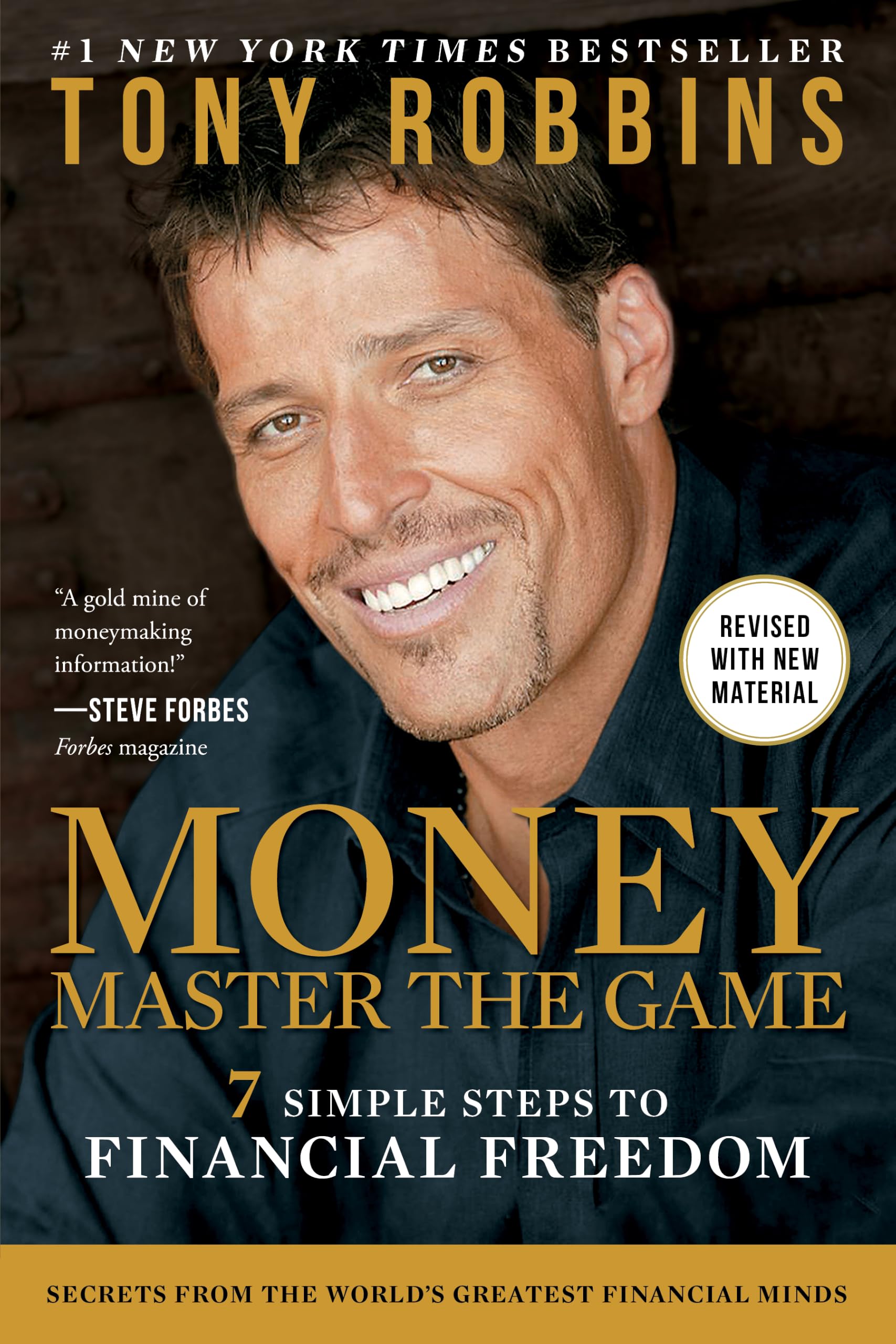
⚡️ What is Money: Master the Game About?
I’ll be honest: when I first saw the size of this book, I thought it was a prank. It’s a 600-page doorstop written by a guy famous for high-energy seminars, not hedge fund management. But here’s the thing—Tony Robbins didn’t write this from his own head. He spent four years interviewing 50 of the most successful financial minds on the planet, from Ray Dalio to Warren Buffett, asking them how they’d win if they had to start over today. More summaries by Tony Robbins are available, but this one is the heavyweight champion of his collection.
The central argument is that the financial system is rigged to extract fees from you, and the only way to win is to stop being a consumer and start being an owner. It’s a masterclass in investing book summaries because it translates high-level institutional strategies into a 7-step plan for the rest of us. Robbins argues that financial freedom isn’t about some lucky stock pick; it’s about the boring, mathematical reality of asset allocation and fee suppression. Have you ever actually looked at what your 401(k) fees are costing you over 30 years? The answer is usually ‘a house,’ and this book is designed to stop that bleeding.
🚀 The Book in 3 Sentences
- Wealth is built by automating a percentage of your income into a ‘Freedom Fund’ before you ever see the paycheck.
- The biggest threat to your retirement isn’t market volatility, but the hidden, compounding fees of actively managed funds that eat up to 60% of your potential returns.
- True financial security comes from asset allocation—diversifying across ‘buckets’ so you can profit in any economic climate without losing your shirt.
🎨 Impressions
Reading this book felt like sitting through a three-day Tony Robbins event—exhausting, loud, but undeniably effective. I walked in skeptical of a ‘motivational speaker’ teaching me about tax-loss harvesting, but the sheer caliber of his sources changed my mind. When you have Jack Bogle (the father of index funds) and Ray Dalio (founder of the world’s largest hedge fund) giving you the exact percentages of their portfolios, you listen. I found myself dog-earing the sections on ‘fiduciary’ standards because I realized I’d been taking advice from people who were essentially salespeople, not advisors.
It’s not all sunshine and rainbows, though. The middle sections on annuities and private placement life insurance felt a bit like a sales pitch for specific financial products. I felt my ‘inner skeptic’ flare up during those chapters. However, the core logic—that we are being fleeced by the ‘mutual fund industrial complex’—is backed by so much data it’s hard to argue with. It’s a book that demands you take notes and actually open your brokerage account while you’re reading. Don’t expect a light read; expect a manual for a second job you didn’t know you had: Managing your own future.
📖 Who Should Read Money: Master the Game?
If you have a 401(k) or any money sitting in a savings account earning 0.01% interest, you need this. It’s perfect for the person who feels ‘financially illiterate’ but is smart enough to know they’re being overcharged. However, if you’re looking for ‘hot crypto tips’ or a way to get rich by next Tuesday, put this back on the shelf. This is for the long-game player who wants a ‘set it and forget it’ system that won’t blow up during the next recession.
☘️ How This Book Changed My Thinking
Before reading this, I thought ‘investing’ was about picking the right stocks at the right time. I spent way too much time looking at charts and not enough time looking at expense ratios.
- I moved my retirement accounts from actively managed funds with 1.5% fees to low-cost index funds with 0.05% fees—a move that will likely save me six figures over my lifetime.
- I stopped trying to ‘beat the market’ and started focusing on ‘asset allocation,’ which is the only lever that actually determines your long-term success.
- I realized that ‘financial freedom’ isn’t a vague dream but a specific number I can calculate and hit through simple math.
✍️ 3 Quotes That Stuck With Me
- “You’re already a financial trader. You might not think of it that way, but if you work for a living, you’re trading your time for money.” — This reframes every hour at the office as a finite resource you can’t afford to waste.
- “If you don’t have a plan, you’re part of someone else’s plan.” — A blunt reminder that the financial industry is designed to make them rich, not you.
- “Compound interest is the 8th wonder of the world. He who understands it, earns it; he who doesn’t, pays it.” — I’ve heard this before, but Robbins shows exactly how ‘fees’ are the inverse of compound interest.
📒 Summary + Notes
The book’s narrative arc moves from psychological preparation to technical execution. Robbins starts by smashing the myths we’ve been told about money—like the idea that you can’t retire unless you earn a massive salary. He argues that your most powerful tool isn’t your paycheck, but the ‘interest’ on your savings. The book builds a bridge from ‘earning’ to ‘owning,’ showing you how to build a money machine that works while you sleep. It’s about moving from being a chess piece to being the player.
By the end, Robbins wants you to believe that financial freedom is a choice, not a matter of luck. He provides a framework for ‘All Weather’ investing—a strategy designed to make money whether the market is going up, down, or sideways. The ultimate goal isn’t just to have a big bank account, but to have ‘certainty’ in an uncertain world. It ends on a surprisingly spiritual note, arguing that the secret to living is giving, and that wealth is only valuable if it allows you to contribute to others.
🧠 Core Ideas Explained Simply
Some of these concepts sound like ‘Wall Street speak,’ but they are actually quite simple when you strip away the jargon.
The Fiduciary Standard
Most ‘financial advisors’ are actually just ‘brokers’—meaning they only have to recommend products that are ‘suitable’ for you, even if those products pay the broker a fat commission. A fiduciary, however, is legally required to put your interests first. It’s the difference between a butcher selling you meat because it’s about to expire and a doctor prescribing what you actually need to stay healthy.
Asymmetric Risk/Reward
Is it possible to risk $1 to make $5? Most people think investing is a 50/50 coin flip, but the ultra-wealthy look for opportunities where the downside is limited and the upside is massive. They don’t take big risks; they take ‘calculated’ risks where the math is heavily in their favor.
The All-Weather Portfolio
Most people’s portfolios are 60% stocks and 40% bonds, which actually means 95% of their risk is in stocks. Ray Dalio’s approach balances the portfolio based on ‘volatility,’ not just dollar amounts. This creates a smoother ride, preventing the 50% drops that cause most investors to panic and sell at the worst possible time.
1: Welcome to the Jungle: The Journey Begins with This First Step
Wealth begins with a simple, psychological shift: you must decide to become an investor instead of a consumer. Robbins insists that you can’t ‘earn’ your way to wealth because you’ll always be limited by your time. Instead, you have to take a percentage of everything you earn—before you pay your bills—and put it into a ‘tax-advantaged’ bucket. He calls this the ‘Freedom Fund.’ Are you willing to pay yourself first, or will you keep giving your best years to your landlord and the tax man?
2: Become the Insider: Know the Rules Before You Get in the Game
Why do most people lose money in the market? Robbins argues it’s because they don’t know the ‘9 Myths’ that the financial industry uses to keep you confused. He spends a significant amount of time debunking the ‘active management’ lie—the idea that some guy in a suit can consistently beat the market. Statistics show that 96% of actively managed funds fail to beat the market over 15 years, yet we keep paying them high fees for the privilege of underperforming.
- **Fees Matter:** A 1% difference in fees can result in a 20-30% difference in your final nest egg.
- **Taxes Matter:** It’s not what you make; it’s what you *keep*. Investing in tax-efficient index funds is like getting an automatic 2% raise.
3: What is the Price of Your Dreams? Make the Game Winnable
I found this to be the most practical part of the book because it forces you to do the math. Most people have a vague ‘dream’ of being a millionaire, but they haven’t calculated what it actually costs to live their desired lifestyle. Robbins breaks this down into five levels: Financial Security, Vitality, Independence, Freedom, and Absolute Freedom. When you realize that ‘Financial Security’—covering your basic housing, food, and utilities—is actually a much smaller number than you thought, the mountain becomes much easier to climb.
4: Make the Most Important Investment Decision of Your Life
Imagine your money is in two buckets: the ‘Security Bucket’ (safe, low return) and the ‘Risk/Growth Bucket’ (volatile, high return). This chapter is about ‘Asset Allocation,’ which Robbins calls the only ‘free lunch’ in investing. Most people mess this up by putting all their money in one bucket or the other. Success isn’t about picking the right stock; it’s about the ratio between these buckets. How much can you afford to lose without losing your mind? That’s the question that determines your allocation.
5: Upside Without the Downside: Create a Lifetime Income Plan
This is where Ray Dalio enters the chat. Robbins managed to get Dalio to share his ‘All Weather’ portfolio strategy for the average investor. This is a mix of stocks, long-term bonds, intermediate-term bonds, gold, and commodities. The goal is to have something that performs well in all four ‘economic seasons’: rising prices (inflation), falling prices (deflation), rising growth, and falling growth. It’s designed to capture the market’s gains but with a fraction of the volatility.
6: Invest Like the .001%: The Billionaire’s Playbook
“Success leaves clues,” and Robbins spent his time hunting for them. He shares insights from interviews with icons like Paul Tudor Jones and Mary Callahan Erdoes. The common thread among these billionaires? They are obsessed with not losing money. While the average person is swinging for home runs, the giants are focused on defense. They use strategies like ‘structured notes’ and other complex tools to protect their capital. While we can’t all access private hedge funds, we can adopt their mindset: prioritize capital preservation above all else.
7: Just Do It, Enjoy It, and Share It!
What’s the point of having all this money if you’re miserable? The final chapter shifts from your bank account to your brain. Robbins argues that the ultimate ‘wealth’ is a state of mind. He talks about the science of spending money on experiences rather than things, and the psychological necessity of contribution. It’s a classic Tony Robbins ‘peak state’ ending, reminding you that money is just a tool to help you live a more meaningful life. If you don’t find joy in the process, you’ve already lost the game.
⚖️ A Critical Perspective
While the advice in Money: Master the Game is structurally sound, it’s not without flaws. At over 600 pages, the book is bloated; Robbins could have delivered the same impact in half the length if he cut the repetitive motivational ‘filler.’ Furthermore, some of his recommendations—like certain types of annuities or life insurance products—can be complex and carry high commissions, which feels slightly contradictory to his ‘anti-fee’ stance. Finally, the ‘All Weather’ portfolio was designed in a 30-year era of falling interest rates; in a 2025 environment of higher inflation and shifting rates, the heavy bond allocation might not provide the same ‘safe haven’ it once did. It’s a great foundation, but don’t treat it as an infallible Bible.
🔄 How It Compares
Compared to a book like *The Simple Path to Wealth* by JL Collins, Robbins’ book is much more complex and ‘institutional’ in its approach. While Collins argues for a 100% VTSAX (total stock market) approach for its simplicity, Robbins advocates for a more diversified, ‘hedged’ portfolio designed to minimize volatility. If you want the easiest possible path, go with Collins; if you want to understand how the big boys protect their billions, stay with Robbins.
🔑 Key Takeaways
These are the core shifts you need to make to stop being a victim of the system.
- **Automate the Savings:** If you have to think about saving money, you won’t do it. Set up an automatic transfer to your investment account the day you get paid.
- **Kill the Fees:** Every 1% you pay in fees is 10 years of retirement income you’re throwing away. Use low-cost Index Funds.
- **Diversity is the Only Shield:** Don’t just diversify across stocks; diversify across asset classes (Bonds, Gold, Commodities) to survive different economic seasons.
- **Know Your Number:** Calculate exactly what ‘Financial Security’ costs. It’s usually much more achievable than the vague ‘millionaire’ dream.
💬 Frequently Asked Questions
What is the Ray Dalio All Weather Portfolio?
It is an investment strategy shared by Ray Dalio in the book that uses a specific mix of assets—30% stocks, 40% long-term bonds, 15% intermediate bonds, 7.5% gold, and 7.5% commodities. It is designed to minimize risk and generate steady returns regardless of whether the market is booming or crashing.
Is Money: Master the Game still relevant in 2025?
Yes, the core principles of fee reduction and asset allocation are timeless. While specific bond performance can vary in high-interest environments, the book’s warning about ‘hidden fees’ in mutual funds and the importance of using fiduciaries remains some of the most important advice for modern retail investors.
What is the ‘9 Myths’ section about?
Robbins identifies nine common lies the financial industry tells to profit from you. The most important myths are that you can beat the market through active trading, that high fees are necessary for high returns, and that you need to take huge risks to make significant money.
Does Tony Robbins recommend specific stocks?
No. Robbins strongly discourages individual stock picking for the average investor. Instead, he focuses on index funds and ‘market-wide’ ETFs. He argues that even the pros fail at stock picking, so you shouldn’t waste your time or money trying to find the ‘next big thing.’
What is a fiduciary and why does it matter?
A fiduciary is a financial advisor legally bound to act in your best interest. Many advisors are just salespeople earning commissions on the products they sell you. Robbins emphasizes that finding an independent, fee-only fiduciary is the most important step in protecting your financial future.
Conclusion
At the end of the day, Money: Master the Game is about taking back your power. Most of us treat our finances like a black box—we hope for the best, but we don’t really know what’s happening inside. Tony Robbins shines a bright, sometimes blinding light into that box and shows you exactly where the leaks are. It’s a book that demands action, not just passive reading. If you actually implement even two or three of these steps—like switching to index funds or automating your savings—the book will pay for itself a thousand times over.
The ONE thing you should remember? You are the CEO of your own life. Don’t outsource your future to someone who doesn’t care about it as much as you do. Take the time to understand the rules of the game, reduce your costs, and protect your downside. If you do that, ‘Financial Freedom’ stops being a buzzword and starts being your reality. For more insights on building wealth, check out our other investing book summaries to keep your momentum going.
More From Tony Robbins →
Discover more from AI Book Summary
Subscribe to get the latest posts sent to your email.