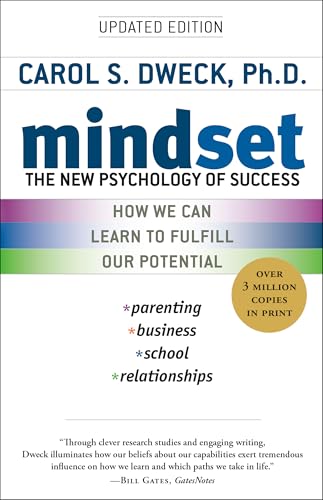
⚡️ What is Mindset: The New Psychology of Success about?
Mindset: The New Psychology of Success is a groundbreaking exploration into the power of our beliefs. Carol S. Dweck, a Stanford University psychologist, reveals that our success is not just about our abilities or talent, but crucially about the mindset we adopt. The book introduces two core mindsets: the fixed mindset, which believes our qualities are carved in stone, and the growth mindset, which sees our abilities as malleable and developable through effort and learning. Dweck’s research, spanning decades, demonstrates how this single fundamental belief influences every aspect of our lives—from our careers and relationships to our parenting and education. It’s a guide to understanding why we do what we do and how we can change our trajectory by changing our minds.
🚀 The Book in 3 Sentences
- Carol Dweck’s Mindset: The New Psychology of Success argues that the way we perceive our abilities—as either fixed or growth-oriented—profoundly impacts our resilience, motivation, and ultimate success.
- Embracing a growth mindset, where challenges are opportunities and effort is the path to mastery, unlocks our potential in ways a fixed mindset never can.
- The book provides a compelling framework and practical growth mindset strategies for identifying our current mindset and consciously choosing to cultivate a growth-oriented perspective in all areas of life.
🎨 Impressions
>Reading Mindset: The New Psychology of Success felt like having a light switched on in a dimly lit room. It wasn’t just another self-help book spouting positive affirmations; it was a rigorous, evidence-based explanation for the patterns I’d seen in myself and others. The concept is simple yet profound, and Dweck masterfully illustrates it with examples from sports, business, and art. What struck me most was the empowering message that our mindset is not a life sentence. It’s a choice. This book provides the vocabulary and the awareness to begin making that choice deliberately, which is perhaps the most powerful tool for personal development one can have.📖 Who Should Read Mindset: The New Psychology of Success?
>This book is essential reading for anyone who feels stuck, fears failure, or secretly believes they’re just not ‘good enough’ at something. Parents, educators, managers, and coaches will find invaluable growth mindset strategies for fostering resilience and a love of learning in others. If you are a leader looking to build a more innovative and collaborative team, or an individual striving to reach new heights in your personal or professional life, the insights in Mindset: The New Psychology of Success are universally applicable and transformative. It’s for anyone ready to unlock their true potential.☘️ How the Book Changed Me
>Before reading this book, I viewed challenges as threats and failure as a definitive judgment on my abilities. My internal monologue was often a harsh critic, quick to label any setback as proof of inadequacy. Mindset: The New Psychology of Success fundamentally rewired that inner voice. I learned to see effort not as a sign of weakness but as the very engine of growth. Now, when I face a difficult task, my first thought isn’t ‘Can I do this?’ but ‘How can I do this?’. This shift from a judge to a learner has been liberating.- I now actively seek out feedback, even when it’s critical, viewing it as valuable data for improvement rather than a personal attack.
- I’ve started using the word ‘yet’ as a powerful tool to reframe my limitations, turning ‘I can’t do this’ into ‘I can’t do this yet’.
- I’ve become more patient with myself and others, understanding that learning is a process and mastery takes time and sustained effort.
- I consciously praise effort and strategy in others, especially children, instead of innate talent, to help foster a growth mindset in them.
✍️ My Top 3 Quotes
- “Becoming is better than being.”
- “If you’re somebody when you’re successful, what are you when you’re unsuccessful?”
- “The view you adopt for yourself profoundly affects the way you lead your life.”
📒 Summary + Notes
>Mindset: The New Psychology of Success is structured to first explain the two mindsets, then demonstrate their effects across various life domains, and finally, provide a practical guide for change. Dweck’s central thesis is that our understanding of success and failure is filtered through our mindset. The fixed mindset creates an urgency to constantly prove oneself, leading to a fear of failure and a hatred of challenges. In contrast, the growth mindset thrives on challenge and sees failure not as evidence of unintelligence but as a springboard for growth and for stretching our existing abilities. The following chapters break down this powerful concept.Chapter 1: The Mindsets
>This opening chapter lays the foundation by defining the two core mindsets. Dweck explains that the fixed mindset is the belief that your qualities—like intelligence or talent—are static traits. You’re either good at something or you’re not. This creates a world of judgment. The growth mindset, conversely, is the belief that your basic qualities are things you can cultivate through your efforts. It’s a world of learning and development. The chapter uses a simple but powerful example of a study where children were praised for intelligence versus effort. Those praised for intelligence (fixed mindset) chose an easier subsequent task, while those praised for effort (growth mindset) chose a more challenging one, eager to learn.- Fixed Mindset: Believes abilities are innate and unchangeable.
- Growth Mindset: Believes abilities can be developed through dedication and hard work.
- The type of praise we receive (for intelligence vs. effort) can significantly shape our mindset.
- Our mindset determines whether we see the world as a place of judgment or a place of learning.
Chapter 2: Inside the Mindsets
>Dweck takes us deeper into the internal world of both mindsets. What does it feel like to have a fixed or growth mindset? In a fixed mindset, a single failure can feel like a verdict, leading to helplessness or a desperate need to cover up deficiencies. Effort is seen as a sign of low ability. In a growth mindset, failure is an uncomfortable but informative event—a problem to be solved. Effort is what makes you smart and talented. This chapter explores how mindsets affect our self-esteem and our response to setbacks. A fixed mindset makes you fragile, while a growth mindset makes you resilient and able to learn from even the most difficult experiences.- People with a fixed mindset often feel threatened by the success of others.
- Those with a growth mindset find inspiration and lessons in the success of others.
- The internal monologue of a fixed mindset is judgmental, while a growth mindset’s voice is more compassionate and focused on learning.
- Dweck introduces the idea that we all have both mindsets; the key is which one we cultivate and allow to guide us.
Chapter 3: The Truth About Ability and Accomplishment
>This chapter tackles the common misconception that success is solely a product of innate talent. Dweck uses research and compelling examples to show that achievement is often more about mindset than natural gift. She discusses famous figures like Charles Darwin and Leo Tolstoy, who were considered ordinary children but achieved greatness through passion and perseverance. The chapter debunks the idea of the ‘natural’ who doesn’t have to try. It argues that even prodigies like Mozart put in years of dedicated practice. The key takeaway is that praising natural ability can create a fixed mindset that undermines long-term accomplishment, while praising process and effort builds the resilience needed for true success.- Potential is not a fixed starting point but a capacity to grow and develop.
- Focusing solely on ‘genius’ can blind us to the role of hard work and learning in achievement.
- The book highlights that a growth mindset helps people convert life’s setbacks into future successes.
- Many high achievers, like John McEnroe, illustrate how a fixed mindset can lead to talent being wasted due to an inability to cope with failure or criticism.
Chapter 4: Sports: The Mindset of a Champion
>Sports provide a perfect arena to observe the mindsets in action. Dweck contrasts athletes like Michael Jordan, who famously used being cut from his high school team as motivation to work harder (a clear growth mindset), with athletes like Billy Beane (as depicted in *Moneyball*), who had immense talent but a fixed mindset that made him crumble under pressure. A champion with a growth mindset sees losing not as a condemnation but as a learning opportunity. They study their failures, seek coaching, and relentlessly work on their weaknesses. This chapter demonstrates that character and mindset are what separate the good from the truly great, often more so than raw physical talent.- Michael Jordan embodies the growth mindset, viewing his failures as stepping stones.
- The ‘natural’ athlete with a fixed mindset often struggles when they finally face a real challenge.
- Greatness in sports is about finding the motivation to become the best you can be, which is a core growth mindset principle.
- Coaches with a growth mindset, like John Wooden, focus on character and effort, not just on winning.
Chapter 5: Business: Mindset and Leadership
>The principles of mindset apply directly to the corporate world. Dweck analyzes leaders like Lee Iacocca, who had a fixed mindset and became more concerned with propping up his ego and being seen as a genius than with the long-term health of Chrysler. In contrast, leaders like Jack Welch (in his later years) and Anne Mulcahy of Xerox championed the growth mindset, fostering collaboration, innovation, and a culture of learning. A fixed-mindset CEO creates a climate of fear where people are afraid to take risks or admit mistakes. A growth-mindset leader builds an organization of people who are not afraid to be innovative, to ask questions, and to voice dissenting opinions, leading to sustainable success.- Fixed-mindset leaders often believe they have all the answers and surround themselves with sycophants.
- Growth-mindset leaders believe in the development of their people and create a culture of trust and empowerment.
- The collapse of companies like Enron is linked to a fixed-mindset culture of ‘genius’ that shunned questioning and learning.
- Effective leadership is less about having all the answers and more about fostering a team that can learn and grow together.
Chapter 6: Relationships: Mindsets in Love (or Not)
>This chapter explores how our mindsets shape our personal relationships. In a fixed mindset, people believe their partners’ traits are fixed. If there’s a problem, it’s a character flaw. This leads to blame, judgment, and a desire to find a ‘perfect’, pre-qualified partner. There is no room for growth or working through issues. With a growth mindset, partners believe that they can develop their qualities and help their partners do the same. Problems are seen as opportunities for understanding and mutual growth. They can communicate, forgive, and support each other through challenges, leading to stronger, more resilient relationships built on a foundation of shared effort.- A fixed mindset in relationships leads to a search for instant perfection and blame when it’s not found.
- A growth mindset supports the idea that all relationships can be nurtured and improved through effort.
- Shaming and labeling are hallmarks of a fixed mindset approach to conflict.
- Communication, empathy, and a willingness to work on problems are signs of a growth mindset in a partnership.
Chapter 7: Parents, Teachers, and Coaches: Where Do Mindsets Come From?
>Dweck investigates the origins of our mindsets, pointing to the powerful influence of parents, teachers, and coaches. The messages we receive as children are critical. Praising a child’s intelligence (‘You’re so smart’) fosters a fixed mindset. Praising their process, effort, and strategies (‘You worked really hard on that puzzle’) cultivates a growth mindset. This chapter provides crucial guidance for anyone in a position of influence. It teaches how to offer constructive criticism that focuses on improvement rather than judgment and how to create an environment where it’s safe to fail and learn. The goal is to raise children who are resilient learners, not fragile perfectionists.- Every word and action from a parent or teacher sends a message about how we think of ourselves.
- The book provides practical fixed mindset techniques for parents to avoid, such as overprotecting children from failure.
- Teachers should convey that they value learning and process, not just perfect scores.
- High standards and a nurturing environment are not mutually exclusive; they are the foundation of a growth mindset in education.
Chapter 8: Changing Mindsets: A Workshop
>The final chapter is a practical guide to making the change. Dweck acknowledges that changing a deeply ingrained fixed mindset is a journey, not an overnight switch. She provides a step-by-step workshop. The first step is to recognize the fixed-mindset voice in your head—the one that fears failure and judges you. The second step is to realize that you have a choice in how you interpret that voice and the challenges you face. The third step is to talk back to it with a growth-mindset voice, reframing challenges as opportunities and setbacks as learning. Finally, you must take growth-mindset action. This chapter empowers the reader to actively practice these steps and begin the process of change.- Step 1: Embrace the Fixed Mindset: Acknowledge its presence and understand its purpose—to protect you.
- Step 2: Recognize Your Choice: You don’t have to obey the fixed-mindset voice.
- Step 3: Talk Back with a Growth Mindset: Counteract fixed thoughts with growth-oriented ones.
- Step 4: Take Growth Action: Act on your growth beliefs, even when it’s uncomfortable.
Key Takeaways
>The lessons from Mindset: The New Psychology of Success are both profound and practical. The core realization is that our perception of ourselves and our abilities is not set in stone. We have the power to choose a perspective that fosters growth and resilience. The book’s ultimate message is one of empowerment. By understanding the two mindsets, we can gain insight into our own behavior and the behavior of those around us. We can learn to praise process over person, embrace challenges, and persist through setbacks. These are not just strategies for success; they are strategies for a more fulfilling and engaged life.- The most important thing you can teach someone is a growth mindset, as it is the foundation for all future learning and achievement. \li>Effort is the key that unlocks ability and potential; it is not a sign of weakness but the path to mastery.
- Failure is not a label but a temporary state and a valuable source of information.
- Changing your mindset requires conscious effort—it’s a journey of recognizing your fixed-mindset triggers and actively choosing a growth-oriented response.
Conclusion
>Reading Mindset: The New Psychology of Success is more than an intellectual exercise; it’s a call to action. It arms you with the awareness to see the world through a new lens and the tools to begin reshaping your own reality. The distinction between the two mindsets is simple, but its implications are vast, touching every corner of our existence. If you find yourself held back by fear of failure or a belief in your own limitations, this book is your roadmap to liberation. It teaches us that our true potential is not something we’re born with, but something we build. I highly recommend picking up the full book to dive deep into the research and stories that make these concepts so powerful and to begin your own journey of transformation.More From Carol S. Dweck →
Discover more from AI Book Summary
Subscribe to get the latest posts sent to your email.