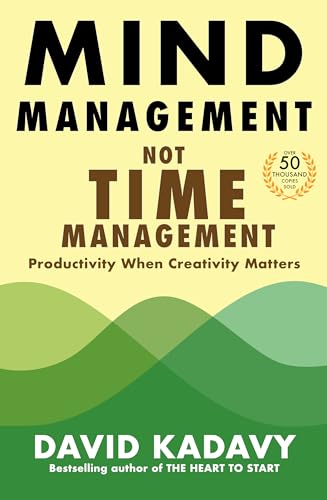
⚡️ What is Mind Management, Not Time Management About?
Ever felt like you’ve meticulously planned every minute of your day, only to end up staring at a blinking cursor for four hours? I’ve been there more times than I care to admit. We’ve been sold this lie that if we just find the right calendar app or the perfect color-coding system, we’ll finally be “productive.” But David Kadavy argues that we’re trying to solve a 21st-century problem with an Industrial Revolution toolkit. Time management was great for factory workers, but for those of us doing creative or knowledge work, it’s a recipe for burnout.
In More summaries by David Kadavy, the central thesis is simple but profound: focus on your mental state rather than the clock. If you try to do deep, creative work when your brain is in “administrative mode,” you’re essentially trying to squeeze blood from a stone. Kadavy spent a decade experimenting on himself—moving to Colombia, dismantling his routine, and tracking every spark of inspiration—to figure out why some hours are worth ten times more than others. This isn’t just another Productivity book summary; it’s a guide to working with your biology instead of against it.
🚀 The Book in 3 Sentences
- Knowledge work is non-linear and depends entirely on fluctuating mental energy, making traditional hourly scheduling obsolete.
- By identifying seven distinct mental states—such as Generate, Research, and Polish—you can match your most demanding tasks to your natural peak energy windows.
- The goal is to move from “forced” productivity to “effortless” output by creating the right conditions for your mind to enter the flow state naturally.
🎨 Impressions
Honestly, I found this book incredibly liberating. For years, I felt guilty because I couldn’t write high-quality content at 4:00 PM on a Friday. I thought I lacked discipline. Reading Kadavy’s breakdown of “mental states” felt like someone finally gave me permission to be human. It’s a very personal book; Kadavy doesn’t hide behind academic jargon. He shares his failures, his weird habits, and his struggles with “The Resistance” in a way that makes you feel like you’re chatting with a friend who’s just a few steps ahead of you on the path.
The part that really dog-eared my brain was his discussion of “Passive Project Management.” We usually think a project is only moving forward when we’re actively working on it. Kadavy shows how the mind “marinates” on ideas in the background. It’s why you get your best ideas in the shower, right? He’s very practical about how to actually use this, which I appreciated. It’s not all high-level theory; there are specific frameworks you can start using on your very next Monday morning.
📖 Who Should Read Mind Management, Not Time Management?
If you’re a freelancer, writer, designer, or anyone whose paycheck depends on “having good ideas,” this is your new bible. It’s also for the burnt-out corporate worker who is tired of living and dying by their Outlook calendar. However, if you work on an assembly line or in a role where your tasks are 100% reactive (like a 911 dispatcher), the core advice here might be hard to implement. This is a book for people with at least some autonomy over their schedule.
☘️ How This Book Changed My Thinking
Before reading this, I treated every hour in my workday as equal. Now, I treat them as unique ecosystem zones.
- I stopped scheduling “writing time” in the afternoons. I realized that’s my “Administrate” or “Research” window, and trying to force creativity then was just self-torture.
- I started using “Passive Project Management” by opening a document 24 hours before I actually intend to work on it, just to let the “spiders” in my brain start spinning.
- I’ve become much more protective of my first two hours of the day. Those are my “Generate” hours, and I now treat them as sacred—no email, no Slack, no exceptions.
✍️ 3 Quotes That Stuck With Me
- “Time management is like squeezing blood from a stone.” — This perfectly captures the futility of trying to force creative output through sheer willpower.
- “The mind is infinite in its capacity for wisdom. The brain is a stupid, little dog that is easily trained.” — Kadavy uses this (citing Seinfeld) to show that we have to trick our biology into doing what we want.
- “If you have eight hours in the day to work, there’s plenty of time to procrastinate. But if you’ve identified a two-hour block… it creates a sense of urgency.” — This reframes procrastination from a character flaw into a structural scheduling error.
📒 Summary + Notes
The overarching argument of Mind Management, Not Time Management is that our creative output is determined by our internal weather, not the external clock. Kadavy walks us through the history of productivity, showing how we transitioned from “effort-based” work (plowing a field) to “result-based” work (writing code). The problem is that results in the information age aren’t proportional to the time spent. You can spend 10 hours on a bad idea and zero hours on a billion-dollar epiphany. To maximize those epiphanies, you have to manage your mind.
He builds a narrative that moves from the macro (how to view your week) to the micro (how to handle the next ten minutes). He insists that productivity isn’t about doing more; it’s about making the things you do more impactful by doing them when your brain is actually ready. By the end of the book, he wants you to view your to-do list not as a list of obligations, but as a menu of options that you match to your current mental state. It’s about building a system that accommodates your humanity rather than trying to turn yourself into a machine.
🧠 Core Ideas Explained Simply
There are a few key concepts Kadavy uses to dismantle the traditional productivity model.
The 7 Mental States
Think of your brain like a toolbox. You wouldn’t use a saw to drive a nail, right? Kadavy identifies seven distinct states: Generate (creating), Research (gathering facts), Polish (editing), Explore (curiosity/brainstorming), Administrate (small details), Prioritize (planning), and Recover (rest). The secret sauce is knowing which “tool” you have in your hand at any given moment and only doing the work that fits that tool. If you’re feeling scattered and low-energy, that’s your “Administrate” state—perfect for clearing your inbox, but terrible for writing a strategy memo.
Passive Project Management
Why do we always get our best ideas when we aren’t at our desks? Kadavy explains that the brain needs time to “incubate” ideas. He suggests “planting seeds” by looking at a task or reading a brief a day or two before you actually sit down to do the work. This allows your subconscious to chew on the problem while you’re sleeping, walking, or doing the dishes. It makes the actual execution phase feel almost effortless because the heavy lifting happened in the background.
The Creative Sweet Spot
Have you ever noticed that you’re most creative right when you wake up, or perhaps late at night? This is your Creative Sweet Spot. It usually occurs when your “prefrontal cortex”—the logic center that tells you your ideas are stupid—is slightly tired or not fully awake. Kadavy argues that we should guard these hours with our lives. Using your Sweet Spot for something like checking email is a productivity sin of the highest order.
1: The Time Management Paradox
Why is it that the more we try to “save” time, the more stressed we feel? Kadavy opens by dismantling the idea that saving ten minutes on a task makes us more productive. In the world of knowledge work, time is not a constant. One hour of high-energy creative work can yield more results than forty hours of low-energy slog. He suggests we stop looking at the clock and start looking at our internal compass. The paradox is that the harder we try to manage our minutes, the less we manage our actual output.
2: The 7 Mental States
Imagine trying to bake a cake using a hammer—it’s the wrong tool for the job. This chapter is the meat of the book, where he breaks down the specific modes our brains inhabit. He goes deep into how to recognize when you are in a “Generate” state versus a “Polish” state.
- Generate: High energy, creation-focused.
- Research: Curious, looking for specific answers.
- Polish: Analytical, detail-oriented.
- Explore: Loose, divergent thinking.
- Administrate: Low energy, mindless tasks.
- Prioritize: Strategic, bird’s eye view.
- Recover: Recharging the battery.
3: Passive Project Management
Is it possible that you’re working even when you aren’t “working”? Kadavy introduces the concept of the “incubation period.” He shares the story of Ignaz Semmelweis and how scientific breakthroughs often happen during periods of rest. The practical takeaway here is to “touch” your projects early and often without the pressure of finishing them. By simply reviewing your notes for a big project on Friday afternoon, your brain will work on it all weekend without you even realizing it. When you sit down on Monday, the ideas are already there waiting for you.
4: The Pre-Week Review
How do you actually plan a week if you aren’t using a rigid calendar? Kadavy suggests a “Prioritize” session every Sunday. Instead of saying “I will write on Tuesday at 10 AM,” you identify which “buckets” of time you have available. You look at your energy cycles. You might decide that Tuesday morning is a “Generate” bucket, and then you pick a task from your list that fits that state when the time comes. This allows for flexibility—if you wake up Tuesday with a headache, you can swap that “Generate” bucket for an “Administrate” bucket without blowing up your entire week.
5: Overcoming Resistance
What do you do when you’re in the right state, you’ve got the right task, but you still just… can’t? This chapter addresses the psychological hurdles of creativity. Drawing on Jerry Seinfeld’s “stupid little dog” analogy, Kadavy argues that we have to trick our brains into starting. Use the “10-minute rule”: tell yourself you’ll only work for ten minutes. Usually, that’s enough to overcome the initial friction of the “Resistance” and get into a flow state. He also discusses how our environment acts as a trigger for different states—using a specific coffee shop only for writing, for example.
6: The Creative Sweet Spot
Your brain isn’t a steady-state machine; it’s a fickle organ that functions differently depending on the sun’s position. Kadavy explains the science of circadian rhythms and how they affect our cognitive abilities. He identifies the “Sweet Spot” as that time of day when your analytical filters are down and your creative associations are up. For many, this is early morning. He makes a compelling case that using this window for anything other than your most important creative work is essentially throwing money—and life—away.
7: Results of Mind Management
What does a life managed by the mind actually look like? In the final chapter, Kadavy brings it all together, showing how this system allows him to produce a massive amount of content (books, podcasts, articles) while still having time for travel and leisure. He emphasizes that this isn’t about being a “productivity hacker” for the sake of it. It’s about finding a sustainable way to contribute your best work to the world without losing your mind in the process. He encourages the reader to start small—pick one mental state and start tracking it this week.
⚖️ A Critical Perspective
While Kadavy’s framework is brilliant, it leans heavily into a “solopreneur” lifestyle. If you work in a high-intensity corporate environment where your boss can ping you for a “quick call” at any moment, some of these sacred boundaries are incredibly hard to maintain. He also glosses over the reality of people with children or caregiving responsibilities; “mind management” is a lot easier when you don’t have a toddler screaming during your Generate window. Finally, the “stupid little dog” analogy for the brain is a bit oversimplified—neuroscience is a lot messier than just “training” a puppy.
🔄 How It Compares
Compared to David Allen’s Getting Things Done, this book is much less interested in the “where” and “how” of filing systems and much more interested in the “when” and “why” of mental energy. While GTD focuses on clearing the deck so you can work, Kadavy focuses on what happens once you’re actually sitting at the desk. It’s the perfect companion for someone who has a system for capturing tasks but still struggles to actually finish the creative ones.
🔑 Key Takeaways
These are the actionable shifts you can make right now to stop the “time management” treadmill.
- Stop treating hours as equal: Your 8:00 AM hour is not the same as your 2:00 PM hour. Schedule accordingly.
- Label your to-do list by state: Instead of “Work,” label tasks as “Generate,” “Polish,” or “Admin.”
- Use “Seed Planting”: Review big projects briefly a day before you start them to trigger subconscious incubation.
- Protect your Sweet Spot: Find the 90 minutes a day where you are most creative and treat that time as a sacred, no-interruptions zone.
💬 Frequently Asked Questions
What is the main argument of Mind Management, Not Time Management?
The book argues that in the information age, our primary constraint isn’t time, but mental energy. Traditional time management fails because it treats all hours as equal. True productivity comes from identifying your current mental state and matching it to the right task, maximizing “effortless” creative output.
What are the 7 mental states David Kadavy describes?
The seven states are Generate (creation), Prioritize (planning), Research (learning), Explore (curiosity), Administrate (maintenance), Polish (editing), and Recover (rest). Success comes from recognizing which state you are in and refusing to perform tasks that clash with that specific mental energy window.
How do I use this if I have a 9-5 job with meetings?
While you can’t control every hour, you can manage the “white space” between meetings. Use low-energy gaps for Administrate tasks and try to block off your most creative window (even if it’s just 30 minutes) for Generate tasks. Consistency in your small windows creates massive long-term results.
What is “Passive Project Management”?
This is the practice of “planting seeds” by reviewing project materials long before you actually sit down to do the work. It allows your subconscious mind to incubate ideas in the background, making the eventual execution phase much faster and more creative than if you started from scratch.
Is this book better than Getting Things Done?
It’s not better, just different. GTD is great for organization and reducing anxiety about forgotten tasks. Mind Management is better for actually producing creative work once you’re organized. If you have a long list of tasks but can’t seem to make progress on the big ones, read this.
Conclusion
At the end of the day, Mind Management, Not Time Management is a call to stop being so hard on ourselves. We aren’t robots. We can’t just flip a switch and be brilliant because it’s 9:00 AM. By learning to ride the waves of our own mental energy, we can actually get more done while working fewer hours. It’s a shift from “hustle culture” to “flow culture.”
If you take nothing else away from this, remember that your brain needs to marinate. Stop trying to force the big ideas and start creating the conditions for them to show up. Whether you’re an artist or an analyst, David Kadavy’s framework offers a way out of the overwhelm and back into the joy of actually creating something that matters. Go check out our other Productivity book summaries for more ways to master your workflow.
More From David Kadavy →
Discover more from AI Book Summary
Subscribe to get the latest posts sent to your email.