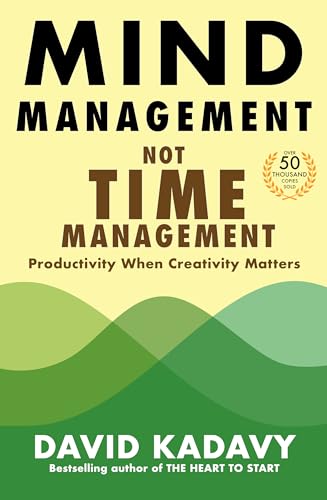
⚡️ What is Mind Management, Not Time Management about?
Mind Management, Not Time Management by David Kadavy revolutionizes how we approach productivity in the knowledge economy. This groundbreaking book argues that managing your mental energy is far more important than managing your clock. Kadavy presents a revolutionary framework centered on seven distinct mental states that determine your ability to produce high-quality creative work. Rather than forcing tasks into arbitrary time slots, you’ll learn to align your work with your natural cognitive rhythms, maximizing output while minimizing burnout. The book provides practical tools for recognizing which mental state you’re in and matching it with appropriate tasks, transforming chaos into creative flow.
🚀 The Book in 3 Sentences
- Mind Management, Not Time Management teaches that creative productivity depends on aligning tasks with your current mental energy state rather than forcing work into rigid schedules.
- David Kadavy identifies seven distinct mental states—Generate, Prioritize, Research, Explore, Administrate, Polish, and Recover—that each require specific types of work to maximize effectiveness.
- By recognizing and honoring these natural cognitive rhythms, you can produce higher quality creative work in less time while avoiding the burnout that comes from mismatched energy and tasks.
🎨 Impressions
Reading Mind Management, Not Time Management felt like discovering the missing manual for creative productivity that I never knew I needed. Kadavy’s approach resonates deeply because it acknowledges what every creative professional secretly knows: traditional time management fails when you’re doing knowledge work that requires cognitive flexibility and creative insight. The seven mental states framework immediately clicked with my experience of having different types of energy throughout the day, validating intuitions I’d always had but couldn’t articulate properly.
What struck me most was Kadavy’s rejection of the industrial-age productivity model that treats all hours as equal. Instead, he embraces the messy reality of creative work, offering a system that works with your brain rather than against it. The writing is accessible yet sophisticated, filled with personal anecdotes and practical examples that make the concepts immediately applicable. This isn’t just another productivity hack; it’s a fundamental rethinking of how creative work actually happens. I found myself nodding in agreement on nearly every page, realizing that my struggles weren’t personal failures but systemic misalignments between my tasks and my mental energy.
📖 Who Should Read Mind Management, Not Time Management?
Mind Management, Not Time Management is essential reading for knowledge workers, creatives, writers, designers, entrepreneurs, and anyone whose work requires deep thinking rather than rote mechanical tasks. If you’ve ever felt frustrated by traditional productivity systems that assume you can schedule creative insights between 2:00 and 3:00 PM, this book offers the liberation you’ve been seeking. It’s particularly valuable for remote workers and solopreneurs who control their own schedules and need frameworks for structuring unstructured time effectively.
The book speaks directly to those experiencing creative burnout or procrastination despite having adequate time. If you find yourself staring at blank screens when you should be producing, or doing administrative tasks when you should be creating, Kadavy’s mental state framework will transform your approach. However, if you work in rigid corporate environments with back-to-back mandatory meetings, you may find the implementation challenging, though the concepts remain valuable for understanding your cognitive limitations. Even managers and team leaders can benefit from understanding these rhythms to better support their creative employees.
☘️ How the Book Changed Me
Implementing the principles from Mind Management, Not Time Management fundamentally altered how I structure my workdays and approach creative projects. I stopped trying to force deep creative work during low-energy afternoon slumps and began honoring my natural cognitive rhythms. The transformation wasn’t immediate, but within weeks I noticed a significant reduction in the anxiety that typically plagued my productive hours. I no longer feel guilty when I choose to answer emails during my afternoon energy crash, recognizing that I’m actually being efficient by matching my Administrate state with my available energy.
- I began tracking my energy levels throughout the day, discovering that my peak Generate state occurs between 9:00 AM and 11:00 AM, completely transforming my scheduling priorities.
- I stopped feeling guilty about administrative tasks during low-energy periods, recognizing that matching the Administrate mental state with tired afternoons is actually efficient, not lazy.
- I created separate to-do lists for each mental state rather than one overwhelming list, reducing decision fatigue and making it easier to start working.
- I implemented “recovery” as a legitimate work category, understanding that rest isn’t unproductive time but essential maintenance for creative capacity.
- I began batching similar mental states together, doing all research in one block rather than context-switching, which dramatically improved my focus and output quality.
✍️ My Top 3 Quotes
- “Time management is like squeezing blood from a stone.”
- “The mind is infinite in wisdom. The brain is a stupid, little dog that is easily trained. Do not confuse the mind with the brain.”
- “If you have eight hours in the day to work, there’s plenty of time to procrastinate. But if you’ve identified a two-hour block in which you can be several times more productive than any other time of day, it creates a sense of urgency.”
📒 Summary + Notes
Mind Management, Not Time Management presents a revolutionary framework for knowledge workers seeking to maximize creative output without sacrificing wellbeing. David Kadavy argues that traditional time management approaches fail because they treat human attention as a uniform resource that can be scheduled arbitrarily. Instead, he proposes managing seven distinct mental states that cycle throughout your day and week, each suited for specific types of cognitive work. This summary explores each chapter’s core concepts and provides actionable insights for implementing this energy-based productivity system in your own life.
Chapter 1: Introduction – The Death of Time Management
Kadavy opens by dismantling the industrial-age concept of time management, arguing that it worked for factory workers doing repetitive tasks but fails spectacularly for creative knowledge work. He shares his personal journey from rigid scheduling to energy-based productivity, explaining how forcing creative work into arbitrary time slots produces anxiety and mediocre results. The chapter establishes the central premise: your mind has different modes of operation, and productivity depends on matching tasks to these modes rather than forcing them into calendar blocks. Kadavy uses the metaphor of baby spiders crawling everywhere to describe the anxiety of unstructured creative work, offering his framework as the web that catches them without killing their vitality.
- Time management assumes all hours are created equal, which is neurologically false for creative work.
- The “stupid little dog” metaphor illustrates how the brain can be trained through repetition and systematization, but the mind requires different care.
- Kadavy introduces the concept of mental states as the solution to creative procrastination and burnout.
- The anxiety of incomplete tasks comes from mental state mismatch, not lack of time.
- Traditional productivity creates cobwebs of anxiety when tasks don’t match available mental energy.
Chapter 2: The Generate State
The Generate state represents the holy grail of creative work—that flow state where you produce original content, whether writing, designing, coding, or strategizing. Kadavy emphasizes that this state is fragile and requires specific conditions to emerge, including adequate energy, freedom from interruptions, and the right environmental cues. He explains why trying to Generate during low-energy periods produces trash that requires extensive later revision, making it more efficient to wait for the right state. The chapter demolishes the myth of “writer’s block,” reframing it as simply being in the wrong mental state or attempting to Generate when your brain is actually in Administrate or Recover mode.
- Generate is “the time to do the work” where original creation happens, requiring the highest cognitive resources.
- This state typically follows a bell curve throughout the day, lasting 2-4 hours for most people, often in the morning.
- Attempting to Generate while in other states produces what Kadavy calls “shadow work”—inefficient half-efforts that need redoing.
- Protecting Generate time requires ruthless boundary-setting and recognizing that not all hours are equally valuable.
- The chapter provides specific tactics for entering Generate mode, including environment setup and warm-up rituals.
Chapter 3: The Prioritize State
Prioritize mode involves strategic thinking, planning, and decision-making about what deserves your attention. Kadavy distinguishes this from administrative task management, explaining that Prioritize requires meta-cognitive awareness to determine which projects align with long-term goals. This state demands clarity but less creative energy than Generate, making it suitable for transition periods or moderate energy levels. The chapter explains why trying to Prioritize when exhausted leads to choosing urgent but unimportant tasks over meaningful work. Kadavy introduces the concept of “capture” to offload planning anxiety, allowing your mind to return to Generate mode without worrying about forgotten obligations.
- Prioritize is distinct from administrating; it’s about choosing direction rather than executing details.
- This state works best when you have enough mental clarity to see big picture connections but don’t need flow-state immersion.
- Weekly reviews and quarterly planning sessions exemplify high-quality Prioritize work.
- Kadavy warns against trying to Prioritize when exhausted, as decision fatigue leads to choosing easy tasks over important ones.
- The chapter introduces “capture” practices to offload planning anxiety so you can return to Generate mode.
Chapter 4: The Research State
Research mode involves searching for specific answers to specific questions, gathering facts to support creative work. Kadavy positions this as distinct from exploratory browsing—it’s targeted information retrieval with a clear objective. This state requires focus and critical evaluation skills but allows for shorter attention spans than Generate, making it suitable for afternoon energy dips. The chapter warns against “research holes” where you continue gathering information to avoid the discomfort of Generate mode. Kadavy provides specific criteria for knowing when you have enough research to proceed, preventing the paralysis of perpetual preparation that plagues many creative projects.
- Research answers specific questions like “what statistics support my argument” rather than browsing broadly.
- This state requires different cognitive muscles than creating—it involves filtering, validating, and organizing external information.
- Kadavy emphasizes the danger of fake Research (procrastination disguised as productivity) versus genuine information gathering.
- The chapter provides frameworks for determining when you have enough research to return to Generate mode, preventing paralysis.
- Research works well in shorter blocks and can serve as a bridge between high-energy Generate sessions.
Chapter 5: The Explore State
Explore represents the curious, open-ended browsing mode where you follow tangents and make novel connections. Unlike Research’s targeted approach, Explore embraces serendipity and allows your mind to wander across disciplines. Kadavy argues this state is essential for creative breakthroughs but requires balancing with Generate to ensure exploration produces rather than procrastinates. The chapter distinguishes healthy exploration from avoidance behavior, providing signals to recognize when you’re avoiding hard work. Kadavy shares how he schedules dedicated Explore time to prevent it from bleeding into Generate sessions, treating curiosity as a necessary nutrient for creativity rather than a distraction to be eliminated.
- Explore is “less focused… calls for being attuned to your curiosity” and allows for cross-pollination of ideas.
- This state resembles browsing poetry books, wandering through museums, or following Wikipedia rabbit holes with intention.
- Explore often feeds Generate by providing unexpected connections and raw material for creative synthesis.
- The chapter distinguishes healthy exploration from avoidance behavior, providing signals to recognize when you’re avoiding hard work.
- Kadavy suggests scheduling Explore time to prevent it from bleeding into Generate sessions.
Chapter 6: The Administrate State
Administrate covers the necessary maintenance work that makes creative production possible: email, scheduling, expense reports, and organizing files. Kadavy reframes these tasks not as interruptions but as legitimate mental states that match low-energy cognitive patterns. Rather than fighting administrative work during peak creative hours, he advocates batching these tasks when your brain is tired but still capable of processing details. The chapter provides relief for those who feel guilty about spending time on logistics, reframing it as essential infrastructure work. Kadavy shares his system of administrative buckets and time-blocking for maintenance work, showing how to clear these tasks efficiently without letting them colonize your Generate time.
- Administrate includes “taking care of details that make your creative work possible” rather than the creative work itself.
- This state requires minimal cognitive load, making it perfect for afternoon slumps or post-lunch energy crashes.
- Attempting to administrate during Generate time wastes precious creative energy on low-value tasks.
- Kadavy shares his system of administrative buckets and time-blocking for maintenance work.
- The chapter relieves guilt about administrative procrastination by recognizing it as state-mismatch rather than character flaw.
Chapter 7: The Polish State
Polish involves editing, refining, and perfecting existing creative work. Kadavy describes this as the critical eye that transforms rough drafts into professional output. Unlike Generate’s expansive creation, Polish requires contraction, criticism, and attention to detail. This state often follows Generate in the creative cycle but requires distinct cognitive resources—analytical precision rather than generative flow. The chapter warns against premature polishing, which creates Resistance and slows initial output. Kadavy provides techniques for switching between Generate and Polish without losing momentum, emphasizing that these states use different brain networks and shouldn’t be mixed. He argues that separating creation from editing produces both faster and higher quality results.
- Polish includes editing writing, debugging code, adjusting design layouts, and refining presentations.
- This state requires sufficient distance from the original creation to see flaws objectively.
- Kadavy warns against premature polishing—trying to edit while generating creates Resistance and slows output.
- The chapter provides techniques for switching between Generate and Polish without losing momentum.
- Polish works well during moderate energy levels when analytical thinking is sharp but creative inspiration isn’t necessary.
Chapter 8: The Recover State
Recover represents the essential rest and leisure that restores creative capacity. Kadavy argues aggressively against hustle culture, presenting recovery not as laziness but as a mandatory mental state for sustainable creativity. This includes sleep, exercise, hobbies, and unstructured time that allows the unconscious mind to process work in the background. The chapter cites research showing that rest periods produce creative insights through the Default Mode Network. Kadavy shares his own struggles with guilt around rest and how he learned to treat recovery as professional necessity. Without adequate Recover time, all other states degrade in quality, leading to burnout and diminishing returns that no amount of discipline can overcome.
- Recover is “down time for leisure or rest” that actively rebuilds neurotransmitters depleted during Generate mode.
- The chapter cites research showing that rest periods produce creative insights through the Default Mode Network.
- Kadavy shares his own struggles with guilt around rest and how he learned to treat recovery as professional necessity.
- Without adequate Recover time, all other states degrade in quality, leading to burnout and diminishing returns.
- The chapter provides frameworks for recognizing when you need recovery versus when you’re avoiding work.
Chapter 9: Implementation and Integration
The final chapters focus on practically implementing the seven mental states in real-world schedules that include interruptions, family obligations, and organizational demands. Kadavy acknowledges that life rarely allows perfect state alignment, offering strategies for “good enough” implementation. He discusses how to communicate these boundaries to colleagues and how to handle emergencies that disrupt mental state sequencing. The chapter addresses the reality of parenting, corporate culture, and visa problems that Kadavy himself experienced. He introduces “productive procrastination” as a fallback strategy—doing Administrate when you can’t Generate is better than doing nothing. The section emphasizes patience and self-compassion while transitioning from time-based to energy-based productivity.
- Kadavy introduces “buckets of time” organized by mental state rather than clock time.
- The chapter addresses common obstacles: children, corporate meetings, and unexpected emergencies.
- He advocates for “state-based task labels” in productivity apps to match work with available energy.
- The concept of “productive procrastination”—doing Administrate when you should be Generating—is explored as better than nothing, but suboptimal.
- Kadavy emphasizes patience and self-compassion while transitioning from time-based to energy-based productivity.
Key Takeaways
After absorbing Mind Management, Not Time Management, several transformative principles emerge for optimizing creative productivity. The core insight is that managing mental energy requires different strategies than managing clock time, demanding awareness of your cognitive rhythms and the courage to protect them. Kadavy’s framework shifts the focus from hours worked to states honored, creating a more humane and effective approach to knowledge work. These takeaways represent the essential practices for implementing the seven mental states in your own life, whether you’re a writer, designer, entrepreneur, or anyone whose value comes from original thinking rather than mechanical output.
- Match tasks to mental states: Align Generate work with peak energy, Administrate with lows, and never force creative work when your brain is in maintenance mode.
- Protect the Generate state ruthlessly: This is your most valuable and limited resource—guard it from interruptions and administrative creep.
- Batch by cognitive similarity: Group Research tasks together and separate them from Explore to minimize context-switching costs.
- Embrace recovery as productivity: Rest isn’t unproductive time but essential maintenance that restores creative capacity.
- Abandon time-based guilt: Stop measuring productivity by hours worked and start measuring by alignment between task and mental state.
- Create state-based systems: Organize your task manager by mental state labels rather than due dates to reduce friction when deciding what to work on next.
Conclusion
Mind Management, Not Time Management offers a paradigm shift for anyone struggling to produce meaningful creative work in a world of constant distraction. David Kadavy’s seven mental states framework provides not just a productivity system but a permission slip to work with your humanity rather than against it. By recognizing that your brain operates in distinct modes requiring different types of work, you can stop fighting your natural rhythms and start leveraging them for sustainable creative output.
The book’s ultimate gift is the relief from time-based anxiety—the nagging sense that you should be working whenever you’re not. Instead, you’ll learn to trust that administrating during low energy is efficient, that exploring during curious moods is productive, and that recovering is essential maintenance rather than indulgence. If you’re ready to replace the cobwebs of anxiety with sustainable creative flow, this book provides the map. I highly recommend picking up the full text to explore Kadavy’s detailed strategies and begin your own journey from time management to mind management.
More From David Kadavy →
Discover more from AI Book Summary
Subscribe to get the latest posts sent to your email.