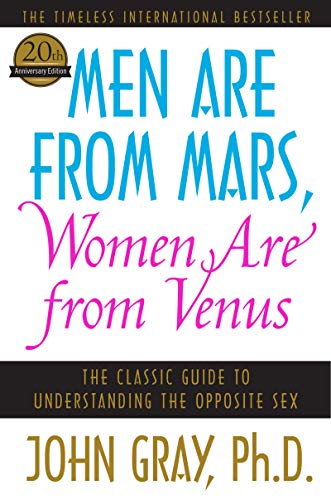
⚡️ What is Men Are from Mars, Women Are from Venus about?
Men Are from Mars, Women Are from Venus is a foundational guide to understanding the fundamental differences in how men and women communicate, process emotions, and approach relationships. John Gray uses the powerful metaphor that men and women are from different planets—Martians and Venusians—to explain why we often feel like our partners are speaking a foreign language. The book argues that these differences are not flaws but innate, and the key to a successful relationship is not to change our partner but to learn their language and respect their unique nature. It provides a practical framework for translating between the Martian and Venusian dialects, ultimately aiming to reduce conflict, foster deeper intimacy, and help couples rediscover the love and understanding that brought them together.
🚀 The Book in 3 Sentences
- Men Are from Mars, Women Are from Venus posits that men and women have inherently different psychological and emotional needs, which often leads to misunderstandings if not properly understood.
- By recognizing key patterns—like men retreating to their “caves” to solve problems and women needing to talk to feel better—we can stop taking our partner’s behavior personally and respond with empathy.
- The book offers practical communication techniques and relationship strategies to bridge this gap, allowing couples to fulfill each other’s needs and build a lasting, loving partnership.
🎨 Impressions
My impression of Men Are from Mars, Women Are from Venus is that it’s a cultural phenomenon for a reason. While some of its gender portrayals can feel a bit rigid or dated by today’s standards, the core psychological observations are remarkably insightful. Gray has a knack for articulating those subtle, frustrating dynamics that so many couples experience but can’t quite name. The book feels like a user manual for relationships you never knew you needed. It’s less about hard science and more about archetypal truths that, when applied, can genuinely defuse tension and create a sense of being understood. It’s a powerful reminder that love often thrives not in spite of our differences, but because we learn to navigate them with care.
📖 Who Should Read Men Are from Mars, Women Are from Venus?
This book is essential reading for anyone in a romantic relationship who feels stuck in a cycle of miscommunication. It’s perfect for couples who find themselves having the same arguments repeatedly without resolution. If you’ve ever thought, “I just don’t understand why he/she does that,” then this book is for you. It’s also incredibly valuable for singles who want to build a strong foundation for their future relationships by learning effective relationship strategies and communication techniques early on.
☘️ How the Book Changed Me
Reading this book fundamentally shifted my perspective on conflict and communication in my own relationships. It moved me from a place of frustration to one of curiosity and understanding.
- I learned to stop offering solutions when my partner just needed to vent, which was a game-changer for our emotional intimacy.
- I now recognize her need to talk through problems not as a complaint, but as her way of seeking connection and processing stress.
- I’ve become more comfortable giving my partner space when she needs it, understanding it’s not a rejection of me but a necessary part of her self-care.
- I’m more mindful of the small, daily gestures that “score points” and show love, rather than focusing only on grand, occasional efforts.
✍️ My Top 3 Quotes
- “Men are motivated when they feel needed while women are motivated when they feel cherished.”
- “To feel better, women need to talk about problems and men need to retreat to their caves to solve problems alone.”
- “Love is magical, and it requires a special kind of communication to keep it alive.”
📒 Summary + Notes
Men Are from Mars, Women Are from Venus serves as a translator’s guide for the most intimate and often confusing conversations in our lives. John Gray’s central thesis is that the friction in relationships isn’t a sign of incompatibility but a result of forgetting that we come from different worlds with different customs. Martians (men) value power, competency, efficiency, and achievement. Venusians (women) value love, communication, beauty, and relationships. When they fall in love, they forget these differences, only to have them resurface once the initial infatuation fades. The book is a roadmap to remembering and respecting these differences, turning potential conflicts into opportunities for deeper connection and understanding.
Chapter 1: Men Are from Mars, Women Are from Venus
This chapter introduces the core metaphor. Gray explains that Martians and Venusians once lived happily on their respective planets, with unique values and ways of being. Martians valued achievement and power, while Venusians valued love and communication. When they met, they fell in love, but upon moving to Earth, they “forgot” they were from different planets. This amnesia is the root cause of relationship problems. Men expect women to think and react like men, and vice versa. The first step to solving this is simply remembering and accepting that these fundamental differences exist and are valid.
- The Core Metaphor: Men are Martians, women are Venusians; they have different values and communication styles.
- Relationship Amnesia: In love, we forget our differences, which causes problems later.
- The Foundation of Understanding: Accepting these differences, rather than trying to erase them, is the key to harmony.
Chapter 2: Mr. Fix-It and the Home Improvement Committee
This chapter tackles a classic communication breakdown. A Martian’s (man’s) primary instinct when hearing a problem is to offer a solution, earning him the title “Mr. Fix-It.” He does this because he wants to show his competence and love by solving the issue. A Venusian’s (woman’s) instinct is to offer empathetic sharing and unsolicited advice, forming the “Home Improvement Committee.” She does this to show she cares and is involved. The problem arises when a woman just wants to be heard and feels dismissed by his solutions, and when a man feels controlled and mistrusted by her suggestions.
- Mr. Fix-It: Men offer solutions to problems to show love and competence.
- Home Improvement Committee: Women offer improvements and advice to show care and connection.
- The Misunderstanding: Women want empathy, not solutions; men want acceptance, not improvement.
Chapter 3: Men Go to Their Caves and Women Talk
Gray explains the different ways men and women handle stress. When a Martian is stressed, he becomes silent and withdraws into his “cave” to solve the problem on his own. This is not a rejection of his partner; it’s his coping mechanism. A Venusian, however, handles stress by talking about it, seeking connection and support to process her feelings. The conflict occurs when a woman sees a man’s withdrawal as abandonment and a man sees a woman’s need to talk as nagging or overwhelming. The solution is for women to give men space in their caves and for men to come out and eventually talk.
- The Cave: Men withdraw to solve problems alone; it’s a source of stress relief.
- Talking it Out: Women talk to relieve stress and seek connection and understanding.
- Respecting Coping Styles: Don’t follow a man into his cave; don’t expect a woman to solve her problems silently.
Chapter 4: How to Motivate the Opposite Sex
This chapter delves into what motivates men and women. A man is primarily motivated when he feels needed, trusted, and accepted. He thrives when he feels his partner believes in his ability to provide and solve problems. A woman is primarily motivated when she feels cherished, understood, and respected. She thrives when she feels her partner is attentive to her feelings and values her. Trying to motivate a man by criticizing him or trying to motivate a woman by ignoring her will backfire. Instead, we must learn to encourage our partners in the language they understand.
- Motivating Men: They need to feel needed, trusted, and accepted for who they are.
- Motivating Women: They need to feel cherished, understood, and respected for their feelings.
- The Power of Encouragement: Supporting a man’s abilities and a woman’s feelings is the ultimate motivator.
Chapter 5: Speaking Different Languages
Gray highlights that men and women often use the same words but mean different things. This is like speaking different dialects. For example, when a woman says, “We never go out,” she is expressing a feeling of wanting more connection, not making a literal accusation. When a man says, “I’m fine,” he often means, “I need to be alone to solve my problem,” not that everything is actually fine. The chapter provides a mini “Martian/Venusian Dictionary” to help translate these common phrases, emphasizing the importance of listening for the underlying feeling or intent, not just the literal words.
- Literal vs. Emotional Meaning: Men tend to be literal; women tend to use language to express feelings.
- “We never go out”: A Venusian expression of wanting more romance, not a factual statement.
- “I’m fine”: Often a Martian signal for “give me space,” not that everything is okay.
Chapter 6: Men Are Like Rubber Bands
\p>The “Rubber Band Theory” explains the male intimacy cycle. Like a rubber band, a man has a natural cycle of pulling away to stretch his sense of independence and then springing back to be close. This pulling away is not a sign of lost love; it’s a necessary way for him to reconnect with his individuality and his sense of self. When he has stretched sufficiently, he will spring back with even more love and energy. Problems arise when a woman fears this pulling away and chases him, preventing the rubber band from stretching fully and snapping back with force. Trusting this cycle is crucial.- The Intimacy Cycle: Men naturally alternate between intimacy and autonomy.
- Pulling Away: This is a need for independence, not a rejection of the relationship.
- Springing Back: After pulling away, a man returns with greater love and connection if given space.
Chapter 7: Women Are Like Waves
\p>This chapter describes the female self-esteem cycle. A woman’s ability to love and give is like a wave. When her self-esteem is rising, she has a surplus of love to give and feels capable and happy. However, her self-esteem inevitably falls, and she hits a “bottom” where she may feel needy, overwhelmed, or negative. At this point, she needs the love and support of her partner to help her rise again. If a partner doesn’t understand this wave, he might feel punished by her negativity. The key is for a man to provide unconditional support at her lowest point, which allows her to feel loved and ride the wave back up.- The Wave Cycle: A woman’s self-esteem and ability to give rise and fall in a wave-like pattern.
- The Bottom of the Wave: This is when she needs the most love, support, and reassurance.
- Unconditional Support: A man’s support at her lowest point allows her to heal and feel loved.
Chapter 8: Discovering Our Different Emotional Needs
\p>Gray outlines the 12 primary kinds of love that men and women need. While both need all 12, the primary needs differ. For a man, the primary needs are Trust, Acceptance, Appreciation, Admiration, Approval, and Encouragement. For a woman, the primary needs are Caring, Understanding, Respect, Devotion, Validation, and Reassurance. When a man feels trusted, he can give the caring a woman needs. When a woman feels cared for, she can give the trust a man needs. Understanding and fulfilling these different needs is the secret to keeping the love tanks full for both partners.- Primary Male Needs: Trust, Acceptance, Appreciation (he needs to be trusted for his abilities).
- Primary Female Needs: Caring, Understanding, Respect (she needs to be cared for in her feelings).
- The Love Tank: Fulfilling these specific needs keeps each partner feeling loved and secure.
Chapter 9: How to Avoid Arguments
\p>Arguments escalate when we don’t feel heard or we blame our partner. The key to avoiding them is to communicate feelings without blame. Gray suggests using “I feel” statements instead of “you” statements. For example, instead of “You never listen to me,” say “I feel unheard right now.” It’s also crucial to listen without getting defensive and to validate your partner’s feelings, even if you don’t agree with their perspective. The chapter introduces the “Love Letter Technique” as a structured way to process and communicate difficult feelings (anger, sadness, fear, regret, love) before having a potentially volatile conversation.- Communicate Feelings, Not Blame: Use “I feel” statements to express your emotions.
- Listen to Understand: Don’t listen just to rebut; listen to validate your partner’s feelings.
- The Love Letter Technique: A powerful tool for writing out and processing negative emotions constructively.
Chapter 10: Scoring Points with the Opposite Sex
\p>This chapter explains how men and women keep track of the “points” of love. For a man, big, impressive gestures (like buying a expensive gift) score many points at once. For a woman, small, frequent, and thoughtful gestures (like a compliment, a call, or doing a small chore) score more points over time. A man might focus all his energy on one big score and then feel confused when his partner’s “love tank” is empty. A woman might do many small things and feel unappreciated because a man doesn’t see them as high-scoring. Understanding this difference helps partners effectively show love in ways that are truly felt and appreciated.- Male Scoring: Big gestures score big points; effort is concentrated.
- Female Scoring: Small, consistent gestures score more points in the long run; it’s about the thoughtfulness.
- Keeping Score Differently: Recognize that what feels like a grand gesture to you may not be what your partner values.
Chapter 11: How to Communicate Difficult Feelings
\p>This chapter expands on the Love Letter Technique. Gray provides a detailed template for writing a letter that helps you process and share negative emotions in a loving way. The letter has five parts: 1) Anger, 2) Sadness, 3) Fear, 4) Regret, and 5) Love. Each section allows you to fully express a specific emotion. After writing the letter, you read it yourself to gain clarity and then can share it with your partner. This technique prevents arguments by allowing you to communicate your vulnerability without blame, making it safer for your partner to hear you and respond with compassion.- The Five Emotions: Write out your anger, sadness, fear, regret, and love.
- A Safe Outlet: This process allows you to express feelings without attacking your partner.
- Sharing Vulnerability: The letter format makes it easier for your partner to listen and understand your pain.
Chapter 12: How to Ask for Support and Get It
\p>One of the biggest mistakes in relationships is expecting a partner to know what you need without being asked. Gray explains that men, in particular, need to be asked directly for support. They respond best to requests that are timely, non-demanding, and specific. Women, on the other hand, often hint at what they need, hoping their partner will pick up on the cues. This leads to disappointment. The chapter teaches women how to ask for what they need in a way that motivates a man to give, and it teaches men how to better recognize these requests and respond positively, even when he can’t say “yes”.- Men Need to Be Asked: They are not mind-readers; direct requests are most effective.
- The Art of Asking: Requests should be direct, specific, and framed as an opportunity for him to give.
- How to Respond: A man can learn to say “no” gracefully while still showing he cares, preventing resentment.
Chapter 13: Keeping the Magic of Love Alive
\p>The final chapter brings all the concepts together to explain how to sustain love over the long term. Relationships go through cycles: love, pain, and then healing on a deeper level. By applying the principles from the book—like understanding the different planets, respecting the cave and the wave, fulfilling different emotional needs, and communicating without blame—couples can successfully navigate these cycles. The magic of love isn’t about avoiding problems; it’s about having the skills to grow through them. Gray concludes that a successful relationship is a journey of learning and growth, where we become better partners and better people through the process of loving each other.- The Cycle of Love: Relationships naturally move through stages of love, conflict, and deeper connection.
- Skills for a Lifetime: The book’s techniques are tools for navigating the inevitable ups and downs.
- Love as a Journey: Lasting love is about continuous learning, growth, and mutual understanding.
Key Takeaways
The lessons from Men Are from Mars, Women Are from Venus are timeless and profoundly practical for improving any relationship. The book arms you with a new lens through which to view your partner’s behavior, transforming frustration into empathy. By internalizing these core relationship strategies, you can stop the cycle of misunderstanding and start building a foundation of mutual respect and lasting love. The key is not just to know these concepts but to actively practice them.
- Embrace the Difference: Stop trying to change your partner; instead, seek to understand their fundamentally different nature.
- Respect Stress Responses: Learn to give a man space in his “cave” and provide a woman with a listening ear when she’s on her “wave”.
- Learn the Language of Love: Fulfill your partner’s primary emotional needs—trust for him, caring for her—to keep their love tank full.
- Communicate with Care: Use “I feel” statements and the Love Letter Technique to express difficult emotions without blame.
- Score Points Effectively: Show love in the way your partner best receives it—big gestures for him, small and frequent for her.
Conclusion
In conclusion, Men Are from Mars, Women Are from Venus is more than just a book; it’s a practical guide to bridging the gender gap in communication and emotion. While its framework may seem simplistic, its power lies in its ability to make the invisible rules of relationships visible. It provides a vocabulary for the frustrations we all feel and offers concrete, actionable solutions. This book is a powerful reminder that a successful relationship isn’t about finding a perfect person but about learning to love an imperfect person perfectly. If you’re ready to move beyond conflict and cultivate a deeper, more understanding connection, the relationship strategies within these pages are an invaluable starting point. I highly recommend picking up the full book to explore these concepts in even greater detail.
More From John Gray →
Discover more from AI Book Summary
Subscribe to get the latest posts sent to your email.