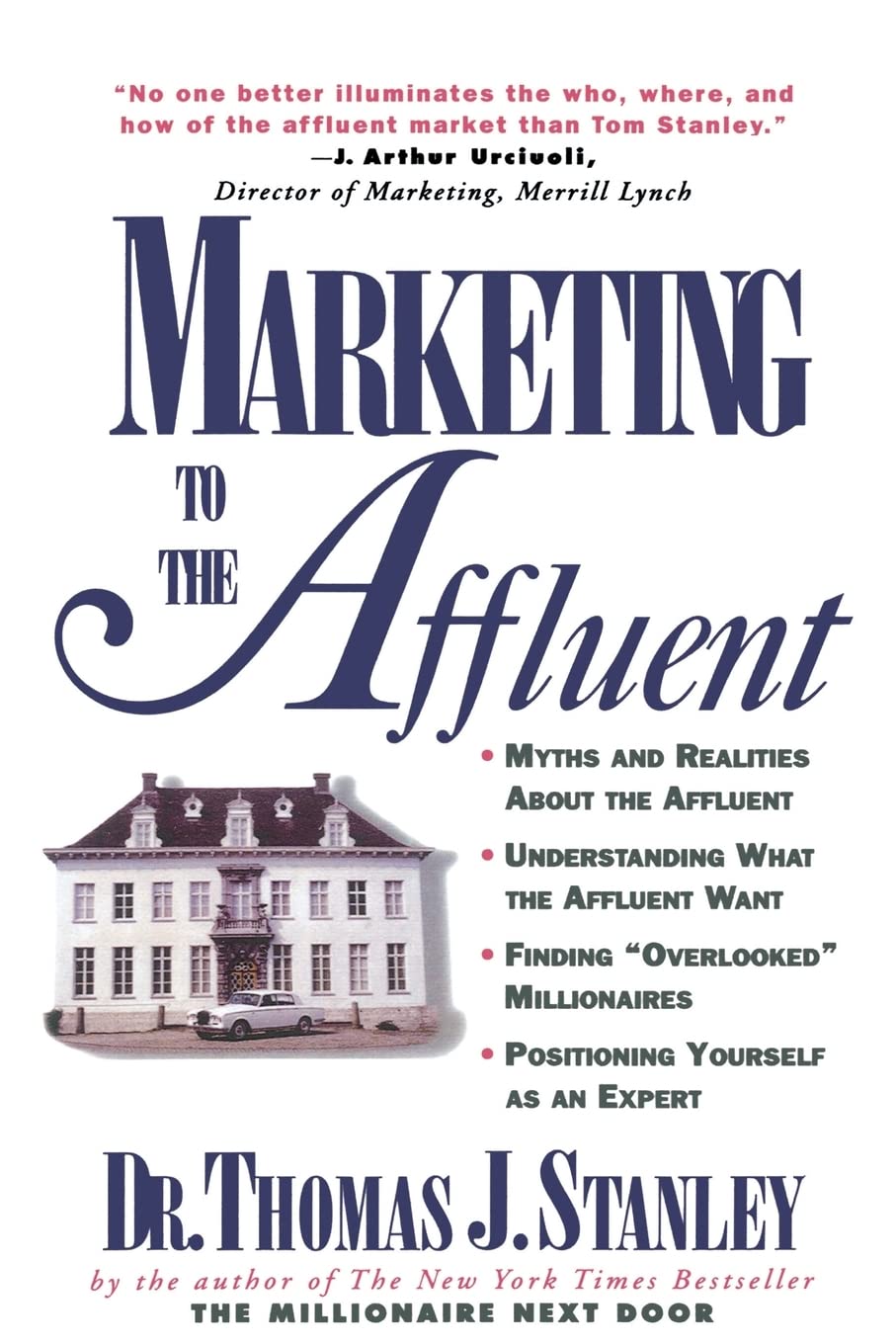
⚡️ What is Marketing to the Affluent About?
Ever wondered why the guy driving the beat-up Ford F-150 sometimes has a larger brokerage account than the guy in the leased Porsche? That paradox is the heart of Thomas J. Stanley’s work. In this book, Stanley takes the data-heavy approach he later used for The Millionaire Next Door and applies it specifically to the art of the sale. He argues that most marketers waste their time chasing the “glittering rich”—those who look wealthy but spend everything they earn—while ignoring the “prodigious accumulators” who actually have the capital to invest.
Stanley, a former professor and a legendary researcher of the wealthy, breaks down the myth that the affluent are a monolithic group. Instead, he reveals a fragmented landscape of business owners, specialized professionals, and self-employed experts who value competence over status. If you’re looking for more insights into the mindset of the wealthy, you can find more summaries by Thomas J. Stanley on our site. This isn’t just about luxury goods; it’s about understanding the psychology of people who view money as a tool for independence rather than a scorecard for vanity.
By the time you finish this, you’ll realize that the best way to reach the rich isn’t through a glossy magazine ad, but by solving a very specific, high-stakes problem for a very specific type of business owner. It’s a masterclass in the marketing book summaries category that focuses on high-precision targeting over broad-market shouting.
🚀 The Book in 3 Sentences
- The truly affluent are rarely the people who look the part; they are disproportionately self-employed business owners and specialized professionals who live well below their means.
- Success in this market requires “niching down” into specific industries (using SIC codes) where you can become the undisputed expert for that specific tribe’s needs.
- The affluent don’t buy status—they buy time, expertise, and the peace of mind that comes from dealing with someone who understands their unique tax, legal, or business headaches.
🎨 Impressions
Honestly, I found this book a bit like a cold shower for my assumptions about wealth. We’re so conditioned to think of “affluent marketing” as gold-foiled brochures and high-end galas. Stanley’s data just shreds that. He points out that the real wealth in America is held by people who own dry cleaners, scrap metal yards, and welding businesses. It’s not “sexy,” but it’s where the liquidity is. I love how he uses actual statistics to show that these people are often more worried about their business’s survival than they are about the vintage of their wine.
What frustrated me? The book is definitely a product of its time. He talks a lot about physical directories and direct mail. If you’re looking for a guide on how to run Instagram ads for luxury watches, this isn’t it. But the psychology—the way he explains why a self-made millionaire trusts a specialist over a generalist—is timeless. It’s the kind of book that makes you want to stop being a “jack of all trades” immediately. I dog-eared the section on how to approach gatekeepers because it’s still the biggest hurdle for anyone selling B2B or to high-net-worth individuals today.
📖 Who Should Read Marketing to the Affluent?
If you’re a financial advisor, estate attorney, or luxury service provider, this should be your bible. It’s also incredibly useful for small business owners who are tired of competing on price and want to move into a high-value niche. However, if you’re in mass-market retail or selling low-cost consumer goods, you’ll likely find the level of research and specialized targeting he suggests to be overkill. This is for the person who wants to win ten clients a year who each pay $50,000, not ten thousand clients who pay $5.
☘️ How This Book Changed My Thinking
Before reading this, I thought “targeting the rich” meant going where the expensive cars were parked. Now? I’m looking at boring industrial parks and trade association directories.
- I stopped trying to sound “fancy” in my professional communications and started focusing on demonstrating specific, technical competence.
- I realized that a “referral” from a trusted peer in a niche is worth more than $100k in advertising spend.
- I started looking at SIC (Standard Industrial Classification) codes as a roadmap for finding untapped wealth rather than just dry government data.
✍️ 3 Quotes That Stuck With Me
- “The affluent are not a single market. They are a collection of niches, each with its own language and set of problems.” — This reminds me that ‘wealthy’ is not a personality trait, it’s just a financial status.
- “Most of the truly wealthy in this country do not live in mansions; they live next door to you.” — A startling reminder to never judge a prospect’s potential by their outward appearance.
- “You cannot sell to the affluent if you are more interested in their money than you are in their business.” — This hits hard on the need for genuine empathy and industry knowledge.
📒 Summary + Notes
The core thesis of Marketing to the Affluent is that the most lucrative path for any professional is to become a specialist for a specific group of self-employed, high-net-worth individuals. Stanley spends a lot of time debunking the “media version” of the rich. He shows that the bulk of American wealth is in the hands of people who own “dull” businesses. Because these people are self-made, they are highly sensitive to value and highly skeptical of anyone who looks like they are trying too hard to impress them.
He builds his case by moving from the “who” to the “where” and finally to the “how.” He argues that the key to success isn’t better sales techniques, but better prospecting. If you spend 80% of your time identifying the right niche—say, owners of private medical labs or successful plumbing contractors—the actual selling part becomes significantly easier because you can speak directly to their industry-specific pain points. The narrative arc moves from general market awareness to the surgical application of marketing effort into high-yield pockets of the economy.
1: The Nature of the Affluent Market
Why do we keep confusing income with wealth? Stanley starts by slapping the reader awake: a high salary doesn’t mean someone is affluent. He defines the affluent as those with a high net worth, often built through years of self-employment and aggressive saving. He introduces the idea that these people are “price sensitive but value-driven.” They’ll haggle over a service fee but will pay a premium for an expert who can save them $50,000 in taxes.
The chapter highlights that the self-employed are four times more likely to be millionaires than those who work for others. This is a massive hint for where to point your marketing. If your current client list is full of middle-managers at big corporations, you’re fishing in the wrong pond. You want the person who signs the front of the check, not the one who signs the back.
2: Who Are the Affluent?
What if I told you the average millionaire hasn’t spent more than $400 on a suit in their life? Stanley leans into his research here to profile the “Typical American Millionaire.” They are usually in their late 50s, married to the same person for decades, and own a business in an unglamorous industry. Think coal, paving, or pest control.
- They are first-generation wealthy (80% didn’t inherit their money).
- They are heavy savers and investors.
- They value “economic outpatient care”—meaning they often use their wealth to help their adult children, which is a secret marketing hook you can use (sell them on helping their kids).
3: Where Are the Affluent?
How do you find someone who is intentionally trying to stay invisible? Stanley suggests that looking at zip codes is a lazy man’s game. Instead, he points toward trade associations and specific industry clusters. He advocates for using the Standard Industrial Classification (SIC) system to identify businesses with high profit margins. If you find a cluster of specialized manufacturers in a low-cost-of-living area, you’ve found a gold mine. These people have high discretionary income because their mortgages are low and their businesses are thriving.
4: Finding the Business Owner
Is there a more ignored group of millionaires than the owners of small-to-medium industrial firms? Stanley obsesses over this group because they have complex needs. They have succession planning issues, high tax burdens, and employee benefit headaches. He suggests that instead of looking for “rich people,” you should look for “people with rich problems.” A business owner facing a transition is 100x more likely to buy a high-end service than someone who is just cruising along. Do you know which businesses in your area are about to be sold?
5: Working with Professional Service Providers
A surprising claim: Doctors and attorneys are often high-income but low-net-worth. Because they feel the pressure to maintain a certain lifestyle, they often spend as fast as they earn. Stanley warns that marketing to “professionals” requires a different tone than marketing to “business owners.” Professionals value credentials and peer recognition. To win them over, you need to be seen as the “doctor’s doctor”—the specialist who other experts go to when they have a problem.
6: Special Interest Markets
Have you ever considered marketing to the “retired affluent” or specific ethnic niches? Stanley explores how wealth is moving into different demographics. He notes that many retirees are sitting on massive piles of cash but are terrified of outliving it. If you can market “certainty” to them, you win. He also touches on the importance of understanding cultural nuances in wealth—how different immigrant groups view property ownership vs. paper assets, for example.
7: Selling Your Services
There is a moment early on where Stanley explains that the affluent don’t want a “friend,” they want a “resource.” This chapter is about positioning. He argues that you should never lead with price. Instead, lead with a case study or a specific result you achieved for someone exactly like them. The affluent are terrified of being a “guinea pig.” They want to know you’ve done this before for someone in their specific industry.
8: Dealing with Gatekeepers
How do you get past the executive assistant who is paid to keep you out? Stanley’s advice is surprisingly human: treat the gatekeeper like the decision-maker. He suggests that many marketers fail because they are rude to the staff, not realizing that the affluent business owner relies heavily on their assistant’s intuition. He also recommends using “low-threat” entry points, like sending a relevant industry article with a handwritten note, rather than a high-pressure sales pitch.
9: Strategic Planning for Marketing to the Affluent
What’s your plan for the next 12 months to penetrate a single niche? Stanley concludes by insisting on a systematic approach. He hates “scattershot” marketing. He wants you to pick one or two SIC codes and own them. Go to their trade shows, write for their newsletters, and learn their jargon. By the end of the year, you shouldn’t just be a salesperson; you should be a recognized figure in that specific sub-culture. That’s how you build a business that relies on high-quality referrals rather than cold calls.
⚖️ A Critical Perspective
While the psychological foundations here are rock solid, we have to admit the world has shifted since the late 80s. Stanley’s heavy reliance on physical directories and direct mail feels incredibly dated in an era of LinkedIn and intent-based digital data. Furthermore, his dismissal of the “glittering rich” might be a bit too broad; with the rise of the creator economy and tech wealth, there is a massive segment of affluent consumers who do value status and speed over traditional frugality. The book also doesn’t adequately address the “New Money” tech sector, where wealth is often tied up in illiquid stock options rather than the cash-flowing dry cleaners Stanley loves.
🔄 How It Compares
Compare this to Seth Godin’s This is Marketing. While Godin focuses on the “smallest viable market” and building a tribe through shared values, Stanley is much more clinical and data-driven. Godin wants you to find people who believe what you believe; Stanley wants you to find people who have the specific tax problems associated with owning a chain of car washes. It’s the difference between marketing as a philosophy and marketing as a surgical strike.
🔑 Key Takeaways
These are the actionable pillars for anyone trying to upgrade their client base:
- Target the Self-Employed: They hold the most wealth and have the most complex financial needs, making them the ideal targets for high-value services.
- Own a Niche (SIC Codes): Don’t just be a “financial advisor”; be the “financial advisor for owners of commercial printing companies.”
- Emphasize Competence Over Image: The self-made rich have high “crap detectors.” They value your track record and industry knowledge more than your expensive watch.
- Solve “Rich Problems”: Look for transition points like business sales, inheritance, or tax law changes to find prospects who are ready to buy.
💬 Frequently Asked Questions
What is the main argument of Marketing to the Affluent?
The main argument is that the most lucrative affluent market consists of self-employed business owners and specialized professionals who live frugally and value technical competence over status. To succeed, marketers must move away from broad luxury appeals and instead target specific industry niches where they can solve high-stakes, industry-specific problems.
How does Stanley define the affluent?
Stanley defines the affluent based on net worth rather than just income. He focuses on “Prodigious Accumulators of Wealth” (PAWs)—people who have built significant assets, usually through self-employment, and who tend to be very price-sensitive for consumer goods but willing to pay for expert professional services that protect their wealth.
Is Marketing to the Affluent still relevant in 2025?
While the tactical advice regarding direct mail and physical directories is dated, the psychological insights remain highly relevant. The “Millionaire Next Door” demographic still controls a massive portion of private wealth. However, modern marketers must adapt Stanley’s niche-targeting strategy to digital platforms like LinkedIn and specialized online communities.
What are SIC codes and why does Stanley recommend them?
Standard Industrial Classification (SIC) codes are government numbers used to categorize businesses by industry. Stanley recommends them because they allow marketers to identify high-profit, low-visibility niches (like specialized manufacturing) where business owners often have high net worths but are ignored by traditional luxury marketers.
Who is the ‘Millionaire Next Door’ mentioned in the book?
The ‘Millionaire Next Door’ is Stanley’s archetype for the wealthy American: a self-employed individual in a ‘boring’ industry who lives in a middle-class neighborhood, drives an older car, and prioritizes financial independence over social status. They are the primary target for the marketing strategies he outlines.
Conclusion
At the end of the day, Marketing to the Affluent is a reminder that wealth is often quiet. If you spend all your time trying to catch the eye of the person shouting the loudest, you’ll miss the person with the quiet, multimillion-dollar business who desperately needs your help. Stanley’s work challenges us to look deeper than the surface and to build a business based on genuine, specialized expertise rather than flash and mirror-tricks.
The one thing you should carry with you? Wealth in America is built on the backs of unglamorous businesses. If you can learn to speak their language and solve their specific headaches, you will never lack for high-paying clients. It’s time to stop marketing to everyone and start marketing to the right someone. For more strategies on high-level persuasion, check out our other marketing book summaries.
More From Thomas J. Stanley →
Discover more from AI Book Summary
Subscribe to get the latest posts sent to your email.