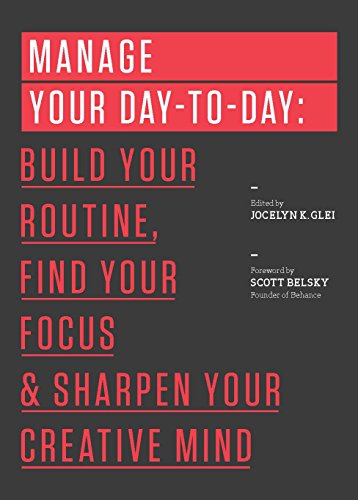
⚡️ What is Manage Your Day-to-Day About?
Ever feel like you’ve spent an entire eight-hour day ‘working’ without actually accomplishing a single thing that matters? That’s the exact frustration that birthed this book. More summaries by Jocelyn K. Glei and her team at 99U put this collection together because the modern workplace is essentially a giant distraction machine. The central argument is simple but painful: if you don’t intentionally design your day, someone else will fill it with their priorities instead of yours.
The book is a curated anthology of wisdom from heavy hitters like Steven Pressfield, Seth Godin, and Gretchen Rubin. It’s not a dry academic text; it’s more like a tactical manual for anyone trying to do creative or deep work in an age of constant pings. Glei frames the struggle as a battle between ‘reactive’ work (responding to emails and requests) and ‘proactive’ work (the big, scary projects that actually move the needle). If you’re looking for more ways to sharpen your output, check out our other productivity book summaries.
🚀 The Book in 3 Sentences
- Professional creativity is the result of a rigorous, repeatable routine rather than waiting for the ‘muse’ to strike.
- The distinction between reactive work (answering others) and proactive work (building your own vision) determines your long-term career trajectory.
- Sustained focus is a finite resource that must be protected through physical boundaries, digital discipline, and scheduled ‘deep work’ sessions.
🎨 Impressions
I read this book during a week when my inbox felt like a Hydra—cut one email, and two more appeared. Honestly, I expected another generic ‘get organized’ guide, but Glei’s curation hits differently because it focuses on the psychological toll of being ‘always on.’ It’s a short read, but I found myself pausing after every essay to audit my own habits. It’s the kind of book that makes you feel slightly embarrassed about how much time you spend ‘polishing’ low -stakes tasks just to avoid the hard, creative lifting.
What I loved most was the lack of fluff. It’s punchy. One chapter might be three pages long but contains a shift in perspective that sticks with you for a month. It’s not about ‘hacking’ your way to a 4-hour work week; it’s about accepting that meaningful work is hard and requires a predictable, almost boring structure to survive. It’s a grounded, realistic look at what it takes to actually produce something of value when the world is screaming for your attention.
📖 Who Should Read Manage Your Day-to-Day?
If you’re a freelancer, writer, designer, or anyone whose paycheck depends on your brain producing something new, this is mandatory. It’s especially useful for the ‘reluctant manager’—someone who used to be a maker but now finds themselves buried in meetings. However, if you work in a role that is purely operational or customer-service based where you *must* be reactive 100% of the time, some of this advice will just frustrate you because you don’t have the autonomy to implement it.
☘️ How This Book Changed My Thinking
I used to think that ‘checking email’ was a neutral activity I could do whenever I had a spare five minutes. Now, I see it as a cognitive drain that poisons the ‘proactive’ well before I’ve even started my real work.
- I stopped checking my phone first thing in the morning. I don’t let other people’s ’emergencies’ set the tone for my first hour.
- I started valuing frequency over intensity. I’d rather write for 20 minutes every single day than try to pull a 5-hour marathon on a Saturday.
- I realized that ‘waiting for inspiration’ is just a sophisticated form of procrastination. Professionalism is doing the work when you don’t feel like it.
✍️ 3 Quotes That Stuck With Me
- “Email is a wonderful tool for people whose role it is to distract us from our work.” — This reminded me that an inbox is just a list of other people’s priorities.
- “Frequency breeds familiarity, and familiarity breeds confidence.” — This takes the pressure off any single session; you just have to show up often.
- “If you’re not the one who’s controlling your time, then someone else is.” — A blunt reminder that passivity is a choice to be used by others.
📒 Summary + Notes
The book’s narrative arc follows a movement from the internal to the external. It starts with your personal routine—the rituals you use to signal to your brain that it’s time to work. Then, it moves into the battle for focus, teaching you how to build a fortress around your concentration. The final sections address the tools we use (and how they use us) and how to maintain a creative edge without burning out. The overarching goal is to turn you from a ‘passenger’ in your own career into a ‘pilot’ who chooses where their energy goes.
Glei and her contributors want you to believe that creativity isn’t a gift from the gods; it’s a byproduct of showing up at the same desk at the same time every day. They argue that the ‘creative’ part happens only after you’ve handled the ‘logistical’ part of setting up your life. By the end, you realize that the most successful people aren’t the ones with the most talent, but the ones with the most resilient systems for handling the mundane distractions of daily life.
🧠 Core Ideas Explained Simply
A few central concepts act as the scaffolding for everything else in the book.
Reactive vs. Proactive Work
Think of reactive work like playing defense in sports. You’re responding to emails, Slack pings, and requests from your boss. Proactive work is playing offense—it’s the strategic stuff that actually builds your career. If you spend all day on defense, you’ll never score a point. The book insists you schedule your proactive work first, ideally when your brain is freshest, and push the reactive ‘busy work’ to the afternoon.
The Myth of Multitasking
Why do we keep pretending we can do two things at once? The book cites research showing that every time you switch from a task to an email, your brain takes up to 20 minutes to fully regain focus. This ‘attention residue’ means if you check your phone every 10 minutes, you are effectively working at half your cognitive capacity all day long. True productivity requires single-tasking.
Frequency Over Intensity
Success isn’t about one big heroic effort. It’s about the small, daily repetition. Writing 500 words a day is infinitely more effective than trying to write 5,000 words once a month. Daily frequency keeps the project alive in your subconscious, making it easier to start each time because the ‘entry cost’ is lower.
1: Building a Rock-Solid Routine
Does your morning routine involve immediately checking your notifications? Mark McGuinness starts this section with a stark claim: the first hour of your day determines the quality of your output. If you start by being reactive, you’ve already lost the battle for your attention. He suggests ‘unplugged mornings’ where the only task is the one that matters most to your long-term goals.
Gretchen Rubin adds a layer here by talking about habits. She argues that once something becomes a habit, it no longer requires willpower. This is crucial because willpower is a limited resource. If you have to *decide* to work every morning, you’re wasting fuel. If you just work because it’s 9:00 AM and that’s ‘what you do,’ you save your brainpower for the actual creative problem-solving.
2: Finding Focus in a Distracted World
What if the tools designed to help us connect are actually making us more isolated from our own thoughts? This section addresses the ‘always-connected’ anxiety. Cal Newport (author of Deep Work) and Leo Babauta discuss the necessity of solitude. They suggest that focus isn’t just about ‘not checking Twitter’; it’s about training your brain to handle boredom without reaching for a digital pacifier.
One of the most tactical bits here is the ‘distraction audit.’ You can’t fix what you don’t track. By actually seeing how many times you switch tasks, you realize why you’re exhausted at 5 PM despite having ‘done nothing.’ The goal is to create periods of ‘locked-in’ time where the internet is off and the door is closed. Is it radical? Maybe. Is it the only way to do great work? Probably.
3: Taming Your Tools
There’s a moment early in this section where it’s pointed out that we are the first generation of workers who have to manage our own ‘broadcast networks’ (social media and email). This is a massive administrative burden we never signed up for. The advice here isn’t to delete your accounts, but to put them in their place. This means turning off all non-human notifications and checking email in ‘batches’ rather than letting it drip-feed into your day.
I found the section on ‘Digital Wellness’ particularly relevant. It’s about setting expectations. If you respond to every email within five minutes, you are training people to expect that. You are teaching them that you are always available to be interrupted. By creating a ‘response lag,’ you reclaim your time and actually gain more respect because people see that you value your own focus.
4: Sharpening Your Creative Mind
How do you stay fresh when you’re grinding out work every day? This is the ‘maintenance’ chapter. It deals with the paradox that to be more productive, you often need to do less. Steven Pressfield talks about ‘The Resistance’—that internal force that tries to stop us from doing anything meaningful. To beat it, you need more than just a calendar; you need a mindset that treats creative work like a professional athlete treats training.
The big takeaway here is the importance of ‘associative thinking.’ This only happens when you give your brain time to wander. If every spare second is filled with a podcast or a scroll, your subconscious never has the space to connect dots. True ‘aha’ moments happen in the shower or on a walk, not while staring at a spreadsheet. You have to schedule ‘nothing’ time to make the ‘something’ time effective.
⚖️ A Critical Perspective
While the advice is timeless, some of the specific mentions of tools (like RSS feeds or early iPad workflows) show the book’s age since its original 2013 publication. It also leans heavily into a ‘maker’ bias; if you’re in a middle-management role where meetings are your actual job, Glei’s disdain for them might feel impractical. Furthermore, it assumes a high level of agency that entry-level workers or those in strict corporate hierarchies might find difficult to exercise without risking their jobs.
🔄 How It Compares
Compared to Cal Newport’s *Deep Work*, this book is much more of a ‘tasting menu.’ While Newport provides a singular, rigorous philosophy, Glei offers a variety of voices and perspectives, making it more accessible if you find Newport’s style too academic or intense. It’s less about the ‘why’ of focus and more about the ‘how’ of daily creative survival.
🔑 Key Takeaways
These lessons serve as a roadmap for transitioning from a reactive worker to a proactive creator.
- Schedule your most important work for when your energy is highest—usually first thing in the morning.
- Create physical and digital ‘focus triggers’ that signal to your brain it’s time to enter a deep state.
- Limit the number of times you check your communication channels; batching is the only way to avoid ‘attention residue.’
- Respect the need for downtime; ‘unplugging’ isn’t a luxury, it’s a necessary part of the creative cycle.
💬 Frequently Asked Questions
What is the main message of Manage Your Day-to-Day?
The core message is that you must proactively build a routine to protect your creative focus from the constant interruptions of modern work. By prioritizing your own ‘deep work’ over reactive tasks like email, you ensure that you are making progress on meaningful goals rather than just staying busy.
How does Jocelyn K. Glei suggest managing email?
The book advocates for batching email rather than checking it constantly. It suggests setting specific times of day for communication—like 11 AM and 4 PM—so that the rest of your time can be spent on high-concentration projects without the cognitive drain of shifting back and forth between tasks.
What does the book say about multitasking?
Manage Your Day-to-Day argues that multitasking is a myth that reduces productivity. It highlights ‘attention residue,’ where your brain stays focused on a previous task for up to 20 minutes after you switch. This makes frequent task-switching incredibly inefficient for any work requiring real creative depth.
Why is a creative routine important?
A routine turns creative work into a habit, which bypasses the need for willpower. By showing up at the same time and place every day, you train your brain to enter a state of flow more easily, making you less reliant on fleeting moments of inspiration or motivation.
Is Manage Your Day-to-Day still relevant in 2025?
Yes, its psychological principles regarding focus and reactive work are more relevant than ever. While some specific app references might be dated, the rise of AI, Slack, and remote work has only increased the number of potential distractions, making Glei’s strategies for protecting attention essential for modern professionals.
Conclusion
Ultimately, Manage Your Day-to-Day isn’t about working harder; it’s about working with more intent. We live in a world that is optimized to steal our attention and sell it to the highest bidder. If you don’t build a ‘fortress’ around your time, you’ll find yourself at the end of your career wondering where all the big projects went. The book is a gentle but firm wake-up call to stop being so available to everyone else and start being available to your own best ideas.
If you take only one thing from this summary, let it be this: frequency beats intensity every single time. Don’t wait for the perfect day or the perfect mood. Just build the routine, show up, and let the work take care of itself. In a world of shallow distractions, the ability to focus is the ultimate competitive advantage. Manage Your Day-to-Day provides the blueprint; it’s up to you to actually build the walls.
More From Jocelyn K. Glei →
Discover more from AI Book Summary
Subscribe to get the latest posts sent to your email.