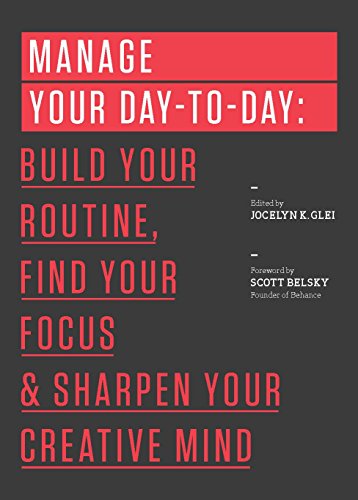
⚡️ What is Manage Your Day-to-Day about?
Manage Your Day-to-Day is a powerful anthology edited by Jocelyn K. Glei that brings together wisdom from creative visionaries like Seth Godin, Cal Newport, and Gretchen Rubin. Unlike traditional productivity books, this collection focuses specifically on the unique challenges faced by creative professionals in the modern digital landscape. The book tackles the fundamental tension between administrative demands and deep creative work.
Through four distinct sections, the book explores how to construct ritualized routines that protect your cognitive resources, navigate the treacherous waters of constant connectivity, and cultivate a mindset that prioritizes meaningful output over reactive busywork. It serves as both a philosophical manifesto and a practical manual for anyone seeking to do their best creative work while maintaining sanity in an age of infinite distraction.
🚀 The Book in 3 Sentences
- The most successful creative professionals treat their daily routines as sacred architecture that protects their attention from the relentless onslaught of digital interruptions and administrative trivia.
- Deep, meaningful work requires us to embrace principles like delayed response, strategic unavailability, and radical focus blocks rather than glorifying constant connectivity and immediate reactivity.
- True productivity is measured not by hours spent working or emails answered, but by the consistency of showing up for your creative practice and the quality of your artistic output over time.
🎨 Impressions
Reading Manage Your Day-to-Day felt like receiving a personal masterclass from some of the most disciplined minds in the creative industry. I was struck by how the diverse voices in this anthology converged on a singular truth: creativity demands boundaries. The essays challenged my assumptions about productivity, particularly the notion that being constantly available equates to being valuable.
What resonated most deeply was the book’s emphasis on ritual and preparation as the foundation of creative work, rather than waiting for elusive inspiration to strike. The contributors don’t offer one-size-fits-all solutions but instead present a buffet of creative productivity strategies that acknowledge the messy reality of modern work life. I found myself pausing frequently to implement small changes—like establishing clearer communication boundaries and protecting my morning hours—rather than waiting to finish the book before acting.
📖 Who Should Read Manage Your Day-to-Day?
This book is essential reading for knowledge workers, artists, writers, designers, and entrepreneurs who find themselves drowning in administrative quicksand while their meaningful projects gather dust. If you constantly feel reactive rather than proactive—spending your days responding to others’ demands instead of advancing your own creative agenda—Manage Your Day-to-Day offers the structural blueprint you need to reclaim your autonomy.
It is particularly valuable for those struggling with digital overwhelm, inbox anxiety, or the perfectionism that paralyzes creative output. Whether you are a freelancer juggling multiple clients, a corporate creative navigating open-plan offices, or an indie developer building your dream project, the focus techniques and routines outlined here will help you draw a definitive line between the world’s demands and your own ambitions.
☘️ How the Book Changed Me
How my life / behaviour / thoughts / ideas have changed as a result of reading the book.
- I implemented a strict morning creative block where I work on my most important projects for 90 minutes before checking email or social media, protecting my peak cognitive hours.
- I stopped treating every notification as an emergency requiring immediate response, instead batching my communication into two designated periods per day.
- I adopted the practice of unnecessary creating—making art with no commercial purpose—to keep my creative muscles flexible and reduce performance anxiety.
- I developed a shutdown ritual at the end of each workday that captures loose ends and clears my mental workspace, allowing me to be present with family.
- I began measuring my productivity by deep work hours completed rather than tasks checked off, fundamentally shifting my definition of a successful day.
✍️ My Top 3 Quotes
- “If you want to create something worthwhile with your life, you need to draw a line between the world’s demands and your own ambitions.” — Mark McGuinness
- “Technology is a useful servant but a dangerous master.” — Christian L. Lange (quoted by Seth Godin)
- “The difference between successful people and really successful people is that really successful people say no to almost everything.” — Warren Buffett (referenced in focus chapters)
📒 Summary + Notes
Manage Your Day-to-Day presents a holistic framework for creative professionals seeking to produce meaningful work without sacrificing their wellbeing to the altar of busyness. The book argues that creativity is not a mystical force that strikes randomly, but a capacity that can be cultivated through deliberate environmental design, ritualistic preparation, and ruthless protection of attentional resources.
The central thesis revolves around the idea that modern knowledge workers face an unprecedented crisis of fragmentation—their attention fractured by digital tools designed to harvest their focus. The anthology offers solutions ranging from tactical time-blocking and email management to deeper psychological shifts regarding perfectionism, procrastination, and the courage required to prioritize long-term creative goals over short-term responsiveness. Each contributor brings scientific research, personal anecdotes, and battle-tested creative productivity strategies to help readers craft a sustainable creative practice.
Chapter 1: Build a Rock-Solid Routine
This section establishes the foundation that makes all other productivity possible: a predictable, defensible routine. Mark McGuinness argues for treating creative work as a daily appointment with yourself that cannot be breached by external demands. Dan Ariely reinforces this by demonstrating that consistency trumps intensity—showing up every day yields far greater results than sporadic marathon sessions.
Gretchen Rubin explores the psychology of preparation, explaining how transitional rituals signal your brain to enter creative mode. Tony Schwartz contributes research on energy management, emphasizing that humans operate in ultradian rhythms requiring 90-minute cycles of focused work followed by genuine recovery. Frank Partnoy concludes the section by championing strategic delay—the counterintuitive power of waiting to respond rather than reacting instantly to every stimulus.
- Daily appointments with creativity must be non-negotiable blocks on your calendar, treated with the same respect as client meetings.
- Preparation rituals act as cognitive on-ramps, allowing your mind to transition smoothly from administrative tasks to deep creative states.
- Working in 90-minute focused sprints aligned with your body’s natural energy rhythms maximizes cognitive output and prevents burnout.
- Strategic procrastination on non-critical decisions preserves mental bandwidth for high-value creative choices.
- Perfectionism is often disguised fear; consistency in showing up daily defeats the paralysis of seeking flawless output.
Chapter 2: Find Your Focus
Cal Newport opens this section with a sobering diagnosis of “distraction addiction,” explaining how fragmented attention destroys the sustained concentration necessary for creative breakthroughs. Christian Jarrett provides neurological context, describing how the brain requires warm-up periods to achieve flow states and why interruptions exact such a devastating toll on productivity.
Elizabeth Grace Saunders offers practical focus techniques for creating mental private workspaces—even within busy environments—through boundary-setting and environmental cues. Tony Schwartz and Catherine McCarthy investigate the biological necessity of switching off completely, arguing that creativity does not happen during work hours but during the recovery periods when the subconscious makes novel connections. Together, these essays make a compelling case that focus is not a character trait but a resource requiring aggressive protection.
- Multitasking is a cognitive illusion that reduces productivity by up to 40% and increases error rates significantly.
- Creating a mental private workspace requires physical signals like closed doors, noise-canceling headphones, or specific lighting that tells others (and yourself) you are unavailable.
- The brain requires approximately 15 minutes of uninterrupted focus to reach optimal creative flow, making even brief interruptions catastrophically expensive.
- True creative insights often emerge during periods of deliberate rest, boredom, or mind-wandering—not while staring at a screen.
- Setting expectations with colleagues about your unavailability windows prevents relationship damage while preserving your attention.
Chapter 3: Tame Your Tools
Seth Godin delivers a provocative thesis: technology, particularly email and social media, functions as the enemy of work because it transforms us from initiators into reactors. Arianna Huffington expands this critique to encompass the broader digital lifestyle, arguing that our devices are eroding our capacity for deep thought and genuine human connection.
Michael Bungay Stanier introduces the liberating concept of letting bad things happen—accepting that maintaining creative focus requires allowing some emails to go unanswered and some opportunities to be missed. Tiffany Shlain provides a balanced perspective on finding technological equilibrium, advocating for “technology Shabbat” or regular digital sabbaths to reset the nervous system. This section challenges readers to become the masters rather than servants of their digital environments.
- Email is fundamentally a system for organizing other people’s priorities; checking it first thing derails your agenda before you begin.
- Implementing technology boundaries like app blockers, notification curfews, and physical device garages creates friction that prevents mindless scrolling.
- The fear of missing out (FOMO) drives compulsive connectivity, but the reality is that most digital interruptions are neither urgent nor important.
- Allowing small disasters to occur—missing a non-critical email or disappointing someone’s expectation of immediate response—trains others to respect your boundaries.
- Regular digital detox periods restore neurochemical balance and improve sleep quality, indirectly enhancing creative capacity.
Chapter 4: Sharpen Your Creative Mind
Seth Godin returns to discuss the creative process as a series of intentional acts rather than mystical revelations, emphasizing that professionals ship work on schedule while amateurs wait for inspiration. Todd Henry introduces the concept of unnecessary creating—projects pursued purely for the joy of making, without commercial pressure—which sustains creative vitality during difficult professional seasons.
Scott Belsky explores the twin engines of creativity: curiosity and courage—the willingness to ask questions and the bravery to pursue unproven ideas. Gretchen Rubin concludes by examining how we develop distinctive creative voices through imitation, experimentation, and eventually innovation. This final section shifts from tactical time management to the deeper work of cultivating an artistic identity that can sustain a lifelong career.
- Professional creatives distinguish themselves by producing consistently even when inspiration feels absent, treating creativity as a practice rather than a feeling.
- Unnecessary creating—art made with no client, deadline, or paycheck—keeps your creative skills limber and reminds you why you fell in love with your craft.
- Curiosity must be actively nurtured through diverse inputs, cross-disciplinary reading, and exposure to unfamiliar experiences that fuel novel connections.
- Developing a unique creative voice requires a period of apprenticeship and imitation before authentic originality emerges.
- Courage in creativity means embracing the discomfort of uncertain outcomes and shipping imperfect work rather than hiding it in endless revision cycles.
Key Takeaways
The most profound lesson from Manage Your Day-to-Day is that creative excellence is not a function of talent or luck, but of systematically designing your environment, schedule, and mindset to support deep work. The book demonstrates that productivity strategies must evolve beyond industrial-era efficiency metrics to embrace the psychological realities of cognitive work in the digital age.
- Protect your mornings as sacred creative time before the world demands your attention, reserving peak cognitive energy for your most important work.
- Measure success by deep work hours and meaningful output created, not by inbox zero or hours spent in the office.
- Establish non-negotiable routines that reduce decision fatigue and create automatic triggers for entering creative flow states.
- Embrace strategic unavailability and the courage to disappoint immediate demands in service of long-term creative goals.
- Maintain creative vitality through unnecessary personal projects, regular digital sabbaths, and the consistent showing up that outperforms sporadic inspiration.
Conclusion
Manage Your Day-to-Day serves as both a wake-up call and a practical roadmap for anyone serious about doing meaningful creative work in an age of constant interruption. The collective wisdom of its contributors makes one thing undeniable: you cannot outsource the protection of your attention. The rituals, boundaries, and mindsets outlined in these pages require implementation, not just intellectual appreciation.
I encourage you to read this book not as a passive consumer of productivity advice, but as an active architect of your creative life. Start with one ritual—perhaps a morning work block or an email curfew—and build from there. The goal is not to become a productivity machine, but to create the spaciousness necessary for your best ideas to surface and your most meaningful work to flourish. Pick up this book, choose your strategy, and begin building the creative life you deserve.
More From Jocelyn K. Glei →
Discover more from AI Book Summary
Subscribe to get the latest posts sent to your email.