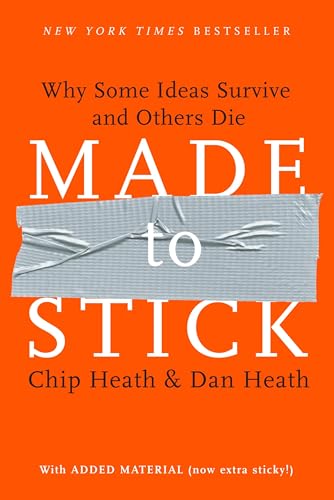
⚡️ What is Made to Stick about?
Made to Stick explores why some ideas capture our attention and linger in our memories while others fade quickly. Chip Heath and Dan Heath identify six key principles that make ideas “sticky” – simple, unexpected, concrete, credible, emotional, and story-driven. The authors provide practical frameworks for crafting messages that resonate, using real-world examples from business, education, and social movements to illustrate their points.
🚀 The Book in 3 Sentences
- Made to Stick teaches that memorable ideas follow six principles: simple, unexpected, concrete, credible, emotional, and story-based.
- The “Curse of Knowledge” prevents experts from communicating effectively because they assume others have the same background information.
- Successful communication strips ideas to their core essence while making them relatable through vivid examples and compelling narratives.
🎨 Impressions
Made to Stick fundamentally changed how I approach communication. The concept of stripping ideas to their core while maintaining impact is brilliantly executed throughout the book. I was particularly impressed by how the Heath brothers used real-world examples to make their framework tangible and immediately applicable to any communication challenge.
📖 Who Should Read Made to Stick?
Made to Stick is essential reading for anyone who needs to communicate ideas effectively – from marketing professionals and educators to business leaders and public speakers. The book is particularly valuable for those who struggle with making complex concepts understandable or memorable, providing practical frameworks that can be applied immediately across various contexts.
☘️ How the Book Changed Me
How my life / behaviour / thoughts / ideas have changed as a result of reading the book.
- I now focus on finding the core message in every presentation, eliminating unnecessary details that dilute impact
- My email communications became more unexpected and vivid, resulting in higher response rates from colleagues and clients
- I started incorporating storytelling elements into my professional pitches and training sessions
- I look for concrete analogies and emotional connections when explaining complex technical concepts
- My presentation preparation now includes checking whether ideas meet multiple stickiness criteria
✍️ My Top 3 Quotes
- “To make our communications more effective, we need to shift our thinking from ‘What information do I need to convey?’ to ‘What questions do I want my audience to ask?’
- “We must avoid the Curse of Knowledge. When we know something, we can’t remember what it’s like to not know it.”
- “Your idea has to be simple, but it must also be profound. The hard part isn’t stripping out the unnecessary; it’s pruning the essential but not truly core elements.”
📒 Summary + Notes
Made to Stick revolutionizes how we understand effective communication by identifying the characteristics that make ideas memorable. The Heath brothers tackle the fundamental challenge of communication: how to make ideas that stick in people’s minds despite the “Curse of Knowledge” that affects how we share information.
Chapter 1: Simple
This chapter emphasizes the importance of distilling ideas to their core without losing meaning. The “Curse of Knowledge” prevents communicators from seeing how complex their message appears to newcomers. To combat this, the authors introduce the Commander’s Intent concept from the military and the inverted pyramid technique from journalism as practical tools for finding and sharing the essential message.
- Commander’s Intent focuses on the outcome rather than the process – “take the bridge” instead of detailed tactical instructions
- The inverted pyramid technique starts with the most crucial information and adds details progressively
- Successful communicators create generative analogies that help audiences understand new concepts through familiar schemas
Chapter 2: Unexpected
Chapter 2 explores how breaking patterns of thinking captures and maintains attention. The key insight is that people pay attention to what violates their expectations, then remember what satisfies their curiosity. Effective communicators create gaps in knowledge that compel audiences to seek resolution, turning passive listeners into active participants in the learning process.
- Mystery stories engage audiences by opening knowledge gaps rather than providing answers upfront
- Genuine surprises create lasting impressions, but gimmicks without substance fail to make ideas stick
- Roone Arledge’s approach to sports broadcasting created compelling narratives by focusing on the human drama rather than just statistics
Chapter 3: Concrete
Concrete ideas appeal to the human senses and are therefore more memorable than abstract concepts. This chapter demonstrates how experts often communicate in abstract terms that are meaningless to novices, highlighting the need to translate complex ideas into tangible experiences. The longevity of Aesop’s fables serves as a perfect example of how concrete imagery creates lasting impact.
- Concrete language transforms abstract concepts like “high-performance” into relatable physical metaphors
- Urban legends succeed because they’re filled with vivid sensory details that make them believable
- The difference between novices seeing details as just details and experts seeing symbolic patterns illustrates the Curse of Knowledge
Chapter 4: Credible
Establishing credibility is crucial for making ideas stick, but external authority isn’t always available. This chapter explores various techniques for building internal credibility within messages. From anti-authorities who gain trust through vulnerability to testable credentials that allow audiences to verify claims, the authors provide practical strategies for convincing skeptical listeners without relying on traditional authority figures.
- Anti-authorities like dying smokers or scientists who experiment on themselves create powerful credibility through lived experience
- Vivid details often substitute for external expertise – people associate detailed knowledge with competence
- The Sinatra Test suggests identifying one powerful example that makes the entire concept credible
Chapter 5: Emotional
Making people care about ideas is essential for stickiness. This chapter explores how emotions drive action and memory formation. Contrary to conventional wisdom, emotional manipulation isn’t the goal; instead, communicators should create genuine connections between their ideas and audiences’ existing values and concerns. The research on charitable giving demonstrates that individual stories often trump statistical appeals in creating emotional engagement.
- Individual stories consistently outperform statistical appeals because they allow audiences to form emotional connections
- Identity-based appeals often work more effectively than simple self-interest arguments
- Associations with existing values and concepts help make new ideas emotionally resonant
Chapter 6: Stories
Stories provide a powerful framework for making ideas stick by engaging audiences in mental simulations that enhance understanding and retention. The chapter identifies three primary story types – challenge plots (underdog triumphs), connection plots (relationships bridge differences), and creativity plots (breakthrough innovations). These narrative structures automatically incorporate other stickiness principles, making them invaluable tools for communicators.
- Challenge plots like the Subway Jared story demonstrate how overcoming obstacles creates compelling narratives
- Connection plots build social bridges and encourage tolerance and cooperation in audiences
- Stories naturally incorporate multiple stickiness principles, making them powerful communication vehicles
Key Takeaways
These fundamental lessons encapsulate the core wisdom from Made to Stick, providing actionable insights for anyone looking to improve their communication effectiveness:
- Made to Stick principles work together synergistically – successful communication incorporates multiple elements from the framework
- The Curse of Knowledge affects everyone and requires conscious effort to overcome through audience perspective-taking
- Stories serve as master frameworks that naturally incorporate other stickiness principles into memorable messages
- Concrete details and emotional connections make abstract concepts relatable and actionable for audiences
- Unexpected elements capture attention while simple core messages ensure clarity and memorability
Conclusion
Made to Stick provides a comprehensive framework for creating memorable, impactful ideas that resonate with audiences. By understanding and applying the six principles of stickiness – simple, unexpected, concrete, credible, emotional, and storytelling – communicators can dramatically improve their effectiveness in any context. The book’s practical examples and actionable advice make it an invaluable resource for anyone looking to make their ideas stick in an increasingly crowded information landscape.
More From Chip Heath; Dan Heath →
Discover more from AI Book Summary
Subscribe to get the latest posts sent to your email.