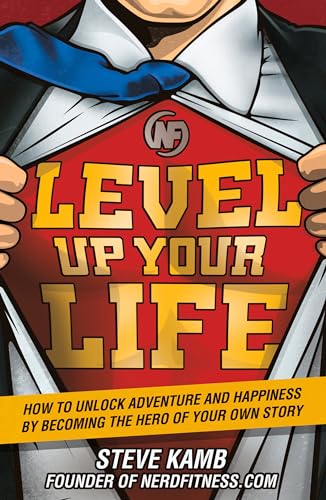
⚡️ What is Level Up Your Life About?
Ever wonder why you’ll spend forty hours grinding for a digital sword in an RPG but won’t spend twenty minutes at the gym to improve your own health? It’s a question that plagued Steve Kamb until he decided to stop treating games as an escape and started treating his life as the ultimate game. This isn’t just another dry guide on productivity; it’s a framework for anyone who identifies more with Link or Batman than with a corporate executive. Kamb argues that the mechanics that make games addictive—clear goals, instant feedback, and a sense of progression—can be applied to our boring Tuesdays to make them legendary.
As the founder of Nerd Fitness, Kamb has spent over a decade helping people who feel like “outcasts” in traditional gym culture. In this book, he maps out a path to transform your physical body, your career, and your thirst for adventure by creating a real-life character sheet. If you’ve been stuck in your “hobbit-hole” for too long, this is your call to adventure. You can find more Self-Help book summaries on our site, but few capture this specific blend of nerd culture and practical habit-building quite like this one.
🚀 The Book in 3 Sentences
- Your life is an ongoing RPG where you are the protagonist, and every action you take either gains or loses you experience points (XP).
- By creating an “Epic Quest List,” you transform vague desires into concrete, tiered missions that provide a sense of momentum and accomplishment.
- The key to lasting change isn’t willpower, but designing your “user interface” (environment) and recruiting a party of allies to keep you accountable.
🎨 Impressions
I finished Level Up Your Life feeling like I’d just downed a mana potion. It’s rare to find a self-improvement book that doesn’t take itself too seriously while still delivering heavy-hitting advice on habit formation. Kamb’s enthusiasm is infectious. I particularly loved how he breaks down world travel—something most of us view as a “maybe one day” dream—into a series of low-cost quests that feel achievable right now. It’s the kind of book that makes you want to go for a run, not because you have to, but because you want to put a point into your “Stamina” stat.
Honestly, I found the section on nutrition a bit basic if you’ve already spent time in the fitness world, but for a beginner, it’s a breath of fresh air. It’s free from the usual “bro-science” and focuses on the Paleo-adjacent “Nerd Fitness Diet” that actually works for most humans. The writing style is punchy, full of references to Star Wars, Lord of the Rings, and The Legend of Zelda. It feels like talking to a friend who knows a lot about fitness but also understands why you’d rather stay up until 2 AM playing Civilization.
📖 Who Should Read Level Up Your Life?
If you’re a gamer who feels like your real life is lagging behind your digital one, this is your manual. It’s also perfect for people who find traditional self-help too corporate or “woo-woo.” However, if you’re looking for high-level athletic training or complex financial advice, you won’t find it here. This is for the person who needs a system to get off the couch and start their first quest, whether that’s losing ten pounds or flying to Japan.
☘️ How This Book Changed My Thinking
I used to view my goals as a giant, terrifying mountain I had to climb all at once. After reading this, I started looking at everything as a series of Level 1 quests. It took the pressure off and made the process fun again.
- I stopped saying “I want to get fit” and started tracking my “Strength XP” through specific lifts, making the gym feel like a progression bar.
- I created my own Epic Quest List with different tiers, which finally pushed me to book a solo trip I’d been putting off for three years.
- I realized that my environment (my “Batcave”) was actively working against my goals, so I redesigned my home office to make healthy choices the default.
✍️ 3 Quotes That Stuck With Me
- “The world needs more heroes.” — This simple call to action reminds us that our self-improvement isn’t just for us; it’s so we can be more useful to others.
- “Don’t live vicariously through your character. Live through yourself.” — This hit me hard because I realized how much time I spent making my avatars perfect while neglecting my own stats.
- “A hero is simply an ordinary person who does extraordinary things.” — It strips away the myth of ‘talent’ and replaces it with the reality of consistent, small actions.
📒 Summary + Notes
The central argument of Level Up Your Life is that we are all playing a game, whether we realize it or not. The problem is that most of us are NPCs (Non-Player Characters) in our own lives—following a script written by someone else, stuck in a loop of work, sleep, and mindless consumption. Kamb wants you to reclaim the controller. He builds the case that by using the psychological hooks of gaming, we can bypass our natural resistance to change and actually enjoy the process of becoming better versions of ourselves.
The book follows a logical progression: first, you define who you are (Character Creation); then, you decide where you’re going (The Epic Quest List); and finally, you build the systems to get there (Habits, Fitness, and Allies). It culminates in the idea that “leveling up” isn’t a destination but a permanent mindset shift. By the end, the author expects you to stop waiting for a “hero” to save you and to start realizing that you’ve had the potential to be the hero all along.
1: The Call to Adventure
Why do we feel so much more capable when we’re holding a controller than when we’re holding a gym bag? Kamb opens by identifying the “Hero’s Journey” in our favorite movies and games, showing how they all follow a similar pattern: a reluctant hero is pulled out of their comfort zone. He argues that most of us are currently stuck in the “The Shire,” safe but bored, and that the first step to leveling up is acknowledging that you’re dissatisfied with your current level.
There’s a moment early on where he describes his own life working a cubicle job he hated. He was the classic “daydreamer” who used games to escape a reality he didn’t like. The shift happens when you realize that the same dopamine hits you get from leveling up in World of Warcraft can be found in real life if you just track the right metrics. It’s about moving from a fixed mindset—thinking you are just “naturally” lazy or weak—to a growth mindset where every attribute is a skill tree that can be leveled up.
2: Character Creation
Most people spend more time designing their Skyrim character than their actual lives. This chapter is about creating your “Alter Ego.” Why bother? Because it’s easier to make tough choices when you’re acting as a version of yourself that doesn’t give up. Kamb suggests picking a “class” (Warrior, Scout, Assassin, etc.) based on your real-world interests. Want to lift heavy things? You’re a Warrior. Want to run through the woods? You’re a Scout.
This isn’t just for fun; it’s a psychological tool. By defining your “Super Suit” (the clothes or gear that make you feel capable) and your “Origin Story,” you create a narrative that supports your new habits. Don’t you find it easier to stay consistent when you have an identity to live up to? Kamb insists that you need to be specific about your starting stats. You can’t improve what you don’t measure.
3: Your Epic Quest List
Imagine standing at a terminal, allocating points to your strength and intelligence. That’s essentially what building an Epic Quest List (EQL) does for your life. Most people have a “Bucket List,” but those are usually vague and overwhelming. An EQL is different because it’s tiered. You have Level 1 quests (walk for 5 minutes) and Level 50 quests (climb Mt. Kilimanjaro).
The brilliance here is the “XP” system. By assigning point values to tasks, you create a sense of urgency for even the smallest wins. Kamb provides a framework for categories:
- Physical Health
- Mental Prowess
- Adventure/Travel
- Financial Freedom
4: Master Your Habits
There’s a specific moment in most games where the tutorial ends and the real grind begins. In real life, that grind is built on habits. Kamb introduces the “Habit Loop”: Cue, Action, and Reward. He argues that the reason we fail at habits is that we make the “Action” too hard and the “Reward” too far away. To level up your habits, you have to shrink the quest.
He also talks about “Batcave-ing” your environment. If Batman didn’t have a Batcave with all his tools ready, he’d probably just stay in bed and watch Netflix. You need to design your surroundings so that the healthy choice is the easiest one. Hide your TV remote, put your gym clothes on your keyboard, and keep healthy snacks at eye level. Are you making it too easy to fail?
5: Level Up Your Health
How do you train for an adventure if you’ve never stepped foot in a gym? Kamb simplifies fitness into basic movement patterns. He avoids the “get shredded in 30 days” marketing fluff and instead focuses on functional strength. The goal isn’t just to look good; it’s to have the physical capacity to complete the quests on your list.
He advocates for the “Paleo-ish” diet, which he calls the Nerd Fitness Diet. It’s about eating whole foods—meat, vegetables, nuts, and fruit—and avoiding processed junk. The key takeaway here is that you can’t outrun a bad diet. Nutrition is 80-90% of the battle. He frames healthy eating not as a restriction, but as “fueling your character” for the missions ahead.
6: The Quest for Adventure
Does the idea of flying to another country feel like something only rich people do? Kamb spent years “travel hacking” and shares how to see the world on a budget. He treats travel like a stealth mission: find the cheapest flights using specific tools, stay in hostels or use Couchsurfing, and eat like a local.
He emphasizes that travel is one of the fastest ways to gain “Life XP” because it forces you out of your routine and challenges your assumptions. He encourages readers to pick one “impossible” location from their favorite movie or game and figure out how to get there. Adventure isn’t a luxury; it’s a requirement for a life well-lived.
7: Building Your Party
No hero ever saves the world alone. Whether it’s Frodo and the Fellowship or the Avengers, every protagonist needs a team. Kamb argues that we are the average of the five people we spend the most time with. If your “party” is full of people who constantly complain and eat junk food, you’re going to have a hard time leveling up.
He suggests finding mentors (High-Level Players) and allies (people at your level) to keep you accountable. This could be a local running club, an online community like the Nerd Fitness Rebellion, or just a friend who won’t let you skip the gym. Who is in your party right now? Are they helping you win, or are they dragging your stats down?
8: Beating the Bosses
What happens when you hit a wall? Every game has a boss battle, and in real life, those bosses are usually internal: Fear, Resistance, and The Big Sad. Kamb discusses the inevitable setbacks and how to handle them. He uses the concept of “Respawning.” In a game, when you die, you don’t quit the game forever; you just start back at the last checkpoint with the knowledge of what killed you.
The final “Boss” is the fear of what others think. Kamb encourages readers to embrace their “weirdness” and realize that the people who judge you for trying to improve are usually just projecting their own insecurities. True leveling up happens when you stop playing for the approval of others and start playing to win your own game.
⚖️ A Critical Perspective
While the gamification aspect is brilliant, the book occasionally falls into the trap of oversimplification. For instance, Kamb treats complex mental health issues or systemic obstacles like “bosses” that can be overcome with just a bit more willpower or a better quest list. It’s a very “can-do” American perspective that might feel a bit tone-deaf to someone dealing with clinical depression or severe financial hardship. Additionally, the travel hacking advice, while still useful in 2025, has become much harder to execute as airlines and credit card companies have closed many of the loopholes that existed when the book was first written.
🔄 How It Compares
Compared to The 4-Hour Body by Tim Ferriss, which is hyper-focused on biological shortcuts and data, Level Up Your Life is much more about the psychological and narrative drive behind change. Ferriss wants you to hack your body; Kamb wants you to hack your identity. Kamb’s tone is also significantly more accessible and less “alpha-male” than many other fitness or productivity books from the same era.
🔑 Key Takeaways
Here are the primary lessons for anyone ready to start their own epic quest:
- Identity First: Don’t just set goals; decide what kind of person (character class) would achieve those goals and act as they would.
- The 20-Second Rule: Reduce the “friction” for good habits by making them take less than 20 seconds to start.
- Tiered Success: Break every major ambition into small, medium, and large quests to ensure you never go too long without a win.
- Respawn Mentality: Failure isn’t the end of the game; it’s a data point that tells you what you need to change for your next attempt.
💬 Frequently Asked Questions
What is the main argument of Level Up Your Life?
The book argues that you can achieve remarkable fitness, adventure, and happiness by applying the mechanics of video games—such as experience points, questing, and leveling up—to your everyday life. It shifts the focus from boring chores to exciting missions, making personal growth feel like a game you actually want to play.
How do I create an Epic Quest List?
To create an Epic Quest List, you brainstorm all the things you’ve ever wanted to do and categorize them into themes like fitness, travel, or skills. You then rank them by difficulty from Level 1 (easy) to Level 50 (epic) and assign them XP values based on the effort required.
Is Level Up Your Life worth reading if I’m not a gamer?
Yes, though you’ll miss some of the specific references to Star Wars or Zelda. The core psychological principles of habit formation, environment design, and tiered goal setting are universal. However, if you actively dislike nerd culture, the constant analogies might feel more distracting than helpful.
What is ‘Batcave-ing’ your environment?
Batcave-ing is the process of optimizing your physical surroundings to make good habits inevitable and bad habits difficult. Like Batman’s cave, your home should be equipped with the tools you need for success (like pre-packed gym bags) while removing obstacles (like junk food or distracting electronics).
Who should read Level Up Your Life?
It’s ideal for beginners who feel overwhelmed by traditional self-help and need a fun, structured way to start improving their health and lifestyle. It’s particularly effective for people who feel like “outsiders” and want a community of like-minded individuals to support their journey toward adventure.
Conclusion
At its heart, Level Up Your Life is a reminder that we only get one play-through. Steve Kamb has managed to take the often-dreaded tasks of dieting, exercising, and saving money and wrapped them in a narrative that makes them feel like essential steps in a grand adventure. While the references might be geeky, the results are very real. I’ve found that even years after first reading this, I still think of my big goals as Level 50 quests, and it keeps me from getting discouraged when I’m still at Level 5.
The ONE thing you should take away from this is that you don’t need permission to start your quest. You don’t need more information, better gear, or a higher level; you just need to step out of the door. If you’re tired of being a spectator in your own life, use this framework to pick your class, write your list, and start earning some XP. It’s time to Level Up Your Life. You can find more inspiration in our Self-Help book summaries to keep your momentum going.
More From Steve Kamb →
Discover more from AI Book Summary
Subscribe to get the latest posts sent to your email.