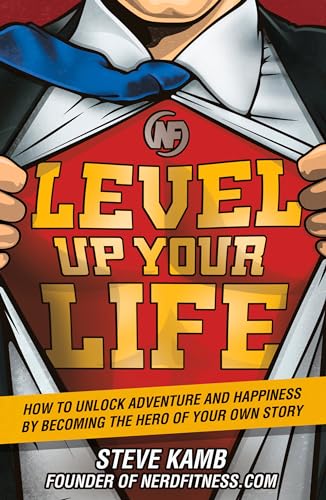
⚡️ What is Level Up Your Life about?
I discovered that Level Up Your Life by Steve Kamb is not just another self-help book; it is a comprehensive blueprint for transforming mundane routines into epic adventures. Kamb, the founder of Nerd Fitness, introduces a revolutionary framework that applies video game mechanics to real-world personal development. The book demonstrates how we can harness the same psychological triggers that make games addictive—progress bars, achievement systems, and epic storylines—to build better habits, achieve fitness goals, and create meaningful connections. By treating life as a role-playing game where you are the hero, Kamb argues that we can overcome procrastination, fear, and stagnation. The methodology centers on the “Hero’s Journey” narrative structure, encouraging readers to view challenges as quests, obstacles as dragons to slay, and daily actions as experience points that lead to tangible character development. This approach makes personal growth feel less like a chore and more like the adventure it should be.
🚀 The Book in 3 Sentences
- Level Up Your Life teaches you to treat your personal development like a role-playing game, where you create a heroic alter ego and complete quests to gain experience points in areas like fitness, career, and relationships.
- Steve Kamb provides a framework for applying the Hero’s Journey to everyday life, turning boring tasks into engaging missions through gamification psychology and community building.
- The book proves that you do not need superhuman willpower to change; you just need better systems that make progress visible, failure temporary, and growth fun.
🎨 Impressions
Reading Level Up Your Life felt like finding the cheat codes to my own existence. I was immediately struck by Kamb’s authentic voice and his deep understanding of nerd culture combined with behavioral psychology. The book does not talk down to readers or offer generic advice; instead, it provides a specific, actionable framework that resonates with anyone who has ever felt stuck in their personal development journey. I appreciated how Kamb shares his own transformation story—from a directionless twenty-something to the leader of a global fitness movement—while providing concrete tools rather than vague inspiration. The writing is engaging, peppered with pop culture references from Star Wars to Zelda, yet the strategies are grounded in solid research about habit formation and motivation. What impressed me most was the balance between grand vision-setting and granular daily actions, making the book both aspirational and immediately practical for anyone ready to change their story.
📖 Who Should Read Level Up Your Life?
Level Up Your Life is specifically designed for anyone who has ever felt that traditional self-improvement methods feel like grinding through tedious side quests rather than embarking on meaningful adventures. I believe this book will resonate most strongly with gamers, pop culture enthusiasts, and self-proclaimed nerds who understand the language of experience points, guilds, and boss battles, though its principles are universal enough for any reader seeking transformation. If you have struggled with consistency in fitness, career goals, or personal projects because they felt boring or overwhelming, Kamb’s gamification approach will speak directly to your need for engagement and progress tracking. The book is ideal for people in their twenties or thirties looking for direction, anyone recovering from burnout who needs to make life fun again, or individuals who love RPGs and want to apply that same progression system to their actual lives. Essentially, if you have ever wished your life had a progress bar or that you could hit “reset” on your character build, this book provides the mechanics to do exactly that.
☘️ How the Book Changed Me
This book fundamentally shifted how I approach my daily routines and long-term ambitions. I stopped viewing my goals as burdensome tasks and started seeing them as parts of an ongoing campaign where I am the protagonist. The concept of creating an “alter ego” or character class helped me embody the traits I wanted to develop rather than just hoping I would magically acquire them through willpower.
- I began tracking my daily habits as “experience points” rather than checking off chores, which made consistency feel rewarding rather than punishing
- I created a concrete “Epic Quest” list with specific boss battles, breaking down my five-year vision into manageable monthly and weekly missions
- I started viewing my gym time as “training for an upcoming raid” rather than exercise, which dramatically improved my consistency and enjoyment
- I established my own “guild” by reaching out to accountability partners who share similar goals, creating mutual support systems
- I adopted the practice of celebrating small wins with leveling up ceremonies, reinforcing positive behaviors through immediate positive feedback
✍️ My Top 3 Quotes
- “You are the hero of your own story, and the only way to win is to play.”
- “Life is not a problem to be solved, but an adventure to be lived.”
- “Every day is an opportunity to gain experience points, even if it’s just +1 STR from doing one pushup.”
📒 Summary + Notes
Level Up Your Life presents a transformative philosophy that combines Joseph Campbell’s Hero’s Journey with modern behavioral psychology to create a sustainable system for personal development. Steve Kamb argues that traditional goal-setting fails because it lacks the narrative structure and feedback loops that make video games so engaging. The book is structured around the premise that your life is a massive multiplayer online role-playing game, and you have complete control over your character class, attributes, and quest log. Kamb guides readers through a process of identifying their current “level” across various life categories, creating a compelling backstory for their hero, and designing specific, challenging quests that advance the plot of their lives. He emphasizes that adventure does not require quitting your job to travel the world; instead, it involves approaching everyday challenges with the mindset of a hero preparing for battle. The system relies on three core mechanics: questing (setting goals), grinding (daily habits), and boss battles (major milestones), all tracked through a tangible scoring system that provides the dopamine hits necessary for long-term motivation.
Chapter 1: The Hero’s Journey
The opening chapter establishes why humans are naturally drawn to stories and games more than abstract self-improvement. Kamb explains that video games succeed where New Year’s resolutions fail because they provide immediate feedback, clear progression paths, and a sense of agency. I learned that we are all hardwired for narrative; our brains process information best when it fits into a story structure where we face challenges, gain allies, and emerge transformed. Kamb demonstrates how classic hero narratives from Star Wars to The Legend of Zelda mirror the patterns we need to follow in our own lives. He introduces the concept of the “Call to Adventure”—that moment when we realize our current reality is insufficient and we must embark on a quest to become our best selves. This chapter reframes fear not as something to avoid, but as the necessary threshold guardian that signals we are on the right path toward growth.
- Games provide better feedback loops than real life, which is why we prefer playing them over working out or studying
- The Hero’s Journey structure appears in every culture because it reflects universal psychological needs for challenge and transformation
- Your “Ordinary World” is your current comfort zone, and leaving it is supposed to feel uncomfortable and scary
- Refusal of the call leads to stagnation and regret; accepting it leads to adventure and growth
- Every hero needs a transformation; you cannot complete the journey and remain the same person you were when you started
Chapter 2: Select Your Character
This chapter focuses on identity transformation through the creation of your “character class.” Rather than saying “I want to run a marathon,” Kamb encourages you to become a “Runner” or “Athlete” as part of your core identity. I discovered that adopting an alter ego allows you to bypass internal resistance by acting “in character” rather than forcing yourself through sheer discipline. Kamb provides specific templates for character classes like the Warrior (strength training), the Ranger (outdoor endurance), the Rogue (bodyweight skills), and the Monk (flexibility and mindfulness). He guides readers through a detailed character creation process including selecting attributes (Strength, Intelligence, Charisma, etc.), writing a backstory, and choosing starting equipment. The key insight here is that we rise to the level of the identity we adopt, not the goals we set. By creating a heroic avatar, you give yourself permission to act braver, stronger, and more disciplined than your current self believes possible.
- Identity-based habits are more powerful than outcome-based goals because they change who you believe you are
- Creating a character class gives you a clear archetype to embody when making decisions
- Your character sheet should track attributes like Strength, Stamina, Wisdom, and Charisma across different life areas
- Wearing specific “armor” or clothing associated with your character helps trigger the desired behavior
- The backstory you write creates emotional stakes that keep you committed when motivation wanes
Chapter 3: Create Your Epic Quest
Here, Kamb details the art of goal-setting using game mechanics. An “Epic Quest” is a major life goal that takes months or years to complete, while “Quests” are the weekly and monthly milestones that get you there. I learned to structure my objectives like video game missions: specific, challenging, and tied to a narrative. Kamb introduces the concept of “Boss Battles”—major milestones like completing a 5K race, writing a book, or changing careers that require preparation and special tactics. He emphasizes breaking down overwhelming goals into “mini-quests” that can be completed in 15-30 minutes, making progress feel achievable even on difficult days. The chapter includes systems for creating quest logs, tracking side quests (secondary goals), and ensuring that every action either contributes to your main storyline or provides necessary rest. This approach eliminates the paralysis of perfectionism by focusing on “completion” rather than “optimization.”
- Epic Quests should scare you slightly; if they do not, they are side quests
- Every quest needs a clear victory condition—know exactly what “done” looks like
- Boss Battles require specific preparation, including grinding levels (building skills) before attempting them
- Side quests should support your main quest or provide necessary mental health breaks
- Use “quest stacking” by combining habits (listening to audiobooks while walking) to maximize efficiency
Chapter 4: Build Your Alliance
No hero succeeds alone, and this chapter explores the critical role of community in personal development. Kamb argues that going solo is the hardest difficulty setting for life, and joining a “guild” or finding “party members” dramatically increases your success rate. I learned how to identify the different roles I need in my support system: mentors who have completed the quests I am attempting, companions who are on the same journey, and accountability partners who check my progress. The book provides scripts for reaching out to potential allies and strategies for finding your “tribe” online or locally. Kamb emphasizes that your alliance should reflect the character you are becoming, not the person you used to be, which sometimes means leveling up your social circle. He also covers how to handle “PvP” (player versus player) conflicts and toxic relationships that drain your health points, teaching readers to set boundaries like a hero defending their kingdom.
- Solo play is possible but exponentially harder; guild membership provides shared resources and motivation
- Find a Mentor who has already defeated the boss you are currently facing
- Create or join an accountability group that meets regularly to compare quest logs
- Be selective about your party members; their stats influence your own through proximity
- Learn to identify and remove “vampires” who drain your energy rather than contributing to the mission
Chapter 5: Slay Your Dragons
This section addresses obstacles, failures, and the inevitable “Game Overs” that occur during any epic journey. Kamb reframes failure not as a permanent state but as “finding another way that doesn’t work,” similar to dying in a video game and respawning with new knowledge. I discovered the concept of “Dragon Analysis”—identifying whether obstacles are external (time, money, resources) or internal (fear, imposter syndrome, perfectionism)—and developing specific strategies for each type. The chapter introduces “Difficulty Modifiers,” ways to adjust quests when life gets complicated, such as scaling workouts during busy weeks or using “tourist mode” to maintain habits without full intensity. Kamb teaches the “Just One” technique for ultra-low motivation days: commit to just one pushup, one paragraph, or one minute of meditation, which usually leads to doing more once started. This resilience framework ensures that temporary setbacks do not become permanent character deaths.
- Treat failure like a video game death: you respawn at the last checkpoint with full health and new knowledge
- Identify your specific dragons—whether they are Procrastination, Imposter Syndrome, or Perfectionism—and create battle plans
- Use Difficulty Modifiers to keep playing on Hard Mode when life gets crazy, rather than quitting entirely
- The “Just One” rule bypasses the insurmountable feeling of big tasks by lowering the barrier to entry
- Create “emergency health potions”—prepared responses for when motivation crashes or obstacles appear
Chapter 6: Experience Points and Leveling Up
The final instructional chapter focuses on the tracking and reward systems that make gamification sustainable. Kamb details how to quantify progress across different “attributes” (physical, mental, social, financial) and celebrate “level ups” when reaching milestones. I learned to assign experience points (XP) to tasks based on difficulty and importance, creating a visible progression bar that triggers dopamine releases. The chapter covers daily, weekly, and monthly review systems to assess which quests are working and which need adjustment. Kamb introduces “Prestige Levels”—the concept that once you master one area, you can “prestige” and start a new specialization while maintaining your base stats. This prevents the common plateau where people achieve a goal and then lose motivation. The system ensures that life remains an infinite game with endless opportunities for growth rather than a finite competition with others.
- Assign XP values to tasks: easy tasks = 10 XP, medium = 50 XP, hard = 100 XP, Boss Battles = 500+ XP
- Create a “Level Up” ceremony when hitting XP thresholds, such as treating yourself to a special item or experience
- Track multiple attribute streams (Strength, Intelligence, Charisma) to ensure balanced character development
- Use monthly “Patch Notes” to review what mechanics are working and adjust your system
- Prestige mechanics allow you to start new Epic Quests without losing the progress you have already made
Key Takeaways
After implementing the strategies from Level Up Your Life, I understand that sustainable motivation comes from narrative engagement rather than discipline alone. The most profound lesson is that we can engineer our environment and psychology to make growth feel like play instead of work. By adopting a character identity, we bypass the internal resistance that typically sabotages traditional goal-setting methods. The framework teaches that consistency beats intensity; showing up daily for small XP gains compounds faster than sporadic heroic efforts. I also learned that community is not optional but essential—surrounding yourself with other heroes who are leveling up creates an upward spiral of accountability and support. Finally, the book reinforced that failure is data, not destiny; every “game over” is simply a chance to respawn with better strategy. These principles have shifted my approach from “trying to be better” to “playing the long game” with patience, strategy, and joy.
- Adopt an alter ego to bypass psychological resistance and embody the traits you want to develop
- Break all goals into quest logs with specific XP values and boss battles to maintain engagement
- Build your alliance intentionally; your guild determines your success rate more than your individual willpower
- Use difficulty modifiers to maintain momentum during hard times rather than quitting the game entirely
- Celebrate level ups with specific rewards to reinforce the dopamine loop that keeps you playing
Conclusion
Level Up Your Life offers more than a productivity system; it provides a complete paradigm shift for viewing your existence as an adventure worth undertaking. Steve Kamb successfully bridges the gap between the fantasy worlds we love and the real world we must navigate, proving that the same principles that make games engaging can make life fulfilling. I encourage you to take the first step today by selecting your character class and creating your first epic quest, no matter how small. Whether you want to improve your fitness, career, relationships, or creativity, this framework provides the mechanics to make it happen while actually enjoying the process. Do not let your story remain in the tutorial phase—pick up this book, press start, and begin your hero’s journey. The game is waiting, and you are the only one who can play your character. Level up your life starting now, because the respawn timer on today is already counting down.
More From Steve Kamb →
Discover more from AI Book Summary
Subscribe to get the latest posts sent to your email.