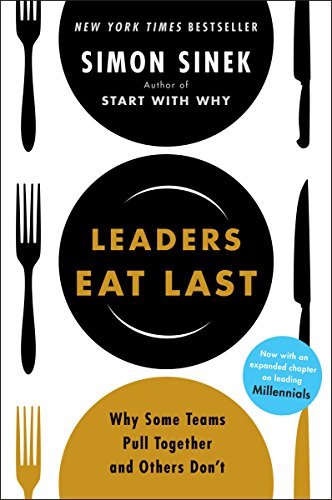
⚡️ What is Leaders Eat Last about?
Leaders Eat Last explores why some teams pull together while others don’t by examining the biological factors that drive human cooperation. Simon Sinek reveals how true leadership creates environments where people feel safe and valued, leading to extraordinary team performance. The book demonstrates that when leaders prioritize their people’s well-being over short-term gains, organizations naturally achieve better long-term results.
🚀 The Book in 3 Sentences
- Leaders Eat Last teaches that effective leadership requires creating a Circle of Safety where team members feel protected and valued.
- The book explains how four key chemicals—endorphins, dopamine, serotonin, and oxytocin—influence our behavior and cooperation in organizations.
- True leaders prioritize their people’s well-being over profits or personal gain, fostering cultures of trust that lead to sustainable success.
🎨 Impressions
Leaders Eat Last profoundly changed how I view organizational dynamics. Sinek masterfully connects biology to workplace behavior, making complex concepts accessible and practical. The military examples and corporate case studies provide compelling evidence that leadership strategies based on empathy consistently outperform those driven by fear and self-interest.
📖 Who Should Read Leaders Eat Last?
This book is essential for anyone in a leadership position, from CEOs to team managers, who wants to build high-performing teams. It’s particularly valuable for those struggling with employee engagement, retention, or organizational culture. Anyone interested in understanding the human side of business dynamics will find Leaders Eat Last transformative.
☘️ How the Book Changed Me
How my life / behaviour / thoughts / ideas have changed as a result of reading the book.
- I now prioritize creating psychological safety in my team, leading to more open communication and innovation.
- I’ve shifted from focusing solely on results to investing in relationships and trust-building activities.
- I regularly evaluate decisions through the lens of how they impact team members’ sense of security and belonging.
✍️ My Top 3 Quotes
- “Being a leader is like being a parent, and the company is like a new family to join.”
- “Leadership is about integrity, honesty and accountability. All components of trust.”
- “Customers will never love a company until the employees love it first.”
📒 Summary + Notes
Leaders Eat Last provides a comprehensive framework for understanding how effective leaders build organizations where people naturally collaborate and innovate. The book combines insights from biology, anthropology, and organizational behavior to explain why some teams thrive while others struggle.
Chapter 1: Our Need for Safety
Sinek introduces the concept of the Circle of Safety, explaining how humans have always thrived in groups where members protect each other. He argues that modern organizations must recreate this sense of security for employees to perform at their best.
- Circles of Safety are environments where team members feel protected from internal politics and external threats.
- Military examples show how soldiers risk their lives for each other when they feel part of a protective group.
- Leaders must create these circles by prioritizing team well-being over short-term results.
Chapter 2: Employees First, Customers Second
This chapter challenges the conventional wisdom that customers come first. Sinek demonstrates through examples that when leaders take care of employees, those employees naturally provide better service to customers.
- The leadership techniques of putting people before profits create sustainable competitive advantages.
- When employees feel secure, they innovate and solve problems more effectively for customers.
Chapter 3: The Lesson of E.D.S.O.
Sinek explains the four key chemicals that drive human behavior: endorphins, dopamine, serotonin, and oxytocin. He shows how these chemicals influence workplace dynamics and leadership effectiveness.
- Endorphins and dopamine are self-serving chemicals that drive individual achievement and short-term rewards.
- Serotonin and oxytocin are social chemicals that build trust, loyalty, and cooperation.
- Effective leaders balance these chemicals by creating environments that foster both individual achievement and social bonding.
Chapter 4: The Big Lie
This chapter addresses the misconception that numbers and metrics are the most important aspect of business. Sinek argues that overemphasizing metrics dehumanizes organizations and erodes trust.
-
li>Many leaders become obsessed with numbers at the expense of building relationships with their teams.
- This abstraction leads to decisions that harm people while benefiting short-term financial targets.
- True leaders maintain focus on human elements even when making data-driven decisions.
Chapter 5: The Courage to Do the Right Thing
Sinek explores how true leadership requires courage to make decisions that benefit the group even at personal cost. He shares stories of leaders who sacrificed their own interests for their teams.
- Leadership strategies must include the willingness to take personal risks for team well-being.
- Courageous leaders prioritize long-term health of the organization over short-term gains.
- The book provides examples of military and business leaders who made difficult choices that ultimately benefited their teams.
Chapter 6: Snowmobile in the Desert
This chapter uses the metaphor of a snowmobile in the desert to illustrate how organizations become ineffective when they apply solutions in the wrong context. Sinek emphasizes the importance of understanding human nature in business.
- Many management practices fail because they ignore fundamental human needs for safety and belonging.
- Effective leaders adapt their approaches to fit human nature rather than forcing people into unnatural systems.
- The chapter provides examples of companies that succeeded by designing organizations around human needs.
Chapter 7: The Leaders of Tomorrow
Sinek addresses the challenges facing younger generations in the workplace and how leaders must adapt to create environments where they can thrive despite different expectations and values.
- Millennials and Gen Z have different workplace expectations but still need circles of safety to perform well.
- Modern leaders must balance technology with human connection to engage younger workers.
- The chapter provides strategies for building trust across generational divides.
Chapter 8: Becoming a Leader
The final chapter provides practical guidance for developing the mindset and behaviors of a leader who eats last. Sinek outlines specific steps for building trust and creating safety.
- Leadership development requires consistent practice of empathy and selflessness.
- The chapter offers daily practices for building stronger connections with team members.
- Sinek emphasizes that leadership is a choice available to anyone, not just those in formal positions.
Key Takeaways
Leaders Eat Last provides essential insights into building organizations where people naturally collaborate and innovate. The most important lessons focus on creating environments of trust and safety.
- Effective leaders create circles of safety where team members feel protected and valued.
- Leadership requires balancing individual achievement with social bonding through understanding E.D.S.O. chemicals.
- Putting employees first leads to better customer experiences and long-term success.
- Courageous leaders prioritize people and principles over short-term metrics.
- Leadership is a choice available to anyone willing to serve others.
Conclusion
Leaders Eat Last offers a powerful framework for understanding how effective leadership transforms organizations. By creating environments where people feel safe and valued, leaders unlock the natural human capacity for cooperation and innovation. The principles in this book provide a roadmap for building teams that pull together rather than apart. I highly recommend reading the complete book to fully grasp Sinek’s insights and apply them to your leadership strategies.
More From Simon Sinek →
Discover more from AI Book Summary
Subscribe to get the latest posts sent to your email.