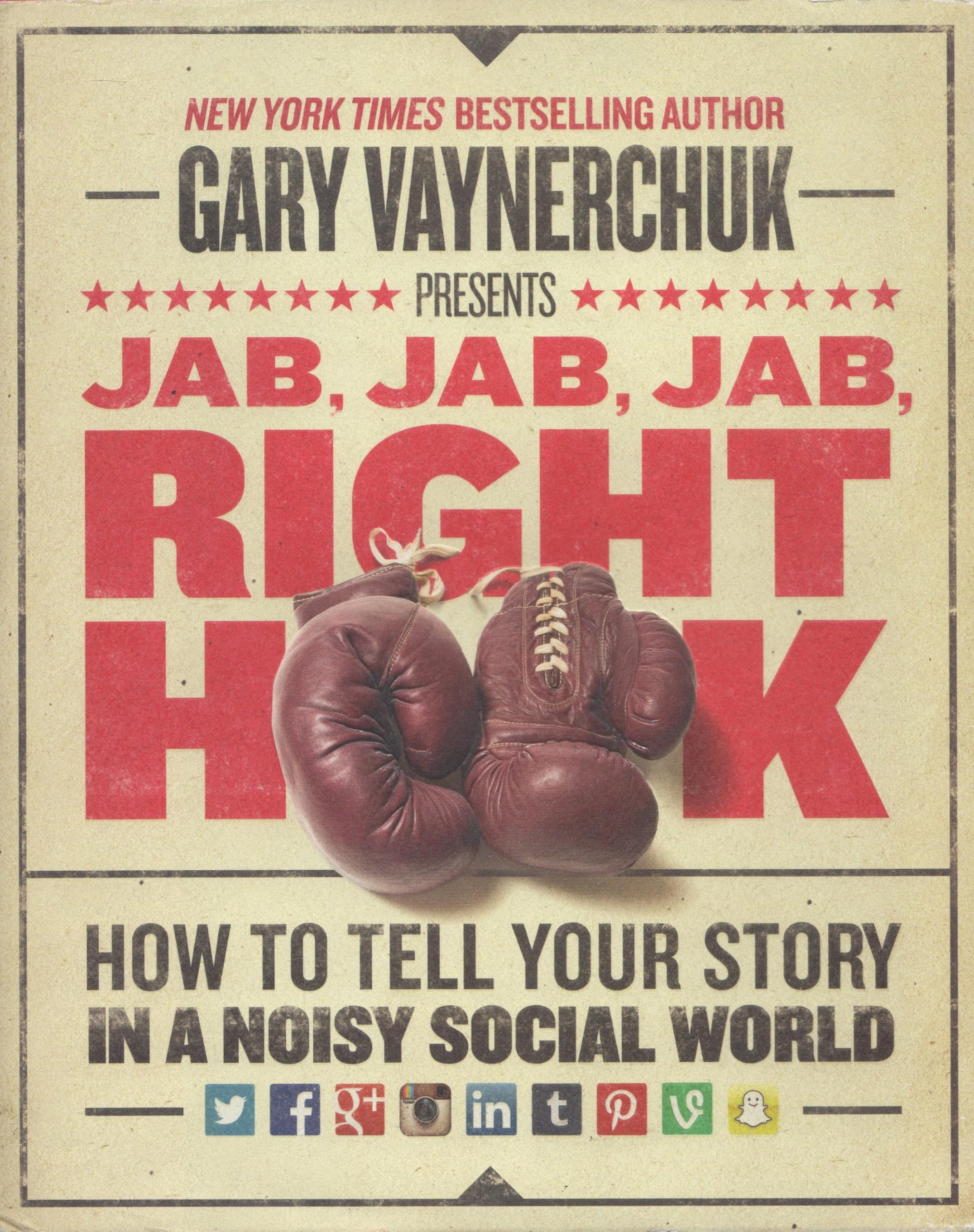
⚡️ What is Jab; Jab; Jab; Right Hook About?
Have you ever been at a party where someone you just met immediately tries to sell you insurance? It’s awkward, it’s annoying, and you probably spent the rest of the night avoiding them. In marketing book summaries, few titles address this social faux pas as aggressively as Gary Vaynerchuk does here. He argues that most brands are that annoying insurance guy on social media. They jump straight to the ‘ask’ without building any rapport first.
I’ve followed Vaynerchuk’s work for years, and while his persona can be polarizing, his logic in this book is incredibly sound. He uses a boxing metaphor to explain modern digital strategy: ‘Jabs’ are the value-added content you give away for free—the jokes, the tips, the stories. ‘Right hooks’ are the asks—the calls to action, the sales pitches, the ‘buy now’ buttons. Most businesses are throwing right hooks constantly and wondering why their audience has their hands up in a defensive crouch. More summaries by Gary Vaynerchuk reveal a consistent theme: give, give, give, and then—only then—ask.
🚀 The Book in 3 Sentences
- Effective social media marketing requires a high ratio of value-driven ‘jabs’ (content that entertains or informs) to sales-driven ‘right hooks.’
- Content must be native to the specific platform it lives on; what works on Facebook will likely fail on Pinterest because the user’s intent is different.
- The ‘right hook’ only lands if you have built enough equity and trust through consistent, high-quality jabbing over time.
🎨 Impressions
I’ll be honest: reading this felt like a frantic, high-energy coaching session. Gary doesn’t do ‘subtle.’ The book is visually heavy, filled with real-world examples of brands failing or succeeding on social media. I found myself nodding along to his critiques of big-budget ad campaigns that clearly didn’t ‘get’ the platform they were on. It’s refreshing to see a marketing expert actually point at a post and say, ‘This is garbage, and here is exactly why.’
What frustrated me slightly was how quickly the tactical advice dates itself. Since I finished the book, several of the platforms he discusses have changed their algorithms or, in the case of some ’emerging’ ones, disappeared entirely. However, the psychological core of the book—the idea of respect for the medium and the audience—is timeless. It’s about the difference between being a guest in someone’s feed and being an intruder. Do you know which one you are?
📖 Who Should Read Jab; Jab; Jab; Right Hook?
If you’re a small business owner frustrated that your Facebook posts aren’t leading to sales, this is your manual. It’s also perfect for content creators who feel ‘icky’ about selling; Gary shows you how to earn the right to ask. If you’re looking for a deep academic study on consumer behavior, skip this. This is a tactical field guide for people who want to move the needle right now.
☘️ How This Book Changed My Thinking
Before reading this, I used to think ‘good content’ was universal—if a video was good, I’d post it everywhere. Now, I realize that’s lazy and disrespectful to the user.
- I stopped ‘cross-posting’ the exact same caption and image to different platforms and started tailoring the ‘vibe’ to each site.
- I drastically increased my ‘jab’ count; I realized I was asking for favors from my audience way before I’d given them anything worth their time.
- I started looking at ‘context’ as being just as important as ‘content.’
✍️ 3 Quotes That Stuck With Me
- “Content is king, but context is queen, and she runs the house.” — This reminds me that a great message in the wrong place is just noise.
- “There is no sale without the story; no knockout without the setup.” — You can’t just expect people to care about your product because you told them it’s on sale.
- “Make it native. Give value. Be consistent.” — It’s the simplest summary of digital success I’ve ever found.
📒 Summary + Notes
The central thesis is that the world has changed, but marketing hasn’t caught up. We still try to interrupt people’s lives with slogans, but in a social world, we have to become part of their lives. Vaynerchuk wants you to understand that social media isn’t a distribution channel for your old TV ads; it’s a completely new way of communicating that requires empathy and nuance. You have to win the ‘micro-moments’ before you can win the sale.
Throughout the text, Gary builds a case for patience. He argues that most marketers are too short-term focused. They want the ‘right hook’ to land immediately so they can show their boss a conversion metric. But by throwing too many hooks, they burn out their audience. The narrative arc moves from understanding the boxing metaphor to a platform-by-platform breakdown of how to ‘jab’ effectively without being ignored.
1: The Setup
Why do most businesses treat social media like a megaphone instead of a telephone? This chapter sets the stage by explaining the ‘Jab, Jab, Jab, Right Hook’ philosophy. Gary argues that a ‘jab’ is any piece of content that builds brand equity. It doesn’t ask for a sale; it offers a laugh, a piece of information, or a moment of connection. If you don’t jab, your right hook—the sale—will never land because you haven’t softened the ‘opponent’ (the customer) up yet.
2: Characteristics of Great Content and Native Advertising
Content is king, but context is the kingdom. Gary highlights that ‘native’ content is the only way to survive. Native content doesn’t look like an ad; it looks like a post from a friend. He breaks down the six rules of great content:
- It’s native to the platform.
- It doesn’t interrupt.
- It doesn’t make demands.
- It leverages pop culture.
- It’s micro (short and sweet).
- It’s consistent.
3: Facebook
You’re at a dinner party, and someone starts screaming about a 20% discount on insurance—that’s what a bad Facebook ad feels like. Gary stresses that on Facebook, you are competing with photos of grandchildren and weddings. Your content has to be as interesting as those life events. He digs into the importance of high-quality imagery and the ‘sponsored story’ format, which was the precursor to the sophisticated ad targeting we see today. The takeaway? If your Facebook post isn’t shareable, it’s dead.
4: Twitter
Imagine a giant cocktail party where everyone is talking at once, but only the listeners are getting rich. On Twitter, context is everything because of the speed of the feed. Gary explains that Twitter is the best place for ‘newsjacking’—connecting your brand to what’s trending right now. He emphasizes the use of hashtags not just for reach, but for joining specific conversations. The ‘jab’ here is the reply. Talking back to people is the ultimate value-add.
5: Pinterest
What if your brand wasn’t a product, but a lifestyle mood board? Pinterest is unique because users are there with ‘aspirational intent.’ They are planning their future lives. Gary argues that on Pinterest, the quality of the image isn’t just important—it’s the only thing that matters. You aren’t selling a product; you’re selling a dream. Jabs on Pinterest involve pinning things that aren’t yours but fit your brand’s aesthetic.
6: Instagram
Art should come first, the sales pitch comes much, much later. At the time of writing, Instagram was still the ‘new’ cool kid. Gary points out that Instagram users are particularly sensitive to ‘corporate-looking’ content. To jab here, you have to be an artist. He talks about the power of the ‘glamour shot’ and why your brand needs to look like it has a soul, not just a marketing department.
7: Tumblr
If you think this is just for moody teenagers, you’ve already lost the battle. Gary dives into the subcultures of Tumblr and the importance of ‘GIF culture.’ This chapter is a masterclass in understanding ‘vibe’ over ‘data.’ He shows how brands can use humor and animation to jab in a way that feels authentic to a younger, more cynical audience.
8: Emerging Platforms
The ground is shifting while you read this sentence. Gary looks at platforms like Vine (RIP) and Snapchat. The lesson here isn’t the specific platform, but the speed of adoption. He argues that marketers should always be ‘first movers’ on new platforms because that’s when the attention is cheapest and the audience is most forgiving. Why wait until it’s crowded to start jabbing?
⚖️ A Critical Perspective
While the philosophy is gold, the tactical examples in this book are noticeably aged. It was written in 2013, before the dominance of short-form video like TikTok and Reels. Gary also tends to oversimplify the ‘Right Hook.’ Sometimes, a direct ask works perfectly well if the product is right, even without months of jabbing. Furthermore, the emphasis on high-quality static imagery has been somewhat replaced by a preference for ‘lo-fi’ authentic video content in the 2025 landscape. He treats every platform as a distinct silo, whereas today’s successful strategies often involve more integrated, omni-channel storytelling.
🔄 How It Compares
Compared to Seth Godin’s This is Marketing, Gary is much more tactical and ‘street-level.’ Godin focuses on the ‘why’ and the empathy of marketing, while Gary focuses on the ‘how’ and the hustle. If Godin is the philosopher of marketing, Vaynerchuk is the high-intensity coach on the sidelines.
🔑 Key Takeaways
Here are the fundamental shifts you need to make to your social strategy.
- Stop Automating: You can’t just link your Instagram to Twitter and call it a day; it looks sloppy and signals you don’t care about the community.
- Respect the Psychology: People use Pinterest to plan, Facebook to connect, and Twitter to learn—your content must match that specific intent.
- The 80/20 Rule: Aim for 80% jabs (value) and 20% right hooks (selling).
- Visual Literacy: In a scrolling world, your first 0.5 seconds is the ‘stop’ moment; if your visuals are boring, your copy doesn’t matter.
💬 Frequently Asked Questions
What is the difference between a jab and a right hook?
A ‘jab’ is content that provides value to the audience without asking for anything in return, such as entertaining stories, helpful tips, or engaging conversations. A ‘right hook’ is the call to action where you ask for a sale, a sign-up, or a specific customer behavior.
Is Jab; Jab; Jab; Right Hook still relevant in 2025?
The core philosophy of providing value before asking for a sale remains essential. While the specific tactical examples of platforms like Vine are outdated, the principle of ‘native content’ and respecting platform psychology is more important than ever in an era of TikTok and AI-generated noise.
What does Gary Vaynerchuk mean by ‘native content’?
‘Native content’ is marketing material that fits the aesthetic, tone, and user behavior of the specific platform where it is posted. It doesn’t look like an advertisement; it feels like a natural part of the user’s social feed, increasing the chances of engagement and trust.
Why does Gary Vaynerchuk say ‘Content is king, but context is queen’?
Who is the target audience for this book?
The book is primarily for small business owners, social media managers, and digital entrepreneurs who want to understand how to tell their brand’s story effectively on social media without alienating their audience through constant, aggressive sales pitches and outdated marketing tactics.
Conclusion
At the end of the day, Jab; Jab; Jab; Right Hook isn’t just about social media; it’s about human psychology. It’s a reminder that we are all emotional creatures who want to be seen, heard, and entertained, not just ‘converted’ into a lead. Gary Vaynerchuk’s loud, aggressive style might not be for everyone, but his fundamental message is one of incredible generosity. He’s telling you that to win, you have to give more than you take.
The ONE thing you should take away from this is: Respect the room. If you wouldn’t say it that way to a friend at a bar, don’t post it that way on social media. Build the relationship first. Throw the jabs. Earn the right to hook. If you do that, you won’t just make a sale; you’ll build a brand that people actually like. It’s a foundational read for anyone looking at marketing book summaries to improve their digital presence.
More From Gary Vaynerchuk →
Discover more from AI Book Summary
Subscribe to get the latest posts sent to your email.