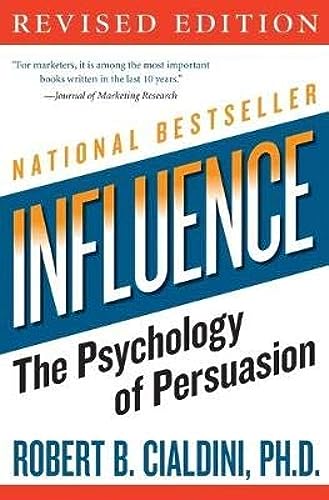
⚡️ What is Influence About?
Have you ever walked away from a purchase feeling slightly greasy, wondering why you agreed to a deal that didn’t even benefit you? Robert Cialdini spent three years undercover—training at used car dealerships, telemarketing firms, and fundraising organizations—to figure out exactly how the world’s most persuasive people get us to say yes. He found that we don’t use all the information available to us when making decisions. Instead, we use shortcuts. More summaries by Robert Cialdini often highlight how these shortcuts, while efficient, leave us vulnerable to anyone who knows how to flip the switch.
The central thesis of the book is that our modern environment is too complex for us to process every detail, so we rely on “fixed-action patterns.” Think of them as mental recordings that play when a specific trigger is pulled. Cialdini identifies seven primary triggers—reciprocity, commitment, social proof, liking, authority, scarcity, and unity—that bypass our critical thinking. This is an essential read for anyone diving into psychology book summaries because it bridges the gap between academic research and the cold, hard reality of the marketplace.
🚀 The Book in 3 Sentences
- Human decision-making relies on automatic, evolutionary shortcuts that “compliance professionals” exploit to bypass our rational minds.
- Influence is built on seven core principles that trigger a “click, run” response, making us say yes to requests we would otherwise decline.
- By recognizing these triggers as they happen, we can move from mindless reaction to mindful choice and defend ourselves against manipulation.
🎨 Impressions
I’ll be honest: reading this book made me feel a bit like a puppet realizing I’ve got strings attached to my limbs. It’s eye-opening, sure, but also slightly infuriating to see how easily my brain is hacked by a free sample or a “limited time offer.” I’ve always thought of myself as a rational buyer, but Cialdini’s stories about the “Contrast Principle”—where showing a terrible, overpriced house first makes the second house look like a steal—hit way too close to home. It’s not a breezy beach read; it’s a manual for mental self-defense that I found myself highlighting every few pages.
What I love most is that Cialdini doesn’t just sit in an ivory tower. He actually went out and got his hands dirty. He tried to sell encyclopedias. He watched vacuum cleaner salesmen in action. That boots-on-the-ground perspective gives the book a grit that most psychology texts lack. Ever wonder why you feel obligated to buy a drink for someone who bought you one first, even if you don’t like them? Cialdini explains it without the jargon, and that’s why it’s stayed relevant for forty years.
📖 Who Should Read Influence?
If you work in sales, marketing, or leadership, this is basically your bible. But honestly? It’s for the person who feels like they’re always getting talked into things they don’t want. If you’re a high-rationality type who thinks they’re immune to ads, you’re exactly the person who needs to read this to see your blind spots. If you’re looking for a deep academic treatise on neurology, you might find the anecdotal style a bit light, but for practical life, it’s gold.
☘️ How This Book Changed My Thinking
I used to think that being “polite” and being “compliant” were the same thing. Now, I see the gap between them.
- I stopped accepting “free” gifts from companies or people I don’t know, recognizing that it’s just a trap to trigger my reciprocity reflex.
- I now wait 24 hours before making any purchase triggered by a “scarcity” claim (like those annoying “only 1 left!” banners on travel sites).
- I’ve started looking for the “man behind the curtain” whenever an authority figure gives me advice, asking if they’re actually an expert or just wearing a fancy suit.
✍️ 3 Quotes That Stuck With Me
- “A well-known principle of human behavior says that when we ask someone to do us a favor we will be more successful if we provide a reason.” — It’s wild how the word ‘because’ works even if the reason is nonsensical.
- “The way to love anything is to realize that it might be lost.” — This perfectly captures the painful pull of scarcity.
- “We all fool ourselves from time to time in order to keep our thoughts and beliefs consistent with what we have already done or decided.” — A sobering reminder of why we stay in bad relationships or jobs.
📒 Summary + Notes
The core of the book argues that we live in an information-heavy world where we can’t possibly weigh every pro and con. Evolution solved this by giving us mental shortcuts. However, these shortcuts act like a “click” that starts a “run” of pre-programmed behavior. Cialdini’s mission is to show us how these tapes are played against us by people who want our money, our votes, or our time. He moves through the principles not as abstract theories, but as weapons used in the trenches of commerce.
By the end of the book, Cialdini wants you to become a “warrior” for your own attention. He doesn’t just want you to be aware; he wants you to actively counter-attack when you realize someone is using a fabricated trigger. The narrative arc moves from the internal triggers (Reciprocity) to social triggers (Social Proof) and finally to identity triggers (Unity), showing how the deeper the trigger goes into our sense of self, the harder it is to resist.
🧠 Core Ideas Explained Simply
The mechanics of persuasion often come down to a few primitive survival traits that haven’t quite caught up to the 21st century.
Fixed-Action Patterns
Imagine a mother turkey who will only care for her chicks if they make a specific “cheep-cheep” sound. If a stuffed polecat (her natural enemy) has a recorder inside playing that sound, she’ll actually mother the enemy. We aren’t much different. We have certain triggers—like a high price implying high quality—that make us act automatically without checking the facts.
The Contrast Principle
Is a $50 scarf expensive? If you just looked at a $5 T-shirt, yes. But if you just bought a $500 suit, that scarf feels like a rounding error. Persuaders use this by showing you the most expensive option first so that everything else feels like a bargain by comparison.
1: Levers of Influence
Why do we respond to the word “because” even when the reason that follows is completely useless? Cialdini points to a study where people let someone cut in line at a Xerox machine simply because they said, “because I have to make some copies.” Everyone there had to make copies! But the “because” triggered an automatic compliance response. We rely on these stereotypes—like “expensive = good”—to navigate a world where we don’t have time to be experts on everything from jewelry to insurance. The danger is that these triggers can be mimicked by those who want to exploit our shortcuts.
2: Reciprocation
There is no such thing as a free lunch, and our brains are hardwired to make sure of it. The rule of reciprocation says we are deeply uncomfortable being in someone’s debt. If a coworker buys you a coffee, you’ll find yourself looking for a way to pay them back, often with a much larger favor. This is why charities send those “free” address labels in the mail—it’s not a gift; it’s a trap designed to make you feel like a “taker” if you don’t donate.
The “Reject-and-Retreat” tactic is a particularly nasty version of this. It works like this:
- Ask for a huge favor that you know will be rejected.
- Wait for the “no.”
- Immediately ask for a much smaller favor (the one you actually wanted).
- The other person feels like you made a concession, so they feel obligated to make one too.
3: Liking
Would you ever buy something you didn’t need just because the person selling it was charming? Of course you would; we all do. We say yes to people we like, and we like people who are similar to us, who pay us compliments, and who are physically attractive. Cialdini highlights the “Halo Effect,” where we automatically attribute positive traits like honesty and intelligence to good-looking people. It’s why politicians try so hard to look like “regular folks” and why car salesmen always seem to have the same hobbies as you. They aren’t your friends; they’re just using your friendship reflex to close a deal.
4: Social Proof
Ever find yourself looking at a crowded restaurant and assuming the food must be good, even if the empty one next door has better reviews? That’s social proof in action. When we are uncertain, we look to others to see how to act. This is why sitcoms use laugh tracks even though everyone hates them—they actually make people laugh more. It’s also why “bystander apathy” happens in crowds; everyone is looking at everyone else to see if an emergency is real, and since nobody is reacting, everyone assumes everything is fine. To beat this, Cialdini suggests that if you’re in trouble, point to one specific person and give them a direct command: “You in the blue shirt, call 911.”
5: Authority
If a guy in a lab coat tells you to do something, do you do it? The infamous Milgram experiments showed that ordinary people would deliver what they thought were lethal electric shocks to strangers just because a man in a coat told them to. We are trained from birth that obedience to authority is “right.” The scary part is that we don’t even need actual authority; we just need the symbols of it. A title (Dr.), a uniform, or even a fancy car can trigger our submissive response. Always ask: “Is this person actually an expert, or are they just wearing the costume of one?”
6: Scarcity
Why does something become more attractive the moment it’s about to be taken away? The scarcity principle relies on our fear of losing freedom. When our access to something is restricted, we want it more—not because it’s better, but because we hate losing options. This is why “limited time offers” and “exclusive access” work so well. The arousal we feel when competing for a scarce resource (like at an auction) actually shuts down our ability to think straight. If you find yourself in a bidding war, take a breath. The item won’t work better or taste better just because it was hard to get.
7: Commitment and Consistency
Can a tiny window sticker really influence how you vote in an election? It sounds crazy, but once we make a small commitment, we feel a massive internal pressure to stay consistent with it. We want to be seen as stable and reliable. Persuaders use the “Foot-in-the-Door” technique by getting you to agree to a tiny request. Once you’ve done that, your self-image changes. You’re now “the kind of person who supports this cause,” which makes you far more likely to agree to a much larger, more expensive request later. If you want to change someone’s mind, don’t attack their logic—attack the commitment they’ve already made.
8: Unity
What happens when a persuader convinces you that they are part of your “tribe”? In his more recent updates, Cialdini added the Unity principle. This goes deeper than Liking. Unity is about shared identity—family, race, religion, or even being a die-hard fan of the same sports team. When we feel a sense of “We-ness” with someone, the traditional rules of influence become supercharged. We don’t just like them; we feel that they are *us*. This is why political polarization is so hard to break; once a belief is tied to your identity, questioning the belief feels like a betrayal of your family. It’s the most powerful, and potentially dangerous, tool in the kit.
9: Instant Influence
The world is moving too fast for our brains, isn’t it? As the information age accelerates, we are becoming more dependent on our primitive shortcuts, not less. We simply don’t have the bandwidth to analyze every bit of data. Cialdini ends by arguing that we must protect these shortcuts. If advertisers or salespeople use *fake* evidence of social proof (like fake reviews) or *fake* authority, they are polluting our decision-making ecosystem. We should feel justified in being “influence warriors”—boycotting and exposing those who use these psychological tools unethically. Our shortcuts are valuable; we shouldn’t let them be turned into our chains.
⚖️ A Critical Perspective
While the book is a masterpiece, it does rely heavily on laboratory studies that were conducted decades ago. Some of the effects Cialdini describes have seen “replication issues” in modern psychology, meaning they aren’t always as strong as he suggests. Additionally, the book can feel a bit cynical; it treats every human interaction like a chess match of manipulation. In the real world, someone might just be nice because they’re nice, not because they’re trying to trigger your reciprocity reflex. It’s important to keep your guard up, but don’t let this book turn you into a hermit who trusts nobody.
🔄 How It Compares
If you’ve read Daniel Kahneman’s Thinking, Fast and Slow, you’ll recognize the overlap. While Kahneman focuses on the internal mechanics of *how* we think (System 1 vs. System 2), Cialdini focuses on the external *triggers* that manipulate those systems. Kahneman is the scientist in the lab; Cialdini is the detective on the street showing you how the scam actually works.
🔑 Key Takeaways
These lessons are about moving from a reactive state to an active one in your daily life.
- Separate the offer from the person: If you like the salesperson, imagine the same deal being offered by a person you find repulsive. Would you still take it?
- Beware of the “Free” trap: Any unsolicited gift is usually a psychological debt invitation. Learn to say “thank you, but no” without feeling guilty.
- Watch for artificial scarcity: If you feel your heart rate spiking because something is “running out,” that is a signal to walk away and think for ten minutes.
- Small yeses lead to big yeses: Never sign a petition or wear a badge for a cause unless you are willing to commit your time and money to it later.
💬 Frequently Asked Questions
What are the 7 principles of influence?
The principles are Reciprocity, Commitment/Consistency, Social Proof, Liking, Authority, Scarcity, and Unity. Each represents a mental shortcut humans use to make decisions quickly. Persuaders use these to trigger automatic compliance, often bypassing our rational thinking processes to get us to say yes to various requests.
Is the book Influence still relevant in the digital age?
Absolutely. If anything, it’s more relevant now. Principles like Social Proof (reviews/likes) and Scarcity (countdown timers) are baked into every e-commerce website. As our world becomes more information-dense, we rely more heavily on the shortcuts Cialdini describes, making us even more susceptible to these psychological triggers online.
What is the difference between persuasion and manipulation?
Cialdini argues the difference lies in the truth of the trigger. Persuasion uses real shortcuts (e.g., showing a real expert). Manipulation uses fabricated ones (e.g., hiring an actor to play a doctor). Ethical influence helps people make good decisions quickly; unethical influence tricks them into making bad ones.
How can I defend myself against these influence tactics?
The best defense is awareness. When you feel a sudden surge of obligation, urgency, or unearned trust, stop. Ask yourself if the trigger is being manufactured. Cialdini suggests mentally separating the person from the product and listening to your “stomach signs”—that gut feeling when you’re being trapped.
What is the ‘Unity’ principle added in the newer editions?
Unity is about shared identity and a sense of ‘We-ness.’ It goes beyond liking someone to actually feeling that they are part of your group (family, religion, or tribe). When we perceive someone as ‘one of us,’ we are far more likely to be influenced by them without questioning.
Conclusion
Influence isn’t just a book about marketing; it’s a mirror held up to our primitive selves. We like to think we are the masters of our choices, but Cialdini proves that we are often just reacting to carefully placed cues in our environment. By understanding these seven triggers, you don’t just become a better negotiator or salesperson—you become a more conscious human being. You start to see the invisible strings being pulled in every ad, every political speech, and every “limited time” sale.
The next time you feel that strange, urgent pull to say yes to a request that doesn’t quite sit right, remember the mother turkey and her “cheep-cheep” tape. Don’t let your brain play its automatic recording just because someone pulled the right lever. Take a beat, look for the trick, and realize that you have the power to say no. This psychology book summaries staple is the ultimate guide to reclaiming that power in an increasingly persuasive world.
More From Robert Cialdini →
Discover more from AI Book Summary
Subscribe to get the latest posts sent to your email.