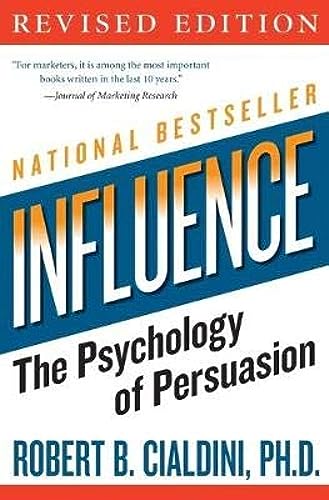
⚡️ What is Influence about?
Influence is a groundbreaking exploration into the psychology of persuasion. Robert Cialdini reveals the six universal principles of influence that guide human behavior, forming the backbone of effective Influence strategies. These principles—Reciprocity, Commitment, Social Proof, Liking, Authority, and Scarcity—are mental shortcuts we all use to navigate daily decisions. The book dissects how these Influence techniques are used, often ethically but sometimes manipulatively, by compliance professionals like marketers and salespeople. Cialdini’s work is based on extensive, evidence-based research, providing fascinating real-world examples. The ultimate goal is to arm readers with the knowledge to both become more persuasive themselves and to defend against unwanted Influence in their own lives, making it an essential read for anyone looking to understand the hidden forces that shape our choices.
🚀 The Book in 3 Sentences
- Human behavior is guided by six key principles of Influence that act as automatic mental shortcuts.
- Understanding these principles allows you to persuade others ethically while also protecting yourself from manipulation.
- Mastering Influence strategies is not about coercion, but about understanding and aligning with the deep-seated psychological drivers of human behavior.
🎨 Impressions
Reading Influence felt like having a secret decoder ring for human interaction. Cialdini’s writing is both scholarly and incredibly accessible, blending rigorous research with compelling anecdotes that make the concepts stick. I was impressed by how practical the book is; it’s not just theory, but a field guide to the subtle pushes and pulls we experience every day. It fundamentally changed my perspective on marketing, sales, and even simple conversations. This isn’t just a book about Influence techniques; it’s a masterclass in behavioral psychology that provides an immediate return on investment by making you a more aware and effective communicator.
📖 Who Should Read Influence?
This book is indispensable for marketers, salespeople, and entrepreneurs who want to understand the core drivers of customer behavior. However, its value extends far beyond business. Managers, leaders, and anyone in a position of authority will benefit from learning how to lead more effectively. Even more importantly, Influence is for every consumer who wants to become a more critical thinker and resist manipulative tactics. If you’ve ever wondered why you bought something you didn’t need or agreed to a request you didn’t want to, this book will provide the answers and the tools to navigate the world of Influence strategies with confidence.
☘️ How the Book Changed Me
Reading ‘Influence’ fundamentally altered my perception of daily interactions, turning me from a passive participant into an active observer of psychological Influence techniques. I now see the world through a lens of persuasion, constantly identifying the principles at play in everything from TV commercials to workplace meetings. This awareness has made me more deliberate in my own actions and more resilient to outside pressure.
- I now consciously recognize and evaluate Reciprocity triggers, like free samples, and can make a decision without feeling obligated.
- I’ve become highly critical of Social Proof, especially online, and now investigate the source and relevance of reviews and testimonials.
- My approach to asking for things has changed; I now use the principle of Commitment and Consistency by starting with small, easy ‘yes’ requests.
✍️ My Top 3 Quotes
- “A well-known principle of human behavior says that when we ask someone to do us a favor we will be more successful if we provide a reason. People simply like to have reasons for what they do.”
- “What the [compliance] professionals know is that it is far more profitable to sell large quantities of a product to a few people than small quantities to many. And they know that the way to do that is to get the few people to make a public, active, and voluntary commitment.”
- “Information is a leash. The information that a person is an authority figure can be a leash, directing our behavior through a most powerful kind of Influence.”
📒 Summary + Notes
The core of Influence lies in its systematic breakdown of the six universal principles of persuasion. Cialdini argues that these principles are so powerful because they exploit the automatic, shortcut-driven nature of human cognition. Each chapter is dedicated to one principle, explaining its psychological basis, providing vivid examples of its application, and offering strategies for both using it ethically and defending against it. This structure makes the complex science of Influence strategies incredibly digestible and actionable. Below, I’ve summarized the key insights from each chapter.
Introduction: The Weapons of Influence
Cialdini introduces the concept of “click, whirr” responses—fixed-action patterns in humans that are triggered by specific stimuli, much like in animals. He explains that in our complex world, we rely on these mental shortcuts to make efficient decisions. However, these shortcuts can be exploited. The chapter sets the stage by introducing the six “weapons of Influence” that will be explored in the book, framing them as powerful tools that can be used for good or for manipulation.
- The human brain uses fixed-action patterns to handle information overload.
- These “click, whirr” responses can be triggered by simple features of a request.
- Compliance professionals study and exploit these automatic triggers for Influence.
- Understanding these principles is key to both effective persuasion and self-defense.
- The book aims to make the reader a savvier participant in social exchanges.
Chapter 1: Reciprocation – The Old Give and Take
This chapter explores the powerful rule of Reciprocity, the deep-seated societal belief that we should try to repay, in kind, what another person has provided us. This rule is so ingrained that we feel obligated to repay a favor, gift, or concession even if we didn’t want it in the first place. Cialdini details how this principle is used in Influence techniques like the “rejection-then-retreat” tactic, where a large request is followed by a smaller, more reasonable one.
- The rule of Reciprocity is a universal human social norm.
- Uninvited favors create a powerful feeling of obligation.
- The “rejection-then-retreat” technique leverages the need for reciprocal concessions.
- To defend, recognize when a favor or concession is a tactic, not genuine kindness.
- Accepting the favor does not mean you must accept the subsequent request.
Chapter 2: Commitment and Consistency – Hobgoblins of the Mind
\p>Cialdini explains our deep desire to be (and appear) consistent with what we have already done. Once we make a decision or take a stand, we will face personal and interpersonal pressures to behave consistently with that commitment. This is exploited by getting people to make small initial commitments (like signing a petition) that lead to larger, related actions. The key is that the commitment must be active, public, and effortful to be truly binding.- We have a strong desire to be consistent with our past decisions and self-image.
- Commitments are most powerful when they are active, public, and require effort.
- The “foot-in-the-door” technique uses a small commitment to secure a larger one.
- Low-ball offers work by securing a commitment before changing the terms.
- To resist, listen to your gut feelings; ask yourself if you’d make the same commitment again.
Chapter 3: Social Proof – Truths Are Us
This principle states that we determine what is correct by finding out what other people think is correct. This Influence strategy is especially powerful when we are uncertain or in ambiguous situations. Cialdini shows how we look to the behavior of others, particularly those similar to us, for cues. This is the basis for phenomena like canned laughter, “best-selling” labels, and the tragic bystander effect, where no one helps because everyone else is also not helping.
- We use the behavior of others as a shortcut for deciding how to act.
- Social Proof is most effective when we are uncertain or the people are similar to us.
- “Pluralistic ignorance” occurs when everyone privately disagrees but no one speaks up.
- Testimonials and reviews are powerful marketing applications of this principle.
- To defend, be wary of social evidence that appears to be manufactured or from dissimilar sources.
Chapter 4: Liking – The Friendly Thief
We most prefer to say yes to the requests of people we know and like. This chapter breaks down the factors that make us like someone: physical attractiveness, similarity, compliments, and contact and cooperation. Cialdini uses the brilliant example of Tupperware parties, where the combination of social pressure, a likable host, and the potential for profit creates immense Influence. This principle shows that personal connection can often outweigh product quality in a purchasing decision.
- We are more easily persuaded by people we like.
- Liking is increased by attractiveness, similarity, praise, and familiarity.
- The “halo effect” causes one positive trait (like good looks) to spill over to other areas.
- Cooperation towards a common goal dramatically increases Liking and compliance.
- To defend, separate the requester from the request; focus on the merits of the deal itself.
Chapter 5: Authority – Directed Deference
\p>From a young age, we are taught to obey authority. This principle is so powerful that it can lead people to act against their own conscience. Cialdini references the infamous Milgram shock experiments to demonstrate this. He explains that Authority is often signaled by symbols like titles (Dr., Judge), clothes (uniforms), and automobiles (expensive cars). These symbols can trigger our automatic compliance, even when the authority is illegitimate.- We have a deep-seated propensity to defer to authority figures.
- Titles, clothing, and other status symbols are powerful, often artificial, triggers of Authority.
- The Milgram experiments showed people will obey authority to shocking extremes.
- Questioning authority is difficult due to our conditioning and fear of social reprisal.
- To defend, ask yourself: “Is this authority truly an expert?” and “How truthful can I expect this expert to be?”
Chapter 6: Scarcity – The Rule of the Few
This chapter details how opportunities seem more valuable to us when their availability is limited. The principle of Scarcity is rooted in two psychological quirks: we are more motivated by the thought of losing something than by gaining something of equal value, and we tend to use availability as a mental shortcut for quality. Cialdini explains how “limited-time” offers, “while supplies last” warnings, and exclusive information are powerful Influence techniques that create a sense of urgency.
- Items and opportunities become more attractive when they are scarce.
- Scarcity is enhanced when something is newly scarce (a reduction in quantity) or when competition is involved.
- The “fear of missing out” (FOMO) is a modern manifestation of this principle.
- Information is more persuasive if it is perceived as exclusive or limited.
- To defend, recognize the rush of arousal that scarcity creates and use it as a signal to calm down and think logically.
Conclusion: Instant Influence
Cialdini concludes by summarizing the six principles and emphasizing their interconnectedness. He introduces the idea of a seventh principle, “Unity,” which he expands on in his later work, “Pre-suasion.” The key takeaway is that understanding these triggers allows for ethical Influence. He frames the knowledge not as a weapon, but as a tool for creating more effective and honest exchanges. The ultimate mastery of Influence strategies comes from knowing when and how to apply the right principle in a given situation.
- The six principles are powerful individually but can be combined for even greater effect.
- Ethical Influence comes from using these principles to benefit both parties.
- Cialdini introduces “Unity” as a seventh principle, based on shared identity.
- The key is to be a “detective of Influence,” always aware of the principles at play.
- The book serves as a guide for both persuasion and self-protection in a complex world.
Key Takeaways
The most profound lesson from ‘Influence’ is that persuasion is a science, not an art. It operates on predictable, universal human principles that can be learned and applied. The book demystifies why we say “yes,” revealing that our decisions are often less rational than we’d like to believe. By understanding these Influence techniques, we gain a superpower: the ability to navigate social situations more effectively, whether our goal is to lead, sell, or simply make better choices for ourselves. Awareness is the first and most critical step toward both wielding and withstanding Influence.
- Influence is driven by six core psychological principles that function as automatic shortcuts. \li>These principles are most powerful when they operate beneath our conscious awareness.
- The most ethical and effective use of Influence strategies aligns with the other party’s genuine interests.
- Protecting yourself from manipulation starts with recognizing the “click, whirr” triggers in your own mind.
- Small, consistent applications of these principles can lead to profound changes in your personal and professional life.
Conclusion
Robert Cialdini’s ‘Influence’ is more than just a book on persuasion; it’s a foundational text on human psychology that remains as relevant today as it was when first published. Its lessons are timeless, applying to digital marketing, corporate leadership, and everyday interactions. By reading this summary, you’ve taken the first step toward understanding the hidden forces of Influence. However, the full book, with its rich examples and detailed analysis, is an essential investment for anyone who wants to master these concepts. I highly recommend you read it to not only transform your ability to persuade but also to fortify your mind against the constant Influence strategies vying for your attention and compliance every single day.
More From Robert Cialdini →
Discover more from AI Book Summary
Subscribe to get the latest posts sent to your email.