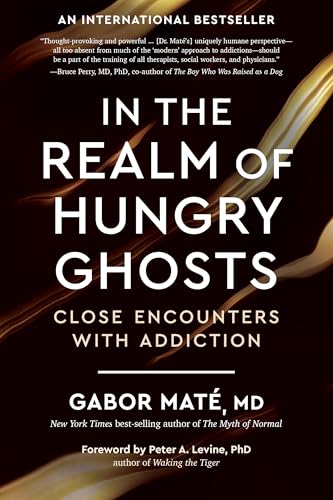
⚡️ What is In the Realm of Hungry Ghosts about?
In the Realm of Hungry Ghosts by Dr. Gabor Maté is a profound exploration into the world of addiction, framed through the Buddhist metaphor of hungry ghosts—beings with immense, unfillable appetites. Drawing from his experience as a physician in Vancouver’s Downtown Eastside, Maté argues that addiction is not a moral failure or a choice, but a complex and desperate response to deep pain, trauma, and emotional loss. The book masterfully weaves together heart-wrenching personal stories, cutting-edge neuroscience, and a sharp critique of societal failures like the “War on Drugs.” It posits that the root of almost all addictive behaviors lies in an attempt to soothe an inner emptiness created by early childhood experiences, challenging us to replace judgment with compassion and punishment with understanding.
🚀 The Book in 3 Sentences
- In the Realm of Hungry Ghosts reveals that addiction is not a choice but a desperate attempt to soothe deep-seated pain rooted in early trauma and emotional loss.
- Gabor Maté masterfully connects neuroscience with social analysis, showing how brain development and societal factors like dislocation fuel the cycle of addiction.
- Ultimately, the book advocates for a radical shift from judgment and punishment to compassion and a humane approach to healing both individuals and society.
🎨 Impressions
I found this book to be profoundly humbling and eye-opening. Dr. Maté’s compassionate storytelling, drawn from his direct experience with addicts in Vancouver, shatters any preconceived notions about addiction. It’s a dense, scientific read, but its core message of empathy for the ‘hungry ghosts’ among us is what truly resonated. The book’s power lies in its ability to make you see the humanity behind the despair, forcing a re-evaluation of how we view not just hardcore drug users but all addictive behaviors. In the Realm of Hungry Ghosts is a challenging yet essential read that stays with you long after you finish the final page.
📖 Who Should Read In the Realm of Hungry Ghosts?
In the Realm of Hungry Ghosts is essential reading for anyone touched by addiction, whether personally or through a loved one. Therapists, doctors, social workers, and policymakers will find invaluable insights and a compelling argument for systemic change. Furthermore, anyone seeking a deeper understanding of human behavior, trauma, and the importance of compassion in our society will be profoundly impacted by this book. It challenges us to look beyond the surface of behavior and see the pain that drives it.
☘️ How the Book Changed Me
Reading ‘In the Realm of Hungry Ghosts’ fundamentally shifted my perspective from judgment to curiosity and compassion. I no longer see addiction as a series of poor choices but as a logical, albeit destructive, response to overwhelming pain. It has made me more empathetic not only towards those with severe substance abuse issues but also to the more ‘socially acceptable’ addictions I see in myself and others, like workaholism or compulsive consumption.
- I developed a deep sense of empathy for people struggling with addiction, understanding their behavior as a symptom of suffering.
- I began to reflect on my own ‘hungry ghost’ tendencies and the underlying emotional needs they might be masking.
- It changed my political views, making me a firm advocate for decriminalization and harm reduction policies.
- I now prioritize creating a ‘compassionate inquiry’ environment in my relationships, seeking to understand rather than to correct.
✍️ My Top 3 Quotes
- “The question is not why the addiction, but why the pain.”
- “Addiction is not a choice that anybody makes; it’s a response to suffering.”
- “If we are to help addicts, we must strive to change not them but their environments.”
📒 Summary + Notes
My deep dive into In the Realm of Hungry Ghosts revealed a meticulously structured argument that builds from personal stories to neurobiology and finally to social policy. Dr. Maté guides the reader through the grim realities of addiction, the science behind it, and a hopeful vision for a more compassionate future. Here’s a breakdown of the key lessons from each part of this transformative book.
Chapter 1: A Hellbound Train
This chapter introduces us to the grim reality of Vancouver’s Downtown Eastside and the Portland Hotel, where Dr. Maté works. We meet patients like Cindy and Tony, whose stories illustrate the relentless nature of addiction. Maté establishes the central metaphor of the ‘hellbound train’ of addiction, a journey from which escape seems impossible. The chapter sets a tone of raw, unfiltered humanity, forcing the reader to confront the lived experience of severe addiction without judgment.
- The Downtown Eastside is portrayed as a place of profound suffering and resilience.
- Addiction is shown as a powerful force that overrides self-preservation.
- The stories of individual patients humanize the abstract concept of addiction.
- Maté establishes his role as a compassionate observer and physician.
- The ‘hellbound train’ metaphor captures the sense of inevitability and despair.
Chapter 2: The Lethal Hold of Drugs
Dr. Maté delves into the physiological power of addictive substances, explaining how they chemically hijack the brain’s reward systems. He discusses the intense cravings and the severe physical and psychological withdrawal that keep users trapped. The chapter highlights the paradox of addiction: the substance that provides temporary relief also causes the most profound suffering. Maté emphasizes that for the severely addicted, the drug is not for pleasure but for a desperate escape from psychic pain.
- Addictive substances create powerful biochemical dependencies.
- Withdrawal symptoms are a major barrier to quitting, driving relapse.
- The initial ‘high’ is often replaced by a need just to feel ‘normal’.
- Addiction is a cycle of seeking relief from the very substance that causes the problem.
- The chapter debunks the myth that drug use for hardcore addicts is about fun.
Chapter 3: A Walk on the Wild Side
This chapter provides a street-level view of the drug trade and the daily lives of addicts. Maté describes the constant search for drugs, the interactions with dealers, and the ever-present dangers of violence and disease. He paints a picture of a subculture with its own rules and survival strategies. The narrative underscores the immense stress and instability that characterize the lives of his patients, showing how this environment reinforces the need for the escape that drugs provide.
- The daily life of an addict is consumed by the logistics of obtaining and using drugs.
- The drug trade is a violent and predatory system that exploits vulnerability.
- Survival on the streets requires a constant state of hypervigilance.
- The community among addicts can provide a semblance of belonging, however dysfunctional.
- This environment creates a perfect storm of stress that fuels addiction.
Chapter 4: Embraced by the Needle
Dr. Maté explores the act of injection and the symbolic meaning it holds for many addicts. The needle is not just a tool for delivering a drug but a ritual that offers a sense of control, predictability, and comfort in a chaotic life. He describes the supervised injection site, Insite, as a pragmatic and humane response that reduces harm and saves lives. This chapter challenges readers to see beyond the act of injecting and understand the deep emotional needs it fulfills.
- The ritual of injection provides a sense of order and control.
- For many, the needle represents a reliable source of comfort and solace.
- Insite, the supervised injection site, is presented as a life-saving public health measure.
- Harm reduction strategies are shown to be more effective than prohibition.
- The act of injecting is a powerful symbol of the addict’s relationship with their substance.
Chapter 5: The Realm of the Hungry Ghosts
This chapter formally introduces the Buddhist metaphor of the hungry ghosts, beings with tiny mouths and huge, empty stomachs, forever craving but never satisfied. Maté uses this to describe the psychological state of addiction—a perennial emptiness that cannot be filled from the outside. He argues that this void is not a lack of things but a lack of self, a deep-seated feeling of deficiency and worthlessness that originates in early childhood experiences.
- The ‘hungry ghost’ metaphor perfectly captures the insatiable nature of addiction.
- Addiction is an attempt to fill a spiritual and emotional void.
- The core feeling is one of deficiency and ‘not enoughness.’
- This emptiness stems from a lack of nurturing and emotional attunement in childhood.
- The chapter shifts the focus from the substance to the internal state of the addict.
Chapter 6: The Landscape of the Hungry Ghosts
Maté broadens the definition of addiction beyond hard drugs to include a wide spectrum of behaviors. He discusses workaholism, gambling, shopping, and eating disorders, showing they all share the same root dynamics. The chapter argues that we are a society of hungry ghosts, constantly seeking external validation and relief through consumption and compulsive behaviors. This makes the book’s message relevant to a much wider audience than just those affected by illicit drug addiction.
- Addiction is a spectrum, not a binary state.
- ‘Softer’ addictions like work or shopping share the same psychological roots as drug addiction.
- Modern consumer culture fosters and encourages addictive patterns.
- The ‘hungry ghost’ dynamic is visible in many aspects of mainstream society.
- This chapter encourages readers to self-reflect on their own compulsive behaviors.
Chapter 7: The Four Steps, One Choice
Dr. Maté analyzes the four-step cycle of addiction: obsessive thinking, craving, engaging in the addictive behavior, and temporary relief followed by guilt and shame. He argues that the ‘choice’ to use is an illusion, as it is driven by powerful neurobiological and psychological compulsions. The chapter explains how this cycle reinforces itself, trapping the individual in a loop from which it is incredibly difficult to break free without external help and internal healing.
- The addiction cycle is a predictable and self-reinforcing pattern.
- Obsessive thoughts and cravings are not signs of moral weakness but of brain pathology.
- The feeling of ‘choice’ is an illusion created by the compulsion.
- Shame and guilt after the act only fuel the cycle, leading to more use.
- Breaking the cycle requires addressing the underlying pain, not just the behavior.
Chapter 8: The Courage to Face Pain
This chapter focuses on the immense courage required to confront the pain that addiction masks. Maté shares stories of individuals who have begun the journey of recovery, highlighting the importance of vulnerability and self-compassion. He argues that true healing begins when a person is able to sit with their difficult emotions without immediately reaching for a substance or behavior to numb them. This is the first and most difficult step towards reclaiming one’s life.
- Recovery requires the courage to feel the underlying pain.
- Vulnerability is not weakness but a necessary strength for healing.
- Self-compassion is a crucial antidote to the shame that fuels addiction.
- Learning to tolerate distress without escaping is a key recovery skill.
- The journey of healing is about reconnecting with a lost sense of self.
Chapter 9: A Different State of the Brain
Maté dives into the neuroscience of addiction, explaining how drugs fundamentally alter brain chemistry and function. He focuses on the brain’s reward circuitry, particularly the role of dopamine. The chapter illustrates how addictive substances create an artificial flood of dopamine, causing the brain to downregulate its own receptors. This leads to tolerance (needing more for the same effect) and withdrawal, as the brain can no longer feel pleasure from normal activities.
- Addiction is a brain disease that changes the brain’s structure and chemistry.
- Dopamine is a key neurotransmitter in the brain’s reward and motivation system.
- Drugs hijack this system, creating an overwhelming drive to use.
- The brain adapts to drug use by reducing its own dopamine receptors.
- This creates a state where the drug is needed just to feel a baseline level of okay.
Chapter 10: The Chemistry of Pain and Pleasure
This chapter explores the brain’s natural opioid system and its role in regulating pain, pleasure, and emotional well-being. Maté explains how endorphins, the body’s natural opioids, are essential for feelings of connection and comfort. He argues that people with early childhood trauma may have underdeveloped natural opioid systems, making them more susceptible to the allure of external opioids like heroin, which chemically mimic the feeling of love and belonging they never received.
- The brain has its own built-in opioid system for managing pain and pleasure.
- Endorphins promote feelings of safety, connection, and well-being.
- Early emotional neglect can impair the development of this natural system.
- Opiate drugs like heroin directly powerfully activate these same receptors.
- For some, drug use is an unconscious attempt to self-medicate a chemical imbalance.
Chapter 11: The Dark Side of Dopamine
Dr. Maté discusses the role of dopamine not just in pleasure, but in motivation, drive, and attention. He explains that in the addicted brain, the dopamine system becomes rewired to prioritize the drug above all else, including survival. The chapter also touches on other brain systems, like those for impulse control (prefrontal cortex), which are impaired by addiction. This creates a perfect storm of overwhelming craving and diminished capacity for self-regulation.
- Dopamine is crucial for motivation and focus, not just pleasure.
- In addiction, the dopamine system becomes hypersensitized to drug cues.
- The prefrontal cortex, responsible for impulse control, is weakened.
- This neurological imbalance makes it nearly impossible to ‘just say no.’
- Addiction is a disease of the brain’s motivation and control circuits.
Chapter 12: Their Brains Never Had a Chance
This chapter argues that the brains of addicts are often primed for addiction long before they ever use a drug. Maté connects addiction to other brain-based conditions like ADHD, which he himself has. He suggests that traits like poor impulse control, low self-esteem, and a need for intense stimulation are common precursors. These traits, often rooted in brain development issues, make individuals more vulnerable to the allure of addictive substances as a form of self-medication.
- Many addicts have pre-existing brain wiring that makes them vulnerable.
- Conditions like ADHD share many traits with addiction-prone personalities.
- Poor impulse control and emotional dysregulation are key risk factors.
- These traits can be traced back to adverse conditions in utero and early childhood.
- The brain’s development is profoundly shaped by the early emotional environment.
Chapter 13: The Heart of Addiction
Dr. Maté makes a powerful case for the link between early childhood emotional trauma and addiction. He uses his own difficult childhood experiences as an example. The chapter explains how a lack of a secure, nurturing attachment in infancy creates a ‘deficient emptiness’ and a deep-seated shame. The addict’s brain and personality develop in a state of chronic stress, making them wired for addiction as a coping mechanism.
- Early childhood trauma is the single most common denominator in addiction.
- A lack of secure attachment creates a core wound of shame and emptiness.
- Chronic childhood stress alters brain development, priming it for addiction.
- Maté uses his personal story to illustrate the universal dynamics.
- The question ‘Why the pain?’ is central to understanding the roots of addiction.
Chapter 14: The Addicted Personality
This chapter synthesizes the traits that characterize an addiction-prone individual. Maté lists poor self-regulation, an underdeveloped sense of self, impaired impulse control, and a deep feeling of deficient emptiness. He emphasizes that these are not character flaws but coping strategies developed in response to a stressful and emotionally deprived environment. The ‘addictive personality’ is a survival personality, formed under conditions that threatened the child’s sense of self.
- The ‘addictive personality’ is a pattern of traits, not a fixed identity.
- Poor emotional self-regulation is a hallmark of the addiction-prone person.
- A weak sense of self makes one vulnerable to seeking external validation.
- Impulsivity is a direct result of an underdeveloped prefrontal cortex.
- These traits are understandable adaptations to childhood trauma.
Chapter 15: The Myth of the Addicted Gene
Maté tackles the controversial topic of genetics and addiction. He acknowledges that there is a genetic component but argues that it is far from deterministic. Genes create predispositions, but it is the environment that determines whether those predispositions are expressed. He uses the analogy of a loaded gun (genes) and the pull of the trigger (environment). The chapter is a powerful argument against genetic determinism and for focusing on the social and emotional factors we can change.
- Genes create a vulnerability, not a destiny.
- No single ‘addiction gene’ has been found; it’s a complex interplay.
- The environment plays a crucial role in whether genetic risks are activated.
- Focusing on genes can distract from the preventable causes of addiction.
- The ‘loaded gun’ analogy effectively illustrates the gene-environment interaction.
Chapter 16: The Power of Compassionate Inquiry
This chapter introduces ‘Compassionate Inquiry’ as Maté’s therapeutic approach. It’s a method of exploring a person’s present-moment experience without judgment, seeking to uncover the hidden dynamics and traumas that drive their behavior. The goal is to help the person connect their present suffering to their past experiences with empathy and understanding. Maté provides examples of how this approach can break through the defenses of the ‘hungry ghost.’
- Compassionate Inquiry is a non-judgmental, therapeutic approach.
- It focuses on uncovering the ‘why’ behind the behavior.
- The therapist’s attitude of curiosity and compassion is key.
- This approach helps people integrate fragmented parts of themselves.
- It aims to bring unconscious trauma into conscious awareness for healing.
Chapter 17: The Truth About Addiction
Dr. Maté discusses the traditional 12-step programs like AA, acknowledging their value while also offering critiques. He appreciates the community, spiritual component, and emphasis on surrender. However, he feels the focus on powerlessness can sometimes be misinterpreted, and the emphasis on ‘character defects’ can inadvertently reinforce shame. He advocates for a deeper understanding that sees these ‘defects’ as coping mechanisms rooted in trauma.
- 12-step programs provide valuable community and a path to recovery.
- The concept of a ‘Higher Power’ can be a source of strength.
- Maté critiques the focus on ‘character defects’ as potentially shaming.
- He advocates for integrating trauma-informed principles into 12-step work.
- The core message of surrender is a powerful and necessary step in healing.
Chapter 18: The Language of the Heart
This chapter is a touching story about a patient named Natalie and her relationship with her son. Through their interactions, Maté illustrates how addiction can be passed down through generations, not just genetically but through patterns of trauma and attachment. The story highlights the transformative power of love and connection in breaking the cycle. It shows that healing is possible when the ‘hungry ghost’ is finally met with the unconditional love and acceptance it craved all along.
- Addiction is often intergenerational, passed down through trauma.
- The story of Natalie shows the deep human need for connection.
- Love and acceptance are powerful healing forces.
- Breaking the cycle requires conscious parenting and healing one’s own trauma.
- The chapter is a powerful testament to the possibility of recovery and redemption.
Chapter 19: Dislocation and the Social Roots of Addiction
Maté expands his lens to the societal level, introducing Bruce Alexander’s theory of ‘dislocation.’ He argues that the breakdown of traditional community, culture, and meaningful relationships in modern society has created a profound sense of isolation and meaninglessness. This ‘psychic dislocation’ is a major driver of mass addiction. The famous ‘Rat Park’ study is discussed, showing that rats in a rich, social environment did not become addicted, even when drugs were freely available.
- Social dislocation is a primary cause of widespread addiction.
- The breakdown of community creates a vacuum that addiction fills.
- The ‘Rat Park’ study proves that environment is crucial to addiction.
- Modern free-market societies are particularly prone to creating dislocation.
- Addiction is a rational response to an irrational and isolating social environment.
Chapter 20: The War on Drugs
This chapter is a scathing critique of the ‘War on Drugs.’ Maté argues that it is a catastrophic failure that has not reduced drug use but has instead created immense suffering, criminalized millions, and destroyed communities. He explains how this war exacerbates the very conditions—stress, isolation, conflict—that drive addiction. The chapter calls for a radical shift in policy from a criminal justice approach to a public health and human rights framework.
- The War on Drugs is an expensive and ineffective policy.
- It has led to mass incarceration, particularly of marginalized communities.
- It creates a dangerous, unregulated black market.
- The war increases the stress and isolation that fuel addiction.
- It treats a health crisis as a criminal problem, which is fundamentally wrong.
Chapter 21: Imagining a Humane Reality
Dr. Maté paints a picture of what a compassionate, rational drug policy would look like. He advocates for the decriminalization of all drugs, arguing that it would reduce harm, save lives, and free up resources for treatment and prevention. He envisions a system where addiction is treated as a health issue, with safe supply, supervised consumption sites, and easy access to compassionate, evidence-based care. The goal is to create an ‘island of relief’ for those suffering.
- Decriminalization is a proven strategy for reducing drug-related harm.
- A humane approach would treat addiction as a health issue, not a crime.
- Safe supply and supervised injection sites save lives.
- Resources should be shifted from policing to treatment and prevention.
- The goal is to create a society that supports healing, not punishment.
Chapter 22: The Four Pillars of Education and Prevention
In the final chapter of the main text, Maté outlines a four-pillar strategy for preventing addiction. These are: promoting healthy brain development in utero and early childhood, supporting nurturing and non-punitive parenting, educating children about emotions and stress, and creating a more compassionate and connected society. He argues that true prevention is not about scaring kids away from drugs but about creating a world where fewer people feel the need to escape in the first place.
- Prevention must start with supporting mothers and infants.
- Parenting education focused on emotional attunement is crucial.
- Schools should teach emotional literacy and stress management.
- Society must prioritize connection and community over competition.
- True prevention is about building resilience, not just delivering information.
Conclusion: The Ecstasy of Surrender
The conclusion is a poignant reflection on the nature of healing and recovery. Maté talks about the ‘ecstasy’ that comes not from a drug high, but from the surrender of the ego—the letting go of the need to control and the acceptance of one’s true self, pain and all. He reiterates that healing is a journey of reconnecting with the self and with others, and that compassion, for oneself and for others, is the ultimate path out of the realm of the hungry ghosts.
- True healing involves surrendering the ego’s defenses.
- There is an ‘ecstasy’ in accepting oneself fully.
- Recovery is a journey of reconnection with the authentic self.
- Compassion is the most powerful tool for transformation.
- The book ends on a hopeful, spiritual note about the possibility of healing.
Key Takeaways
The most profound lessons from In the Realm of Hungry Ghosts extend far beyond understanding substance abuse. They are lessons about human nature, healing, and society. The book provides a new lens through which to view pain, connection, and the very conditions that allow us to thrive or wither. Dr. Maté’s work is a masterclass in integrating science, personal story, and social commentary to deliver a message of urgent importance.
- Addiction is a complex interplay of brain chemistry, early childhood trauma, and social environment, not a moral failing.
- Compassion and connection are the most powerful antidotes to addiction, replacing shame and isolation.
- The ‘War on Drugs’ is a catastrophic failure that exacerbates the problem; a humane, health-focused approach is urgently needed.
- Healing requires addressing the root pain (‘Why the pain?’) through self-awareness, therapeutic work, and supportive relationships.
- Many of us have ‘hungry ghost’ tendencies; understanding addiction helps us understand ourselves and our culture.
Conclusion
In the Realm of Hungry Ghosts is more than a book about addiction; it’s a profound meditation on what it means to be human in a world that often fosters dislocation and pain. Dr. Gabor Maté’s work is a crucial call to action, urging us to replace judgment with compassion and punishment with understanding. By reading this book, you will not only gain a scientific and compassionate understanding of addiction but also be challenged to create more connection and healing in your own life and community. It is an essential read for our times.
More From Gabor Maté →
Discover more from AI Book Summary
Subscribe to get the latest posts sent to your email.