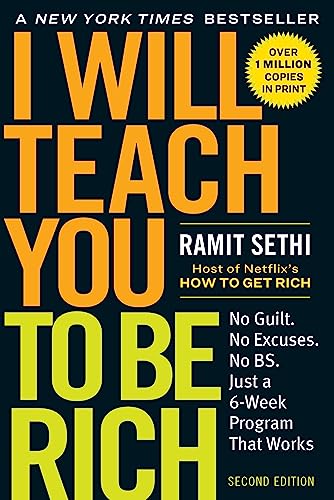
⚡️ What is I Will Teach You to Be Rich about?
I Will Teach You to Be Rich is a comprehensive personal finance guide that presents a practical 6-week program for managing money, building wealth, and living a rich life. Ramit Sethi cuts through the financial jargon and provides actionable advice on optimizing credit cards, beating banks, investing wisely, and automating finances. The book focuses on implementing systems rather than relying on willpower, making it accessible for those who feel overwhelmed by traditional financial advice. Sethi’s approach combines psychology, technology, and sound financial principles to create a roadmap for financial success that doesn’t require sacrificing the things you enjoy.
🚀 The Book in 3 Sentences
- I Will Teach You to Be Rich provides a 6-week program that transforms your relationship with money through automated systems and conscious spending.
- Building wealth isn’t about complex strategies or extreme frugality, but rather about setting up simple, automatic systems that grow your money over time.
- By focusing on the big wins—optimizing credit cards, choosing the right accounts, investing early, and automating your finances—you can live a rich life today while building wealth for tomorrow.
🎨 Impressions
What impressed me most about I Will Teach You to Be Rich is its refreshingly direct, no-nonsense approach to personal finance. Sethi combines practical advice with psychological insights to create a system that actually works for real people. Unlike many finance books that focus on deprivation, this one emphasizes conscious spending and designing a rich life that aligns with your personal values and goals.
📖 Who Should Read I Will Teach You to Be Rich?
I Will Teach You to Be Rich is ideal for young professionals in their 20s and 30s who want to take control of their finances but feel overwhelmed by traditional financial advice. It’s perfect for those who have tried budgeting and failed, people who want to invest but don’t know where to start, and anyone looking to build wealth without sacrificing their current lifestyle. The book is especially valuable for those who appreciate direct, actionable advice over vague theories.
☘️ How the Book Changed Me
How my life / behaviour / thoughts / ideas have changed as a result of reading the book.
- I completely transformed my approach to credit cards, learning to use them strategically to earn rewards while avoiding debt—a key lesson from I Will Teach You to Be Rich.
- I automated my entire financial system, from bill payments to investments, reducing decision fatigue and ensuring consistent progress toward my goals.
- I shifted from a mindset of restriction to one of conscious spending, allowing me to spend extravagantly on things I value while cutting costs mercilessly on things I don’t.
✍️ My Top 3 Quotes
- “The single most important factor to getting rich is getting started, not being the smartest person in the room.”
- “Frugality, quite simply, is about choosing the things you love enough to spend extravagantly on—and then cutting costs mercilessly on the things you don’t love.”
- “Getting rich isn’t about one silver bullet or secret strategy. It happens through regular, boring, disciplined action.”
📒 Summary + Notes
I Will Teach You to Be Rich presents a revolutionary approach to personal finance that prioritizes action over perfection. Ramit Sethi’s 6-week program guides readers through optimizing credit cards, beating bank fees, setting up investment accounts, creating a conscious spending plan, automating finances, and implementing simple investment strategies. The book’s genius lies in its psychological approach—acknowledging human behavior and designing systems that work with, not against, our natural tendencies. What follows is a detailed chapter-by-chapter breakdown of the key concepts and actionable advice from this transformative financial guide.
Introduction: Would You Rather Be Sexy or Rich?
Sethi opens by challenging the common misconception that personal finance has to be boring or restrictive. He introduces the concept of living a rich life—one that’s defined by personal values, not just money. The introduction sets up the book’s core philosophy: small, consistent actions trump perfect, complex systems. Sethi emphasizes that financial success is 80% psychology and 20% mechanics, explaining why most people fail despite having access to the same information.
- The book focuses on actionable advice rather than theory, with each chapter providing specific steps to implement immediately.
- Sethi’s approach acknowledges that perfection is the enemy of good enough when it comes to personal finance.
- A rich life means having the freedom to pursue what you value, which requires but isn’t limited to financial resources.
Chapter 1: Optimize Your Credit Cards
Chapter 1 reveals how to beat credit card companies at their own game. Sethi explains that credit cards can be powerful tools when used strategically. He details how to choose the right cards, negotiate fees, improve credit scores, and maximize rewards. The chapter includes a step-by-step guide to handling existing credit card debt and establishing excellent credit, which can save thousands over a lifetime through better interest rates on mortgages and loans.
- Having excellent credit can save you over $100,000 over your lifetime through lower interest rates.
- Sethi recommends having just 2-3 credit cards with no fees and rewards that match your spending patterns.
- The chapter provides a specific debt repayment strategy that prioritizes either the highest interest rate or smallest balance first.
Chapter 2: Beat the Banks
In Chapter 2, Sethi exposes how banks profit from customer inertia and provides strategies to turn the tables. He explains the differences between checking and savings accounts, how to find accounts with no fees and higher interest rates, and how to negotiate with banks. The chapter includes scripts for calling bank representatives and specific criteria for evaluating financial institutions. Sethi emphasizes that choosing the right bank accounts is foundational to building wealth, as it affects every other aspect of your financial life.
- The average person pays $250 annually in bank fees that could be completely eliminated with the right accounts.
- Sethi recommends having both a checking account for daily transactions and a high-yield savings account for emergency funds and goals.
- The chapter provides a bank account evaluation framework that considers fees, interest rates, customer service, and convenience.
Chapter 3: Get Ready to Invest
Chapter 3 demystifies investing and explains why starting early is more important than being an expert. Sethi breaks down different retirement accounts (401(k)s and IRAs), explains compound interest in accessible terms, and addresses common psychological barriers to investing. He provides specific guidance on how to open investment accounts, what to look for in funds, and how much to contribute. The chapter emphasizes that investing doesn’t require a large sum of money—starting with just $50 per month can make a significant difference over time.
- Compound interest is the most powerful force in investing—starting just 5 years earlier can double your retirement savings.
- Sethi explains the importance of maxing out employer matching in 401(k) accounts, calling it free money that shouldn’t be left on the table.
- The chapter includes a step-by-step guide to opening an IRA, even for those who feel intimidated by the process.
Chapter 4: Conscious Spending
Chapter 4 introduces Sethi’s signature concept of conscious spending, which replaces restrictive budgeting. He explains how to allocate money according to personal values rather than arbitrary rules. The chapter provides a detailed framework for dividing income into fixed costs, investments, savings, and guilt-free spending. Sethi argues that this approach is more sustainable than traditional budgeting because it acknowledges human psychology and allows for spending on things that truly bring joy.
- The conscious spending plan typically allocates 50-60% to fixed costs, 10% to investments, 5-10% to savings, and 20-35% to guilt-free spending.
- Sethi distinguishes between being frugal versus cheap—frugality is strategic cost-cutting on things you don’t value, while cheapness is cutting costs indiscriminately.
- The chapter includes practical strategies for reducing big expenses that have the most significant impact, rather than focusing on minor cost-cutting.
Chapter 5: Save While Sleeping (Automate Your Finances)
Chapter 5 reveals how to create an automated financial system that ensures consistent progress toward wealth without relying on willpower. Sethi details the exact flow of money between accounts, how to set up automatic transfers, and how to automate bill payments and investments. He explains that automation is the key to long-term financial success because it removes decision-making and ensures that saving and investing happen consistently, regardless of motivation or mood.
- A properly automated financial system requires only 1-2 hours of maintenance per month, compared to the hours many spend tracking expenses manually.
- Sethi provides a specific money flow diagram showing exactly how money should move between checking, savings, investment, and credit accounts.
- The chapter addresses common automation fears and provides solutions for those with irregular income or variable expenses.
Chapter 6: The Myth of Financial Expertise
In Chapter 6, Sethi debunks the myth that you need to be a financial expert or hire expensive professionals to manage your money effectively. He exposes the conflicts of interest in the financial advisory industry and explains why most actively managed funds underperform simple index funds. The chapter empowers readers to take control of their investments by providing the essential knowledge needed to make informed decisions without paying unnecessary fees.
- Over 80% of actively managed funds underperform simple index funds over the long term, yet they charge significantly higher fees.
- Sethi explains how to evaluate financial advisors and recognize potential conflicts of interest when seeking professional advice.
- The chapter provides a simple investment philosophy that anyone can implement without needing to become a market expert.
Chapter 7: Investing Isn’t Only for Rich People
Chapter 7 provides a straightforward guide to investing for beginners. Sethi explains different asset classes, the importance of diversification, and why index funds are the best choice for most investors. He walks readers through opening a brokerage account, selecting appropriate funds, and implementing an automatic investment plan. The chapter addresses common fears and misconceptions about investing and provides reassurance that simple, consistent investing beats complex strategies for nearly everyone.
- Sethi recommends low-cost index funds as the core investment vehicle for most people, explaining their advantages over individual stocks and actively managed funds.
- The chapter includes a step-by-step guide to opening a brokerage account and making your first investment, even with as little as $50.
- Sethi explains the concept of asset allocation and provides model portfolios based on age and risk tolerance.
Chapter 8: Easy Maintenance
Chapter 8 focuses on how to maintain your financial system with minimal effort. Sethi explains when and how to review your accounts, rebalance your investments, and adjust your spending plan as your life circumstances change. He emphasizes that a well-designed financial system shouldn’t require constant attention—just periodic check-ins to ensure everything is running smoothly. The chapter provides specific timelines for different financial activities and addresses common life transitions that may require adjustments.
- Sethi recommends rebalancing investments once every 12-18 months, not more frequently, to maintain your target asset allocation.
- The chapter provides a financial calendar outlining when to perform various maintenance tasks throughout the year.
- Sethi addresses how to handle major life changes like marriage, having children, or changing jobs without derailing your financial progress.
Chapter 9: A Rich Life
In the final chapter, Sethi expands the definition of a rich life beyond money. He explains that financial freedom is simply a tool to live life on your own terms. The chapter focuses on identifying what truly brings you joy and fulfillment, then using your financial resources to maximize those experiences. Sethi addresses common psychological barriers to enjoying wealth, provides strategies for negotiating salary increases, and emphasizes the importance of generosity and relationships in creating a truly rich life.
- Sethi emphasizes that a truly rich life includes strong relationships, personal growth, and contribution to others—not just financial wealth.
- The chapter provides specific negotiation strategies for increasing income, which Sethi identifies as one of the most powerful wealth-building tools.
- Sethi encourages readers to define their own version of a rich life rather than adopting society’s definition of success.
Key Takeaways
I Will Teach You to Be Rich transforms personal finance from a source of stress into a manageable system that builds wealth automatically. The book’s core insight is that financial success comes from setting up the right systems, not from willpower or complex strategies. By implementing Sethi’s 6-week program, readers can optimize their financial infrastructure, automate their money flow, and create a spending plan that aligns with their values—all while investing for long-term growth.
- The 80/20 rule applies to personal finance—focus on the few actions that deliver the biggest results, like optimizing credit cards, choosing the right accounts, and automating finances.
- Start investing now, even with small amounts—time in the market beats timing the market, and compound interest is your most powerful wealth-building tool.
- Create a conscious spending plan instead of restrictive budgeting—allocate money to what you value while cutting costs mercilessly on what you don’t.
- Automate your finances to ensure consistent progress toward your goals without relying on willpower or motivation.
- A rich life is defined by your values, not your bank balance—use money as a tool to live the life you truly want.
Conclusion
I Will Teach You to Be Rich stands out in the crowded field of personal finance books by combining practical advice with psychological insights. Sethi’s 6-week program provides a clear roadmap to financial success that doesn’t require sacrificing the things you enjoy. By focusing on the big wins and setting up automated systems, readers can build wealth while living richly today. The book’s greatest strength is its recognition that personal finance is personal—there’s no one-size-fits-all solution, but rather a framework that can be customized to individual values and goals. If you’re ready to take control of your finances without the usual stress and deprivation, this book provides the perfect starting point.
More From Ramit Sethi →
Discover more from AI Book Summary
Subscribe to get the latest posts sent to your email.