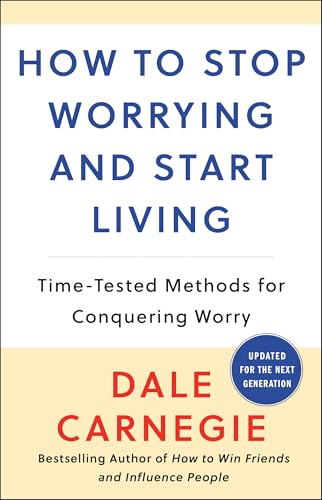
⚡️ What is How to Stop Worrying and Start Living about?
“How to Stop Worrying and Start Living” is Dale Carnegie’s comprehensive guide to overcoming anxiety and worry that prevent us from living fulfilling lives. Published in 1948, this timeless classic provides practical strategies for managing stress and transforming our relationship with fear, uncertainty, and negative thinking patterns. The book combines scientific insights with real-life anecdotes to demonstrate how worry affects our health, relationships, and overall well-being. Carnegie emphasizes that worry is not just an emotional issue but a serious health concern that can lead to physical illness, poor decision-making, and diminished quality of life.
🚀 The Book in 3 Sentences
- How to stop worrying and start living begins with accepting what cannot be changed and focusing energy on actionable solutions.
- The book teaches us to live in “day-tight compartments” to avoid being overwhelmed by past regrets or future anxieties.
- Carnegie provides practical techniques for worry management including analysis frameworks and habit formation.
🎨 Impressions
This book feels remarkably relevant despite being written over 70 years ago. Dale Carnegie’s insights into human psychology and worry patterns remain incredibly accurate for modern readers struggling with anxiety. The practical approach to how to stop worrying and start living makes it accessible to anyone willing to implement the suggested techniques. What stands out most is Carnegie’s emphasis on action over analysis – he doesn’t just explain why we worry, but provides concrete steps to overcome it. The anecdotes may feel dated at times, but the core wisdom remains powerful and transformative.
📖 Who Should Read How to Stop Worrying and Start Living?
This book is essential for anyone struggling with chronic worry, anxiety, or feeling overwhelmed by life’s uncertainties. People who find themselves constantly ruminating about past mistakes or future possibilities will benefit enormously from Carnegie’s strategies for worry reduction. The book is particularly valuable for perfectionists, overthinkers, and those who struggle with decision-making due to fear of consequences. Whether you’re dealing with work stress, relationship concerns, or general anxiety about life direction, how to stop worrying and start living provides practical tools that can be implemented immediately for lasting relief.
☘️ How the Book Changed Me
How my life / behaviour / thoughts / ideas have changed as a result of reading the book.
- Stopped catastrophizing minor problems after implementing Carnegie’s three-question analysis method for worry situations
- Learned to focus on present-day challenges instead of worrying about distant future scenarios that may never happen
- Developed healthier routines that prevent worry from taking root, such as evening reflection and morning intention setting
- Became more decisive by accepting that perfection isn’t possible and good enough is often sufficient
- Started practicing the “day-tight compartment” principle to avoid carrying yesterday’s stress into today’s opportunities
✍️ My Top 3 Quotes
- “The average person indulges in about 18 minutes of worry during the day. If you want to stop worrying, limit your ‘worry time’ to 10 minutes per day.”
- “Our main business is not to see what lies dimly at a distance, but to do what lies clearly at hand.” – William Osler
- “When you stop worrying about the worst that can possibly happen, and calmly set about improving on the worst, you put yourself in a position where you can start at once to improve upon the worst.”
📒 Summary + Notes
Learning how to stop worrying and start living requires understanding that worry is fundamentally a habit that can be broken through conscious effort and practice. Carnegie emphasizes that worry isn’t just an emotional burden but a serious health hazard that affects our physical well-being, relationships, and productivity. The key insight is that most of what we worry about never actually happens, making worry largely an unnecessary mental exercise that drains our energy and prevents us from enjoying life fully.
Chapter 1: What’s Wrong with This Book
This introductory chapter sets the tone by acknowledging that the book itself, like all self-help materials, has limitations. Carnegie emphasizes that readers shouldn’t expect to become worry-free overnight but should instead view the book as a collection of practical tools to gradually improve their mental health. He stresses that real change comes from consistent application rather than passive reading.
- Self-help books are only as effective as the reader’s willingness to implement their suggestions
- Worry management requires active participation and daily practice, not just intellectual understanding
- True transformation happens through consistent application of proven strategies for worry reduction
Chapter 2: Do You Want to Live Longer?
Carnegie makes the compelling case that worry directly impacts our physical health and longevity. He presents medical evidence showing how chronic worry contributes to heart disease, digestive problems, and weakened immune systems. The chapter emphasizes that worrying about health problems often exacerbates them, creating a vicious cycle of anxiety and illness.
- Chronic worry is a serious health hazard that can shorten lifespan by years
- Medical studies show that people who worry excessively are more prone to ulcers, heart attacks, and other stress-related illnesses
- Learning how to stop worrying and start living is literally a matter of life and death
Chapter 3: What’s Worry?
Carnegie defines worry as a mental habit characterized by repetitive negative thinking about potential future problems. He distinguishes between productive concern (which leads to action) and destructive worry (which paralyzes). The chapter explores how worry affects our decision-making abilities and overall mental clarity.
- Worry is essentially useless mental activity that serves no productive purpose
- The difference between useful concern and harmful worry lies in whether action is taken
- Understanding what worry truly is helps in developing effective techniques for worry management
Chapter 4: How to Analyze Worry
This crucial chapter introduces Carnegie’s systematic approach to dissecting worry problems. He provides a step-by-step method for analyzing concerns: first, ask what the worst possible outcome is; second, prepare mentally to accept that outcome; third, calmly work on improving the situation. This technique prevents the mental paralysis that worry often causes.
- The three-step worry analysis process is perhaps the most valuable tool in how to stop worrying and start living
- Writing down worries and analyzing them objectively breaks the emotional grip they have on us
- Accepting the worst-case scenario often removes most of the anxiety associated with the problem
Chapter 5: Live in Day-tight Compartments
Carnegie introduces one of his most powerful concepts: living in “day-tight compartments.” This means focusing only on today’s challenges without carrying the weight of yesterday’s problems or tomorrow’s anxieties. He argues that most people waste energy worrying about future events that may never happen while neglecting present opportunities.
- Focusing on today’s tasks prevents worry from becoming overwhelming
- The “day-tight compartment” principle is fundamental to strategies for worry reduction
- Living mindfully in the present moment is the antidote to future-oriented anxiety
Chapter 6: How to Crowd Worry Out of Your Mind
This chapter explores various practical techniques for replacing worry thoughts with positive, productive mental activities. Carnegie suggests engaging in physical work, hobbies, or social activities to prevent the mind from ruminating. He emphasizes that worry must be actively displaced by constructive alternatives.
- Keeping busy with meaningful activities prevents worry from taking root in idle moments
- Physical exercise is particularly effective for eliminating worry through natural endorphin release
- Developing a systematic approach to how to stop worrying and start living requires conscious replacement of worry habits
Chapter 7: The Worry Habit
Carnegie explains that worry is primarily a learned habit that can be unlearned through conscious effort. He discusses how family upbringing, cultural conditioning, and personal experiences contribute to worry-prone thinking patterns. The chapter emphasizes that breaking worry habits requires consistent practice and patience.
- Worry is not genetic or inevitable but a learned mental pattern that can be changed
- Habitual worry often stems from childhood conditioning and environmental influences
- Understanding worry as a habit makes it easier to develop techniques for worry management
Chapter 8: Worry and Health
This chapter delves deeper into the medical consequences of chronic worry, particularly how it affects digestive systems, cardiovascular health, and immune function. Carnegie presents case studies of people who improved their health simply by changing their worry habits. He emphasizes that worry-related illnesses are largely preventable.
- Many physical symptoms are actually manifestations of worry rather than genuine medical conditions
- Learning how to stop worrying and start living can literally heal stress-induced illnesses
- Health problems often worsen when patients worry excessively about their symptoms
Chapter 9: How to Keep from Worrying About Criticism
Carnegie addresses one of the most common sources of worry: fear of criticism from others. He provides strategies for developing emotional resilience against negative feedback while remaining open to constructive advice. The chapter emphasizes the importance of self-worth independent of others’ opinions.
- Most criticism comes from people with their own insecurities and should be taken with perspective
- Developing thick skin against criticism is essential for strategies for worry reduction
- Learning not to worry about criticism frees up mental energy for productive pursuits
Chapter 10: How to Develop a Mental Attitude That Will Insure Peace and Happiness
This chapter focuses on cultivating a positive mental framework that naturally resists worry. Carnegie suggests gratitude practices, focusing on blessings rather than problems, and maintaining a solution-oriented mindset. He emphasizes that peace of mind is an active achievement, not a passive state.
- Gratitude and positive thinking create natural barriers against worry and anxiety
- Mental attitude is a choice that can be developed through consistent practice
- Mastering how to stop worrying and start living requires deliberate cultivation of peaceful thinking patterns
Key Takeaways
The book’s most essential lessons center on practical techniques for removing worry from daily life while building mental resilience. Carnegie emphasizes that worry management is a skill that improves with practice, and that small consistent efforts yield significant long-term benefits for mental health and overall life satisfaction.
- Mastering how to stop worrying and start living requires implementing Carnegie’s three-step analysis method for every worry situation
- Living in day-tight compartments prevents future anxieties from overwhelming present opportunities
- Worry is a learned habit that can be unlearned through consistent application of proven techniques for worry management
- Physical and mental health improve dramatically when people stop ruminating about problems they cannot control
- Developing constructive replacement activities is essential for crowding worry out of the mind
Conclusion
Dale Carnegie’s “How to Stop Worrying and Start Living” remains one of the most practical guides for overcoming the mental barriers that prevent us from living fulfilling lives. The book’s enduring value lies in its focus on actionable solutions rather than theoretical analysis. By implementing Carnegie’s strategies for worry reduction, readers can transform their relationship with anxiety and unlock greater peace of mind. Whether you’re dealing with occasional stress or chronic worry, this book provides timeless wisdom that can be immediately applied to create lasting positive change in how you approach life’s challenges.
More From Dale Carnegie →
Discover more from AI Book Summary
Subscribe to get the latest posts sent to your email.