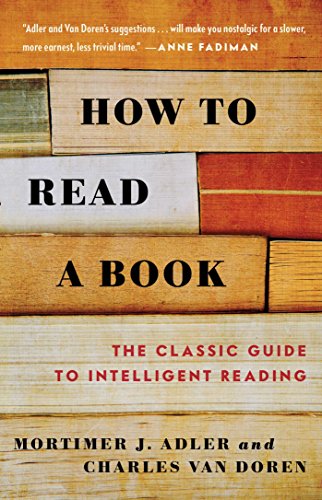
⚡️ What is How to Read a Book About?
Have you ever reached the bottom of a page and realized you have absolutely no idea what you just read? It’s a frustratingly common experience, and according to Mortimer J. Adler, it’s because most of us were never taught how to read for understanding—only for information. Originally published in 1940 and revised in 1972, this is the definitive guide to active reading. It’s not about speed-reading; it’s about the demanding, athletic process of “X-raying” a book to extract its soul.
Adler’s central argument is that reading is a skill with distinct levels, much like learning a sport or a musical instrument. If you’re just looking for facts, a newspaper or a social media feed will do. But if you want to grow your mind and increase your understanding, you have to engage in a conversation with the author. This classic fits perfectly within our collection of Self-Help book summaries because it provides the foundational skill upon which all other learning is built.
🚀 The Book in 3 Sentences
- True reading is an active process that requires the reader to work as hard as the writer to bridge the gap in understanding.
- The hierarchy of reading consists of four levels: Elementary, Inspectional, Analytical, and Syntopical, each building upon the last.
- Mastering a subject requires “Syntopical Reading,” which involves reading multiple books on the same topic and making them speak to each other rather than following a single author’s narrative.
🎨 Impressions
I’ll be honest: parts of this book are incredibly dense. Adler and Van Doren don’t pull any punches, and at times, the tone feels a bit like a stern Victorian professor lecturing you for not being rigorous enough. But once I got past the academic shell, I realized how much I’ve been “cheating” myself by being a passive reader. I used to think finishing a book was the goal. Now? I realize that if I haven’t wrestled with the author’s arguments, I haven’t really read it at all.
This was the book I dog-eared most this year. It completely dismantled my ego regarding my own literacy. We often mistake the ability to decode words on a page for the ability to understand complex ideas. How many of us can actually outline a difficult argument after one pass? Adler’s insistence on “marking a book” felt revolutionary to me—I used to treat my books like museum pieces, but now they’re covered in ink, which makes the experience much more personal and lasting.
📖 Who Should Read How to Read a Book?
If you’re a student, researcher, or anyone who feels overwhelmed by a growing “to-read” pile, this is your manual. It’s perfect for the person who wants to actually retain what they learn rather than just hoarding titles. However, if you only read light fiction or thrillers for entertainment, you can probably skip this. Adler is focused on books that are “over your head,” and if you aren’t looking to stretch your brain, his methods might feel like overkill.
☘️ How This Book Changed My Thinking
I used to feel guilty for skipping chapters or skimming a book before reading it. Adler actually encourages it. He transformed my guilt into a strategy.
- I stopped treating every book with the same level of reverence; some deserve a weekend of intense study, while others only deserve a 15-minute skim.
- I started writing in the margins as a way to stay awake and engage in a “dialogue” with the author.
- I shifted from reading one book at a time to reading “syntopically,” gathering multiple perspectives on a single problem simultaneously.
✍️ 3 Quotes That Stuck With Me
- “Reading is a conversation between you and the author.” — This makes reading feel less like a chore and more like a high-level networking event.
- “The person who says he knows what he thinks but cannot express it usually does not know what he thinks.” — A brutal reminder that if you can’t summarize a book’s argument in your own words, you haven’t mastered it.
- “In the case of good books, the point is not to see how many of them you can get through, but rather how many can get through to you.” — This single sentence killed my obsession with vanity reading goals.
📒 Summary + Notes
Adler’s core thesis is that reading for enlightenment requires a level of activity that most of us abandoned in elementary school. He suggests that we are mostly “taught” to read by age seven or eight, but that is only the first level. To truly understand a great book, we must elevate ourselves to the level of the author. The author is someone who knows more than we do about a specific subject; therefore, the book is a ladder we must climb.
The book’s narrative arc moves from the mechanical basics of reading to the sophisticated art of comparing multiple authors’ views on the same subject. Adler spends a significant amount of time on “Analytical Reading,” which is the heavy lifting of understanding a book’s structure, its propositions, and its arguments. He concludes by arguing that the ultimate goal of reading isn’t just to gain knowledge, but to keep the mind alive and growing, preventing it from atrophying as we age.
🧠 Core Ideas Explained Simply
Adler’s framework relies on four specific levels of reading that stack on top of each other.
The Four Levels of Reading
Think of these as gears in a car. Level 1 (Elementary) is just basic literacy—knowing what the words say. Level 2 (Inspectional) is “skimming with a purpose,” where you figure out what the book is about in a limited time. Level 3 (Analytical) is where you chew and digest the book, asking what the author is trying to prove. Level 4 (Syntopical) is the highest gear, where you read many books on one subject to form your own conclusion that none of the individual books offer on their own.
The Art of Active Reading
Why do we often forget what we read? Adler claims it’s because we aren’t asking the four basic questions: 1. What is this book about as a whole? 2. What is being said in detail, and how? 3. Is the book true, in whole or part? 4. What of it? If you aren’t answering these while you read, you’re just staring at paper.
1: The Activity and Art of Reading
Is reading a passive activity? Adler starts by shattering the myth that reading is like receiving a punch or a blow. Instead, it’s like catching a ball. The pitcher (author) does the work of throwing, but if the catcher (reader) is passive, the ball just hits the dirt. Reading for “information” (facts) is easy, but reading for “understanding” (insights) requires you to move from a state of knowing less to a state of knowing more. Have you noticed how rare it is for a book to actually change your mind lately? That might be because you aren’t exerting enough effort.
2: The Levels of Reading
Imagine reading as a ladder where each rung requires the previous one. Adler introduces the four levels here: Elementary, Inspectional, Analytical, and Syntopical. Most adults never truly move past the second level. We treat complex philosophy the same way we treat a cereal box. This chapter sets the stage for the rest of the book, establishing that you can’t just “read” a book; you have to read it at the appropriate level for its difficulty.
3: The First Level of Reading: Elementary Reading
There’s a moment early on where Adler explains that our schools have failed us. He argues that we stop being taught how to read once we can decode sentences. But literacy isn’t a binary (on/off) state. It’s a spectrum. This chapter covers the developmental stages of reading, from basic word recognition to the refined literacy expected of a high school graduate. It’s a short section because, frankly, if you can read this summary, you’ve already passed this level.
4: The Second Level of Reading: Inspectional Reading
How much time do you waste on books that don’t deserve your attention? Inspectional reading is the art of “systematic skimming.” Adler breaks this into two steps: 1) Pre-reading (checking the title, table of contents, and index) and 2) Superficial reading (reading through a difficult book quickly without stopping to look up things you don’t understand). It sounds counterintuitive, but if you stop every time you’re confused, you’ll never see the forest for the trees. Get the big picture first, then go back for the details.
5: How to Be a Demanding Reader
Do you ever feel like you’re just “going through the motions” with a book? To fix this, you must buy the book—not just the physical copy, but the ideas. Adler insists on writing in the margins. It keeps you awake, forces you to express your thoughts, and helps you remember. He lists the four questions every reader must ask (What is it about? What are the details? Is it true? What of it?) and notes that if you don’t answer these, you’re not reading, you’re just day-dreaming with your eyes open.
6: Pigeonholing a Book
You wouldn’t try to play tennis with a golf club, so why would you read a book of philosophy the same way you read a history book? The first rule of Analytical Reading is to know what kind of book you are reading as early as possible. Adler distinguishes between theoretical books (which teach you *that* something is the case) and practical books (which teach you *how* to do something). If you misidentify the genre, you’ll judge the author by the wrong standards.
7: X-Raying a Book
Every great book has a skeleton hidden under the skin of its words. Your job as a reader is to find it. This involves stating the unity of the whole book in a single sentence or a short paragraph. Then, you must outline the major parts and show how they are organized. If you can’t outline a book, you don’t understand its structure. This chapter is where Adler gets really demanding, requiring a level of structural analysis that most of us haven’t done since our best college essays.
8: Coming to Terms with an Author
Have you ever had an argument with someone only to realize you were using the same word to mean two different things? Adler calls this a failure to “come to terms.” In books, a “term” is a word used without ambiguity. You must identify the author’s keywords and figure out exactly how they are using them. If you don’t agree on the definitions, you’ll never understand the author’s message. You’re effectively speaking two different languages.
9: Determining an Author’s Message
What is the author trying to prove? This chapter moves from words (terms) to sentences (propositions) and paragraphs (arguments). A proposition is a declaration of knowledge or intent. You haven’t finished this stage until you can state the author’s main propositions in your own words. If you can only parrot the author’s specific phrasing, you haven’t actually learned anything; you’ve just memorized a sound bite.
10: Criticizing a Book Fairly
“I don’t like this book” is not a valid criticism. Adler argues that you have no right to disagree with an author until you can honestly say, “I understand.” Criticism should be a disciplined dialogue. You must be able to state the author’s case as well as they can before you attempt to tear it down. This level of intellectual honesty is rare, and Adler’s rules for fair criticism are a masterclass in etiquette and logic.
11: Agreeing or Disagreeing with an Author
If you do disagree, you must have a specific reason. Adler provides four: 1) The author is uninformed, 2) The author is misinformed, 3) The author is illogical, or 4) The author’s analysis is incomplete. If you can’t point to one of these four flaws, your disagreement is just a matter of personal prejudice. This chapter effectively teaches you how to think, not just how to read.
12: Aids to Reading
Should you use a dictionary or a commentary? Adler’s answer is: not until you’ve tried to understand the book on its own. He calls these “extrinsic aids.” While they are useful, they can become crutches. He especially warns against reading a summary (like this one!) as a substitute for the book itself. A summary is an aid to help you decide *how* to read the book, not a way to avoid reading it entirely.
13-19: How to Read Different Genres
These chapters are the “choose your own adventure” section of the book. Adler provides specific rules for different types of literature: practical books, fiction, history, science, philosophy, and social science. For example, when reading fiction, you shouldn’t look for propositions; you should immerse yourself in the experience. When reading philosophy, you must identify the primary questions the author is trying to answer. Each genre requires a slightly different mental toolkit.
20: The Fourth Level of Reading: Syntopical Reading
This is the ultimate goal. Syntopical reading involves reading multiple books on the same subject to investigate a specific question. It’s the hardest work of all because you have to force different authors—who may have lived centuries apart—to talk to each other. You create your own terminology that bridges their different styles. The goal isn’t to master a single book, but to master a subject. It’s the difference between being a fan of an author and being a student of a topic.
21: Reading and the Growth of the Mind
What happens to your brain if you stop reading difficult books? Adler ends on a philosophical note. The mind, unlike the body, does not have a limited capacity for growth. It only withers if it isn’t used. Reading “good” books is not enough; you must read “great” books—the ones that are just slightly beyond your current reach—to keep your mind expanding. If you only read what you already agree with or understand, you are mentally standing still.
⚖️ A Critical Perspective
Honestly, Adler’s approach is incredibly elitist and time-consuming. He assumes the reader has the luxury of spending weeks on a single text, which isn’t always realistic in 2025’s fast-paced world. Furthermore, his “Great Books” list is famously criticized for being almost exclusively white, male, and Western, which limits the scope of “enlightenment” he advocates. While the *methods* of reading are timeless, his specific recommendations for *what* to read feel a bit dated and narrow by modern standards.
🔄 How It Compares
Compared to a modern book like *Reading Like a Writer* by Francine Prose, Adler is much more concerned with the logical structure of non-fiction and philosophy, whereas Prose focuses on the craft of sentences and narrative. Adler wants you to be a scientist of the text; Prose wants you to be an artist of the word. If you want to understand *arguments*, stick with Adler.
🔑 Key Takeaways
Mastering these reading levels will fundamentally change how you learn.
- **Skim first, always.** Never start a difficult book on page one without knowing the general layout and the author’s main goal.
- **Be a demanding owner.** A clean book is a sign of a lazy mind; use a pen to engage with the author’s points in real-time.
- **Understand before you judge.** You cannot fairly disagree with a book until you can perfectly summarize the author’s argument.
- **Read above your level.** If a book is easy to read, it’s not increasing your understanding; it’s only providing more information.
💬 Frequently Asked Questions
What are the 4 levels of reading in How to Read a Book?
The four levels are: 1. Elementary (basic literacy), 2. Inspectional (systematic skimming), 3. Analytical (deep, thorough reading for understanding), and 4. Syntopical (comparative reading across multiple books on the same subject). Each level is cumulative, meaning Analytical reading includes both Elementary and Inspectional steps.
Is How to Read a Book still relevant in 2025?
Absolutely. In an era of digital distraction and “skim-culture,” Adler’s methods for deep focus and structural analysis are more necessary than ever. While his list of “Great Books” is narrow, the actual techniques for breaking down complex arguments remain the gold standard for serious students and professionals.
What is the difference between reading for information and reading for understanding?
Reading for information is acquiring facts you didn’t know before (like a news report). Reading for understanding is the process of a mind elevating itself from a lower to a higher state of comprehension. It requires wrestling with ideas that are initially “over your head.”
How does Adler suggest you mark a book?
Adler suggests underlining key sentences, circling keywords, placing stars or asterisks in the margins for major points, and numbering sequences of arguments. Most importantly, he suggests using the blank pages at the front and back to create your own personal index and summary of the author’s case.
What is syntopical reading?
Syntopical reading is the most advanced level of reading. It involves reading several books on the same subject and identifying the “neutral terms” and questions that all the authors address. The goal is to develop an analysis of the subject that no single book provides on its own.
Conclusion
At its heart, **How to Read a Book** is a call to intellectual arms. It reminds us that reading isn’t just a way to kill time—it’s a way to expand the very boundaries of our own minds. Adler and Van Doren want us to stop being passive consumers of content and start being active participants in the great conversation of human history. It’s hard work, and you won’t finish every book you start if you follow these rules, but that’s exactly the point.
The one thing you should carry with you is the realization that your mind is a muscle. If you only lift the “light weights” of easy-to-digest articles and pop-fiction, you’ll never be strong enough to tackle the big questions of life. Pick up a book that scares you a little, grab a pen, and start a conversation. You can find more strategies for mental growth in our Self-Help book summaries. But for now, just remember: don’t just read more books; read them better.
More From Mortimer J. Adler →
Discover more from AI Book Summary
Subscribe to get the latest posts sent to your email.