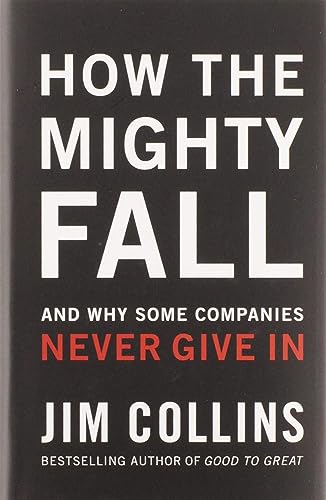
⚡️ What is How the Mighty Fall about?
How the Mighty Fall examines the systematic process by which once-great companies decline and eventually collapse. Jim Collins identifies five distinct stages of decline that organizations go through, from initial hubris born of success to ultimate capitulation or death. The book provides a comprehensive framework for recognizing warning signs early and implementing preventive measures to avoid catastrophic failure. Through detailed case studies and research analysis, Collins demonstrates that decline is largely self-inflicted and therefore reversible if detected and addressed promptly.
🚀 The Book in 3 Sentences
- Companies don’t fall suddenly; they decline through five predictable stages that can be identified and reversed if caught early.
- Hubris born of success leads to undisciplined pursuit of growth, denial of risks, and ultimately desperate grasping for salvation.
- Organizational decline is largely self-inflicted, making recovery largely within leadership’s control through disciplined action.
🎨 Impressions
How the Mighty Fall is a sobering yet empowering read that strips away the mystique of corporate immortality. Collins’ research methodology is rigorous and his conclusions are backed by extensive historical data. The five-stage model provides a clear diagnostic tool for any organization wanting to avoid the fate of once-mighty companies. This book should be required reading for every executive team, as it offers both warning signs and hope for recovery.
📖 Who Should Read How the Mighty Fall?
Any leader, manager, or executive who wants to understand how successful organizations can systematically destroy themselves through How the Mighty Fall patterns. The book is essential for anyone in positions of authority who wants to preserve their organization’s success and avoid common pitfalls. It’s particularly valuable for companies experiencing rapid growth or those that have achieved market dominance, as these are often the most vulnerable to the decline patterns Collins identifies.
☘️ How the Book Changed Me
How my life / behaviour / thoughts / ideas have changed as a result of reading the book.
- I now regularly assess organizational warning signs and question success assumptions to prevent complacency.
- I’ve become more disciplined about growth decisions and avoiding the temptation of undisciplined expansion.
- I approach risk assessment with greater humility and focus on what could go wrong rather than what could go right.
✍️ My Top 3 Quotes
- “Great enterprises can become insulated by success; accumulated momentum can carry an enterprise forward for a while, even if its leaders make poor decisions or lose discipline.”
- “Decline can sneak up on you, and—seemingly all of a sudden—you’re in big trouble.”
- “The longer a company remains in Stage 4, repeatedly grasping for silver bullets, the more likely it will spiral downward.”
📒 Summary + Notes
How the Mighty Fall provides a comprehensive analysis of how once-great companies systematically decline through five predictable stages. Collins’ research methodology involved studying companies that experienced significant decline despite previous success, comparing them with companies that successfully recovered from similar situations. The book serves as both a warning system and a recovery guide for organizations at risk of falling from greatness.
Chapter 1: Introduction and Research Methodology
This foundational chapter establishes the research framework and methodology used throughout the book. Collins explains how the question of American decline prompted his investigation into corporate decline patterns. He describes the extensive research process involving decades of corporate data and comparative analysis between declining companies and those that successfully recovered. The chapter sets the stage for understanding that decline is a systematic process rather than random failure.
- The research was inspired by discussions about national decline at West Point with military leaders and CEOs.
- Collins treats institutional decline like a disease – easier to cure in early stages but harder to detect.
- Bank of America’s dramatic fall from prominence serves as a key case study illustrating how quickly mighty companies can fall.
Chapter 2: The Five Stages of Decline
This chapter introduces the core framework of the book: the five stages of organizational decline. Collins explains each stage in sequence, emphasizing that decline is a gradual process that can remain invisible until Stage 4. He highlights the dangerous misconception that visible problems indicate the beginning of decline, when in reality companies may already be deeply compromised. The model provides leaders with a diagnostic tool to assess their organization’s health and take preventive action.
- Companies don’t visibly fall until Stage 4, making early detection crucial for prevention.
- The five stages proceed sequentially but can accelerate once momentum builds toward decline.
- Understanding these stages enables leaders to apply “brakes” before reaching irreversible decline.
Chapter 3: Stage 1 – Hubris Born of Success
The first stage of decline occurs when successful companies become arrogant and lose sight of the factors that created their initial success. Collins describes how accumulated momentum can mask poor leadership decisions and declining discipline. Leaders begin attributing success to their own superiority rather than understanding the role of luck, timing, and external factors. This stage sets the foundation for all subsequent decline by creating blind spots and overconfidence that prevent recognition of emerging problems.
- Success becomes viewed as an entitlement rather than something that must be continuously earned.
- Leaders replace penetrating understanding with rhetoric about their inherent superiority.
- The best leaders retain an “irrational fear” that success may be temporary, preventing hubris.
Chapter 4: Stage 2 – Undisciplined Pursuit of More
Building on Stage 1 hubris, companies in Stage 2 pursue growth and expansion without maintaining the discipline that initially led to success. Collins details how organizations stray from their core competencies, making “undisciplined leaps” into areas where they cannot excel. This stage is characterized by overreaching – growing faster than organizational capabilities, investing in areas without distinctive competitive advantage, and neglecting core business fundamentals. The pursuit becomes about accumulating more rather than achieving excellence.
- Companies abandon disciplined creativity that led to greatness in favor of rapid expansion.
- Growth outpaces the ability to fill key positions with the right people, creating organizational weakness.
- Leaders begin using the organization primarily for personal success rather than long-term institutional health.
Chapter 5: Stage 3 – Denial of Risk and Peril
As internal warning signs multiply, leaders in Stage 3 begin denying or minimizing risks while external performance still appears strong. Collins explains how this denial manifests through discounting negative data, amplifying positive results, and blaming external factors for setbacks. Decision-making becomes less fact-based, and internal dialogue deteriorates. Leaders take increasingly risky actions while denying potential consequences, setting the stage for inevitable collapse. This stage is particularly dangerous because problems remain hidden while damage accumulates.
- Leaders explain away disturbing data as temporary or cyclical rather than addressing fundamental issues.
- Fact-based dialogue disappears as those in power surround themselves with supportive voices only.
- The “waterline principle” illustrates how decisions can create catastrophic holes below the organizational waterline.
Chapter 6: Stage 4 – Grasping for Salvation
Stage 4 becomes visible to all stakeholders as decline accelerates and previous denial can no longer mask serious problems. Collins describes how leaders react with desperation, grasping for “silver bullet” solutions like charismatic visionary leaders, bold new strategies, dramatic cultural transformations, or game-changing acquisitions. These reactive measures often provide temporary improvements but fail to address root causes. The chapter emphasizes how fear and survival instincts can lead to even worse decisions that accelerate the decline rather than reverse it.
- Late-stage companies often make “lurching” decisions that are reactive rather than strategic.
- Silver bullet solutions provide initial positive results but prove unsustainable over time.
- Leaders must resist the urge to try everything and instead focus on disciplined recovery actions.
Chapter 7: Stage 5 – Capitulation to Irrelevance or Death
The final stage occurs when accumulated setbacks and failed recovery attempts erode both financial strength and organizational spirit. Collins describes how leaders abandon hope of building a great future, either selling out, allowing the organization to atrophy into insignificance, or watching it die outright. This stage represents complete capitulation where the original purpose and vision are forgotten in favor of mere survival. The chapter serves as a stark warning of what happens when decline progresses unchecked through all previous stages.
- Repeated failures and expensive false starts destroy both financial resources and organizational morale.
- Leaders abandon long-term vision in favor of short-term survival, losing sight of their original purpose.
- Some leaders sell out while others watch their organizations become completely irrelevant.
Chapter 8: Recovery Stories and Well-Founded Hope
This chapter provides hope by examining companies that successfully recovered from Stage 4 decline, including Xerox under Anne Mulcahy’s leadership. Collins demonstrates that recovery is possible even after severe decline, provided leaders maintain faith in ultimate triumph while taking necessary painful actions. The chapter emphasizes that recovery requires both tough cost-cutting measures and continued investment in long-term capabilities. It shows that great enterprises can emerge stronger after setbacks, proving that temporary failure doesn’t determine permanent destiny.
- Xerox’s recovery under Anne Mulcahy demonstrates how determined leadership can reverse severe decline.
- Successful recovery requires both financial discipline and continued investment in future capabilities.
- Great organizations are defined not by the absence of difficulty but by their ability to recover stronger.
Key Takeaways
How the Mighty Fall offers crucial insights for any organization wanting to maintain long-term success and avoid systematic decline. The book’s central message is that decline is predictable and preventable when leaders understand the warning signs and take appropriate action. By studying the five-stage model, organizations can diagnose their current position and implement corrective measures before reaching irreversible stages. The key is maintaining discipline, humility, and focus on core competencies while avoiding the traps of hubris and undisciplined expansion.
- Decline follows five predictable stages that can be identified and reversed if caught early through How the Mighty Fall framework.
- Hubris and undisciplined growth set the foundation for decline by creating blind spots and organizational weakness.
- Recovery requires disciplined action, financial discipline, and unwavering commitment to long-term vision despite short-term pain.
Conclusion
How the Mighty Fall provides an invaluable roadmap for organizational longevity and success. Collins has created a practical framework that every leader should understand and apply to prevent systematic decline. The book’s strength lies in its combination of rigorous research, clear warning signs, and hope for recovery. By internalizing the five stages of decline, leaders can maintain organizational health and take preventive action before small problems become catastrophic failures. This is essential reading for anyone responsible for organizational success and sustainability.
More From Jim Collins →
Discover more from AI Book Summary
Subscribe to get the latest posts sent to your email.