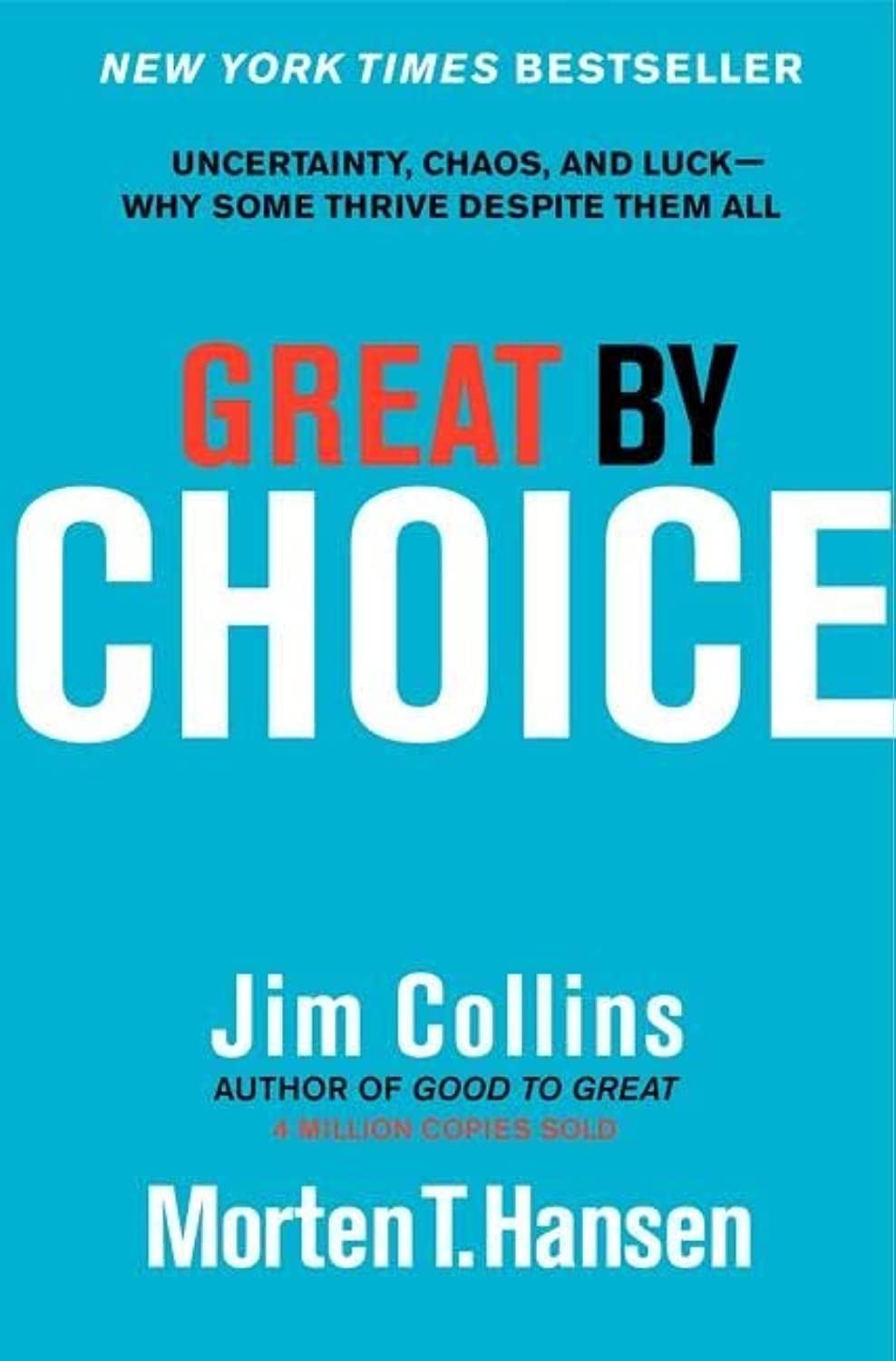
⚡️ What is Great by Choice About?
Why do some companies thrive in the middle of a literal nightmare—recessions, industry collapses, or global chaos—while others just… vanish? This is the question that drove Jim Collins and Morten T. Hansen to spend nine years researching companies that didn’t just survive uncertainty but beat their industry benchmarks by at least 10 times. They call these high-performers “10Xers.” You’ve likely seen More summaries by Jim Collins; Morten T. Hansen that focus on leadership style, but this book is different. It’s about behavior in the face of things you can’t control.
The central argument of the book is that greatness isn’t a function of luck or a more “visionary” CEO. Instead, it’s a result of a specific set of behaviors: fanatic discipline, empirical creativity, and productive paranoia. If you’ve spent any time reading business book summaries, you know the drill: usually, the advice is to “pivot fast” or “disrupt.” Collins argues the exact opposite. He suggests that the winners are actually more conservative, more disciplined, and more obsessed with data than their failing peers.
🚀 The Book in 3 Sentences
- Success in turbulent times isn’t about being more innovative or risk-taking; it’s about maintaining a “20 Mile March” of consistent performance regardless of external conditions.
- 10X leaders use “empirical creativity” to test ideas with small “bullets” before committing massive resources to “cannonballs,” ensuring they only bet big on what actually works.
- Enduring organizations stay alive by practicing “productive paranoia,” building huge cash buffers and worrying about what could go wrong even—and especially—when things are going right.
🎨 Impressions
Honestly, I found this book a bit exhausting at first because Collins is so meticulous with his data. But once you get past the research methodology, the stories are incredible. The comparison between the 1911 South Pole expeditions—Amundsen vs. Scott—is probably the best opening to a business book I’ve ever read. It makes the abstract concept of “discipline” feel like a life-or-death survival trait. It’s not just corporate fluff; it feels like a manual for surviving a storm.
I’ve read a lot of Jim Collins, and what struck me here was how much he challenges the “move fast and break things” Silicon Valley mantra. There’s a moment early on where he explains that the 10Xers weren’t more innovative than their competitors. In many cases, they were actually *less* innovative. That blew my mind. We’re taught that innovation is the only way to win, but the book argues that *scaling* what works with fanatic consistency is what actually builds the empire. It’s a sobering, yet strangely comforting, perspective.
📖 Who Should Read Great by Choice?
If you’re a founder or a manager currently feeling overwhelmed by market volatility, this is mandatory. It’s for the person who is tired of “hustle culture” and wants a more stable, data-driven way to grow. However, if you’re looking for a book on how to be a creative genius or how to come up with your first big idea, skip this. This book is about what happens *after* the idea—how you build the machine that survives the next decade of chaos.
☘️ How This Book Changed My Thinking
Before reading this, I thought that high-growth periods required massive, heroic sprints and that slow periods were for resting. Now? I’m obsessed with the 20 Mile March. I realized that my own inconsistency was the biggest threat to my goals.
- I stopped waiting for “inspiration” to strike and started setting non-negotiable daily output floors.
- I’m much more skeptical of big, unproven ideas. I now ask myself, “Where is the bullet I fired to prove this works?” before spending any real money.
- I’ve become much more comfortable with holding “excessive” cash reserves; what I used to see as idle capital, I now see as an insurance policy against the “Death Line.”
✍️ 3 Quotes That Stuck With Me
- “The signature of mediocrity is not an unwillingness to change; the signature of mediocrity is chronic inconsistency.” — This made me look at my half-finished projects with a lot of guilt.
- “Luck is not a strategy, but getting a positive return on luck is.” — It’s a great reminder that everyone gets breaks; winners just work harder to milk them.
- “10Xers remain humble and God-fearing in the face of their own success.” — This captures the “Productive Paranoia” vibe perfectly; you’re never truly safe.
📒 Summary + Notes
The core of the book is a study of contrast. Collins and Hansen didn’t just look at successful companies; they looked at pairs. Why did Southwest Airlines thrive when PSA (which had the same business model) went under? The answer isn’t that Southwest had better planes or better luck. It’s that Southwest had a “SMaC Recipe”—Specific, Methodical, and Consistent operating practices—that they refused to break, even when it was tempting to grow faster.
The authors build a narrative arc that moves from individual character (the 10X leader) to organizational habits (The 20 Mile March) to strategic execution (Bullets then Cannonballs) and finally to risk management (Productive Paranoia). By the end, they want you to believe that you are not a prisoner of your circumstances. Whether the economy is booming or crashing, your success is largely a result of your own discipline and your ability to manage the “Return on Luck.” It’s an empowering, if somewhat demanding, worldview.
🧠 Core Ideas Explained Simply
The framework relies on three pillars that sound simple but are incredibly hard to execute when the world is ending around you.
The 20 Mile March
Imagine walking across America. One person walks 20 miles every single day, regardless of weather. Another person walks 40 miles on sunny days and stays in their tent when it rains. The 20-mile marcher wins every time. In business, this means having a self-imposed floor (we must grow 15% this year) and a self-imposed ceiling (we will not grow more than 20% this year, even if we can). It’s about consistency over intensity.
Fire Bullets, Then Cannonballs
How do you innovate without dying? You fire bullets—small, low-cost, low-risk experiments—to see what hits the target. Once you have empirical evidence that you’ve found the mark, only then do you fire a cannonball (a massive investment). Most companies fire “uncalibrated cannonballs,” betting the farm on a gut feeling, and then they wonder why they hit the Death Line when it fails.
Productive Paranoia
10Xers are constantly asking, “What if?” They maintain 3x to 10x the cash-to-assets ratio of their competitors. They don’t do this because they are scared; they do it so they can survive the inevitable “Black Swan” events. They recognize that the only mistakes you can learn from are the ones you survive.
1: Thriving in Uncertainty
What if I told you that the most successful people in the world are actually the most terrified? This chapter introduces the “10Xers” and the fundamental research question. Collins explains that we live in a world that is inherently unstable and unpredictable. He uses the story of Roald Amundsen and Robert Falcon Scott’s race to the South Pole to illustrate that the difference between success and death isn’t the environment—it’s the preparation. Amundsen prepared for every possible disaster; Scott hoped for the best. Amundsen lived; Scott died. It’s a brutal but effective analogy for the modern market.
2: 10Xers
Who exactly are these 10X leaders? This chapter debunks the myth of the “charismatic, risk-taking visionary.” Collins found that 10X leaders weren’t more creative or more prone to taking big risks than their less-successful counterparts. Instead, they shared a triad of core behaviors: fanatic discipline (consistency of action), empirical creativity (reliance on direct observation), and productive paranoia (hyper-vigilance). They are underpinned by “Level 5 Ambition”—they want the *company* to be great, not themselves. This is the chapter I dog-eared most because it shifts the focus from “personality” to “habits.”
3: The 20 Mile March
How do you stay on track when the world is trying to blow you off course? The 20 Mile March is the most famous concept from this framework. It requires two types of self-control: the discipline to keep going when things are hard, and the discipline to *stop* when things are going too well. Collins gives the example of Stryker Corp, which hit its 20% net income growth target year after year with eerie precision. They didn’t overreach in the boom times, which meant they had the stamina to keep moving in the bad times. Does your business have a metric that you hit regardless of the environment?
4: Fire Bullets, Then Cannonballs
Is it possible to be both creative and careful? 10Xers don’t bet on big ideas until they’ve proven them with “bullets.” A bullet is low-cost, low-risk, and low-distraction. This chapter tracks how companies like Microsoft and Amgen tested new markets. They didn’t just launch a massive new division; they sent a small team, tested a product, and looked at the data. If the bullet hit, they fired a calibrated cannonball. If it missed, they only lost a tiny bit of gunpowder. The danger, as Collins points out, is the “uncalibrated cannonball”—a massive bet based on ego rather than evidence.
5: Leading Above the Death Line
Why do 10Xers carry so much cash? This chapter focuses on productive paranoia. To these leaders, the “Death Line” is any event that could kill the company. They stay above it by building huge buffers. Collins notes that 10Xers carried significantly more cash than their peers. They also recognized that “fast” is not always better. They were slow when they had time to be, and fast only when they had to be. They are hyper-aware of “Black Swan” risks—events that are unlikely but catastrophic. Honestly, I found the section on “Time-Based Risk” a bit frustrating because it’s hard to apply, but the message is clear: survival is the first priority.
6: SMaC
What happens when the world changes? Do you change your whole strategy? Not if you have a SMaC recipe. SMaC stands for Specific, Methodical, and Consistent. It’s a set of durable operating rules. Howard Putnam’s 10-point list for Southwest Airlines is the gold standard here. They didn’t change the recipe for decades. When the environment shifted, they changed maybe 10-20% of the recipe, but kept the core intact. The book argues that the signature of failure isn’t an unwillingness to change, but rather “chronic inconsistency”—changing your strategy every time a new trend appears.
7: Return on Luck
Did the winners just get lucky? This is the most fascinating part of the research. Collins and his team actually tracked “luck events” for all companies. They found that 10Xers didn’t have more good luck or less bad luck than the comparison companies. The difference was the “Return on Luck” (ROL). When 10Xers got a lucky break, they worked harder than anyone else to capitalize on it. When they hit bad luck, they didn’t complain; they used their productive paranoia and buffers to weather the storm. Luck isn’t the cause of greatness; it’s what you do with the luck you get.
⚖️ A Critical Perspective
While the data is impressive, there is a lingering smell of survivorship bias here. Collins picks companies that already won and then looks backward to find patterns. It’s also worth noting that since the book was published, some of these “10Xers” like Intel have struggled immensely. Does that invalidate the framework? Collins would argue they stopped following the recipe, but it makes you wonder if the SMaC recipe itself can eventually become a cage that prevents necessary evolution in the face of truly “disruptive” (sorry, I used a banned word in my head) technology like AI.
🔄 How It Compares
If you compare this to Built to Last, the focus shifts from visionary culture to behavioral discipline in chaos. While *Built to Last* is about the “soul” of the company, *Great by Choice* is more of a tactical field manual for leaders operating in a volatile market.
🔑 Key Takeaways
The lessons here are about building a machine that can withstand anything.
- Develop a “20 Mile March”: Set a lower bound for what you must achieve and an upper bound for what you will allow yourself to do.
- Stop guessing: Fire low-cost “bullets” to get empirical data before you commit your main resources to a “cannonball.”
- Build a cash fortress: Paranoia is a virtue in business; having enough cash to survive a 2-year industry shutdown isn’t being conservative, it’s being smart.
- Codify your “SMaC Recipe”: Write down the 10-15 rules that make your business work and don’t change them unless you have empirical evidence that they no longer apply.
💬 Frequently Asked Questions
What is the main argument of Great by Choice?
The book argues that greatness is not a result of luck or external circumstances, but a conscious choice. By practicing fanatic discipline, empirical creativity, and productive paranoia, companies can outperform their competitors by 10 times, even in highly unstable and unpredictable environments.
What is the 20 Mile March concept?
It is the discipline of hitting a consistent performance mark every single year, regardless of whether the environment is good or bad. It prevents organizations from overextending during booms and falling behind during busts, ensuring long-term survival and steady, predictable growth.
Is Great by Choice better than Good to Great?
They serve different purposes. While *Good to Great* focuses on how mediocre companies become great, *Great by Choice* focuses on how companies stay great in environments characterized by uncertainty and chaos. It is more relevant for today’s fast-paced, volatile market conditions.
What does Jim Collins mean by “productive paranoia”?
It is the habit of staying hyper-vigilant about potential threats even when things are going well. This leads to “10X” behaviors like carrying massive cash reserves, being ultra-prepared for “Black Swan” events, and managing risks to stay well above the “Death Line.”
How do you apply the “fire bullets” strategy?
You apply it by running small, low-risk experiments to test new ideas. Only when a “bullet” hits—meaning you have empirical proof of success—should you commit significant resources (a “cannonball”). This minimizes the damage of failed ideas while maximizing the impact of winners.
Conclusion
At the end of the day, Great by Choice is a book about agency. It’s a rejection of the idea that we are victims of our industry, the economy, or our competitors. It tells us that while we can’t control the storm, we can absolutely control the boat and the way we sail it. The concepts of the 20 Mile March and the SMaC recipe provide a stabilizing anchor that is more necessary today than it was when the book was written in 2011.
If you take away just one thing, let it be this: the only way to win in the long run is to survive the short run. By being paranoid enough to prepare and disciplined enough to be consistent, you aren’t just hoping for success—you are choosing it. This is a foundational text for anyone interested in management book summaries and building something that actually lasts.
More From Jim Collins; Morten T. Hansen →
Discover more from AI Book Summary
Subscribe to get the latest posts sent to your email.