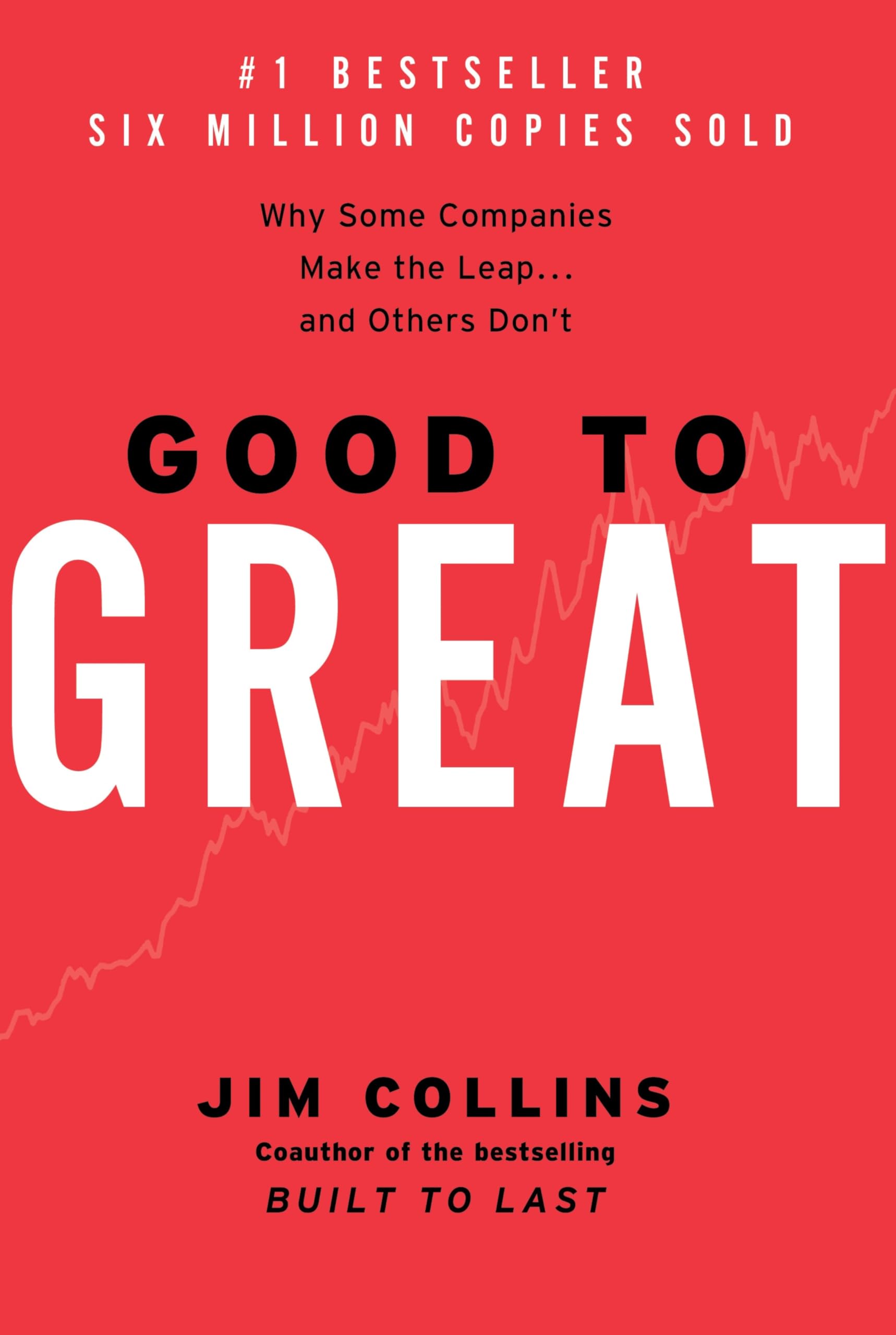
⚡️ What is Good to Great About?
Why do some companies achieve massive, sustained success while others—often in the same industry with similar resources—just treading water? That’s the question that haunted Jim Collins and his research team for five years. They screened 1,435 companies, looking for those that showed 15 years of average returns followed by 15 years of beating the market by at least three times. Only 11 made the cut. This isn’t a book about corporate theory; it’s a autopsy of success based on hard data and rigorous comparison.
The central thesis is that “good” is actually the enemy of “great.” Most organizations stop improving because they reach a level of competence that feels comfortable. Collins argues that greatness isn’t a stroke of luck or a single “killer app.” Instead, it’s a disciplined process of getting the right people, facing the truth, and pushing a heavy flywheel until it builds its own momentum. If you’re looking for more management book summaries, you’ll find that this one remains the gold standard for organizational health.
🚀 The Book in 3 Sentences
- Enduring greatness requires “Level 5 Leaders” who possess a paradoxical blend of personal humility and professional will.
- Success isn’t about where you’re going first, but about getting the right people “on the bus” and the wrong people off before you even pick a direction.
- Sustainable growth happens by finding your Hedgehog Concept—the intersection of what you’re passionate about, what you can be best at, and what drives your economic engine.
🎨 Impressions
Honestly, I expected this to be another dry business text filled with survivor bias and corporate buzzwords. I was wrong. What caught me off guard was how much Collins focuses on character and psychology rather than just spreadsheets. There’s a moment early on where he explains that the “great” CEOs were often introverted, quiet people who gave credit to others and took blame themselves. It’s the complete opposite of the “celebrity CEO” culture we see on social media today, and I found that incredibly refreshing.
The data is from 2001, so some of the companies mentioned—like Circuit City or Fannie Mae—have since struggled or vanished. At first, that made me skeptical. But as I read further, I realized the principles actually explain *why* those companies fell: they stopped following the very rules that made them great. It’s a bit chilling to see the “Flywheel” in action and then watch what happens when a company enters the “Doom Loop.” This book didn’t just teach me about business; it changed how I look at my own habits and discipline.
📖 Who Should Read Good to Great?
If you’re a founder or a manager who feels like your team is stuck in a cycle of “busy but not better,” you need this. It’s perfect for people who prefer evidence over inspiration. However, if you’re looking for a book on how to launch a startup from scratch in a week, you’ll probably find this frustrating. This is about the long game—building something that lasts decades, not something you flip in eighteen months.
☘️ How This Book Changed My Thinking
Before reading this, I thought strategy was the most important part of any venture. I’d spend weeks planning the “what” before thinking about the team.
- I stopped asking “What should we do?” and started asking “Who is the right person to lead this?”
- I’ve adopted the “Stop Doing” list. I realized that what you stop doing is often more important than what you add to your plate.
- I’m much more focused on the “Stockdale Paradox”—balancing brutal honesty about my current failures with total faith that I’ll eventually win.
✍️ 3 Quotes That Stuck With Me
- “Good is the enemy of great.” — It’s a reminder that settled competence is the biggest barrier to actual excellence.
- “The right people are your most important asset? No. The right people are.” — This distinction changed how I look at hiring entirely.
- “Leading from good to great does not mean coming up with the answers and then motivating anyone to follow your vision. It means having the humility to grasp the fact that you do not yet understand enough to have the answers.” — It frames leadership as a learning process rather than a performance.
📒 Summary + Notes
Good to Great is essentially a roadmap for transition. Collins builds a narrative arc that starts with disciplined people, moves to disciplined thought, and ends with disciplined action. He argues that you can’t skip steps. You can’t have disciplined action without the right people in place first, and you can’t have disciplined thought if you’re lying to yourself about the facts of your business.
By the end of the book, you’re convinced that greatness is a choice, not a gift. It’s the result of a thousand small pushes on a flywheel that eventually starts to turn with its own weight. Collins wants us to believe that any organization—even a mediocre one—can become elite if they have the stomach for the boring, consistent work of adhering to these frameworks. It’s about building a culture where people don’t need to be “managed,” but rather where they are self-disciplined and aligned with a clear, simple mission.
🧠 Core Ideas Explained Simply
Collins uses a few specific metaphors to make these heavy research findings easier to digest.
Level 5 Leadership
Imagine a leader who is as ambitious as Steve Jobs but as humble as a monk. That’s Level 5. They don’t care about being the “genius with a thousand helpers.” Instead, they want the company to be even more successful after they leave. They look in the mirror when things go wrong and out the window at their team when things go right.
The Hedgehog Concept
Are you trying to do twenty things well or one thing better than anyone else in the world? A fox knows many things, but a hedgehog knows one big thing. Great companies find the sweet spot where their deepest passion, their unique talent, and their money-making engine all meet. If it’s not in that circle, they simply don’t do it.
The Flywheel Effect
Success never happens all at once. Think of a massive, 5,000-pound metal disk. Pushing it the first inch is exhausting. Pushing it the first foot takes forever. But if you keep pushing in the same direction, eventually the weight of the disk starts helping you. Most companies fail because they keep changing direction, stopping the flywheel every time it gains speed.
1: Good is the Enemy of Great
Why do so few companies actually reach the top of the mountain? Collins starts by pointing out that we don’t have many “great” schools or “great” governments because we have so many “good” ones. We settle. The research team spent years looking for the inflection point—that specific moment when a company shifted from average to elite.
They found that greatness isn’t a function of circumstance. It’s not about being in a “great” industry (some of the winners were in boring fields like steel and paper). Instead, it’s about a conscious refusal to accept a “good” status quo. How many times have you stopped pushing because you were “doing okay”? That’s the trap this chapter warns against.
2: Level 5 Leadership
Imagine a CEO who is so quiet and humble that nobody outside the company knows their name. While the media loves the high-profile, charismatic leaders, the data shows they often hurt their companies in the long run. Level 5 leaders are different. They have an iron will to do whatever it takes to make the company great, but they have zero ego about it.
Collins uses the example of Darwin Smith at Kimberly-Clark, who was told he’d never be a leader. He went on to transform the company by making the gutsy decision to sell off their core paper mills and move into consumer goods. He didn’t do it for the fame; he did it because the data said it was the right move. Do you have the humility to admit when your current path is wrong?
3: First Who… Then What
What if the “where” of your business matters less than the “who”? Most leaders start by setting a new vision and then trying to motivate people to follow it. Great leaders do the opposite. They get the right people on the bus, get the wrong people off the bus, and *then* figure out where to drive it.
- If you have the right people, the problem of motivation largely goes away.
- The right people are self-managed by their internal drive for excellence.
- Hiring the wrong person and trying to “fix” them is a waste of everyone’s time.
4: Confront the Brutal Facts (Yet Never Lose Faith)
Facing the truth is painful, but lying to yourself is fatal. This chapter introduces the “Stockdale Paradox,” named after Admiral James Stockdale, who survived years in a POW camp. He noticed that the optimists—those who kept saying “we’ll be out by Christmas”—were the ones who died of a broken heart. The survivors were those who accepted the horror of their reality while never doubting they would eventually prevail.
In business, this means creating a culture where people can speak the truth without fear. You can’t make good decisions if you’re filtering out the bad news. Collins suggests using “autopsies without blame.” When something goes wrong, look for why it happened, not who to fire. Are you brave enough to look at your lowest sales numbers and not make excuses for them?
5: The Hedgehog Concept
Are you a fox or a hedgehog? The fox tries many things and sees the world in all its complexity, but the hedgehog simplifies the world into a single organizing idea. To find your “Hedgehog Concept,” you have to answer three questions:
- What are you deeply passionate about?
- What can you be the best in the world at?
- What drives your economic engine?
If you can’t be the best in the world at your core business, then your core business cannot be the basis of a great company. It doesn’t matter if you’ve been doing it for 100 years. This chapter is a brutal call to focus and eliminate anything that doesn’t fit in that tiny overlap of the three circles.
6: A Culture of Discipline
Discipline isn’t about having a drill sergeant; it’s about having a system that runs itself. Most companies build bureaucracy to manage the small percentage of “wrong” people on the bus. But if you have the right people, you don’t need bureaucracy. You need a culture of discipline where everyone understands the Hedgehog Concept and refuses to deviate from it.
The most important tool here is the “Stop Doing” list. Truly disciplined people have the courage to stop doing things that are profitable but don’t fit their core mission. It’s about saying “no” to great opportunities because they aren’t *your* opportunities. How many projects are you currently running just because you’re already halfway through them?
7: Technology Accelerators
Does more tech always mean more growth? Collins found that great companies never used technology as the *primary* cause of their greatness. Instead, they used it as an accelerator of the momentum they already had. They were pioneers in applying carefully selected technologies, but only if those technologies directly supported their Hedgehog Concept.
Mediocre companies often jump on every new trend, hoping it will be the “magic pill” that solves their problems. It never is. If you’re struggling, adding more software or AI won’t save you; it’ll just help you fail faster. Technology is an organic growth tool, not a strategy in itself. Are you using your tools to push your flywheel, or are you just chasing the newest shiny object?
8: The Flywheel and the Doom Loop
Imagine a massive, heavy metal disk that takes hours of pushing just to make one full rotation. From the outside, the moment it starts spinning fast looks like a breakthrough. But for the person pushing, it was the result of all those previous, agonizing turns. There is no single “lucky break.”
Companies that fail fall into the “Doom Loop.” They try a new program, it doesn’t yield immediate results, so they panic and try a *different* new program. They keep stopping and starting, never building the momentum needed to achieve escape velocity. Consistency isn’t sexy, but it’s the only way to build a great organization. Are you willing to keep pushing the same wheel for a decade?
9: From Good to Great to Built to Last
How do you keep the fire burning for fifty years? In this final chapter, Collins connects this research to his previous book, *Built to Last*. He argues that to sustain greatness, you need to preserve your core values while constantly changing your operating practices. The principles in this book are the “how” of getting to the top; the values are the “why” of staying there.
The goal isn’t just to be successful. The goal is to build something that makes a meaningful contribution and outlasts its founders. It requires a level of devotion that goes beyond just making money. If your company disappeared tomorrow, would anyone actually miss it? That’s the ultimate test of greatness.
⚖️ A Critical Perspective
While the data in Good to Great is impressive, it suffers from a heavy dose of survivorship bias. Many of the “great” companies Collins identified, like Circuit City and Fannie Mae, crashed spectacularly within a decade of the book’s publication. This suggests that the “Greatness” framework might be a snapshot in time rather than a permanent law of nature. Additionally, the book largely ignores the role of external market forces and luck, focusing almost entirely on internal management. It’s a fantastic guide for organizational health, but it’s not a foolproof crystal ball for stock performance.
🔄 How It Compares
Compared to Zero to One by Peter Thiel, this book is far more conservative. While Thiel argues for radical innovation and “monopoly” thinking, Collins argues for disciplined, incremental pushes on an existing wheel. Thiel is about the birth of greatness; Collins is about the evolution and maintenance of it. If Thiel is the visionary architect, Collins is the master engineer.
🔑 Key Takeaways
These are the core lessons you can apply to any team or project today.
- Hire for character and work ethic over specific skills; skills can be taught, but Level 5 traits are innate.
- Create a “Stop Doing” list to force focus on your Hedgehog Concept.
- Balance unwavering faith in your mission with the courage to face your most embarrassing failures.
- Don’t look for a “miracle moment”; look for the small, consistent actions that build flywheel momentum.
💬 Frequently Asked Questions
What is the main argument of Good to Great?
The main argument is that greatness is not a matter of luck, but a result of disciplined people, disciplined thought, and disciplined action. By focusing on Level 5 leadership and the Hedgehog Concept, companies can transition from average performance to outperforming their peers by massive margins over decades.
What are the 3 circles of the Hedgehog Concept?
The three circles are: what you can be the best in the world at, what you are deeply passionate about, and what drives your economic engine. A company becomes great by finding the intersection of these three areas and refusing to do anything that falls outside of that overlap.
Is Good to Great still relevant today?
Yes, though it should be read with caution. While some of the specific company examples have since failed, the core principles of leadership humility, disciplined hiring, and facing brutal facts remain timeless. Modern tech giants like Amazon have famously used the Flywheel concept to dominate their markets for years.
What does it mean to get the “right people on the bus”?
It means prioritizing hiring and retention over strategy. Collins argues that if you have the right people, they will help you find the right direction and will be self-motivated to succeed. Conversely, the wrong people will sabotage even the best strategy, regardless of how much you manage them.
What is the Stockdale Paradox?
It is the ability to maintain absolute faith that you will prevail in the end, regardless of the difficulties, while simultaneously confronting the most brutal facts of your current reality. It prevents leaders from becoming delusional optimists or hopeless pessimists, allowing for realistic and effective problem-solving during hard times.
Conclusion
At its heart, Good to Great is a book about the power of simplicity. It tells us that we don’t need to be the loudest person in the room or have the most complex strategy to win. We just need the discipline to stick to what we are best at and the humility to put the mission before our own egos. It’s a challenging read because it demands a level of patience that is rare in our “hacker” and “disruptor” culture.
The next time you’re feeling overwhelmed by a hundred different priorities, remember the hedgehog. Stop trying to do everything and focus on the one big thing that you can do better than anyone else. If you can do that, and keep pushing that flywheel every single day, greatness isn’t just a possibility—it’s inevitable. This remains one of the most essential management book summaries for anyone serious about building a legacy.
More From Jim Collins →
Discover more from AI Book Summary
Subscribe to get the latest posts sent to your email.