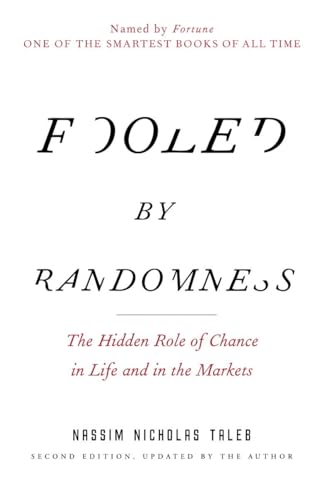
⚡️ What is Fooled by Randomness about?
Fooled by Randomness is a profound exploration of how randomness influences our lives and financial markets, often leading us to draw false conclusions about success and failure. Nassim Nicholas Taleb argues that humans have a fundamental misunderstanding of probability, causing us to attribute skill where there is only luck. The book critiques the overconfidence of traders and decision-makers who mistake random outcomes for expertise, providing insights into cognitive biases and the hidden role of chance in shaping our perceptions and achievements.
🚀 The Book in 3 Sentences
- Fooled by Randomness reveals how our brains are wired to see patterns where none exist, especially in financial markets.
- Taleb demonstrates that many successful traders are simply lucky, not skilled, and are often unaware of this crucial distinction.
- The book teaches readers to distinguish between genuine expertise and random success, fostering better decision-making in uncertain environments.
🎨 Impressions
Reading Fooled by Randomness was an eye-opening experience that fundamentally challenged my understanding of success and probability. Taleb’s rigorous yet accessible approach to dissecting randomness in human affairs is both thought-provoking and practically valuable. The book succeeds in revealing the hidden forces that shape our perceptions, making it essential reading for anyone navigating uncertainty in life or finance.
📖 Who Should Read Fooled by Randomness?
Fooled by Randomness is ideal for investors, traders, and decision-makers who want to understand the role of chance in outcomes. It’s particularly valuable for those in finance or risk management looking to avoid common cognitive pitfalls. Anyone interested in improving their analytical thinking and recognizing the difference between skill and luck should read this illuminating work.
☘️ How the Book Changed Me
How my life / behaviour / thoughts / ideas have changed as a result of reading the book.
- Became more skeptical of success stories and attributing outcomes to skill rather than chance
- Developed better understanding of probability and randomness in decision-making processes
- Started questioning assumptions about expertise and performance in various fields
✍️ My Top 3 Quotes
- “We fear the unfamiliar, yet we are not aware of the arbitrariness of our current labels and categories.”
- “The combination of unpredictability and irresistibility is what makes randomness so effective in fooling us.”
- “History is more random than we think, and our brains are programmed to be fooled by randomness.”
📒 Summary + Notes
Fooled by Randomness by Nassim Nicholas Taleb explores how randomness and probability pervade our lives, particularly in financial markets, often leading us to incorrect conclusions about success and skill. Taleb, a former derivatives trader, uses his experience to demonstrate how our cognitive biases make us vulnerable to misinterpreting random events as meaningful patterns. The book challenges readers to reconsider fundamental assumptions about expertise, performance, and the nature of uncertainty in decision-making.
Chapter 1: Solon’s Warning
This opening chapter establishes the foundational theme of the book: we should never consider anyone happy until their death, as life’s outcomes are profoundly influenced by randomness. Taleb references the ancient Greek statesman Solon’s wisdom that fortune can change abruptly, challenging our linear thinking about success. The chapter introduces the reader to the central argument that apparent success might be temporary luck rather than permanent skill, setting the stage for deeper exploration of cognitive biases and probability misinterpretation.
- The ancient concept that happiness is incomplete until death challenges modern assumptions about success
- Taleb uses the story of a wealthy trader who faces financial ruin to illustrate how quickly fortune can change
- This chapter warns readers about the dangerous illusion of control and predictability in life outcomes
Chapter 2: Yossarian’s Business
Building on the first chapter, Taleb explores how our brains are wired to find patterns even in randomness, drawing parallels with Joseph Heller’s character Yossarian from Catch-22. The chapter delves into the human tendency to construct narratives around random events, demonstrating how this cognitive bias leads to flawed decision-making. Taleb explains that while our pattern-seeking behavior was evolutionarily advantageous, it becomes problematic in modern contexts where randomness dominates outcomes, such as financial markets.
- Human brains naturally seek explanations for random events, leading to false conclusions about causation
- Taleb uses examples from his trading experience to show how market movements often appear patterned but are actually random
- The chapter emphasizes that pattern recognition can be both a strength and a weakness in decision-making
Chapter 3: A Random Walk Down Wall Street
Taleb examines the random walk theory and challenges popular investment strategies that claim to predict market movements. He argues that many investors are fooled into believing they can beat the market when they’re simply riding random fluctuations. The chapter illustrates how cognitive biases and overconfidence lead people to attribute their investment successes to skill rather than chance. Taleb provides rigorous statistical analysis to demonstrate that most active traders perform no better than random chance in the long term.
- Most fund managers and traders fail to consistently outperform random market returns over extended periods
- The chapter critiques popular investment gurus who attribute random market success to superior strategies
- Taleb recommends passive investing as a rational alternative to the illusion of market timing skills
Chapter 4: I Am a Fool… Sometimes
In this introspective chapter, Taleb humbly admits his own susceptibility to the same cognitive biases he criticizes, acknowledging that even experts can be fooled by randomness. He shares personal anecdotes about his trading experiences, showing how even successful traders can make flawed decisions based on incomplete information. The chapter emphasizes the importance of self-awareness and intellectual honesty in recognizing one’s limitations. Taleb stresses that acknowledging our fallibility is the first step toward making better decisions in uncertain environments.
- Taleb admits that he has been fooled by randomness in his own trading activities
- The chapter demonstrates how even sophisticated probabilistic thinking can be overridden by emotional responses
- Self-awareness and admitting limitations are crucial for avoiding overconfidence in decision-making
Chapter 5: Fooled by Randomness, or Statistics is Not a Field of Knowledge
Taleb critiques traditional statistical approaches and argues that many statistical methods fail to account for rare, high-impact events he later calls “Black Swans.” He demonstrates how mainstream statistical education teaches people to ignore outliers, leading to dangerous misinterpretations of risk. The chapter challenges the notion that historical data can reliably predict future outcomes, especially in complex systems like financial markets. Taleb emphasizes that understanding the limitations of statistical models is crucial for making informed decisions in uncertain environments.
- Standard statistical methods often ignore rare but significant events that can dominate outcomes
- Historical data can be misleading when predicting future performance in complex adaptive systems
- Understanding the limitations of quantitative models is essential for proper risk assessment
Chapter 6: The Problem of Induction, or What You See Is All There Is
This chapter delves into the philosophical problem of induction, questioning how we can justify beliefs about unobserved phenomena based on past experiences. Taleb argues that humans tend to extrapolate from limited observations, making us vulnerable to unexpected events. He discusses the concept of survivorship bias, where we only see successful examples and ignore failures, leading to false conclusions about what leads to success. The chapter emphasizes that our observations are inherently incomplete, making it dangerous to draw firm conclusions from partial data.
- Humans naturally extrapolate from limited data, making us prone to unexpected failures
- Survivorship bias causes us to study only successful cases while ignoring countless failures
- Incomplete observations lead to overconfidence in predictive models and theories
Chapter 7: Fat Tony Meets the Suckers
Taleb introduces his memorable character Fat Tony, a street-smart trader who understands the difference between genuine risk and academic risk models. Through conversations between Fat Tony and academic researchers, Taleb contrasts practical wisdom with theoretical knowledge. The chapter highlights how real-world experience often provides better insights than formal education when dealing with uncertainty. Fat Tony’s skepticism toward statistical models that ignore rare events demonstrates the value of experiential learning in understanding complex systems.
- Fat Tony represents street-smart intuition that often surpasses academic theories in practical applications
- The character illustrates how formal education can be blind to real-world complexities and risks
- Practical experience with volatility provides better risk assessment than theoretical models
Chapter 8: The Uncertainty of the Phony
The final chapter synthesizes the book’s main arguments and addresses how to navigate uncertainty without being fooled by randomness. Taleb discusses the importance of skepticism and intellectual humility in dealing with complex systems. He advocates for adopting a more stoic approach to success and failure, recognizing that outcomes are often influenced by factors beyond our control. The chapter concludes with practical advice on how to maintain rationality and avoid common cognitive traps that lead to poor decision-making in uncertain environments.
- Adopting intellectual humility helps in making better decisions under uncertainty
- Skepticism toward apparent patterns and predictions is essential for avoiding random-related mistakes
- A stoic approach to outcomes helps maintain emotional stability despite life’s uncertainties
Key Takeaways
Fooled by Randomness provides essential insights for understanding probability in finance and life. The book challenges readers to question their assumptions about success and expertise, offering practical strategies for better decision-making. Taleb’s analysis reveals how cognitive biases and misunderstanding of randomness lead to poor outcomes across various fields. These key takeaways encapsulate the most valuable lessons for applying this knowledge in real-world situations.
- Success is often more about luck than skill, particularly in fields dominated by randomness like finance
- Humans naturally see patterns in randomness, leading to false conclusions about causation and expertise
- Understanding probability and risk is crucial for making informed decisions in uncertain environments
- Awareness of cognitive biases like survivorship bias helps avoid common decision-making pitfalls
- Intellectual humility and skepticism toward apparent expertise lead to better long-term outcomes
Conclusion
Fooled by Randomness offers a compelling framework for understanding how probability shapes our lives and decisions. Taleb’s insights help readers avoid the common trap of attributing success solely to skill while ignoring the role of chance. By recognizing our cognitive limitations and the pervasive influence of randomness, we can make more rational decisions and maintain appropriate humility about our predictive abilities. This book is essential reading for anyone seeking to navigate uncertainty with greater wisdom and understanding, particularly in financial and professional contexts.
More From Nassim Nicholas Taleb →
Discover more from AI Book Summary
Subscribe to get the latest posts sent to your email.