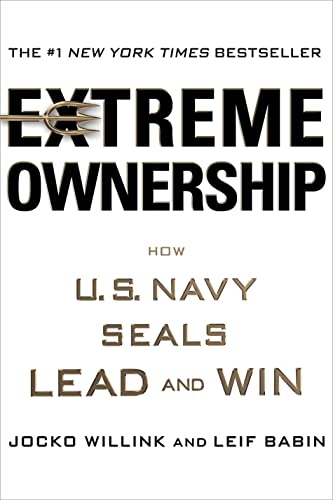
⚡️ What is Extreme Ownership about?
Extreme Ownership is a leadership guide written by former U.S. Navy SEALs Jocko Willink and Leif Babin. Drawing on their battlefield experiences in Iraq, the authors distill powerful leadership principles that contributed to their team’s success and survival. These leadership strategies applicable in combat can also be implemented in the corporate world and everyday life. The book offers compelling stories and actionable insights, making it an essential read for anyone aiming to lead teams with high performance.
🚀 The Book in 3 Sentences
- True leadership starts with taking full responsibility for all outcomes, whether good or bad.
- Successful teams are not born out of talent alone, but from effective leadership at every level that promotes clarity, discipline, and teamwork.
- Leaders must simplify complexity, prioritize tasks, and remain decisive even when facing uncertainty.
🎨 Impressions
‘Extreme Ownership’ presents a remarkably practical approach to leadership grounded in real-world experience. The Extreme Ownership Book Summary gives readers a glimpse into the discipline and mindset cultivated within elite forces. The principles may seem simple, but they demand a cultural shift in how we perceive accountability and team collaboration. This book challenges leaders to evolve beyond traditional management practices.
📖 Who Should Read Extreme Ownership?
Ideally suited for current or aspiring leaders across fields, from military and corporate executives to entrepreneurs and project managers. Anyone looking to deepen their understanding of leadership strategies through proven extreme ownership book techniques will benefit. It’s also valuable for teams seeking to strengthen organizational culture and individuals wanting to own their personal and professional results.
☘️ How the Book Changed Me
How my life / behaviour / thoughts / ideas have changed as a result of reading the book.
- I began to accept responsibility for outcomes rather than blaming externalities.
- I learned how to clearly define objectives and expectations in team collaborations.
- I adopted a proactive mindset toward problem-solving in high-pressure situations.
✍️ My Top 3 Quotes
- Leaders must own everything in their world. There is no one else to blame.
- If your team isn’t doing what you need them to do, you first have to look at yourself.
- It is critical for leaders to act decisively amid uncertainty; to make the best decisions they can based on only the immediate information available.
📒 Summary + Notes
The Extreme Ownership Book Summary explores core leadership philosophies derived from U.S. Navy SEAL experiences. The foundational premise is simple yet transformative: leaders must take complete responsibility for all outcomes under their control. This idea sets the stage for building cohesive teams that execute missions flawlessly, whether on the battlefield or in the boardroom.
Chapter 1: Extreme Ownership
This chapter introduces the primary mantra that defines the entire book – “extreme ownership.” It emphasizes that a leader must hold himself accountable for everything that happens within his area of influence – success, failure, or neither. This mindset prevents finger-pointing and strengthens trust among team members.
- A leader’s ability to own failures directly influences team morale and execution potential.
- An illustrative case highlights how accepting blame spares valuable resources from destructive internal inquiries.
- As a result, accountability boils down to recognizing areas where leadership has fallen short and correcting them quickly.
Chapter 2: No Bad Teams, Only Bad Leaders
The second chapter deconstructs the myth that certain teams are inherently weak. Instead, it argues that team performance is entirely dependent on leadership quality. A weak leader undermines capability, while a strong one empowers their group.
- Leaders elevate others by defining clear goals and fostering unity.
- Weak leaders demotivate their teams by deflecting accountability.
- Real-life contrasts show how different leadership styles yield dramatically different results.
Chapter 3: Leaders Lead the Way
Chapter Three explains that direction and inspiration come directly from the top. Leaders must believe in the mission themselves before expecting commitment from subordinates. Without conviction, tasks become chores instead of missions.
- Embodiment requires courage and integrity to push forward authentically.
- Indifference spreads rapidly and resists remediation once entangled.
- Authentic alignment leads to collective purpose rooted in shared vision.
Chapter 4: Check the Ego
Ego remains a silent antagonist of effective leadership. Chapter Four dissects how excessive pride distorts judgment and stalls collaboration. To apply extreme ownership techniques, you must keep your ego in check and remain open to ideas from any source.
- Putting personal gain above the mission creates fragmentation and poor outcomes.
- Empathy and feedback create environments where learning flourishes.
- Great leaders check and manage the egos of others, keeping the team focused on its mission.
Chapter 5: Cover and Move
Militarily, this term means supporting and advancing together. In leadership terms, it refers to aligning different departments or units toward a common goal. Chapter Five highlights how strategic collaboration enhances overall performance.
- Units must not operate in isolation without shared objectives.
- Mutual backing structures ensure protection and momentum for long-term projects.
- External agency competence reinforces internal strength, preventing overreach.
Chapter 6: Simple Is Better
Clarity is king when deadlines loom. Chapter Six reinforces the idea that overcomplicated plans confuse participants and increase chances of failure. By reducing information to digestible chunks, leaders enable clarity-based implementations.
- Execution depends on shared understanding among team members.
- Overly detailed procedures misalign rather than guide actions.
- Good leaders trim linguistic superfluity, helping teams focus only on critical actions.
Chapter 7: Prioritize and Execute
In rapidly changing environments, overload looks inevitable. However, Chapter Seven argues leaders must stay calm under pressure, identify the highest priorities**, and task execution accordingly. This rational sorting out eliminates fatigue and errors from reactive decision-making.
- Mission clarity helps distinguish mission-critical from secondary concerns.
- Focusing efforts enables efficiency and urgent action progression.
- Great leaders re-assess priorities continuously and adapt flexibly.
Chapter 8: Decentralized Command
This chapter discusses empowering front-line operators by giving them detailed context. Instead of issuing rigid commands, effective decentralized leadership provides Why and What-then allows subordinates to decide How. This empowerment speeds responsiveness without undermining stability.
- Subordinates trained on comprehensive understanding gain increased flexibility in unpredictable scenarios.
- Complimentary know-how awareness eliminates assumptions that stifle progress.
- Well-trained individuals generate better independent problem-solving capacity when direction seems unclear.
Chapter 9: Plan
Solving future problems starts with predictive thinking. Chapter Nine explains how good leaders create rigorous planning systems that consider uncertainty, alternatives, and human elements. While not immune to changes, solid plans enable faster decision-making.
- Strong foundations come from anticipating obstacles early and preparing responses.
- Engagement in strategic review generates buy-in and smoother execution later.
- Ongoing evaluation ensures plans stay relevant amid evolving conditions.
Chapter 10: Lead Up and Down the Chain
True leadership transcends rank. Chapter Ten frames effective influence as a two-way street. Strong leaders provide clarity both upward toward superiors and downward toward junior members. They’re proactive communicators, building bridges between echelons and reducing misunderstandings.
- Raising awareness upwards allows executives to understand constraints below.
- Guidance exchanged maintains continuity when transitions occur unexpectedly.
- Collaboration rooted in transparency stabilizes cross-functional efforts.
Chapter 11: Decisiveness amid Uncertainty
Indecision kills momentum. Chapter Eleven explains how capable leaders make informed choices despite incomplete data. Making a timely decision is often better than waiting for perfect information.
- Objectivity helps filter available inputs before choosing decisive paths.
- Erring forward beats stagnation, especially in time-sensitive contexts.
- Resilient leaders adjust when further insights surface post-decision.
Chapter 12: Discipline Equals Freedom
Disciplined routines often appear restrictive. However, Chapter Twelve posits that order breeds autonomy. Extreme discipline of behavior and mindset allows greater adaptability and effectiveness in dynamic situations.
- Structure eliminates chaos and guesswork from repeated processes.
- Freedom finds its truest place within organized boundaries.
- Maintaining consistency and rigidity allows better responsiveness during unpredictable moments.
Key Takeaways
After dissecting the entire book, the key takeaways of the Extreme Ownership Book Summary can be reduced to five fundamental ideas to implement in any context:
- Ownership begins with the individual and cascades instantly to influence others.
- Effective leadership underlies strong operational performance in every domain.
- Communication and clarity are prerequisites for mission success.
- Ego management eliminates barriers between people and peak performance.
- An actionable plan forms the backbone of sustainable progress, even under uncertainty.
Conclusion
‘Extreme Ownership’ stands as a definitive manual that teaches leadership rooted in resilience, commitment, and clarity. For anyone serious about personal development or team effectiveness, the Extreme Ownership Book Summary offers invaluable insights deserving of frequent revisitation. This is not just a leadership text but a blueprint for conquering any outcome-based challenge in business or life.
More From Jocko Willink; Leif Babin →
Discover more from AI Book Summary
Subscribe to get the latest posts sent to your email.