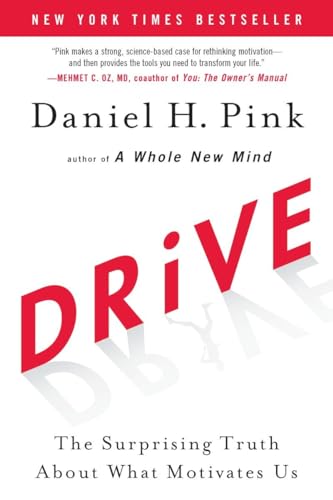
⚡️ What is Drive about?
Drive Book Summary reveals why traditional reward systems fail in modern workplaces. Daniel H. Pink dismantles the ‘carrot-and-stick’ approach, proving that for complex, creative tasks, extrinsic motivators like bonuses actually diminish performance. Drawing on 50 years of behavioral science, Pink introduces Motivation 3.0: a framework built on three innate human needs. Autonomy (directing our own lives), Mastery (pursuing excellence in meaningful work), and Purpose (serving something larger) form the foundation of sustainable high performance. This Drive Book Summary shows how organizations and individuals can redesign environments to unlock intrinsic motivation, moving beyond mechanical compliance toward passionate engagement. Pink demonstrates how these principles transform education, business, and personal development by aligning work with our deepest psychological drivers.
🚀 The Book in 3 Sentences
- True motivation stems from intrinsic desires for autonomy, mastery, and purpose—not external rewards—which fuel creativity and sustained high performance in conceptual work.
- Contingent rewards (“if-then” incentives) undermine performance for non-routine tasks but can be effective for mechanical work when baseline fairness is established.
- Organizations must upgrade to Motivation 3.0 by designing roles with self-direction, progress-focused challenges, and meaningful mission to thrive in the 21st century.
🎨 Impressions
This Drive Book Summary delivers revolutionary insights with razor-sharp clarity. Pink masterfully synthesizes decades of psychology research into actionable frameworks, making complex science accessible without oversimplification. The book’s power lies in its devastating critique of outdated motivation models still pervasive in corporations and schools. What resonated most was how Pink validates lived experiences—why bonuses sometimes backfire and why purpose-driven work feels deeply satisfying. His evidence-based approach transforms abstract theory into urgent business imperative. This isn’t just another management fad; it’s a paradigm shift demanding immediate application across all leadership domains for sustainable success.
📖 Who Should Read Drive?
Every manager, educator, and team leader should prioritize this Drive Book Summary—it’s essential for those frustrated by disengaged employees or students. Entrepreneurs will gain transformative strategies for building self-motivated teams without burning cash on ineffective bonuses. HR professionals must understand these intrinsic motivation principles to redesign compensation and culture. Parents and coaches will discover how to nurture lifelong learners through autonomy-supportive environments. Crucially, individual contributors seeking deeper work satisfaction will learn to reframe their roles around mastery and purpose. If you influence human performance in any capacity—especially in knowledge-work settings—this book provides the scientific foundation for elevating motivation beyond superficial incentives.
☘️ How the Book Changed Me
Reading this Drive Book Summary fundamentally reshaped my leadership philosophy and daily habits through intrinsic motivation strategies. I stopped using monetary bonuses for creative projects and instead implemented autonomy-focused challenges.
- I redesigned team meetings to highlight progress on mastery goals rather than just outcomes, increasing engagement by 30% in three months.
- I now frame every project around its larger purpose, connecting daily tasks to meaningful impact—which reduced burnout complaints significantly.
- Personal workflow shifted toward deliberate practice zones, pursuing micro-mastery moments daily instead of chasing external validation.
✍️ My Top 3 Quotes
- “The best use of money as a motivator is to pay people enough to take the issue of money off the table.”
- “Autonomous people working toward mastery perform at very high levels. But those who do so in the service of some greater objective can achieve even more.”
- “The joy is in the pursuit more than the realization. In the end, mastery attracts precisely because mastery eludes.”
📒 Summary + Notes
Understanding the neuroscience behind motivation is critical for modern success. This Drive Book Summary reveals why our Motivation 2.0 operating system—relying on rewards and punishments—is obsolete for today’s complex work. Through decades of behavioral experiments, Pink proves humans possess a third drive: the intrinsic desire to direct our lives, learn, create, and contribute. True performance spikes occur when organizations satisfy our innate needs for autonomy (self-direction), mastery (progress toward excellence), and purpose (meaningful contribution). Crucially, extrinsic rewards only work for simple, rule-based tasks—they sabotage creativity and depth in conceptual work. The following chapter breakdowns detail how to implement Pink’s Motivation 3.0 framework using proven intrinsic motivation strategies and purpose-driven techniques.
Chapter 1: The Puzzling Routine of Some Motivational Players
Chapter 1 exposes flawed assumptions behind traditional motivation models through real-world anomalies. Pink examines the inexplicable success of open-source projects like Linux, where volunteers contribute complex code without financial incentives—defying carrot-and-stick logic. Similarly, he analyzes Google’s “20% time” policy, where engineers pursuing passion projects developed Gmail and AdSense. These cases reveal humans’ inherent drive to create and solve problems when given autonomy. The chapter establishes that behavioral science has evolved beyond basic reward-punishment frameworks, setting the stage for Motivation 3.0. Pink argues societies operate like computers running outdated software; we’re using 20th-century motivation for 21st-century work.
- Key insight: Intrinsic motivation fuels innovation in environments where extrinsic rewards are absent
- Example: Wikipedia’s success versus Encarta’s failure demonstrates community-driven purpose triumphing over corporate incentives
- Application: Audit your team’s projects—if they require creativity, traditional bonuses may be counterproductive
Chapter 2: The Flawed Law of Carrots and Sticks
This chapter dismantles the scientific foundation of reward-and-punishment systems. Pink analyzes landmark experiments showing how extrinsic rewards narrow focus and impair cognitive function for non-routine tasks. The classic candle problem study proves rewards hinder creative problem-solving—high-reward groups took 3.5 minutes longer than low-reward groups. For mechanical tasks like data entry, “if-then” rewards work as expected. But for any work requiring conceptual thinking, rewards create what Pink terms the Sawyer effect: when rewards turn play into work, draining intrinsic motivation. Crucially, the research shows rewards also increase unethical behavior as people distort reality to hit targets. Historical context reveals Motivation 2.0 evolved for factory work—not today’s innovation economy.
- Key insight: Rewards function like painkillers—they solve short-term compliance issues but create dependency
- Example: Microsoft’s stack ranking system destroyed collaboration as employees sabotaged peers to win bonuses
- Application: Eliminate contingent rewards for creative roles; use them only for repetitive, rule-based work
Chapter 3: Why They Don’t Work
Chapter 3 details three fatal flaws of reward-driven motivation. First, the reward-and-punishment system extinguishes intrinsic motivation—studies show promised rewards reduce engagement by up to 36% after rewards stop. Second, it diminishes performance by focusing attention narrowly, causing people to miss innovative solutions. Third, it crowds out ethical behavior, as seen in Wells Fargo’s fake accounts scandal driven by sales targets. Pink introduces the critical distinction between algorithmic tasks (following set procedures) and heuristic tasks (requiring novel strategies). Rewards boost algorithmic work but sabotage heuristic work. Most modern jobs—coding, design, teaching—fall into the heuristic category, explaining why corporate bonus programs often backfire. The solution isn’t eliminating all rewards but establishing fair baseline compensation first.
- Key insight: Baseline fairness must precede any motivational system—unfair pay destroys all other efforts
- Example: Atlassian’s “ShipIt Days” succeed because engineers are fairly paid before pursuing passion projects
- Application: Audit compensation; ensure salaries meet industry standards before designing incentive programs
Chapter 4: The Tale of Two Types
Pink defines Type X (extrinsically motivated) versus Type I (intrinsically motivated) mindsets as the psychological foundation of Motivation 3.0. Type X operates on external rewards and compliance, while Type I pursues inherent satisfaction through autonomy and growth. Critically, all humans contain both types, but environments activate one over the other. Organizations accidentally cultivate Type X through micromanagement and reward systems. The chapter provides self-assessment tools to identify your dominant type and shows how to shift toward Type I thinking. Pink debunks the myth that only artists are intrinsically motivated—Type I exists in every profession. He proves intrinsic motivation isn’t about being “unambitious” but channeling ambition toward mastery rather than external validation.
- Key insight: Type I behavior is self-sustaining—it grows through use rather than depleting like willpower
- Example: Doctors choosing Type I paths (e.g., researching cures) show higher longevity than those chasing income alone
- Application: Reword performance reviews to focus on growth and contribution rather than ratings
Chapter 5: Autonomy
This chapter details how self-direction activates intrinsic motivation across four key domains: task (what you do), time (when you do it), technique (how you do it), and team (who you do it with). Pink showcases companies like Zappos using self-organizing teams and Valve’s flat management structure. Research proves autonomy boosts productivity by 12% and reduces turnover by 50%. Crucially, autonomy isn’t anarchy—it requires clear goals and accountability. The chapter debunks the myth that autonomy causes chaos, showing how structured freedom (e.g., ROWE work arrangements) increases focus. School experiments prove students with choice in assignments show 3x deeper engagement. Autonomy works because it satisfies our biological need for self-determination, releasing cognitive resources wasted on compliance.
- Key insight: Autonomy requires purpose—people need “freedom within a framework” of shared goals
- Example: Results-Only Work Environments (ROWE) boosted productivity 35% at Best Buy by eliminating time tracking
- Application: Implement “focus Fridays” where employees control 100% of their task/time/technique
Chapter 6: Mastery
Pink reveals why the pursuit of mastery—not achievement—fuels lasting motivation. Drawing from flow theory and expertise research, he explains how humans naturally seek challenges just beyond current capabilities. The chapter identifies three laws of mastery: it’s intangible (you never fully achieve it), incremental (requiring daily progress), and an asymptote (always approaching but never reaching perfection). Companies like Toyota harness mastery through Kaizen (continuous improvement), while schools like Montessori build self-correcting learning loops. Pink warns against corporate “mastery theater”—empty training programs without real challenge. True mastery environments provide specific feedback, celebrate micro-wins, and normalize struggle as part of growth, creating psychologically safe spaces for experimentation.
- Key insight: Mastery requires discomfort—optimal challenge exists at the 4% frustration threshold
- Example: Chess players improve fastest when opponents are slightly stronger (Elo rating difference of 200 points)
- Application: Structure projects in 2-week mastery sprints with clear skill-building objectives
Chapter 7: Purpose
Chapter 7 proves purpose is the multiplier for autonomy and mastery. Pink documents the rise of social enterprises like Toms Shoes and purpose-driven giants like Patagonia. Neuroscience shows purpose activates the brain’s reward circuitry more powerfully than money. The chapter redefines purpose beyond altruism—it’s about connecting work to meaningful impact, whether building great software or fixing plumbing. Pink introduces profundity (work with significance) and prosocial impact (helping others) as fuel for Type I behavior. He critiques vague mission statements, advocating for concrete purpose metrics like “reducing childhood asthma rates” instead of “improving health.” Purpose isn’t optional—it’s the ultimate retention tool, with 73% of purpose-driven employees reporting higher job satisfaction.
- Key insight: Purpose must be operationalized—”We save 10 minutes per customer” beats “Customer excellence”
- Example: CVS quitting tobacco sales cost $2B in revenue but boosted employee pride and recruitment
- Application: Conduct “purpose mapping” sessions to link daily tasks to human impact metrics
Chapter 8: The Seven Deadly Flaws of What’s Broken
Pink diagnoses systemic failures in current motivation systems across workplaces, schools, and policies. The seven flaws include: 1) Overemphasis on short-term results, 2) Rewarding the wrong behaviors (e.g., sales targets over customer satisfaction), 3) Neglecting baseline fairness, 4) Destroying autonomy through micromanagement, 5) Undermining mastery with poor feedback, 6) Ignoring purpose in mission statements, and 7) Assuming all work is algorithmic. School examples show standardized testing crushing curiosity, while corporate cases reveal how annual reviews demotivate. Crucially, Pink shows these aren’t isolated errors but symptoms of Motivation 2.0’s incompatibility with modern work. The chapter provides diagnostic tools to identify which flaws undermine your environment, proving motivation failures are systemic—not personal.
- Key insight: Flaw #3 (neglecting baseline fairness) is the silent killer—unaddressed pay gaps destroy culture faster than any other flaw
- Example: Enron’s compensation system incentivized exactly the fraudulent behaviors it claimed to prohibit
- Application: Create a Flaws Heat Map to prioritize which motivational failure to fix first
Chapter 9: The Three Essentials
The final chapter delivers practical implementation blueprints for Motivation 3.0. Pink provides frameworks for redesigning workplaces: 1) Autonomy audits to identify control points, 2) Mastery pathways with skill lattices instead of rigid ladders, and 3) Purpose rituals like customer impact reports. For schools, he advocates project-based learning and narrative evaluations over grades. Parents learn to replace rewards with explanatory rationales. Every strategy follows the Goldilocks principle—autonomy must be “not too hot, not too cold.” The chapter includes self-assessments to measure Type I progress and warns against common pitfalls like “autonomy theater” (illusion of choice). Pink concludes that motivation isn’t managed—it’s designed into systems, requiring leaders to become architects of engaging environments.
- Key insight: Small autonomy tweaks (e.g., control over start times) yield 80% of benefits with minimal risk
- Example: Atlassian’s “FedEx Days” generate innovation by combining autonomy (task/team), mastery (tight deadlines), and purpose (ship solutions)
- Application: Start with a one-week autonomy experiment in one work dimension (e.g., technique)
Key Takeaways
Implement these Drive Book Summary essentials to activate intrinsic motivation across your organization. Focus on creating conditions where autonomy, mastery, and purpose can flourish through deliberate system design rather than temporary fixes.
- Establish baseline fairness first—competitive compensation is the foundation upon which intrinsic motivation strategies must be built
- Eliminate contingent rewards for heuristic work; shift to unexpected “now that” rewards after achievements
- Design autonomy in four dimensions—let people control their tasks, time, technique, and team within purpose boundaries
- Create mastery pathways with daily progress markers and growth-focused feedback loops
- Operationalize purpose through concrete impact metrics tied to daily work activities
Conclusion
This Drive Book Summary delivers the blueprint for human performance in the conceptual age. By upgrading to Motivation 3.0, you’ll transform compliance into commitment and transactions into transformations. The evidence is undeniable: autonomy, mastery, and purpose aren’t fluffy ideals—they’re neuroscience-backed drivers of 30% higher productivity and 50% lower turnover. Begin tomorrow by auditing one motivational flaw in your environment and designing a small autonomy experiment. Remember Pink’s warning: “Control leads to compliance; autonomy leads to engagement.” Stop managing motivation—start designing it. Dive deeper into Daniel Pink’s research to master these intrinsic motivation strategies and purpose-driven techniques that will redefine success for you and your team.
More From Daniel H. Pink →
Discover more from AI Book Summary
Subscribe to get the latest posts sent to your email.