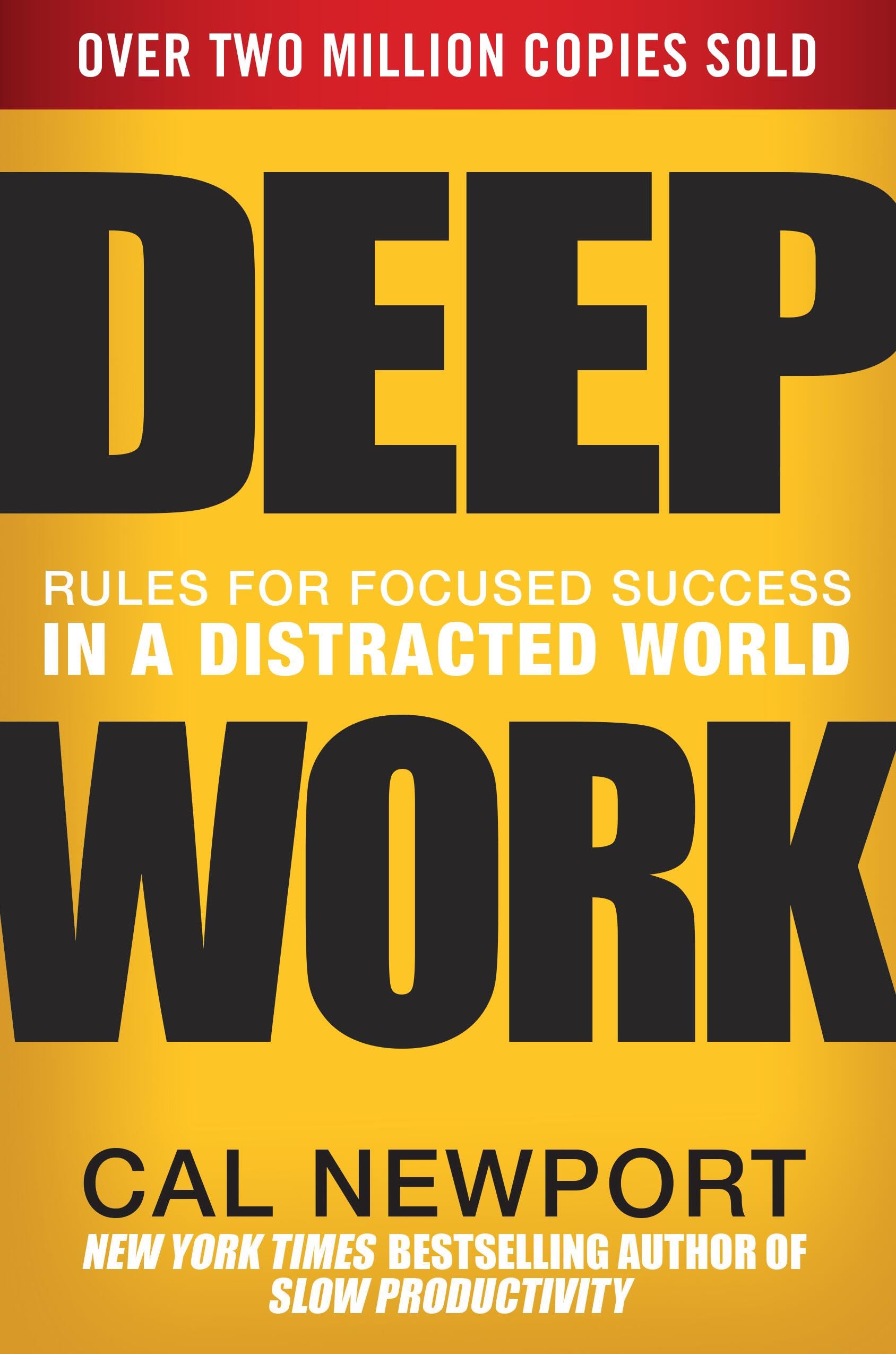
⚡️ What is Deep Work About?
I finished reading this book last week and, honestly, I haven’t looked at my phone the same way since. More summaries by Cal Newport show his obsession with how technology reshapes our brains, but this specific framework is his masterpiece. The central thesis is simple but terrifying: the ability to perform Deep Work—concentrating without distraction on a cognitively demanding task—is becoming increasingly rare at the exact same time it’s becoming increasingly valuable in our economy.
Newport isn’t just giving you another productivity hack. He’s making an existential argument. He suggests that if you spend your day in a state of “shallow work” (think emails, Slack, and social media), you’re not just being less productive; you’re actually rewiring your brain to be incapable of focus. If you’re interested in more productivity book summaries, you’ll notice a lot of authors talk about doing more. Newport is the only one telling you to do less, but with a terrifying intensity. Why are we so afraid of just sitting with a difficult problem for four hours?
🚀 The Book in 3 Sentences
- Professional success in the information age belongs to those who can quickly master hard things and produce at an elite level—both of which require undistracted focus.
- The modern workplace, with its open offices and constant connectivity, is a factory for shallow work that actively destroys our ability to concentrate.
- To reclaim your focus, you must treat your attention as a finite, sacred resource by building rigid rituals and literally practicing the skill of being bored.
🎨 Impressions
Reading this felt like a cold splash of water to the face. I’ve always thought of myself as a “productive” person because I’m fast at clearing my inbox, but Newport’s argument made me realize I was just being busy, not effective. It’s a bit uncomfortable to realize that most of what we do at work doesn’t actually move the needle. I found myself dog-earing the pages where he talks about “attention residue”—that mental fog that hangs over you when you switch from one task to another.
There’s a certain elitism in Newport’s tone that might rub some people the wrong way. He writes from the perspective of a computer science professor, and his examples often involve famous writers or high-level researchers. But once you get past the “ivory tower” vibe, the logic is bulletproof. It’s not a “feel-good” book; it’s a call to arms for anyone who feels like their brain is being turned into mush by a thousand digital papercuts.
📖 Who Should Read It?
If your job requires you to create things—code, strategies, writing, or complex designs—this is your manual. It’s specifically for knowledge workers who feel like they spend 8 hours a day “working” but have nothing of substance to show for it by 5:00 PM. However, if you’re in a role that is inherently reactive (like customer support or certain types of middle management), some of these strategies will be physically impossible to implement without getting fired. Just being honest!
☘️ How This Book Changed My Thinking
Before reading this, I thought focus was a talent you were born with. Now, I see it as a muscle that I’ve let atrophy by checking my phone every time I’m bored in a grocery store line.
- I stopped believing that “being reachable” is a virtue; now I see it as a liability to my best work.
- I’ve started scheduling my distractions—giving them a specific 20-minute block—rather than letting them leak into my entire day.
- I’ve embraced the idea of “productive meditation,” where I try to solve a specific problem while walking or doing the dishes.
✍️ 3 Quotes That Stuck With Me
- “The Deep Work Hypothesis: The ability to perform deep work is becoming increasingly rare at exactly the same time it is becoming increasingly valuable in our economy.” — This is the whole book in a nutshell and it’s a terrifying economic reality.
- “If you give your mind something meaningful to do throughout all your waking hours, you’ll end the day feeling more fulfilled.” — This challenged my idea that “relaxation” means scrolling.
- “Who you are, what you think, feel, and do, what you love—is the sum of what you focus on.” — A sobering reminder that our lives are just the aggregate of our attention.
📒 Summary + Notes
The author’s case is built on the idea that we’ve reached a breaking point. We are currently in what he calls the “Great Restructuring,” where machines and automation are eating low-level cognitive tasks. If you want to remain relevant, you have to be able to do things that machines can’t—which requires intense, focused thought. He splits the book into two parts: the “why” and the “how.” By the time you finish the first half, you’ll feel like every minute spent on Twitter is a minute spent actively making yourself stupider.
The narrative arc isn’t just about productivity; it’s about the “Good Life.” Newport argues that a life of depth isn’t just more profitable; it’s more meaningful. He uses Carl Jung’s stone tower retreat as a recurring image—a physical manifestation of the need to go “deep” to produce something of lasting value. The goal is to move away from the “Principle of Least Resistance,” where we do whatever is easiest at the moment, and toward a life of deliberate, difficult craftsmanship.
🧠 Core Ideas Explained Simply
While the book is packed with advice, these three concepts are the pillars everything else rests on.
Attention Residue
Think of your brain like a giant whiteboard. Every time you check an email or a quick text, you’re writing something new on that board. When you try to go back to your main task, you have to erase the old stuff, but it leaves a smudge. If you switch tasks every 10 minutes, your board eventually becomes a gray, unreadable mess. This is why you feel “fried” at the end of a day even if you didn’t do any “hard” work.
The Any-Benefit Mindset
Do you use a social media tool because it offers “some” benefit? Newport calls this a trap. A craftsman doesn’t use a tool just because it has a tiny benefit; they use it only if the benefits significantly outweigh the costs. We’ve been tricked into thinking that because LinkedIn might help us find a job in five years, we need to check it five times a day. Is that tiny potential win worth the permanent fragmentation of your focus?
Fixed-Schedule Productivity
This is the counter-intuitive idea that setting a hard limit on your workday (like finishing at 5:30 PM no matter what) actually makes you more productive. When your time is infinite, you waste it on shallow nonsense. When the clock is ticking and you have a hard stop, you’re forced to ruthlessly prioritize the deep stuff.
1: Deep Work is Valuable
Imagine a world where “good” isn’t enough anymore because a machine or a freelancer in a lower-cost market can do your job for half the price. Newport opens with this chilling economic reality. He identifies three groups that will thrive in this new economy: High-Skill Workers (who can work with complex machines), Superstars (the best in their field), and Owners (those with capital). The common thread? To be in the first two groups, you must be able to master hard things quickly and produce at an elite level. Neither is possible without depth.
2: Deep Work is Rare
Why does every modern office look like it was designed to prevent you from actually thinking? Newport argues that businesses have fallen for the “Principle of Least Resistance,” preferring easy connectivity over actual productivity. Because we lack clear metrics for what a “good” knowledge worker looks like, we’ve defaulted to “busyness as a proxy for productivity.” If I see you answering emails, I assume you’re working. If I see you staring at a wall thinking, I assume you’re slacking. This cultural shift has made the capacity for depth rarer than ever, which—from an economic standpoint—is great news for you if you can actually do it.
3: Deep Work is Meaningful
Is a life spent in front of a screen inherently depressing, or are we just doing it wrong? Newport takes a philosophical turn here, arguing that focus is actually the key to happiness. He cites Winifred Gallagher, whose cancer diagnosis taught her that her quality of life was defined by what she chose to pay attention to, not her circumstances. When you’re in a state of “flow” (deep work), your brain is literally too busy to worry about the petty anxieties of life. Depth isn’t just about money; it’s about mental health.
Rule 1: Work Deeply
Pick your poison: are you a monk, a journalist, or a creature of rhythm? Newport knows that you can’t just “decide” to focus; you need a strategy. He outlines four “philosophies” for scheduling:
- Monastic: Cutting out all distractions entirely (think Bill Gates’ “Think Weeks”).
- Bimodal: Dividing your time into clearly defined deep and shallow stretches (days or weeks).
- Rhythmic: Making depth a daily habit (the Seinfeld “chain” method).
- Journalistic: Fitting depth into any free gap in your schedule (only for the pros).
The key here isn’t which one you pick, but that you pick one. You have to create rituals—where you work, how long you work, and how you support your brain (coffee, walks, etc.)—to lower the friction of starting.
Rule 2: Embrace Boredom
What if I told you that checking your phone while waiting for coffee is ruining your career? Most people think focus is something you turn on when you need it. Newport disagrees. He says that if you spend every spare moment of your life avoiding boredom by scrolling, you’ve trained your brain to constantly crave a “hit” of novelty. When it comes time to work deeply, your brain won’t be able to handle it. You have to practice being bored. You have to train your “concentration muscle” by not giving in to the urge to check your phone the second things get quiet.
Rule 3: Quit Social Media
The “Any-Benefit” mindset is a trap that keeps us tethered to tools we don’t actually need. Newport is ruthless here. He suggests a 30-day “digital detox” where you stop using social media entirely. After 30 days, ask yourself: was my life significantly worse? Did anyone actually notice I was gone? If the answer is no, stay off. He argues that most of these tools are designed to hijack our attention for profit, and the tiny social benefits they offer aren’t worth the cost of our cognitive sovereignty. Are you using the tool, or is the tool using you?
Rule 4: Drain the Shallows
Your cognitive capacity has a hard ceiling; why are you wasting it on emails about lunch? Shallow work is anything that doesn’t require a high level of focus and could be done by a smart college grad. Newport suggests “scheduling every minute of your day”—not to be a robot, but to be intentional. If you don’t give your hours a job, they will default to the path of least resistance (distraction). He also recommends the “3-2-1” approach to emails: don’t respond to anything that doesn’t have a clear point, a clear next step, or a clear reason for your involvement.
⚖️ A Critical Perspective
While the logic is tight, this framework is undeniably built for a specific kind of worker. Newport largely ignores the reality of people in service, healthcare, or collaborative industries where “not being reachable” isn’t a badge of honor—it’s a fireable offense. Furthermore, his dismissal of social media feels a bit dated in an era where community and networking are legitimately done online. He treats attention as a purely individual struggle, downplaying the systemic ways that modern corporate culture makes focus almost impossible for the average employee.
🔄 How It Compares
Compare this to Getting Things Done by David Allen. While Allen focuses on the mechanics of organizing tasks to clear mental space, Newport focuses on the intensity of the work itself. Allen wants you to have a system so you don’t forget things; Newport wants you to have a system so you can forget everything else and focus on one thing for four hours.
🔑 Key Takeaways
These are the fundamental shifts you need to make to transition from a shallow to a deep worker.
- Schedule the Internet: Don’t take breaks from distraction; take breaks from focus. Only use the internet during specific, pre-planned blocks.
- The Shutdown Ritual: Have a specific routine at the end of the day to tell your brain work is done, preventing “attention residue” from bleeding into your rest.
- Embrace Productive Boredom: Train your brain by refusing to check your phone during transitions or lulls in your day.
- Quantify Depth: Ask yourself: “How many months would it take to train a smart college grad to do this task?” If the answer is low, it’s shallow work.
💬 Frequently Asked Questions
What is the main argument of Deep Work?
Newport argues that the ability to focus intensely on a single task without distraction is becoming the most valuable skill in our economy. As shallow work becomes automated or outsourced, those who can produce elite-level results through deep focus will be the ones who thrive financially and professionally.
How can I start practicing deep work?
Start by scheduling a single 90-minute block of focused work each day. During this time, turn off all notifications and move to a quiet space. The goal is to build a ritual that lowers the mental resistance to starting, eventually increasing the duration as your “focus muscle” grows.
Is Deep Work still relevant in 2025?
It is more relevant now than when it was written. With the rise of AI, tasks that used to be “deep” for humans are becoming shallow. The bar for what constitutes unique human value has moved higher, making extreme focus and complex synthesis the only remaining competitive advantages for workers.
Does Cal Newport really not use social media?
Yes, Cal Newport famously has never had a Facebook, Twitter, or Instagram account. He practices what he preaches, arguing that the costs to his concentration and research far outweigh any networking benefits he might gain. He prefers to connect with his audience through his blog and books.
What is the difference between deep and shallow work?
Deep work involves tasks that push your cognitive limits and create new value. Shallow work consists of logistically-heavy tasks like emails, meetings, and data entry that don’t require intense focus. Shallow work keeps you busy; deep work makes you successful.
Conclusion
Look, we all know we’re distracted. We feel it every time we reach for our phones in the middle of a difficult task. What Deep Work offers isn’t just a list of tips; it’s a worldview. It’s the realization that your attention is your most precious asset, and you’re currently giving it away for free to companies that want to sell you ads. Reclaiming that attention is the hardest—and most rewarding—work you’ll ever do.
If you take only one thing from this book, let it be this: don’t let your life become a series of reactions to other people’s priorities. Build your stone tower. Set your rituals. And for heaven’s sake, put the phone in another room. Your best work—and your best life—is waiting for you to just sit down and focus. This is easily one of the most important entries in our Productivity collection.
More From Cal Newport →
Discover more from AI Book Summary
Subscribe to get the latest posts sent to your email.